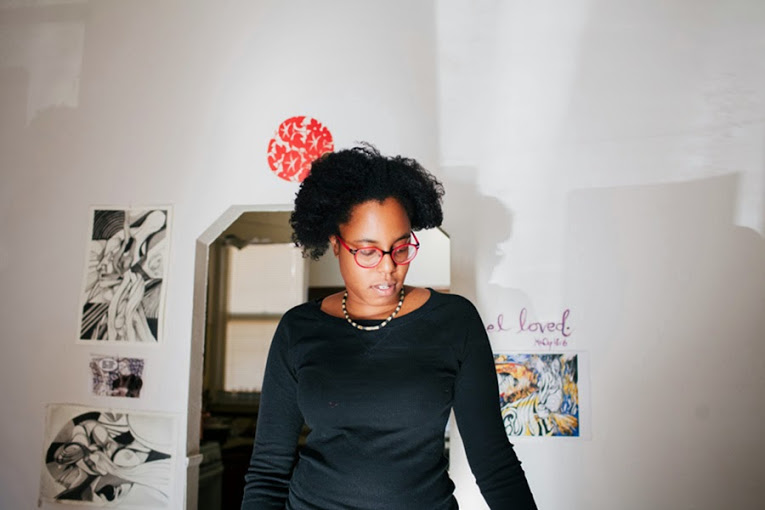
Born and raised in Richmond, VA, Lyric Prince received her Bachelor’s of Arts from Saint Joseph’s University, and is currently studying artistic trends online as a part of her graduate studies in Science, Technology, and Society at Drexel University. Her past experience includes online and real-world public art installations, blogging, and drawing and painting large-scale works. She has also contributed her art to local art happenings and events in Philadelphia- notable productions include The Last Word Open Mike, the African American Museum of Philadelphia annual gala, and the Association for Public Art Candy Coated mural installation. She currently lives and works in Philadelphia.
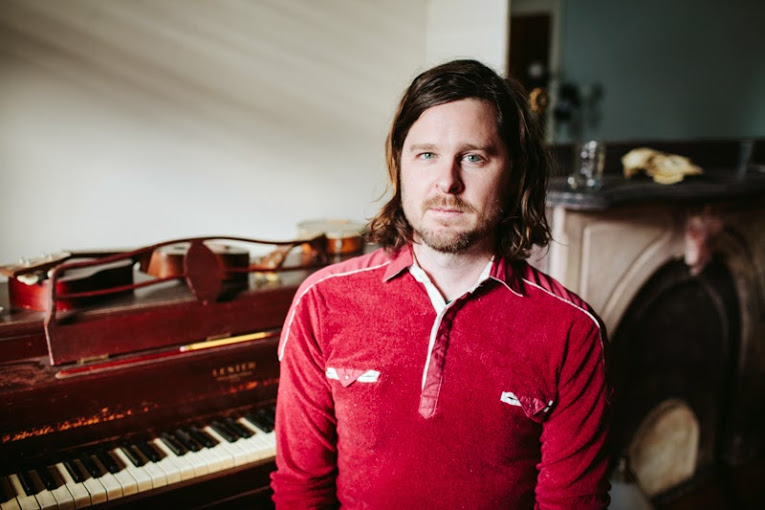
Michael Kiley is a Philadelphia based composer, sound designer, performer and educator working in dance, theatre and public installation. Past collaborators including Faye Driscoll Group (NY), SubCircle, The ActingCompany (NY), Lars Jan (NY), Dan Rothenberg of Pig Iron Theater Co., Sylvain Emard Danse (Montreal), Luciana Achugar (NY), Magda and Chelsea, and Nichole Canuso Dance Company.
In addition, Michael creates his own work under the moniker of The Mural and The Mint (TM&TM). In 2010, TM&TM created As the Eyes of the Seahorse, an interdisciplinary performance of dance and live music which premiered at HERE Arts Center (NY). 2013 marked the release of The Empty Air and Animina, two soundwalk pieces as iPhone application which use Global Positioning Service to determine what the listener hears depending on their location within two separate public spaces in Philadelphia. Michael also released Kuerner Sounds in 2013, a commission by The Brandywine River Museum to be heard during a tour of the Kuerner Farm, which inspired painter Andrew Wyeth for his entire career.
Michael’s work has been supported by The Independence Foundation, The Pennsylvania Council on the Arts, The American Composers Forum, FringeArts (Live Arts Brewery Fellowship), Philadelphia Music Project (PCAH), The Hacktory, and the Wyncote Foundation through The Painted Bride. The Empty Air won Best of Philly from Philadelphia Magazine for Best Smartphone Application, 2013.
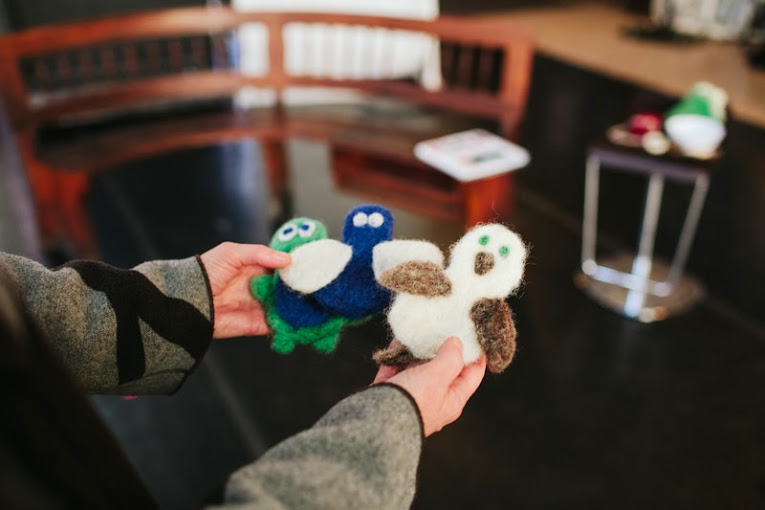
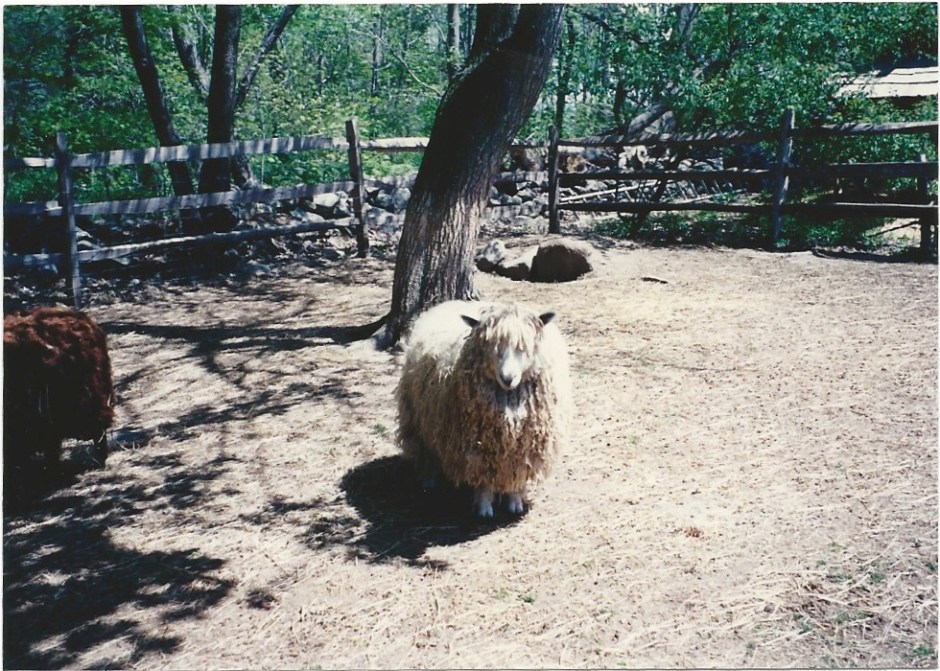
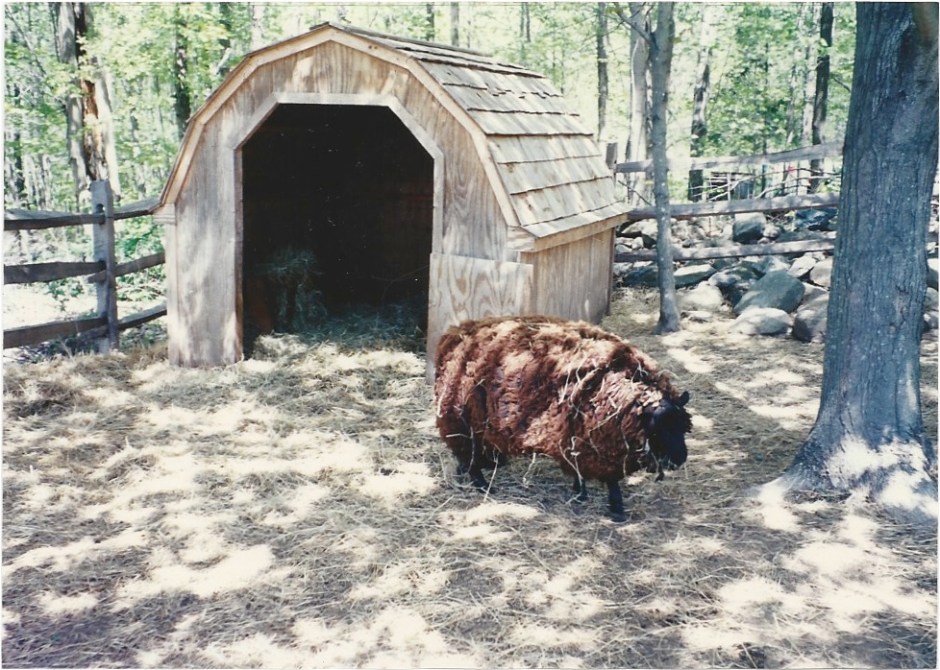
The whole residency started with a mutual interest in grief and loss. It’s a morbid topic, but the tone of their early conversations were never grim. Instead, death became a mystical, almost humorous presence for the week. Cappy brought in Choo Choo the dog in her little doggie cremation box. Eun Jung brought in a wax head she found in Brazil, imbued with the power to purge a loved one of an ill feeling or disease. Adrienne shared a story of a recent loss in her life. Cappy taught us how to use the fleeces of her three sheep (who passed many years ago) in craft projects. The three women took turns sharing “sad” stories, but rather than leaving us somber, the telling of the stories made the room warmer, familiar, and comforting.
During the first few days of the residency we all sat on the floor, working with Brillo, Millie, and Suds’ wool.
Adrienne enjoyed carding the wool, aligning all of the fibers in one direction. Cappy continued to spin the wool on a Navajo spindle, a sabre-like wooden dowel, while Eun Jung felted a mitten. The three worked and shared stories about objects of personal significance. There was a special feeling to this time together. It was very pleasant; food was shared alongside laughter. We continued working with the wool and talking. In many ways, the repetitive movements of the fiber crafts made it easier to open up and listen: I found my own mind more attentive as I drove a small felting needles into a hunk of indigo wool.
Adrienne talked about traditional folk singing and vocal improvisation. We learned a few songs from her and sang together while working with the wool fibers. The rhythmic motions of carding, knitting, and felting became entwined in our singing. When did we stop learning or rehearsing the song? Did our repetition become a performance?
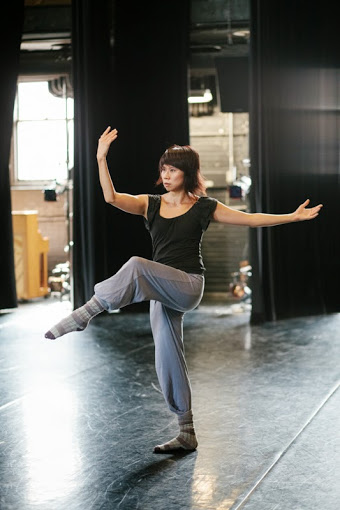
Eun Jung began to talk about repetitive motions, short choreographic phrases, which could be repeated until they were boring. What happens when you continue with a movement past the point of boredom? Eun Jung led us in a movement meditation that culminated in a long period of shaking. We were free to explore the space and the limits of our attention as we kept our bodies in a state of constant motion. Then, we came together in a few moments of stillness.
As the week progressed, Eun Jung, Cappy, and Adrienne worked towards building an “onion-like” experience for participants. They decided to create something in a workshop format that would seamlessly turn into a performance. The performance would be participatory and would emerge from individual physical, tactile, and aural experiences. It would focus on togetherness and inclusivity, but there would always be the possibility to choose. You could dance, or not. You could sing, or not. Being there would be enough, but a more interactive experience would be available to those who desired it.
The research we did in our meetings was very interesting, and the lines between rehearsal and performance, research and composition, blurred during our time together.
Out of a desire to capture the strange nature of their collaboration, I’d like to share what happened during their showing – a piece that is as much rehearsal as it is performance – from my perspective as an observer and participant.
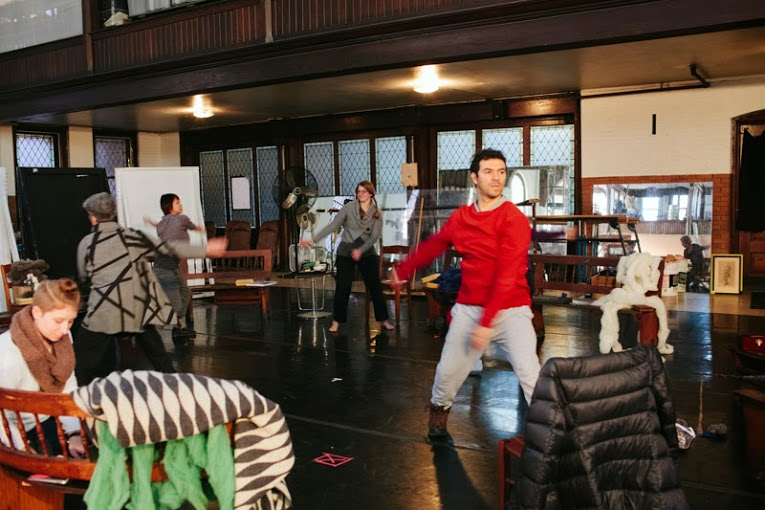
Old wooden benches and chairs are scattered throughout the space, loosely enclosing us in a circle. We sit on the marley floor, on cushions, on blankets, on benches. Classrooms turned into massive, shuttered storage spaces look on to the vestry in which we sit. There’s apple cider and homemade cookies on the Navajo-style rug Cappy made. There’s carrots and clementines, and other treats.
We are invited to grab a craft – wool fibers transformed into tiny matted hearts, strands of handspun yarn, knit scarves. Adrienne cards wool between two large paddles covered in tiny spikes. Strands of hay and other detritus fall onto the floor in front of her. You can hear soft cooing in the rafters as we all sit, happily working alone, together.
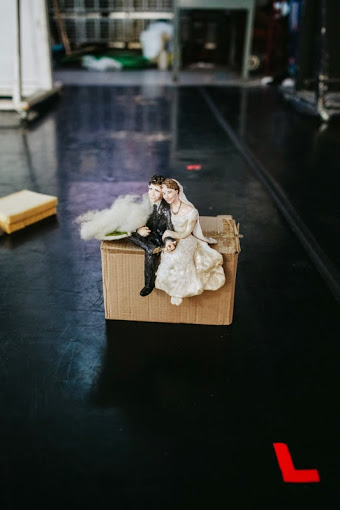
Other than the tools of our work there are other objects placed throughout the room, strewn with soft clouds of freshly carded wool. Brown tufts frame a happy tableaux: a wedding topper from a past marriage sitting on a dented cardboard storage box. A wax head wears a toupee of felted wool. An elaborate elastic and silver belt hangs off the back of a chair.
“Has the piece started yet?”
“Yeah. Or not…”
Cappy stands up and explains why the cushions in the room are emblazoned with puffy-paint computers, names, and dates. Unable to throw away these remembrances of her ex-husband, they sit in storage, along with bags and bags of uncarded fleece. She shows us pictures of her deceased sheep, explaining that the wool we are using to create our hand crafts are Brillo, Millie, and Suds (well, mostly Suds).
We all go back to our crafts, the repetitive movements both relaxing and lulling. The quiet piercing sound of felting needles and wool and the faint knocking of wood spools on wood benches underscore our conversations. A young girl felts wool with her mother on the floor and two younger women spin wool while sitting on a bench.
Eun Jung asks us to leave our crafts aside and start to move, “or not…”
Some people keep working on their crafts while those of us standing start moving. We find heat between our hands and move it around our bodies, and soon, the room. Bodies swaying in increasing arcs, we being to move around the room, spreading this heat. After reaching out and away from our bodies, we allow ourselves to collapse inwards. We collapse to the floor then reconstruct our bodies, engaging upwards. We start to shake. We shake for ten minutes. We try to shake until we’re bored with the shaking. And then we keep shaking.
After ten minutes, the music stops. We are instructed to “wash ourselves,” running our hands over the vibrating muscles in our bodies. We bring ourselves to stillness, and I observe a new frequency of peace between my shoulder blades.
We return to the now familiar motions of our crafts. Adrienne teaches us a song, call-and-response style. Some of us know the song, and lead the charge. Singing in unison, we continue to work on our projects. The sound of our voices echoes in the highest corners of the vaulted ceiling.
In the diminishing winter light we stand again, this time in a circle. Adrienne teaches us another song, and we listen to each other, alternating between drones, and variations on the melody.
As I sing, I feel parts of myself drawn out by others’ voices. I feel joy hearing our voices fill the massive space of this church, despite the somber, plodding tone of the song. As the song dissipates into its last drones, Adrienne, Cappy, and Eun Jung regroup. We are asked to continue our handy-work, explore sound, or indulge in repetitive movement phrases. I start making simple repetitive movements, easily broken down into ever smaller increments. I get lost in the small articulations of my feet required by normal walking.
I recall one person dancing, a hank of vermillion wool passing between her hands as she lunges through space, collapsing, the red wool soft viscera spilling out in front of her. She repeats this action a few more times before she continues on with a new sequence. Another person explores the dark perimeter of our circle repeating large, sweeping movements with metered breath. Two young ladies continue to talk and knit, while a man sits on the bench opposite them in the circle, felting furiously, his gestures increasing in amplitude. The room had an intensified air to it. Things were of a slightly more theatrical hue as dance and song enhanced our craft-making.
The transition between this state of exhilaration and discovery to sitting down is fuzzy in my memory. It’s as though I come to minutes later, sitting on the floor, knitting in hand. We’re talking in a circle about the performance, what people felt, what it was like. One man offers up a John Cage quote as a response to the performance:
In Zen they say:

If something is boring after two

minutes,

try it

for four.

If

still boring,

try

it for eight,
sixteen,
thirty-two,
and so on.
Eventually one discovers that it’s not
boring at all
but very interesting.
Others remark that the workshop felt like going to church or that it was a sort of community-building exercise. People seemed to enjoy the ability to actually create things with their hands, just as they enjoyed the somewhat “soft” ending of the piece.
Eventually, people collected their belongings, drifting out of the church as the four of us moved the benches back into their storage space. We gathered the wool strewn throughout the room, packing the tufts into large storage bags. Personal objects were returned to their owners. The piece was finished… Or not…
In fact, the collaboration between Eun Jung, Cappy, and Adrienne has continued on past this sharing. Their research will continue to extend and grow over the course of another month as they continue to invite more collaborators into this experience.
This first attempt, accounted for above, created a communal vulnerability in which blind participants, and those with a little more training, were able to meet each other in a space that invited them to create and share. Their upcoming research hopes to build upon this formula, or perhaps abandon it. What seems certain is a desire to achieve a practice that observes itself as it is being observed by others, both intimate and public at the same time.
Arianna Gass is a recent graduate of Vassar College. In addition to documenting Cross Pollination, she is the Program Manager for Drexel University’s Entrepreneurial Game Studio. Her own art practice is located at the intersection of digital and embodied play, and her scholarship focuses on feminism, performance studies, and game studies. You can find more of her writing and work at www.ariannagass.com.
Eun Jung Choi is an artistic co-director of Da·Da·Dance Project. The company’s mission is to challenge traditional notions of art making while promoting social awareness and diversity through collaborative performance efforts. The company has toured in the US, Mexico and Korea since 2008, presenting works by Gerald Casel, Elise Knudson, Luke Gutgsell, Helena Franzen, Melanie Stewart, Erick Montes as well as work by two artistic directors: Guillermo Ortega Tanus and Choi. As an independent artist, she has worked with independent artists/dancers, collaborators and companies in New York, Mexico and San Diego since 1996. As a teacher, She has taught at the NC Governor’s School, North Carolina School of the Arts, Center of Choreographic Investigation (Mexico), Laborame (Mexico), University of Veracruz (Mexico), Temple University, University of the Arts, Rowan University and Bryn Mawr College. She graduated with a master’s degree from the Interactive Telecommunications Program at NYU in 2003 and earned her MFA in Dance from Temple University, where she was a University Fellow and recipient of the Rose Vernick Choreographic Achievement Award. She was an Artist-in-Residence at the Live Arts Brewery 2011-2012 and at the Sacatar Institute Brazil 2014.
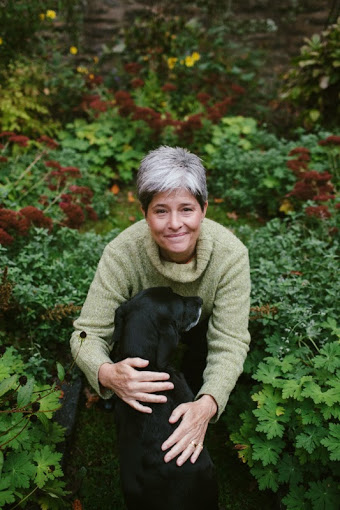
Catherine (Cappy) Rush is a playwright and fiber artist. Her plays have been produced and developed at such theaters as The New York Theatre Workshop and TheatreWorks of Palo Alto. Her play The Loudest Man on Earth, originally created for Philadelphia Theatre Workshop, was awarded the “wild applause Little Man” by the San Francisco Chronicle and was voted one of the top ten plays for the 2013 San Francisco season. As a fiber artist, Catherine learned to crochet and knit in the New Zealand school system at 8 years of age. Later in life she branched into weaving and spinning studying floor loom weaving and spinning at the Guildford Handcrafts School in Madison, Connecticut and Navajo upright loom and spinning in Taos, New Mexico. As the previous owner of three curiously odd llamas and three mostly docile sheep – Millicent a Cotswold, Suds a Romney-Suffolk cross, and Brillo a black Border Leicester – Catherine is still busily spinning wool with her hands and stories in her head as she works with their fleeces. She incorporates both explorations working with Cross Pollination artists Adrienne Mackey and Eun Jung Choi.
Nora Gibson trained with Sylvester Campbell at Baltimore School for the Arts, and through ballet residencies at Chautauqua and NCSA. She later graduated with a BFA from Tisch, at NYU. Nora has had the privilege of dancing for the Ellicott City Ballet Guild, PATH Dance Company, Andrew Marcus, ClancyWorks Dance, and Jeffrey Gunshol. From 2011-2013, Nora worked with Lucinda Childs and Ty Boomershine to perform Childs iconic 1970s works. Nora has performed her own work throughout Philadelphia and in NYC at various downtown venues such as P.S. 122, St. Marks Church, and DIA Center for the Arts. In 2009, she established Nora Gibson Performance Project, now re-named, Nora Gibson Contemporary Ballet. Since its inception, her work has received consistent critical recognition for its unique and progressive approach to ballet. “severely focused intellectual beauty”, “laser-like vision of arc” Philadelphia Inquirer.
Bradley N. Litwin is a Philadelphia based, multi-disciplined artist, born in Dayton, Ohio. Primarily self-trained, his career as an artist has taken a serpentine path through craft, manufacturing, multimedia production, music, and the fine arts. Through it all, he has been making machinery of one kind or another for over forty years.
Beginning with model-making as a child; then teaching himself guitar making as a teenager, Litwin has always asserted his destiny as an unconventional independent. Not following more traditional school and career paths, he has nonetheless excelled in various professions, relying on the merits of demonstrated skill and experience, gained through a continuing practice of self-directed, conscious observation, and synthesis.
That unique career path has included: medical product manufacturing design, museum exhibit design and fabrication, electronics manufacturing equipment design and prototyping, 3D animation, graphic design and interactive multimedia production.
Today, as a sculptor of kinetic automata, as well as a singer and guitarist, performing 1920s era, ragtime, jazz and blues; as an arts educator, working with students of every description, Litwin continues to redefine himself as an artist. His most recent projects have involved community outreach and residencies, sometimes combining both visual, musical, and literary arts, throughout the mid Atlantic and Midwest region.
This week Nora Gibson, Adrienne, and I convened in Brad Litwin’s back office, amidst spare gears, cranks, drill presses, all finely blanketed with sawdust. Huddled around Brad’s desktop computer, they started throwing out phrases “strange attractors,” “chaos theory” and “quantum mechanics” as possible starting points for their week together. This unorthodox pairing between Nora, a choreographer, Brad, a kinetic sculptor, and Adrienne promised an interesting mix of contemporary ballet, science, song, theater, and kinetic sculpture.
The group opted to have minimal communication before their residency week started, so their initial conversation centered around the similarities between what Brad does with his sculptures and Nora does with dancers. For example, when Nora describes her work, she talks about using bodies as angles and curves in space. Brad’s work as a kind of choreography in Nora’s mind; Brad’s medium happens to be gears, levers, springs, and cranks, while Nora’s is bodies. Both make complex machines, arrangements of moving parts that produce an aesthetic experience.
“Solo Phase,” one of Nora’s dances, demonstrates this idea nicely; it’s easy to how the intricacies of this solo dancer, overlaid with herself, come together to form something much like a machine. To Nora, bodies are moving objects in space, not dissimilar to the pieces and parts of one of Brad’s kinetic sculptures. The main difference, an added plus, is that Nora’s pieces and parts have a human-ness that only adds to their functionality.
People often anthropomorphize Brad’s sculptures even if they start from a purely conceptual place. A sculpture like the “Quadrotopult” demonstrates the miraculous adherence of the physical world to the laws of physics and gravity. [The fact that the catapulted balls always make it through the small holes in the rotating plexiglass never ceases to amaze.] Another one of Brad’s sculptures, entitled “The Sway of Public Opinion,” looks like a series of cycling figures on a never-ending track. These pieces epitomize Brad’s self-proclaimed fascination with “how easily mechanical systems can serve as both visual and literary metaphors for human social interaction and structure.” Brad’s work is not just about gears and motors, it’s about the interaction they have with metaphor.
Adrienne works in a really different way. She works with narratives, not arcs and lines or springs and gears. Adrienne usually explores an idea with the intention of creating a narrative. She presents a group of people with various source materials, and the resulting aesthetic product is the result of the group’s ability to tell stories through their unique perspectives.
Despite their differences, the three quickly started to think of ways they create rules or some kind of system that would be interesting to make a piece of art in. The conversation switched from mathematical concepts to video games and other kinds of procedurally generated art experiences.
Adrienne introduced us to Different, a heartbreaking game that communicates the difficulties and realities of being an immigrant or a minority. This minimalistic game has a strong narrative arc, but player interaction is entirely proscribed by an algorithm. From here, we took a look at “Taroko Gorge,” a procedural poem by Nick Montfort. This poem offers a never-ending series of koan-like phrases about a national park in Japan. Both Different and “Taroko Gorge” are compelling examples machines creating aesthetic experiences.
We started to move away from purely digital art and began to ask how we could create a live, sculptural machine. We started thinking about creating a logic game that, when played, might yield an interesting dance machine. Nora dreamed up a game that would teach audience members composition through the use of dancers. On Adrienne’s suggestion, we discussed the possibility of abstracting writing, like an excerpt from Italo Calvino’s On a Winter’s Night a Traveler, into a dance score through a program that would sort words into data points.
And then Brad asked, “Is my work in this? I don’t feel like I’m doing anything here.”
Brad focuses his artistry in his ability to use gears, levers, cranks, and everything else in between to make his sculptures. As I understood the situation, while the ideas in the room up to this point may have included a conceptual understanding of kinetic sculpture, his work is actually about the assembly of a machine that produces an aesthetically and conceptually pleasing experience. He wanted to find a way to use that skill in a more tangible way during the residency; perhaps making sculptures dancers would wear while dancing.
After this discussion, we took a step back and looked at our understanding of dance and Brad’s sculptures. We watched Interior Drama, by Lucinda Childs, and something clicked. The lyricism of the dancers’ movements, paired with the mathematically precise, iterative choreography hit a collective “sweet spot.”
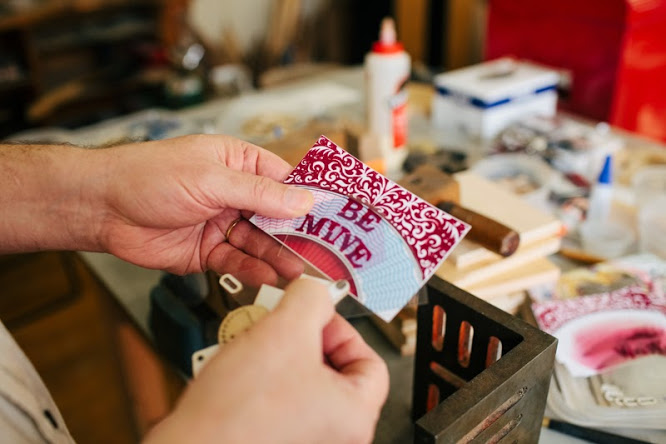
We’d found a piece of art that spoke to everyone in some way. Circling back to Brad’s question, we realized that we could use one of Brad’s MechaniCards and find a way to make a dance and musical accompaniment to bring one of Brad’s sculptures alive.
We took a field trip to Brad’s workshop, just outside of his office. Amidst the many drill presses and table saws were MechaniCards in all states of production. After watching and listening to several beautiful cards, we found the one that spoke to everyone: “Counter-Productivity.”
From then on, the residency became a series of interconnected solo-projects. The next day, the team decided to make a video that would take an animation of the blueprint for “Counter-Productivity” and overlay it with videos of dancers dancing and a recording of Adrienne’s vocal improvisation.
Adrienne, Brad, and Nora spent time working separately. Adrienne started to record music, Brad started animating the CAD drawings, and Nora set to work translating Brad’s machine into a dance score.
So, after two days of brainstorming and laying the groundwork for the video, the team split up. Nora needed studio time with dancers, Adrienne wanted to bring in vocalists to do an improvisation with her, while Brad needed time to work on animating the blueprint for his Mechani-Card. As I was unable to witness these solo endeavors, I interviewed Brad, Adrienne, and Nora on the last day of the residency to hear more about their processes.
Brad
Brad Litwin: The video is based on […] these actual mechanical drawings that I made in preparation to produce the sculpture called “Counter Productivity.”
Actually I didn’t have a name for the card when I first made it, it was called “MechaniCard #7” and I held a contest – who ever came up with a name, if I picked it, I would send them an early edition. As soon as I heard “Counter Productivity” I was like, “Duh.” Haha, it was so perfect. It was this fellow in Grenada, Spain. He was my winner.
So, the piece incorporates several mechanisms to provide a little bit of arithmetic/puzzle/illusion where numbers are counted up and down… Actually, they are counted down, and not just counted down, they are counted down and every other time they are decremented twice. In other words, it would go 10, 9, 7, 6, 4, 3, 1. It’s a little trick, and the way that is achieved is through a mechanism that has two cycles of operation: one that takes one cycle and one that takes two cycles. The operation that takes two cycles is offset in time from the first.
Arianna Gass: Those are the purple guys on the side?
BL: Yeah, so the purple guys advance the wheels one digit every time, but if you look carefully on the outskirts of the larger wheels – see if we can see it, right there – these wheels go around only half a time for every one time the purple ones do. Every other time that the purple ones advance the wheel, the large wheels here advance the counters an extra time.
AG: Oh! Because of the little peg. Gotcha.
BL: That’s how the little trick is performed.
AG: Trick!
BL: And you can’t really see much of this mechanism because in the real model it’s covered with this plate with windows that reveal part of what’s going on. It’s kind of a shame because it’s a fascinating mechanism to look at. When they picked this as a source of dancing inspiration, that was a lot of fun because it opened up the opportunity to look at the mechanism carefully.
Basically, there are pieces that move in circular motion, there are pieces that move in straight, linear motion, there are pieces that work intermittently, and they’re all choreographed in time to produce this funny little mind trick.
So, to make it into a… I had originally made the computer model, had made all the parts in the computer in order to check what was called “clearance” – that is making sure that things don’t bump into each other when they are moving. I didn’t need to animate that to do the checking. Animating the parts was a whole different process which these guys were privy to. That was neat, doing that extra step to actually animate the parts. I used 3D Studio Max which is a professional animation tool.
And uh, what else to say about it? Well, this is a 1400 frame animation. That is, the entire cycle of the longest movement takes 1400 frames. This is based on the amount of time Nora said she wanted to see things moving. We had watched the yellow shuttle piece cross and then return in 700 frames, so in 1400 frames it does it twice.
So what I did was I rendered those 1400 frames a number of different times. About 11 different times. With different parts of the mechanism visible and the rest hidden.
AG: Cool.
BL: And then I imported each of those frame segments into Premiere, which is a video-editing software, and played with which segment would appear when partly to satisfy the exploration of what the mechanism does and how it works, and also partly for the grace of the particular motions in juxtaposition with one another. Also, it was nice to be able to show things moving without necessarily showing the effectors which control them. There was a certain whimsy about that. At a certain point you are going along you see something moving, then you see the thing revealed which moves it, and you see the thing that moves that, and then you can see how all of those parts are inter-related. In fact, by the end it’s… you get this blast where you see everything moving, then bit by bit it’s all taken away. Then you think it’s gone, but by the end the little crank thingy comes in to say, “Hi there!”
AG: It’s interesting because when you’re interacting with your sculptures the input is just this little crank guy, you and that, in the beginning when I approached you pieces I just wanted to spin the
that was the “hot” part for me. I just want to turn this little guy!
Oh it’s so funny, sometimes little kids will come up to the table where I’m showing my stuff and they’ll turn the crank and be looking all around, turning the crank itself is the satisfying thing to do.
Nora Gibson: Huh… Yeah.
AG: that’s what I wanted, I wanted to turn the thing
BL: I should just make a “Turn the Crank MechaniCard,” or a MechaniCard with seven different cranks.
AG: Woah, that’s like candy.
Adrienne Mackey: Or something you stand on and turn the crank and something happens to you!
[laughter]
NG: That’s called a sit and spin.
[laughter]
AG: It’s so funny because the crank was my tactile focus, but now that I’m looking at this, it’s that peg [on the gear]. After seeing the inside workings of the sculpture, I’m focusing on that little peg.
BL: It’s also interesting because turning the crank has a different tactile experience depending on which MechaniCard you’re using.
NG: Yeah, totally.
AG: They all feel different.
NG: There are certain ones where it will feel smooth, and then there will be a little bit of tension, smooth and tension. Others are more even.
I have to say. I feel like learned so much more about it after seeing this deconstruction. Everything’s in concert when you’re doing it, and you try to pick apart it and you’re like “Wait, what’s moving that? I don’t… But this isn’t moving now…”
BL: Yeah, it’s a little mechanical orchestra.
NG: Yeah, and it was interesting, especially when you had something moving and then a part that was static next to it. It’s like “Okay, I’ve mentally ruled that one out. That one does not have anything to do with that particular piece,” but then later you see the one that does and you’re like, “Ahh, I get it, this is connected to A, B is connected to this!”
BL: Yeah, and one of the highlights for me of this particular design is something called hypocycloidal motion which you’re seeing right there.
AG: That’s the gear there?
BL: That is the round… Yes that’s the gear with the little anchor on it and that’s showing that a circle that rotates within a second circle of twice the diameter. All points on the smaller circle’s circumference will move in a straight line. That is, if I put the circle over here and put the motion point on the periphery anywhere, it’s going to follow a straight line as the circle rotates.
AG: Huh.
BL: In this particular case, I put it at a point on the smaller circle so that it moves in a horizontal line relative to the entire card, but that’s completely arbitrary.
AG: Yeah.
NG: I do have a three part step that goes in that pattern. I wanted to reflect that pattern against the circles.
AG: Nora, did you address the crank [in your dance]?
NG: That’s the only part of the card I didn’t address. I stopped at 14 people…
AG: Hum…
AM: Arianna could be the crank!
AG: No, that’s okay.
AM: Or Brad!
NG: Yeah
BL: I’d be the crank…
Nora
Nora Gibson: We started from this mechanical drawing of one of Brad’s MechaniCards, which are hand operated… What would you call them?
Brad Litwin: Kinetic sculptures.
NG: Right, kinetic sculptures. So I went and I labeled all of the parts [of Brad’s sculpture] for reference. I have a pretty visual approach to making dances anyway, so, to me, this looked like a score. Brad’s rendering is basically things in two dimensions… It’s a depiction or representation of parts moving in space. They have their own directions, spatial relationships with other parts. This [rendering] was a perfectly good representation of people in space, moving.
So, as soon as I labeled this drawing I was like, “Oh wow, this is a dance score.”
What I did was, I took this rendering and I turned it into a score in two stages.
The first thing I made was this graph, which is just a way of looking at time. It’s a way of organizing the information from Brad’s rendering. In the rendering you see all of the parts and you see their relative spatial relationship to each other. Unless we wanted everyone dancing all together, we would have diverge, use artistic license, and step away from the drawing itself. So we were left with this question of, over time, how many of these parts did we want to show? Which parts in conjunction with others? How did we want that experience to elapse over time?
This first graph is a way of organizing that information.
AG: Did you guys collaborate on this?
NG: No I just made these decisions. The column on the left labels all of the moving parts.
AG: The parts that were chosen…
NG: Yeah. [Brad’s machine] is very symmetrical, so [my score] winds up sometimes acknowledging that symmetry and sometimes disregarding it.
AG: That makes sense because in Brad’s video animation, parts are added and subtracted to the animation over time.
NG: Exactly, yeah. In that sense, the video and the score mirror each other, but they don’t literally mirror each other. We made different choices.
AG: Right.
NG: So In my mind… This [graph] was before I invented any movement to go along with it: it was just conceptual. I just imagined these parts… I sort of thought of these parts as just dancing beings in and of themselves. I actually kind of was imagining what Brad wound up making. Which was just which parts dancing with other parts did I want to see grouped and re-grouped over time.
So this is just a dance in my mind of these parts. The X’s are when the part itself operates
and the circles are where I wanted to see the part on stage, just not moving.
AG: so I see the score is 27…
NG: Units long. So we were all playing with timing but originally we working with timing of an actual minute, so there were 30 second blocks, but now they are 30 count blocks. So it’s just 27 units of 30 counts each.
So that was the first step.
Then I did this second score, because this score allowed me to visualize [the dance] more in the space much more like what the animation turned out to look like. So spatially I could see where everyone would be.
In here I started to think more about not the individual steps, but people and pathways. So I imagined people doing walking patterns and then just followed the initial chart and drew them in. So that allows me to see people in the space and compositionally what that may look like.
AG: And the shapes of the pathways were inspired by the shapes of the parts [in Brad’s sculpture]?
NG: Exactly. For instance, J is shaped kinda of like this curving arrow, but it doesn’t literally move in that way. That shape is not the way it moves, it actually moves more like a lever. So I’m having someone dance their pathway like that shape. They make a diagonal, then they actually come back more triangularly. The pathways work off of both the mechanical motion and the actual wooden part that forms the outside of the artwork that the moving lever or gear controls.
So those are the scores.
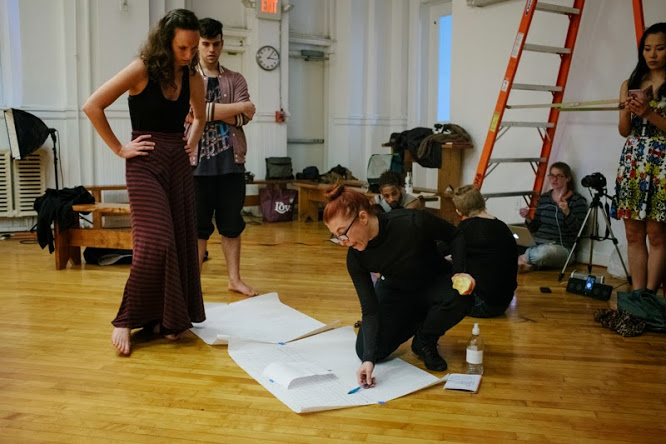
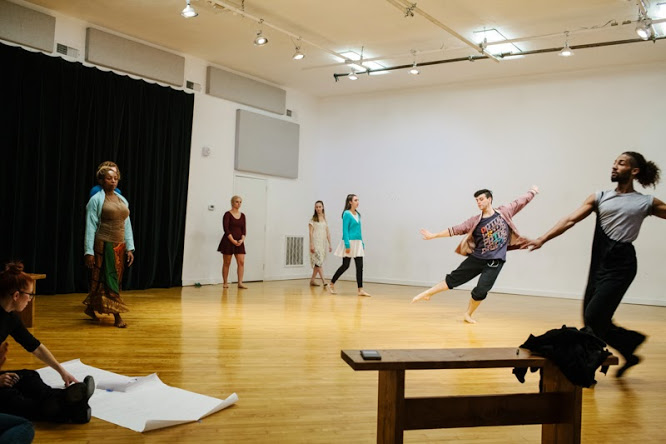
The last step was in the studio yesterday, thinking who’s where and then starting to apply some movements to each of their pathways with some similarities and some differences so there will be some counterpoint.
AG: So each letter or part has their own movement sequence?
NG: Most of them are actually paired. So, D and E are actually the same motion. J and K are the same in motion. But there’s only one A, one B, and one C. So, some of them are solos, but most of them are symmetrical.
Adrienne
AM: So what I did first was … I sat down and I basically tried to create a vocal part for each of the gears.
So, for example, if I take the effect off of this part – it’s just a really simple, a very literal equivalent
and then I’d add a second piece.
BL: Oh, this is the one in the shop! This is still my favorite.
AM: So I was singing it in thirds, you know, and then adding some other sound on top of that. And then I added… It felt very vocal a cappella to me, which I was not so crazy about, so I added a long pan and then an echo, so you get this bouncing back and forth thing.
AG: That’s a little scary.
BL: I still think that’s the best one, even with the background noise.
[laughter]
AM: And that’s all of that. The thing that bothered me about this one was the air conditioner in the background…
AM: So I went back and I re-recorded all the parts without the background noise, and I created a much longer version where I take out each of the pieces singularly. It’s interesting for something, but I don’t think it… it has a little bit of an Enya thing that happens to it.
NG: I love the similes you come up with.
AM: What I did like… eventually it’s like two different parts with really minor adjustments back and forth of these long notes. It actually feels more like the mandala [MechaniCard], than it does for this particular piece. Then I started adding those [bouncing notes] back in. Somehow they sound darker in this version than they did in the first version, I don’t know why…
AG: They sound like… not a human sound.
AM: So, blah blah. That goes on. [Stops music.] I’ve been trying to figure this out. The parts are literally the same thing I recorded in your studio. It’s literally the same things but it feels so much heavier in this version. It sounds more intentional, in a way.
NG: I like that it sounds… You have a round sound to your voice and that, to me, contrasts with the dissonance of the melodic play. It’s a contrast between the round and the sharp.
AM: It’s funny, I like [the first one] better too. I guess it’s just the microphone…
AG: Did you share these recordings with Michael Kiley and Liz Filios when you improvised with them?
AM: Yes, some of it.
AG: What else did you “seed” them with?
AM: I showed them [a video of] Brad playing with two “Counter-Productivities,” one on its own and one in a stand. And then I had a recording of the card at half-time.
AM: We kept watching the videos… We’d do a thing, and then we’d watch the video and we’d do another thing.
We really tried to mimic the different kinds of sounds, and then, I don’t know why, but we did an improv where we really played against the mechanical nature, so we just did a series of soundy-things.
One of the things I realized, actually, was that I have a hard time collaborating with myself. I don’t tend to do a lot of things where it’s just me on a ton of tracks. I feel like I get bored. I need things to bounce against. And Mike and Liz are really different singers rhythmically and tonally, but we sing with each other a lot so we know how to blend. Mike comes from a folk music background and Liz comes from musical theater — we’ve all studied classically, but I think I’ve spent the most time living in it.
AM: That goes and goes. And then we did the version that I ended up using.
I think by then I’d shown them Brad’s other website. I figured, well, Brad’s a musician, so I played one of your songs, and we did a bluesy improv.
The track I ended up with is the same track overlaid in a bunch of different places. I just chopped up an improv and reassembled it.
And then the last thing I did [with Mike and Liz] was do a 10-minute improvisation, you know, just to see if it was something. Turns out, no, it’s not. It was very fun to do, but it literally goes through every style possible.
The first piece was my interpretation of how the dance might look and how the machine works, but the final piece is actually most similar to the kind of music I like to listen to and sing.
Arianna Gass is a recent graduate of Vassar College. In addition to documenting Cross Pollination, she is the Program Manager for Drexel University’s Entrepreneurial Game Studio. Her own art practice is located at the intersection of digital and embodied play, and her scholarship focuses on feminism, performance studies, and game studies. You can find more of her writing and work at www.ariannagass.com.
Originally from Wilmington, Delaware, Raphael Xavier is an award winning artist based in Philadelphia. A self taught Hip Hop dancer and Breaking practitioner since 1983, Raphael has forged an exceptional approach to improvisation. As an Innovative Movement Conceptualist, he creates new ways to expand the vocabulary of the dance form. He not only draws from the culture, but also from his visual background as a Hip Hop magazine photographer and musical artist.
His extensive research in the Breaking form has led to the creation of Ground-Core, a Somatic dance technique that gives the practitioner a better understanding of the body within all dance forms. As active Alumnus of the world renowned Hip Hop Dance Company, Rennie Harris Puremovement, Xavier’s choreographic dance works (solo and ensemble) have been performed worldwide. Raphael is also a 2013 recipient of the prestigious Pew Fellowship.
Emmanuelle Delpech is a theater artist: an actor, director and teacher. A native of France, she works and lives in Philadelphia. She was classically trained at l’École Superieur d’Art Dramatique de la Ville de Paris and then studied physical theatre at l’École Internationale de Theatre Jacques Lecoq. Additionally, she has earned an MFA in Directing from Temple University.
Emmanuelle has performed with the Pig Iron Theatre Company and Second City Chicago, and she has also produced several successful solo shows. She has won a Barrymore Award, a City Paper Award, a LAB fellowship, and a Philadelphia Magazine Award for Best Theater Artist.
From 2008-2014, Emmanuelle honed her directing skills, bringing shows to life for the Philadelphia Live Arts Festival and the Arden Theatre. During that time she was also a clown / mime consultant for The Civilians and 1812 Productions.
Teaching credits include the University of the Arts, Swarthmore College, Temple University, Movement Theater Studio NYC, Headlong Performance Institute and the Pig Iron School for Advanced Performance Training.
Ken Kalfus is the author of three novels, Equilateral (2013), The Commissariat of Enlightenment (2003) and A Disorder Peculiar to the Country, which was a finalist for the 2006 National Book Award and has appeared in several foreign editions, including French and Italian translations. He has also published two collections of stories, Thirst (1998) and Pu-239 and Other Russian Fantasies (1999), a finalist for the PEN/Faulkner Award. Kalfus has received a Pew Fellowships in the Arts award and a fellowship from the John Simon Guggenheim Memorial Foundation. He’s written for Harper’s, The New York Review of Books, and The New York Times. A film adaptation of his short story, “Pu-239,” aired on HBO in 2007.
Kalfus was born in New York and has lived in Paris, Dublin, Belgrade and Moscow. His new book, Coup de Foudre: A Novella and Stories, will be published in May.
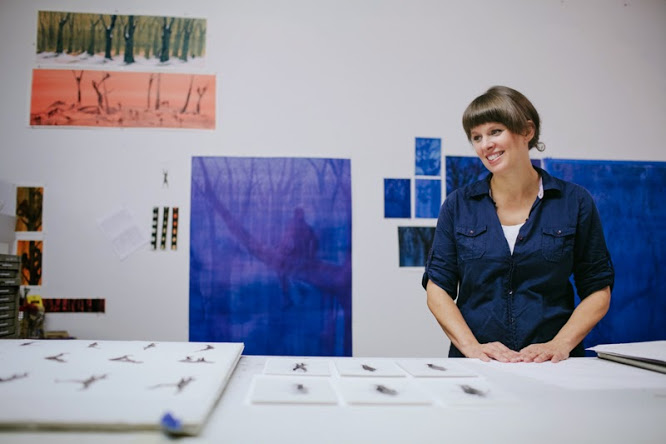
Cindy Stockton Moore is a Philadelphia based artist. Her site-specific installation ‘Other Absences’ is currently on view at Eastern State Penitentiary through 2015. Recent solo projects include ‘Consciousness & Revolt’ at The Galleries at Moore (Philadelphia), ‘Toward Futility’ at Artspace Liberti (Philadelphia), in addition to the two person exhibitions: ‘An Island Now Peopled’ at Chashama Chelsea Project Space (New York) and ‘Water/Line’ at The Center for Contemporary Art (Bedminster, NJ.) She has shown throughout the US and abroad with group exhibitions at venues such as Heskin Contemporary (New York, NY,) PS122 (New York, NY,) Hillyer Art Center (Washington DC,) The Painting Center (New York, NY,) Sandy Carson Gallery (Denver, CO,) Public Fiction (Los Angeles, CA,) and The Boston Center for the Arts (Boston, MA.) Cindy Stockton Moore received her MFA in Painting from Syracuse University. Her writing on art has appeared in ArtNews, NYArts Magazine, The New York Sun, and Title Magazine in addition to university and gallery publications in the US and Canada. She has been a part of the artist-curatorial team that runs Grizzly Grizzly gallery in Philadelphia since 2011.












 swimpony.org