Random

Dispatches from The Awesome Lady Squad: #1

At the start of 2014 I made a resolution to become a superhero.

I made a resolution to seek out and form a superhero-style team of bad-ass ladies who are art makers to help spread our art and bad-assery across the city of Philadelphia. I began forming a group that will henceforth be known as The Awesome Lady Squad.

Oh, excuse me. I meant to say:

cooltext1368115366

First thing you ought to know: there are a lot of us.

I didn’t need to send out a bat signal. I only had to put up a single facebook post and a note on the blog. Almost as an afterthought. I thought I’d get a handful of people. A dozen if I was really lucky. Instead I found 40 people gathered with me last week for two hours to talk and share and start to plan. Clearly, there’s a need to be filled here.

Because from what I can tell, these awesome ladies are just the tip of the iceberg.

So here’s what we, the Awesome Ladies of the Awesome Lady Squad, did in our first gathering:

1) We put out a whole bunch more chairs (Because there were, you know, a lot of us).

2) I said hello. I said that I was excited (Because I really really was).

3) We went around and said our names and the kind of awesome stuff we make.

4) I shared a vision.  It went something like this:

Hi, I am Adrienne.

And you are all awesome.

You are all awesome ladies.

I’ve been thinking a lot over the last year about what it means to be an awesome female artist and the rewards and challenges that come with that. I’ve been thinking about it a lot, in lots of different ways – through writing, through conversation with friends and colleagues, in the back of my brain as I do my work each day.

I think part of the reason I’ve been thinking about this so often is that one of the most powerful developments in my artistic life of last few years has been finding other women who make work. I’ve found women further along in their careers who have experience that inspires me. I’ve found brand new artists who come to the table with a whole new perspective that invigorates and uplifts me. And in meeting these creators, I’ve been craving a way to take all the interactions and thoughts and excitement generated with them individually, and collectivize that into something more power than any of us singularly might be able to achieve.

I believe in talking about problems and highlighting them. I’ve done a fair share of that over the last year. But even more, I want to assume that there are concrete things we can do, that with effort over time, can shift the problems we see into solutions.  I believe very strongly in Philadelphia’s strength as an artistic community. I think we are different than most places in our support of each other as not only as creators but as human beings.

Which is why I’m inviting you to join me in a lofty goal: To make Philadelphia a model city. A model of the way we believe that female artists should be treated, a model for the kinds of work that’s possible when such awesome artists are allowed to access their full capacity, a model for how an imperfect situation can be shifted through collective effort and a will to do better.

What I want to do today is ask a series of questions that I hope will be useful in the future. I want to use your responses as a kind of divining rod for what work we should be doing.  For what it’s worth, my assumption is that there is no such thing as a singularity of perspective. I think there is no such thing as “a” female creative voice. So it’s great if you share someone else’s experience. But I think it’s interesting and useful to hear a multitude of opinions even if they differ. We begin from a place of respect and support. So feel free to respond to a question however you want to, even if you are a minority voice. That’s the Awesome Lady Squad way.

And for today, you’d prefer to just listen, that’s cool too.

I think we ought to get started.

And then we moved onto the last part of the meeting:

5) We got down into the dirt and started digging.

The two-hour conversation that followed, it flowed, it morphed, and it moved all around. It was, I have to say, pretty damn awesome. These are the three main questions we talked about in the general order we tackled them:

i) What is your work?

Does being female affect you as an artist or creator? Does it change the kind of work you make or the way in which you make it? If applicable, has that shifted in any way over time?

ii) How do you get it made?

How you get your work into being? Does being a female artist differ from being a male one? What are the advantages or disadvantages? Are there things you crave or stuff you wish could be different? If applicable, has that changed in any way since you started your career?

iii) What should the future look like?

If money, time and other people’s attitudes were no barrier and the world could be exactly as you wish, what would be the working theater community look like? Try and answer as often as possible with “It would have –” or “It would be – ” versus “It wouldn’t –”

And these are some excerpts of what people shared, grouped roughly by my own intuitive  categories:

Making it work in the current system or setting off on your own

–       When I started working, I was auditioning in NYC with a million women and 5 men who all got cast. It was a constant feeling of, “God I hope there’s a part for me.” That was the model for a long time. But at some point I decided I wasn’t willing to sit and wait around for theaters to call me. That all changed when I started making my own work.

–       I stay away from classic pieces. I don’t like the kinds of women in those stories. They aren’t familiar. They aren’t modern. They say things I don’t agree with. And yet, a lot of modern drama, I don’t see myself in either. I think this is why there are so many creator-slash-director-slash-performer-slash-I do everything people here. Because it’s an outlet. If I’m always going to be assigned this kind of play through the traditional spaces, I’ll just go make my own.

–       It’s a real privilege to be able to make one’s own work, to self-produce and get space and money, etc. In addition to gender both race and socioeconomic status factor in. It can be shocking how segregated theater is.

–       A few years ago I did this show that required me to bring myself to the work. It was a turning point in my life. Men have had a big voice for a long time. I see the context of this moment in this room, of women finding their voice. We are getting closer. The younger people in this room, I wish I had come out of college like you saying, “Yeah I can do whatever I want.” And it makes me hope this room may not be needed 20 years from now.

Juggling identities, finding one’s place in the artistic world

–       There’s a catch 22 sometimes.  The roles that are available are fewer, and they are more likely written poorly or as a stereotype. But if you protest how women are represented you’re not supporting the director’s vision. It’s actually a very patriarchal system by its nature. I want to work and it feels like I’m choosing between being seen or sticking to principles.

–       I have kids and lots of life in addition to my identity as an artist. I have to juggle so much more compared to men. My sense is that unlike men I see who just say yes when opportunity arises, I have to “check” to see if there’s a conflict with others’ need for me.  I’ve started embracing the doing of everything. And realizing I just need to say yes rather than check.

–       I have been lucky in not getting cast by “regular” theaters. It’s meant I primarily have a resume of projects that are devised rooms full of women that are awesome and not “normal” roles. Go up for things that aren’t me, I always felt really strange at the auditions. That strangeness and otherness that kept me from getting parts became the work I’m now known for.

–       As a young artist, I sign on for projects because I want to be doing. But I think I have to look at it and saying, do I really want to be doing this? Maybe I just can’t be a part of this. Ethically sticking to our guns will matter in the long run.

Strengths and challenges in being a female artist

–       I notice that I’m often asked to be nurturing. I’ve never seen actors ask a male director ask for that.  I’m not looking to be cruel, but I don’t want to be required to have a motherly element.

–       I think it’s important to remind myself sometimes that I believe in listening and being attentive. That’s my strength as a creator. It took a long time not to feel bad about it.

–       All of the working models were very male. Very auteur mindset. I get so tired of that word. But its useful to remember there are things that style can’t do. Collaborating, cooperating, being sensitive, working differently with different people, facilitate for collaboration. Those are artistic strengths. And I think we need a model that celebrates that.

–       Collaboration that is very deep produces different art. It can solve problems in new ways. If you don’t have to worry about the desire to put a stamp on everything as “mine” you have room to find the actual best idea.

–       Creating a warm and collaborative environment has demonstrably powerful effects. Collaborators have told me it’s an easier space to work in.

Habits, situations and problems that need to change

–       I hate saying sorry. I hear sorry a lot. “I’m sorry can I ask this question?”  “I’m sorry but have you noticed this?” I’m sorry but I think that maybe there’s another way to do this.” I hear myself making excuses before even start talking.

–       I also can get mad about the fact that if I were a man I’d be working more. And when I see scripts that say shitty things about women I get mad that I can’t direct them. Because I want more work, but I also can’t do that play.

–       This is the trouble with being a “mercenary” working on other people’s shows. Lately I feel like the representative woman in the room. I become acutely aware if I end up seeing something I disagree with. I only want to put my name on things that represent my ethics but I am young and don’t want to overstep bounds. I don’t want to “not work” because of this.

–       I’ve been told that I didn’t have enough vision as a director. I think what’s actually going on is that I don’t articulate “vision” in this masculine way.

–       I also don’t know why but I get worried if my work feels like a stereotype. If I explore gender in my art it feels like a stereotype. Why do I feel defensive about exploring genuine questions for myself?

–       It’s tricky to try and start these conversations. I don’t want to punish people who don’t realize what they’re doing but it’s tiring. It feels like I’m doing calculus on this issue and they’re doing arithmetic. At a certain point it’s hard to be impressed that they can add simple numbers.

Getting the support to get your work made

–       A huge aspect of this also comes into play with the funding community. Often you’re forced into writing about your work in male language. Can we talk to the funding community about how the way their language is gendered? The most insidious glass ceilings are in the semantics of that language itself.

–       I dealt with a funder who just didn’t think the work I did qualified me as an artist. And I had to realize they don’t hate me, they literally just don’t understand.  That took an enormous amount of energy and engendered a world of anger in my life. I am tired of feeling like all the dudes get opportunities. I am tired of thinking “This is no fucking fair.” I don’t want that rage to take up all that space in me.

–       It’s also important to stop seeing status that doesn’t matter to you. It’s easy to get caught in what other people tell you are important. How can you say no to this thing that other people would kill for? I’ll tell you how, because I don’t value it.

–       The funders, the presenters, they need to change. We also need more women in these roles and need to become aware. Eventually they have to die. But we also have to get into positions where we can make them change the system.

And finally, we ended the conversation by starting a list of things we’d love to see, things  that might be a good place to start if we’re trying to make an awesome future:

–       I wish Philly had a grant for women that was not linked with social change

–       I want to see equal genders represented in directors, actors, plays, etc.

–       I’d like a world where we stand up for each other.

–       I want more resource sharing – of space, info, etc

–       I want more women becoming the new gate keepers of festivals, funding, etc

–       I’ve never seen a woman direct, never assisted, etc. I want to see that.

–       I want funded apprenticeship with younger artists with older female artists.

–       I want to offer and accept opportunities, not just wait for things to come to me, but actively give whatever I can to folks coming down the pike.

So.

What comes next?

First thing: another meeting. This will either be Sunday 1/26 or Monday 1/27 in the evening with the same format as meeting #1 to give 9 – 5ers that couldn’t get to the first one a chance to share their thoughts too.

And then?

Well, I’m going to think long and hard about how to take these awesome thoughts and feelings and translate them into a setting where we can start to take action. This is really where I think the Awesome Lady Squad really will become a superpower. I know that we are capable of changing some of the problems we see and my hope is to come up with a plan for how to do that. If you have ideas, feel free to send them along!

That’s it for now.

Oh, and thanks for being awesome.

– A
52 Weeks, 52 Plays: Week 1

Back in high school my theater department’s office had a giant catalog of scripts. My senior year I decided that I would read a play every week for an entire school year. A lot of those plays I’ve forgotten, a few have burrowed into my brain very deep. But I think the real lasting impact was less any particular show, and more the fact that I felt like it gave me a concentrated bit of time to sit and ruminate on theater, on how I would stage that play, if I would stage that play, what I thought the playwright wanted and whether I would want something similar or different.

2014 has, at least nascently so far, been a year of initiatives.

A few weeks back I was thinking again about plays. Scripts, specifically. Being a deviser I so rarely read “finished” scripts. And I thought that it could be interesting to check back in with the writer-first world that most of my profession lives in. I wanted to know more about contemporary playwriting, what trends are out there, and who the outrageous creators were. But I also wanted that sense again, the time to look at someone else’s idea of theater and to just… react. So I put up a post on the old book of faces asking for play submissions, bound only by the stipulations that it should be something from the last 3 – 4 years with a bonus for female playwrights.  Happily, I got a ton of response.

The public-ness of this blog, another formerly nascent initiative of its own, was very helpful in  keeping me on track with getting writing out back in the earlies of 2013. A rule lover by nature, I liked knowing that I was in a little way publicly accountable for doing what I’d set out to. So I liked the idea of trying to catalog this idea of reading a play a week for the entire year of 2014. I made a list, started thinking about how to organize the endeavor and I start off the very first week with a copy of a play called The Noise by Rachel Bonds.

Here’s the thing though…  I don’t want to write a review of this play.

I am incredibly aware of how subjective a given random day’s awesome-ness or shitty-ness affects my view of a thing. I am also aware that reading an assessment of another’s work will bias future people about that work because you’re either reacting to or against their positive or negative assessment.  So while I don’t think I’m incapable or unqualified to read a play and assess it, I kept thinking, what end am I aiming for? I am certain that this project will not result in Swim Pony suddenly deciding to produce new young American playwrights. I also don’t particularly want the responsibility of advocating for or against another artist’s work. This space, for me, it feels like it’s really for something else.

So I’m trying to shoot instead the kind of feeling that I had back in high school: using a particular play as a springboard to jump start the way about the way I think about theater, what I want to make and see, and how it reminds me of the possibilities of what are out there and what I can imagine could be out there if I were to make it. So without further ado, Swim Pony musings from The Noise.

A synopsis in a just a few lines: The plot of The Noise centers on four characters – Ellie – a 28 year old math teacher who has lost her mother, Amos – a 30 something history teacher with whom Ellie becomes romantically entangled, Bert – Ellie’s father recently remarried and finding a sudden need to tend the garden his last wife once kept, and Janice – Bert’s new wife who is trying to deal with his blocks in processing his previous wife’s death. Ellie and Bert both work to try and deal with their feelings at the loss, Ellie by guarding herself against new love, Bert by an obsessive need to rebuild to the vegetal life his wife once tended. It’s a story about people searching for connections to each other. Added to this is an eerie/magical presence of The Noise – a form that emerges from darkness and beckons Ellie into the most quiet, silent and still places in the world and in herself.

This is in many ways, a play about grief – a daughter who has lost her mother, a man who has lost a wife. But for me it was equally as much a play that explores darkness and silence. I was captivated by this idea throughout the reading, how we can create a performance that invites an audience into such a deep and still place. I wondered as I read if it possible to ask the audience to do what The Noise asks of Ellie, to invite them into a “moment of utter and complete stillness.”

There’s a kind of anticipated rhythm of drama that I feel in most of the theater I see. Working in the field you can sometimes start to sense a kind predictable structure. Even in the messiest of emotions, there is a kind of arc that becomes ingrained – the anticipation of the lights going down, the building action of conflict, the perfect timing of a character coming to catharsis, knowing just when you’re supposed to cry or laugh as an audience whole. It’s funny how in a way this journey can become incredibly familiar, perhaps even to the point of banality. It’s why, sometimes, a person in the audience coughing can so thoroughly draw attention of everyone in the room – because such events stubbornly refute the tempo and timing we expect of the moment.

Such an occurence, pedestrian as it may be, is living by the pulse of some other kind of world. It rubs so coarsely against the slickness of a polished piece, it is so imprecise and un-theatrical, that it can stubbornly demand our attention.

Reading this play I wondered, how long could you ask someone to sit in the dark and close their eyes and just… be?  Talk of such stillness in concert with dialogue so sharp that it snaps (Which this piece has, by the way. If you want a scene for young actors that is smart and sweet, the first pages of this play are quite fitting.) such contrast highlights my hunger to really experience such a sensation for myself. What if you created a space where a room full of people were asked instead of watching someone listen for the most perfect silence possible, actually were invited to find it for themselves. Silence is of course, a kind of sound, one end of a spectrum, and as a creator who very often lives in my ears, I love the idea of taking a moment with a listener to turn off the lights and work at awakening this sense. The Noise is a play filled with the sense and absence of sound, with vibrations and reverberations that move in and through us, and as a director it makes me wonder how one might take this impulse even further.

The other element suggested in the staging is The Noise itself, a kind of fantastic presence that emerges from and pulls others into darkness. The playwright notes that she first imagined the presence as a girl (10 – 16) standing in a doorframe unmoving from a nightmare she used to have as a child (can I just say, I’d love to see this nightmare?). She instructs the reader to seek an ageless quality but not an overly heavy creepiness. Like Victorian child in a frilly dress. Which is funny because it’s exactly what the others who read the play mentioned envisioning.

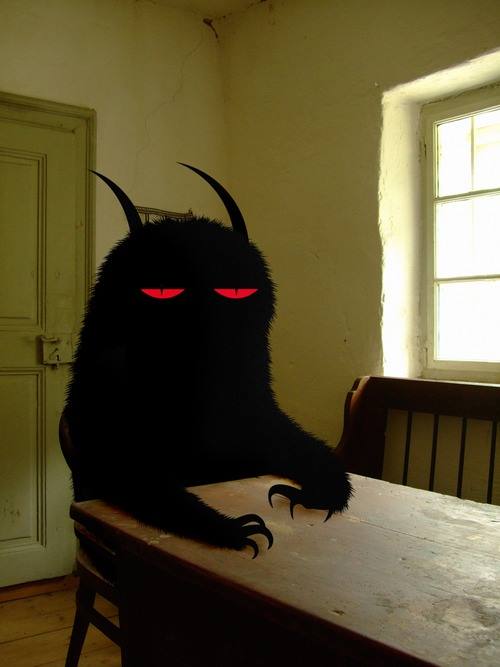
The Noise appears in the shadows of streetlamps with an unsettling howl. And though nothing in the play suggests it, for some reason all I could imagine was a picture from a friend’s facebook profile that looks like this:

The noiseI kept imagining the character one part jaunty animation and one part black oil from the X-Files. And it made me wonder how to create such a thing in a live performance setting. Made me want to try and create a presence out of the kind of things that theater does very well – where a thing that has no life or seems very ordinary transforms into a kind of magic.

And last, this play made me wonder about my taste for messiness.  It made me think about how strong the impulse to tie things up neatly can be and how perhaps our work, like our lives, might benefit from a bit of nasty bits left in.

So there’s week 1.

Here’s to another 51.

– A

PS – For those interested here’s her website and a bit of info on her recent work with the Arden Writer’s Room.

11,000 views, 101 posts

This one is a little bit of a cop out. But hopefully an amusing one.

I was dinking around my blog’s stats this morning and found a summary list of search terms used to refer people to ye olde Swim Pony Musings…

The results are pretty wonderful.

So in the end of the year spirit I thought I’d share the list (in order of predominance) of terms that people have typed into google or yahoo or whatever they use to get themselves here, even if only for a moment.

Enjoy

– A

TOP SEARCH TERMS REFERRING VIEWERS TO MY SITE IN 2013

Jealousy

what would you do with 10 million dollars

window gobo

Catfish

Fear of falling

Philly Fringe 2006

Country time lemonade commercial porch

Responsibility

Story naked male pony

Strong bridge made out of toothpicks

Recitative

Eulogy project

Timon of Athens review PAC

Laundromat interview

Vampire freak profiles

negative experience stronger than positive ones

15000 words

Artistic code of ethics project

Adrienne Mackey

A stick in the mud to show the time

I learned from the past

Goth boobs

New life in the arts

Fat women pony .com

predicted functional skills grades swimming

put the money where the people are

playplays

Garbage man saw me naked

Where can I buy 100 dollars real pony

Get your shit together

Brash Young Thing

OMG.  I am typing this on a new computer y’all.

For those not personally acquainted with the previous Swim Pony computational control center this is a big frickin’ deal. I will no longer have to look at the wine stain in the lower left corner of the screen. I will no longer have to deal with the processing speed of a drunk hamster on a rusty wheel. And best of all, I will FINALLY be able to walk away from my computer for more than 60 seconds without worrying that it’s turned off.

“Woah.” You interject, “What did you mean in that last thing?”

“Well…” I sheepishly shrug, “I kind of of had some issues with the circuiting on the keyboard which meant that the power button constantly believed itself being pushed.”

“What?” You reply, aghast. “So, what? You just never walked away from your computer for more than 2 minutes?”

“Yeah…”

“So what if you’re editing a video and it needs to export out of that program? That takes hours.”

“Yeah…”

“Oh my God Adrienne. What is wrong with you?  Don’t you work 90% of the time from home? Wouldn’t that make any small thing you had to do on your computer a giant decision about whether to turn on and reboot your laptop? Wouldn’t that prohibit you from using it for any kind of movie or music playing application? Wouldn’t you also have to constantly live under the tyranny of whether you’ve saved your documents every 60 seconds? Wouldn’t that make even simply answering the phone and getting caught up for a moment too long a danger? Might you not have lost tens, nay hundreds, perhaps thousands of words that you had slaved over due to a single second’s distraction?”

“Yeah…”

So you can see why this is huge for me. After three years of the “Oh, yeah, sorry, I need to keep fussing with it or my computer might turn off” shame and embarrassment I am finally free.  And so you’d think that as I sit here not having sprung for the “idiot spill protection” insurance that cost just a bit more than I’d budgeted I wouldn’t be staring a label on a bottle of spring water in the face. But no, it’s right there, to the right in fact, in the same spot where the cat knocked over the coffee that began the last big mess I was in.

There. That’s moved to a far away window sill. Maybe we can learn something and not repeat the same mistakes over and over.

Anyway.

As I bask in the literal glow of my new toy (PS I just walked away from my computer for 5 minutes and came back to type this sentence) I am forcibly required to look into my past, at least for a little bit, as I sync the accounts and passwords of the old with the new. I keep my spam to a minimum on my personal email and so I generally send things requiring me to “verify this” or “click to sync that” on my old right-out-of-college email account.  And as I went to check one of those “please click to update your account” emails I saw a notification for my old blog, the one I keep back in the early aughts of this century. The comment of course was spam, as I’m sure no one has looked at the thing in nigh on a decade, but I was caught in a little moment of nostalgia and clicked back and read a few. All I could think as I read was:

Brash Young Thing.

It is sweet and a little bitter to see oneself from the past. This person that was very much figuring it out, this persona of knowledge and bravado, this was what I needed to be at that time. I needed a self as oversized and hungry as the lack of real meaning and control that I felt. I wrote with complete certainty about life and work and love, replete even with seemingly aged wisdom on how I had grown and changed and come to deeper understanding of all those things. I wrote because then, as now, I needed to. Because something inside felt twisted up and boiling and I had to throw it off my chest. I wrote veiled messages to others, wrote with heart and passion and fervor, wrote little missives that I threw out in blog bottles to the internet ocean hoping they would come back to me some day. I wrote, in part, to help myself define what I currently was and what I wanted to be soon. The writing was the thing that helped me try and chart a path from one to the other. And more than anything, that writing was the thread between the work I had done as a student and the oh-so tenuous idea of the “professional” I was striving to become. I didn’t know how one made theater. I didn’t know where to begin. I just knew I needed to create something.

At the start, in the first awful year out of college, the very worst year of my life so far, I created drama. I created chaos. I created illusions that were bound to come crashing down so that I had something interesting to pay attention to. It worked for a little while, until I realized that the thing I’d created was a mess that I didn’t want. It was nothing I could hold or touch or care about.

Oh my dear, dear, Brash Young Thing. It took all that mess to finally kick you in the ass and realize that you needed figure something out, had to find some way to make something one would actually want to share with the world. That mess is what started the writing every day. And eventually forced your to make a play, and then another, and then another. It took so long to realize that you didn’t have to wait, that your art is nothing more or less than the stuff you manage to make. It took you so much longer than necessary to realize that there’s no such thing as “enough to get started.”

I had a meeting with a lovely young woman the other day who is just beginning her own journey. She asked me how you start to make theater.  I said, “If you want to know know some tips on fundraising, I can pass that along. But the truth is you just figure out how you are going to make theater. And then you have to go make it.”

As I read the words of that Brash Young Thing I see both the need and the pain that she was in. I cringe a bit at her ignorance and I mourn a little for the confidence that she simply had to lose to actually start getting shit done. We all have to get off our high horses a little, don’t we? Brash Young Thing wanted to be smarter than everyone else. She wanted to magically know how to do it. She wanted to be the prodigy that everyone had told her she was for a long time. She wanted an A. She wanted a prize.

And I have to keep reminding myself every day that the work is the prize. This life, as insane and poverty inducing as it is, is the prize. I love what I do so much that I am afraid of it. So much that it scares me. It literally manifests the struggle to be be and create something amazing. And here I am, with a partner and a house and some savings and decent health insurance on the cusp of a new chapter in which that struggle may soon be the only thing I do every day.

Brash Young Thing, don’t despair. You’ll do just fine.

A

Over or Around

Back in 2008 I was lucky enough to travel to Paris and study for 8 weeks with the Roy Hart affiliated Pantheatre. It was valuable training at a time when I needed a creative hurdle. And I definitely appreciate the specifics of what I took away in terms of approach to the voice in theater.

But also concurrent with the particulars of that program was an interesting personal exploration. Things I noticed while in this program:

–       I can spend an inordinate time alone

–       I am often content not to speak to people for long stretches

–       Without other distractions I implement an incredibly rigid and rigorous routine in almost every aspect of my life

–       If I give myself the task to do so, I will write a lot, and do so every day


These were not particulars to the work at Pantheatre. At least not intentionally. The habits I developed arose in part because I knew this was a time, the first in a very long time, in which my only task was to be in one place working on a skill. And because I really had total control of my environment and my schedule I slipped into extreme habits that I normally couldn’t.

I woke up early, made my breakfast and lunch for the day, took the metro to class and spent the next 6 – 8 hours there. I then would go home, buy groceries for dinner, workout for 60 minutes, listen to one of three podcasts while I ate, write for a half an hour or more, read a chapter of the book I was researching in for a new piece, and then go to bed at 10:30. On Wednesdays when we had only had half days of class I spent afternoons visiting a destination selected from a list of places I’d made before leaving the US. Saturdays I’d pick two. Sundays I cleaned my apartment from top to bottom and looked over my finances.

Every single day I cooked each meal I ate. Every day I exercised. Every day I wrote.

I pasted my schedules and lists onto the walls of my Parisian apartment so that I could be surrounded with order and structure. I took copious notes in class, ones that I still use today. I journaled about every place that I saw, dissected each moment and feeling I had. I didn’t really talk to a lot of people other than my classmates, and even them, just a few. I deviated just once or twice to go out with the group on the class outings.

And I when I write all this it seems a little lonely but in truth it was one of the happiest, richest times I can remember. I felt incredibly full, expanding in all directions. The work resonated in the tiniest spaces of me and the routine became a kind of ritual that I could dig a little deeper into each day. I tasted food more than I had in years. I was in tune with my physical being in a way that I had not been perhaps ever. All of my teachers noted that by the end of the program I seemed settled and happy and calm in a way that was remarkable given where I’d started. They all said that my performing became freer and easier than it had at the start. I felt that too. Something about the structure outside the room made me ready and able to tackle the wild challenge inside it.

As soon as I came back home, all of these habits vanished. In truth, I didn’t even really try to keep them going. I knew even before I stepped off the plane that there was just no way to be the same person here that I was there. And the kind of rigidity that had come so naturally, just wasn’t suited to the life I lived in the “real” world.

I think about this time a lot.

I think about what I should think about it.

It’s probably obvious that I’m a pretty introverted person when left to my own devices. There are a lot of things that come with being a theater professional that I find inordinately anxiety producing or difficult. I have often had to suck up this tendency and learn skills that are not always easy. I have also found ways to circumvent traditional ways of doing something. This is the perennial question: over or around?

I’m never certain whether trying to navigate a new path is cowardly or inventive. Am I simply giving in to fear when I try and do something in a more complicated but easier for me style? Or am I making a world where people like me can do things like I do them? Hard to know.

More on this tomorrow I think.

A

Thoughts for the cast and crew of Clark Park’s “The Tempest”, on the occasion of our first rehearsal…

I’ve been on a bit of a hiatus past couple weeks. It’s summer and we’re all a bit more relaxed, no? You needed the time to catch up on other things.

Part of that hiatus has been a dive into prepping my next project, The Tempest for Shakespeare in Clark Park this summer. Last night we had our very first rehearsal as a group and I’m not going to lie, this is going to be a good one.

Here’s some thoughts I shared with them, that I now share with you…

—-

For me it begins from the experiment.

I tend to make work that one might classify as “experimental” which I think gets a bad wrap for being weird or strange for its own sake. But for me, “experimental” is not a look or style but a philosophy, one that assumes there is always more we can discover. That we use the wealth of knowledge we already gained and see if we can push ourselves to further greatness than we currently know.

I formed my artistic sensibilities at the same time I worked in an actual laboratory. And in spending that time with equal feet in both arts and sciences, when I finally committed to this path, I brought with me the lessons I learned as a science experimenter. And what I most took away was this deep sense that you run an experiment because you’re looking to answer to something, that you must always have an active question and know what it is you’re seeking or you lose the vitality and excitement of the result.

So for me, a creative work always begins from, “What if we…? Is it possible to…? Can I get I make the audience…?” and the process is experiment through which define the questions we all want to be asking and figure out how we want to answer them. And I’m inviting all of us to propose the questions we hope to find answers to.

And The Tempest, for me, is an experiment.

It’s an experiment in an author’s work that lots of people know and love and have strong feelings about. Which is partly why I picked an oddball – one with elements that were new and untested when he wrote them, the same aspects that challenge that excite me. This is a rare Shakespearean work in that it actually takes place in real time, almost time frame that the show will perform in. It has almost no break between acts and scenes. It has weird shit in it. Even Shakespeare didn’t try to stage this one outdoors. But we will.

It’s an experiment in what we really need to create theatricality. I really want to create a sense of magic and surprise, which will be doubly tough in a setting so exposed. We have one long light cue that’s going to dwarf almost every trick we try. So we must be extra smart in thinking about how our intimate human scale can grow to fill all that space.

It’s an experiment in sound. I want to fill this story with music. I want the music to be the magic in this world in a way I have not yet seen. And I’m excited to have on board, someone for whom this way of approaching music is also a kind of brave new world, so to speak.

In some ways it’s an experiment in casting, but I want all of us to get on the same page in talking about this aspect to others. I think we’d do well not to let people get caught up in that. I cast the people I thought were the most interesting artists to tell this story, and some of those choices I hope will add complexity and intrigue into character conceptions and relationships. But this is not a gender story, in Shakespeare’s version or ours, and to focus to narrowly on that will undermine the artistic excellence that drove the choices in the first place.

You’ll notice that I haven’t used the word “play” yet. That’s intentional. I don’t want us to think of what we’re doing as a play, but as a story we share, an event, a gathering.

Because more than anything, Clark Park is an experiment in connection. To a vast range of people on a massive scale.

I imagine Marla was surprised when I approached her about wanting to create this show. This isn’t a cannon I live in often, my own past work tending toward the new and unusual, in dusty basements, using Gregorian chant or with 122 variant performance possibilities. But that impulse to experiment with form and content comes from a desire to surprise people into letting their guard down, into stopping for a moment and being with other people in a way that is immediate and human, which I think we desperately need in a time when so many things allow us to isolate and stay separate.

And through skill or luck or magic, Clark Park has managed to pull the spectacle of theater into a massive public space and amazingly create an event that is deeply personal and communal, the exact kind that I seek in my own work. It gathers together people that would never, ever, have reason to be with each other and gives them an experience that binds them. And for lots of folks, it is literally the first, maybe the only theatre they will ever encounter. And for many it is the only time it occurs them to take part in the art form we’ve all committed ourselves to. We become a gateway. And that is a great and wonderful responsibility to shoulder.

And the best part is, we can’t mess it up. Seriously. We actually can’t mess it up. There have been Clark Park performances in which I’ve marveled at the artistry and those I have not. But the experience as a whole is always a lovely late summer evening picnic in the park with a thousand people gathered together and feeling happy with their kids and their dogs and their wine. On the lucky days there are 100 of them for every one of us. And we can’t touch that, it’s so much bigger than we can hope to be. We can only try and lift our work up to meet that awesome massiveness. We can only try and make that amazing, literally amazing, event a little better.

And seeing the hard work you have already begun, I know we’ll get there.

Let’s get started.

– A

Digging Deeper

A few weeks ago I wrote an essay about a few reviews for local company The PAC’s production of Timon of Athens that I thought were heinously misogynist. Right after I finished, still vibrating from the anger that I felt from writing it, I went into a brainstorming session with a collaborator of mine that I really respect. And because the essay and the larger issues that it alluded to were so present on my mind we ended up getting into a two hour discussion about opportunity and success and how that works in regards to dealing with making theater more equal for “othered” communities. And I’ve been trying in the days since that conversation to put into words something that I’m wondering about.

Let me diverge for just a moment and share something: I have my mother’s last name.

And I’d like to be clear that I knew my dad all through growing up and he was part of my life from the start of it. My sister and I received my mother’s last name not because my dad was not in the picture. No, my parents were married during both my and my sister’s birth.

And yet, I have my mother’s last name.

It was a bet. The name thing. Or rather, a decision left to chance. As I’ve heard the story told my parents agreed that if the first born of my parent’s union was a boy, it would have my dad’s family name Gude. If a girl, we’d be Mackeys. And then, for consistency, all kids after that would get the same no matter what the gender.

I, as the eldest, came into this world a girl, and as such, the Mackey line continues.

It was a point of extreme confusion to many many people when I was growing up. People from school called my father Mr. Mackey all the time. My dad, for his part, seemed to take it in relative stride. (Though he did, I noticed, seem to find it a bit more annoying than the mother of my good friend whose name was different than her husband and daughter.) But on my part, it took me a long time to get why people were so incredibly surprised by this. I was in my teens before I understood how incredibly rare such a thing was.

I do now.

Something else: I’m in the midst of reading the book Lean In by Sheryl Sandberg that’s been getting so much press lately – so many people had mentioned it to me that I almost felt obligated. And there is a lot in there that feels like a larger parallel to some of the issues that I’ve discussed about gender parity in theater. Especially a 2003 study in the book (cited all over the internet if you want to read the full thing) from two Columbia Business School and NYU professors that showed students (both male and female) who rated impressions of a successful venture capitalist were less likely to view the person as likeable when that person was a woman. In both cases the person was respected but while success and likeability were positively correlated for men the opposite was true for women.

Instinctively, as women succeed we tend to like them less. As an emerging leader in the field, I feel this deeply in theater. The study indicates that there there’s an unspoken but present and persistent hurdle towards success for women. And while it’s not insurmountable but it’s likely always there. Which means that even if people are smart, open minded, even if they believe in equality. Even in a “liberal” art form we can have let biases infuse our choices. From within and without we have this extra bit in the way.

As my friend and I discussed my PAC review essay we both brought up Malcolm Gladwell’s book Outliers and the study in it that showed professional hockey players in Canada are nearly all born in the first four months of the year. Researchers surmise this is because the cut off date for participation falls at the end of the year and so children born in early months are a small bit larger due to an extra few months of growth, a huge advantage at a young age, and receive attention and positive reinforcement for their successes. Their little bit of totally random age advantage is seen as a greater degree of talent even though it’s really just being born in the right month.

That study makes me depressed because it showed how small advantages seem to make concrete differences in the long run.

There’s another study we talked about, one about societal messages that influence us. This test, the IAT, measures instinctual associations between words. Here’s the site where you can take a number of such tests.

I took the “Gender – Career” test which “often reveals a relative link between family and females and between career and males.” In other words, how strongly we correlate a particular gender with working and another with staying home.

I understood the implications of the test and how I felt (that I didn’t want to associate male gender with work more highly than female gender).  I knew what the test was testing, how it worked and tried to prove that I could outsmart it. Here’s the result I got:

Your data suggest a STRONG association of Male with Career and Female with Family compared to Female with Career and Male with Family.

And on that same page with the result was this sentence:

“Evidence suggests that implicit associations form based on everyday experiences, so the daily exposure to differences in gender roles in one’s own family might be influential on how these associations form in memory – whether we consciously agree with them or not.”

That’s tough.

Consciously, clearly, I do not agree with that statement. A major part of my identity is wrapped up in the idea that I am no less capable as a theater professional, a professional of any kind, because I am a woman. I think that my success in the directing field, one that is stereotypically male, is in large part because of that belief. That success is due to the fact that I believe myself to every bit as creative, intelligent and capable as a male director.

And yet I, Adrienne – I have my mother’s last name – Mackey seem to have instincts to the contrary. Even I, Adrienne – I run my own company – Mackey seem to have that hurdle there to have to jump over. Even I, Adrienne – I’ve made a giant stink on the internet about the equality in this work field women deserve – Mackey seem to have a little voice in my head somewhere deep down that tells me otherwise.

So I stopped for a second and thought. I made myself picture in my head women in power suits sitting behind fancy wood desks typing on computers. I imagined the names Michelle and Julia and Anne on the marquees of theaters and in programs. I imagined women battling over budgets and running production meetings. And then I pictured a bunch of guys carrying babies and hugging at weddings. I imagined them sitting in houses and doing dishes. I did that for two minutes straight.

And then I thought about my name. I thought about what a small but potent message it provided me with as I grew up. And sitting here just a few days after mother’s day, I let myself be struck by what a powerful gift that last name was.

I made myself think about the fact that my name tells me that my mother’s lineage, work, identity and being was just as important to carry into the future as my father’s.

And I took the test again.

Your data suggest a SLIGHT association of Male with Career and Female with Family compared to Female with Career and Male with Family.

Look, this is obviously an unscientific measure. But we’re finally getting to the point here. This is the thing I’ve been wondering about: Let’s roughly assume that most people don’t really want the huge gender inequity we see in the arts. But for whatever cultural reason it is instinctually in us to make certain biased choices that may make real tangible differences in opportunity for people. They may not want to, but they might still do it.

If this is true, what do we do about it?

I think we have to take time out to prime ourselves – give our brains a small kick towards a particular thought or idea – away from the negative directions that they’ll tend to go.

John Bargh is a researcher who has come up with a series of experiments in priming I read about in a different Gladwell book. One of his experiments sprinkled a disproportionate number of words that people associated with being old into a random word test and found people walked slower down a hall immediately afterwards. In another words that intimated demureness and quiet caused people to wait longer before interrupting someone.

In a different Dutch study (also pulled from Gladwell’s blink) people who thought of themselves as professors got 13% more questions right in a game of Trivial Pursuit than those who thought of themselves as rowdy sports fans. And students who are reminded of their minority race immediately before taking the GRE drop their scores by up to half.

So back to the conversation about the essay:

One question we debated was what you do to combat that that negative stereotype. We argued about how to deal with the difference in opportunities. Do you take an affirmative action type route? What do you do if you have an A+ play from a man and a B+ play from a woman? Which one do you put on? Is it fair to deny the “better” work? What if you hadn’t known the gender of the playwright at all?

And as I’ve thought more about it, I think that perhaps the question should just be framed differently. I think instead, we need to really ask ourselves if those grades are fair. If that kind of situation ever actually arises. Given the subjectivity of art making, can we really always trust those judgments about absolute “quality” in the first place? Perhaps, rather than assuming there will be B+ plays from women, we should take a step back and re-prime our expectations. I think we need to say that we’re not going to argue for or against the merits of doing lower quality work by women for the betterment of the theater medium because the choice isn’t that kind of either or. We need to believe we can do good work by men and and we can do good work by women. We need to start assuming that both are out there.

There’s a lot of negativity that flies around about this, on both sides. I’m not saying we never need a little angry shove sometimes to motivate – writing letters, demanding equal space, letting people know you see the gender parity – but perhaps we can also take concerted time and effort in our interactions to encourage another view.

What if every literary manager had to take a minute before reading a female playwright’s script to stop and read a short list of amazing plays by women authors?

What if every time artistic staff met to discuss a season they read a few short positive press quotes about the female driven shows that their company has produced?

What if every time a director had a role in which gender really didn’t matter and could be cross-cast they thought about three different women in the role?

What if every grant panel took a second to remind themselves that women’s work is equally important to represent?

Could that tiny thing make a huge difference?

Not because women’s work needs help. Because everyone (whether we want to or not) has a lifetime of subtle cultural pushes away from our ability to see women’s work as equal. And these little pushes back to the center might help make things fair again.

Artistic leaders, creators, and supporters are you daring enough to find out?

I hope so.

– A

It ain’t that deep, but it really is

If you visit this site often you’ve probably noticed that it’s been a little thin on the posting the last week.  It’s because I’ve been going through some family health stuff, specifically with my Dad. And while I know that this isn’t exactly an autobiographical space, it is one that I feel comes pretty directly out of the thoughts and experiences that I’m having on a given day.

Usually, my day includes a lot action and thought about the making (or not making) of artwork.

And for the past week or so, that hasn’t been true.

Or rather, it’s been as true as usual, but in a very different way. That is to say, while I’ve not been in rehearsals (but that’s not usually a majority of my time) I’ve still been keeping tabs on a few projects, answering emails, doing some planning, working on budgets and reading of research. The difference is that right now I’m doing it with a slow and steady pulse of fear and anxiety in the background.

And so, the art making things (or art making supporting things) I’ve been doing have seemed to fade pretty far into the scenery of my feelings this week. I have felt a lot of things, but none that I was quite able to articulate in a way that felt complete enough to share here.

Today, April 29th, at roughly 5pm EST I expected to be arriving at the Art Museum. I expected to be receiving an award for an $80,000 dollar project that will hopefully launch me into a year of nearly full time art work. I expected to be celebrating with the other Knight Arts Challenge grantees on their great success and excitement embarking on something new and wonderful.

But instead I am sitting and my recent passed grandmother’s dining table waiting in limbo for the results of an operation on my father’s heart, one that is not simple nor routine.

And as I sit here pondering this series of events, and the cascade of cancellations that followed me to this moment, I realize something about my own work that seems but deeply paradoxical and true all at once:

A life in art, my life in art, is somehow simultaneously really not that deep, and at the same time, totally is.

Which is to say, that it is not the extent of me, that it should not consume me, stop me from remembering it is a life I am living and not some task to be completed, and will likely also be the only thing in the end that saves me, saves all of us.

At times like these I am confronted with the vast enormity of my own powerlessness, made aware of how little I am prepared. When I stares at such definites, I am so keenly aware of what a tiny portion of things I actually have any control over. I am made supremely conscious of how little I matter in the vaster cosmic scale of things. I realize this in a way that is both utterly terrifying and strangely freeing. It seems so true that who I am and what I do matter very very little when it really comes down to it.

In the face of such a truth there is potential paralysis, and it is a feeling that I have felt often in the last 48 hours. But there is also a way of seeing all of that meaninglessness and impossibility that removes from me a sense of obligation. In the face of a truly impossible situation, I cannot fall back on attempts to fix, or work harder, or do more. Regardless of love or duty, in this case I have no choice but to simply hold out my hand to take what is given, and do no more or less than the very best I can.

It is a rare time when I can do this in my work, to really look at the thing head on and say, “Ok, regardless of what has come before, here we are. Let’s do everything of which we are able.”

I think of all the times I have been confronted with moments so very much smaller than these that have taken up so infinitely larger a proportion of my heart and mind. And it is only logical that such things, those that work on the personal, human scale, feel so large at the personal human size. I think about the moments I have lost so much of myself in trying to perfectly solve this single problem or that particular person and getting lost in it. Lost in myself in worrying and fretting and letting myself ignore what I was really doing, to obsess over a tiny fragment of the whole.  These are the choices I have wept over, sweated bullets for and tied myself in knots about. These are the things that got so much in the way and seem so silly in retrospect.

And when they come again, and they will, these are the times I hope I can still capture just a bit of this feeling and remind myself to do the thing I know I need to and get back to everything else.  I hope I can remember that no one of these little choices really matter in the long run, not matter how large they seem in the moment. To do the thing that may be difficult or hard in that teeny tiny second, but pushes me closer to something bigger and truer in the long run. To use that cosmic sensibility to offer some perspective on the human scale so that I can see this moment both large and small.  That if I can see this huge feeling moment as a tiny bead on a longer chain, it might be easier to do the best I can, whether on not this single moment goes right or wrong, because I can see its connection to a larger string of that matter – forthrightness of character, honesty, kindness, an unwillingness to baby or coddle, a relentless seeking of excellence. Without it, I fear giving myself over to ease in the sake of the moment, in the sake of fear, in the sake of seeming safety. But if I can remember at these times that there is no ease or safety, not really, not in the long run, then I can be fearless, than I can dare to do the difficult, even when I might not know exactly what that will mean.

And at the same time I see all this, I also begin to see how deep, how very important it is to make a space for art in the world. In the face of such a thing as this moment, I see how vast my emotional strength must be. And more than ever before I see how we need to practice for these moments of sitting at our grandmother’s dining tables, of emotional weight lifting that readies us, however little, for what lies ahead.

We use art to build our capacity, our strength of heart and spirit muscles so that we might be a bit stronger.

Our work is instruction. It is sadness and joy delivered in ways that help us train through experience, teach us to process and think and prepare. Artwork is a way to add weight to our soul’s daily training, a bench press for the psyche, cardio of the guts.

Art work keeps us emotionally vital, it teaches our hearts to expand, and feel and understand. It toughens our inner selves and makes supple our character. And while it cannot prepare us fully for the intensity of actual battle, this training for life does help to bolster and build us up so our resources are there when we truly need them.

Our work teaches us to love and laugh and cry and give that up freely, so that it does not block us when we must race into the fray. It reaches us to open and receive when there is no other choice but to do so. It pushes out the boundaries of our hearts so that they can take in more than we thought possible. And it helps us in some tiny way see meaning in things that are so impossibly more than we can know.

It helps me to open up the borders of myself so that I can receive the enormity of a moment just like this.

There is no adequate preparation for the fracas of life better than this.

And it isn’t really that deep these little works on little stages, but oh yes, it really really is.

A

A fruitful metaphor

Something a little new for today. A sharing of work in progress.

Soon, I’ll be embarking on a week of exploration about choice, fate and living life. I’m interested in creating metaphor for things that we feel and experience every day as a way to look at them a little differently. And, partly in response to one of my challenges posted here, I’m interested in writing more.

So here’s a bit of… something. Something in the midst of becoming… something. Think of it as a step down the road. I’ll keep you posted on where it ends up.

——-

A SHORT SOMETHING ABOUT LIFE AND FRUIT


(You sit down at a table)

(You notice a bowl fill with fruit)

(Inside your head you hear a voice that is not your own. It’s a comforting voice, likely female. It is not too loud and not too soft. It is not to cocky and not too uncertain. It is simply the truth. This is what the voice says:)

On the table in front of you sit a pear, an apple, a papaya, a bunch of grapes and a plum.

(There is exactly this on the table)

They are in a bowl.plum

(They are)

You are closest to the plum.

(You are, literally)

You are closest to the plum.

(You are, non-literally as well)

Sometimes the plum is small and sometimes the plum is scared. Other times the plum feels the opposite. This is because it knows there is something that makes the plum very different.

On the outside it’s much the same as the rest: shiny skin, plump, waiting for what it was meant for to finally happen. It, like all fruits, wants communion, consumption, to be made meaningful. And perhaps, hopefully, yes most surely, some day it will take its secret (guarded) wish and send it on to the future. The plum wants more than just to sit and wait and rot. Inside it has something to share, something that will grow.

The plum is the only single pitted fruit of the bunch. This is the secret it carries, it’s single inner promise, one that is big and solid and palpable.

And as the plum waits, it shrinks back into itself, desiccating infinitesimally every moment, and feels this rock of expectation within: immobile, immutable, and taking up an ever larger proportion of itself.

(Silence for a moment)

The plum feels cramped. It is being pushed upon. Who can see it with so many others in the way?

(It is in fact being touched by the other fruits. Perhaps it is near the bottom of the bowl. Another fruit is picked up and eaten.)

The plum thinks, “Why must I be buried under these indecisive many seeded monsters? Why do I have to spend so much time pondering this single thing inside me? Why does it take up so much of myself?”

The plum wonders what would happen if things were different. Wonders if the grapes wouldn’t spill over so much if they too had to commit themselves to one single investment, one sturdy wish to the future.

(Another person turns the bowl and you now see a papaya, blocking the plum from vision.)

The plum is sure the papaya is the worst of all fruits.

Why must they carry with them an excess of chances showering the ground beyond their fair share? For the plum it is an excess. A greedy hunger. The plum sees this as an attack – a wish to remove the opportunity from those that would happily share the soil if only each could keep to his own fair share of land.

It’s why the papaya must be so large. It can’t help itself, holding all those seeds.

The plum imagines a life in which it too were able to spread itself thinner and across a greater number of chances.

But wish or no, the plum still feels that singular purpose, and it’s sharpness is a reminder.

– A

Everyone is NOT a critic

Reviews.

We all feel strongly when we get them. Good or bad, they change how we feel about our work. They influence us, even if we choose to ignore them by entering the room through our audiences. Good or bad, they color what people see and prime the aspects of the work that are highlighted. So rather than asking whether a given critic is right or wrong, let me back up and ask, do they need to be at all?

Last fall, I remounted The Giant Squid (with co-producers The Berserker Residents) and toured the show to a variety of academic institutions in the Philadelphia area. We had wanted to rework the show for a while, and had lots of thoughts about the things that we hadn’t been able to get to in the first round. The show in its original conception was quite successful, and in many ways helped define an aesthetic sensibility that carried forward into future work. We got good reviews. We got nice sized audiences. We handled some crazy challenges working in a non-traditional space. It spawned some future opportunities for both companies. As we spent our time trying to market the thing we used the press quotes as indicators of its inherent value. We held these opinions out as proof of our worth. And in many ways, I think of it as my first real “big girl” show.

But in coming back, there was a funny kind of comfort. Not because the work was always easy – which it wasn’t – or because we knew exactly how to solve the problems – which we didn’t – but because at its core the piece had already been through the debut hazing. Because we were taking it to places with mostly built in houses, we didn’t have to make the work for anyone other than ourselves and these very specific audiences. And despite the bumps in the road getting to the actual performance, once we got there, I felt like I really could just sit back and enjoy what we’d made. I could see the audience loving it. I knew that I was proud of the progress. I knew that it was a better work this time than it had been before and I measured that in the people I watched and their reactions to watching the show.

As I said, for most of the run we played to closed communities – schools or our already solid circle of audience base – and thus weren’t really looking to draw “the general public” in the way that most shows are. That relief of trying to impress the outside world in general, and just make work for these audiences in particular, was a weight that suddenly lifted. And the amount of lightness it generated was a real surprise.

It’s funny, because I didn’t really notice that I’d been carrying it. I hadn’t noticed how much this idea of being judged “in general” had affected me.  And I think it unfortunately still comes down a lot to the traditional reviewer. Squid did end up getting a review, a fine one, not spectacular, and about what I expected. The person saw the show in the worst of our venues, a place a bit stuffier and more formal than the show was really meant for, and with an audience that didn’t quite get what we were about.

And surprisingly, and I can say this with a complete and total 100% certainty, I didn’t care.

I knew that audience at that location wasn’t a great fit. And I knew that space wasn’t exactly what the piece needed. In touring it to so many locations, I really got to see what kind of surrounding helped the show to sing, and what kind of people we really should be going after, neither of which were perfectly in place the night the reviewer came.

So he took those external influences – which I could see so clearly – and assumed that they were inherent characteristics of the thing he saw. And in that context they were. But it also didn’t stop me from knowing that out of that place and space and personage, this new version of the show was glorious and crafted and so so so so much better than the first version he mentioned liking better.

I’m not digging on the guy. If it has to happen, he’s actually one of the writers I’d prefer to see my stuff.

But does it have to happen?  What is the use of criticism? What is its purpose?

Is it for the artists? Is it a chance for an informed and outside eye on the medium to offer perspective on our work in context of the whole?

Is it for audiences? Do they need a medium through which to evaluate the multitude of cultural intakes they might participate in?

Or is it more functional? Is it a way to separate the good from the bad and point out that for the world to see?

On each of these levels, I think I disagree that the current system is working, at least in terms of the work I like, the work I believe in making and seeing. I sometimes agree with these folks’ assessment and sometimes not. It really feels about as random as chance.  And the works that I feel spectacularly strongly (both positive and negatively) about, I almost never agree with.

My own experience with review has been this: it is totally unaligned with my sense of my own work.

I have had pieces that I loved that were panned. I have had pieces I thought were weaker and not ready for audiences that get raves. Mostly, it feels really random.

And perhaps more importantly, I have had a show utterly slaughtered in print but sell out every performance and another get glowing words in literally every venue that it was showcased in that I was dying to get butts in seats for. I have had every iteration in between. And always, it feels really random and disconnected to the work.

What was amazing about the experience of remounting Squid was this: I never had to think about getting people in the door through this imperfect intermediary. I could just market directly to these people and then watch how much they liked it myself. I could talk to them and ask what they thought. I could hear them laugh or gasp. I could see how the things I’d tried to do worked or didn’t.

And it made me think, “What if I never had to have a critic in a show of mine again?”

Because if I don’t feel in alignment with the assessment and most of the time the assessment doesn’t seem to make a difference on who comes, why bother? What does a review do for me if not generate audiences? Does it help me get into a festival? Not really. At least not so far. I’ve only ever done that by making a personal connection with a presenter.

Does it help me reach a wider viewing base? Maybe. But I don’t think so. Not in my anecdotal experience. Because of the kind of performance runs I have (which unlike the traditional Broadway deal, is maybe a few weeks, max) I haven’t seen a noticeable uptick from a rave. I don’t think the people I am best suited to are reading these things. And I’m pretty confident that the people that are reading them are less likely to be interested in what I’m after with my artwork.

And even if I could prove that these reviews actually brought in new people and even if I could prove that these new people were well suited to seeing what I make, I’m STILL not sure that it’s worth it.

Because I don’t believe that one person is a stand in for all people. Because I don’t believe we should come down on declaring if the thing is good or bad. Because I’m more interested in knowing what the artist was trying to do, how they attempted it, and how close they felt they got.

Because I don’t believe there is such a thing as an objective truth about a piece. Because I deeply believe that art work should not be universally appealing or it will only appeal to the shallowest and least complicated parts of ourselves. Because I believe that a multitude of opinions are necessary and diverse expression is the point of artistic creation.

Because so much of what I believe rests on a system of artistry that builds over months or years. And when I read things like so and so “has repeatedly proved herself an excellent director and [she] should stick to that” instead of trying to do something new, I think what an ignorant and limited view of art-making that is.  I think that the idea that a single work as a litmus of potential is ridiculous and that anyone who has ever made anything knows that reward is predicated on risk. And I think that to denigrate the attempt (even if the result is spectacular failure) is short sided and ultimately harmful to the form as a whole.

Because so much of what I do is about a different kind of critique, one that is less concerned with whether the thing is good or not good but whether the thing is asking interesting questions and answering them in new or surprising or thoughtful ways. I don’t know that I need someone to tell me if a work of art is worth buying, because so much of the time, it’s the less polished, midway things that I want to see more of, even when, maybe especially when, they are still in progress.

And putting all that into a system in which one voice is meant to stand in for all the possible interpretations of a work, to sum up what it is and means, and stamp whether those things are worth twenty bucks makes me feel a little ill.

I believe in feedback. I believe in response. I believe that it is important to hear how our work resonates with our audiences, as we define and seek them to be. But not everyone is my audience. And I don’t need to keep asking, “What did you think?” from folks that want something different out of theater than I do.

And the truth is that NOT everyone is a critic. We all have opinions, but we’ve set up a system in which we allow some opinions a greater forum for expression than others. And if I – the artist being judged – fundamentally don’t trust those opinions more than the general public, what the hell am I letting myself be judged by them for? If I don’t agree with their assessment of works that I see, why do I assume what they say about me is any more true? Why do I give them the power to have influence over me? I’m the one giving these people tickets.

I think about the times I’ve spent waiting for those words to come and the stress it caused and the uncertain help that it offered and I wonder why put myself through that?

And maybe, just maybe, next time I won’t.

A