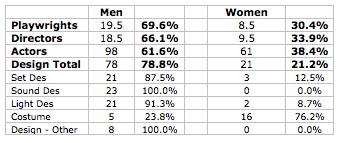
A few weeks ago I wrote an essay about a few reviews for local company The PAC’s production of Timon of Athens that I thought were heinously misogynist. Right after I finished, still vibrating from the anger that I felt from writing it, I went into a brainstorming session with a collaborator of mine that I really respect. And because the essay and the larger issues that it alluded to were so present on my mind we ended up getting into a two hour discussion about opportunity and success and how that works in regards to dealing with making theater more equal for “othered” communities. And I’ve been trying in the days since that conversation to put into words something that I’m wondering about.
Let me diverge for just a moment and share something: I have my mother’s last name.
And I’d like to be clear that I knew my dad all through growing up and he was part of my life from the start of it. My sister and I received my mother’s last name not because my dad was not in the picture. No, my parents were married during both my and my sister’s birth.
And yet, I have my mother’s last name.
It was a bet. The name thing. Or rather, a decision left to chance. As I’ve heard the story told my parents agreed that if the first born of my parent’s union was a boy, it would have my dad’s family name Gude. If a girl, we’d be Mackeys. And then, for consistency, all kids after that would get the same no matter what the gender.
I, as the eldest, came into this world a girl, and as such, the Mackey line continues.
It was a point of extreme confusion to many many people when I was growing up. People from school called my father Mr. Mackey all the time. My dad, for his part, seemed to take it in relative stride. (Though he did, I noticed, seem to find it a bit more annoying than the mother of my good friend whose name was different than her husband and daughter.) But on my part, it took me a long time to get why people were so incredibly surprised by this. I was in my teens before I understood how incredibly rare such a thing was.
I do now.
Something else: I’m in the midst of reading the book Lean In by Sheryl Sandberg that’s been getting so much press lately – so many people had mentioned it to me that I almost felt obligated. And there is a lot in there that feels like a larger parallel to some of the issues that I’ve discussed about gender parity in theater. Especially a 2003 study in the book (cited all over the internet if you want to read the full thing) from two Columbia Business School and NYU professors that showed students (both male and female) who rated impressions of a successful venture capitalist were less likely to view the person as likeable when that person was a woman. In both cases the person was respected but while success and likeability were positively correlated for men the opposite was true for women.
Instinctively, as women succeed we tend to like them less. As an emerging leader in the field, I feel this deeply in theater. The study indicates that there there’s an unspoken but present and persistent hurdle towards success for women. And while it’s not insurmountable but it’s likely always there. Which means that even if people are smart, open minded, even if they believe in equality. Even in a “liberal” art form we can have let biases infuse our choices. From within and without we have this extra bit in the way.
As my friend and I discussed my PAC review essay we both brought up Malcolm Gladwell’s book Outliers and the study in it that showed professional hockey players in Canada are nearly all born in the first four months of the year. Researchers surmise this is because the cut off date for participation falls at the end of the year and so children born in early months are a small bit larger due to an extra few months of growth, a huge advantage at a young age, and receive attention and positive reinforcement for their successes. Their little bit of totally random age advantage is seen as a greater degree of talent even though it’s really just being born in the right month.
That study makes me depressed because it showed how small advantages seem to make concrete differences in the long run.
There’s another study we talked about, one about societal messages that influence us. This test, the IAT, measures instinctual associations between words. Here’s the site where you can take a number of such tests.
I took the “Gender – Career” test which “often reveals a relative link between family and females and between career and males.” In other words, how strongly we correlate a particular gender with working and another with staying home.
I understood the implications of the test and how I felt (that I didn’t want to associate male gender with work more highly than female gender). I knew what the test was testing, how it worked and tried to prove that I could outsmart it. Here’s the result I got:
Your data suggest a STRONG association of Male with Career and Female with Family compared to Female with Career and Male with Family.
And on that same page with the result was this sentence:
“Evidence suggests that implicit associations form based on everyday experiences, so the daily exposure to differences in gender roles in one’s own family might be influential on how these associations form in memory – whether we consciously agree with them or not.”
That’s tough.
Consciously, clearly, I do not agree with that statement. A major part of my identity is wrapped up in the idea that I am no less capable as a theater professional, a professional of any kind, because I am a woman. I think that my success in the directing field, one that is stereotypically male, is in large part because of that belief. That success is due to the fact that I believe myself to every bit as creative, intelligent and capable as a male director.
And yet I, Adrienne – I have my mother’s last name – Mackey seem to have instincts to the contrary. Even I, Adrienne – I run my own company – Mackey seem to have that hurdle there to have to jump over. Even I, Adrienne – I’ve made a giant stink on the internet about the equality in this work field women deserve – Mackey seem to have a little voice in my head somewhere deep down that tells me otherwise.
So I stopped for a second and thought. I made myself picture in my head women in power suits sitting behind fancy wood desks typing on computers. I imagined the names Michelle and Julia and Anne on the marquees of theaters and in programs. I imagined women battling over budgets and running production meetings. And then I pictured a bunch of guys carrying babies and hugging at weddings. I imagined them sitting in houses and doing dishes. I did that for two minutes straight.
And then I thought about my name. I thought about what a small but potent message it provided me with as I grew up. And sitting here just a few days after mother’s day, I let myself be struck by what a powerful gift that last name was.
I made myself think about the fact that my name tells me that my mother’s lineage, work, identity and being was just as important to carry into the future as my father’s.
And I took the test again.
Your data suggest a SLIGHT association of Male with Career and Female with Family compared to Female with Career and Male with Family.
Look, this is obviously an unscientific measure. But we’re finally getting to the point here. This is the thing I’ve been wondering about: Let’s roughly assume that most people don’t really want the huge gender inequity we see in the arts. But for whatever cultural reason it is instinctually in us to make certain biased choices that may make real tangible differences in opportunity for people. They may not want to, but they might still do it.
If this is true, what do we do about it?
I think we have to take time out to prime ourselves – give our brains a small kick towards a particular thought or idea – away from the negative directions that they’ll tend to go.
John Bargh is a researcher who has come up with a series of experiments in priming I read about in a different Gladwell book. One of his experiments sprinkled a disproportionate number of words that people associated with being old into a random word test and found people walked slower down a hall immediately afterwards. In another words that intimated demureness and quiet caused people to wait longer before interrupting someone.
In a different Dutch study (also pulled from Gladwell’s blink) people who thought of themselves as professors got 13% more questions right in a game of Trivial Pursuit than those who thought of themselves as rowdy sports fans. And students who are reminded of their minority race immediately before taking the GRE drop their scores by up to half.
So back to the conversation about the essay:
One question we debated was what you do to combat that that negative stereotype. We argued about how to deal with the difference in opportunities. Do you take an affirmative action type route? What do you do if you have an A+ play from a man and a B+ play from a woman? Which one do you put on? Is it fair to deny the “better” work? What if you hadn’t known the gender of the playwright at all?
And as I’ve thought more about it, I think that perhaps the question should just be framed differently. I think instead, we need to really ask ourselves if those grades are fair. If that kind of situation ever actually arises. Given the subjectivity of art making, can we really always trust those judgments about absolute “quality” in the first place? Perhaps, rather than assuming there will be B+ plays from women, we should take a step back and re-prime our expectations. I think we need to say that we’re not going to argue for or against the merits of doing lower quality work by women for the betterment of the theater medium because the choice isn’t that kind of either or. We need to believe we can do good work by men and and we can do good work by women. We need to start assuming that both are out there.
There’s a lot of negativity that flies around about this, on both sides. I’m not saying we never need a little angry shove sometimes to motivate – writing letters, demanding equal space, letting people know you see the gender parity – but perhaps we can also take concerted time and effort in our interactions to encourage another view.
What if every literary manager had to take a minute before reading a female playwright’s script to stop and read a short list of amazing plays by women authors?
What if every time artistic staff met to discuss a season they read a few short positive press quotes about the female driven shows that their company has produced?
What if every time a director had a role in which gender really didn’t matter and could be cross-cast they thought about three different women in the role?
What if every grant panel took a second to remind themselves that women’s work is equally important to represent?
Could that tiny thing make a huge difference?
Not because women’s work needs help. Because everyone (whether we want to or not) has a lifetime of subtle cultural pushes away from our ability to see women’s work as equal. And these little pushes back to the center might help make things fair again.
Artistic leaders, creators, and supporters are you daring enough to find out?
I hope so.
– A




 swimpony.org