getting it done

What’s old is new again (?)

The 2006 Philadelphia Live Arts Festival and Philly Fringe

Coming home…

Sometimes a piece of art in early stages is filled with a certain kind of special newness.

It’s a fluttering, butterfly feeling, a buoyancy that fills me with brilliance and space. It feels like being full of something delightfully lemony and bright. It feels like opening a door a crack and peaking into a possible future full of light.

It can be with a person – an actor or co-creator. But it just as easily could be a bit of writing, a song, an inspiration, the kind of process you’ve just discovered.

It’s a creative crush, this affinity and affection. I think of this thing, the who or what I’m falling for, and it starts to feel like a piece of me. Or rather, it feels like I am beginning to know it, and I like it, and I want to be even more a part of it. It feels like it could become a piece of me, lifting me up and making me better. I want to mesh these two separate things – the work and myself – into a single whole.

In the wanting to be filled up with this deliciousness I treat my memories of this bit of text written or character choice. I do it over and over. I listen to the same snippet of music or replay in my mind this or that scenic choice. I take it out when I’m blocked like a secret piece of candy, mining this tiny taste of sweet for sustenance. And through this replaying of little moments, obsessing and relishing in the details like a gushy teenager, I think of where this thing might go in the future. I think about our potential happily ever after.

It’s sort of like falling in love. Falling in love the way one would with a potential lover, but instead with my work, with my own capacity for creation.

And while it does feel that way, like love, I think that love is not exactly the right way to describe this feeling. I think it’s closer to desire, infatuation. Closer because the feeling gives a glimpse at something perfect and mysterious without letting one in on all the arduousness of specificity, of actually having to do the work of completing the promised outcome.

Perhaps in art as in life, infatuation and love feel confusingly similar, but are not quite the same.

Desire, need, infatuation are emotions based in hunger and lack. They are shadows, mere glimpses at potential. And I think it is only possible in absence of the whole where one can maintain an imagined perfection.

As I once heard someone say, there are two kinds of art works – perfect ones and finished ones.

Love is something different. It grows out of actually weathering through the test of stress and time. It is a gathering. Of knowledge. Of familiarity. Of fault. Of history. It is precise in a way that infatuation cannot be, because it is built on actual details and shared experience.

I think that our artistic work is like a romantic partner. It is a relationship we have to manage over time. And I think that in our art, as in our personal lives, we need to define what kind of partnership we believe in having with our companion. Do we seek a turbulent but intense bond that is unknowable and always elusive? Or do we work our way to a cozy if duller comfort?

Perhaps this is where the myth of the wild art of youth comes from. The work of our 20’s is like the kind of boyfriends one had right out of college. They are a bit messy and dangerous. They hurt you and teach you where you need to keep yourself protected. But they mean so very very much. They have moments that seems so impossibly intense and lovely that even if they turn out terribly, you love them for their failures.

Are these early plays the ones we settle down with? Or do we instead slowly grow into our art? As we grow we begin to revisit things we initially passed over because they weren’t shiny enough. We tackle subjects and modes of working that we couldn’t quite grasp the depth of in the first go round. And we stop trying so hard to impress and begin to steep ourselves in tenderness and support, in a making that is deeper and perhaps more lasting…

Is one better? I don’t know. But I’ve been thinking about this a lot lately.

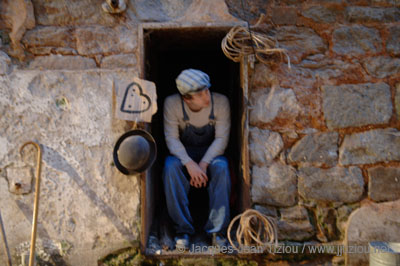
The first full piece I premiered in Philadelphia was a show I created called The Ballad of Joe Hill. I made that work in 2006. And this fall I will be presenting it again after seven years.

This seems a little impossible – seven years for a work to come to fruition. That a thing I started during a time in my life that was intensely uncertain will find a new form when so much of who I am and what I do is now known. This piece, which is one that examines what a life is worth and how we make it so, is one that began a relationship with so many of the people I now think of as home. And it is one that I have often looked back fondly on for the sheer creative ineptitude and blind luck and intuitive spirit that guided its creation. It was a piece born out of those infatuated seeds. It was a piece I wept and worried and laughed over at every step of its creation. And in watching it again, in thinking about what was there that first go round, I see so many things that still lift me up with light. And I wonder what it will mean to go back there.

Can I find love within this thing borne of infatuation?

Or perhaps I’m simply framing this all wrong.

If desire is steeped in anonymity and vulnerability and love in recognition and protection, perhaps my question ought not to be whether one is better than the other. Perhaps I do not need to assume that the thing must be one or the other.

Maybe my question should be whether they must be mutually exclusive.

A

Owning It

There’s a great quote that starts one of my favorite books about the artistic process – Art and Fear by David Bayles and Ted Orland – that goes like this:

Writing is easy: all you do is sit staring at a blank sheet of paper until the drops of blood form on your forehead.

– Gene Fowler

The book is a pretty straightforward and unsentimental view about art making. It talks about how much of your output will be ignored (“Virtually all artists spend some of their time – and some artists spend virtually all their time – producing work that no one much cares about”) and the various ways we set ourselves up for self-sabotage. What this book also says is that the only way to get better at making work is to make a lot of work. As they say, much of your output is there simply to “teach you how to make the small fraction of your artwork that soars.”

I like the idea that when I make crap, it’s not just crap, but crap that builds a bridge towards something else that is not crap. Then at least the crap is useful. And I need that crap to feel useful. Why?

Because I live, work and create in a shame-based economy.

It might not seem like it from the outside, but if I’m really being truthful, most of what I do is to avoid the pain of looking like an idiot. That awesome rehearsal plan didn’t just spring happily from my mind. It took the spectral terror of being left with nothing substantive to say in front of the room to make it come into focus.

People have asked me why this writing project was something I wanted to make public. I might, if I’m being cagey, tell you that I sensed a lot of people were feeling the same way I was.

True. But not actually the truth.

I do appreciate the people who’ve responded to what I’ve written. And I love hearing from you all that these struggles are shared. But the real reason I am writing publically is to shame myself into getting my ass in gear to put words on (virtual) paper on a regular basis.

I do things like this when I know I need a kick in the ass. When I decided I had to leave my day job at NBOME, I wrote a post-it that I affixed to my computer with the date. I gave myself one year from that post it to get out of that job. And then I told everyone I knew about it.

Why? Because, like I said, I live work and create in a shame-based economy.  I knew if I kept telling people about the post-it, people would remember to ask me about it. And when those people asked me about, that feeling that I might not get it together to find some other, more sanity inducing, way to make money would surface. I did get nervous that I would disappoint, and I figured out a way to make life happen without the work that was making me miserable.  And 4 months before the post-it deadline I left.

If I know that someone will think less of me, if I think that someone will perceive me as failing, I work harder. It’s why I love structure and clear evaluative systems. It’s easy to know if you’re staying ahead of the curve if it’s clear what wrong looks like. I spent a lot of my education in high shame-potential situations. I committed to more than seemed possible. I tried things that I saw other people do a lot better than I did and then held myself to their standards. Once in a while I felt a little insane. I beat myself up about stuff a lot. I was also really productive and found myself doing things I never knew I was capable of.

You might say that this is unhealthy. You might be right. Heck for a really long time I felt a lot of shame about feeling so much shame.  That’s how deep it goes.

So for a period of time after school I worked really hard to remove all the shame inducing motivators and gave myself huge swaths of freedom for my art to wander through. I stopped comparing myself to people who had more advantage or resource. I kept things a little closer to the chest so that stuff couldn’t be critiqued until I decided it was ready. I wanted to give my art room to blossom on it’s own, without that fear of failure looming over me.

And while I was in the middle of doing that I noticed something:

I wasn’t making or doing anything I cared about.

I had tried to force myself into a place where I acted as if I didn’t need to care or listen to that niggling feeling in the pit of my stomach when I didn’t do anything creative for a few days. I had convinced myself that the ambition and failure terror weren’t linked. And I was semi-successful for a little while. Until I looked at what a life without one of my biggest motivators actually left me. And that was something I wasn’t really all that excited about.

And then I started to feel bad about that.

Oh, old friends embarrassment and remorse, you’re back! How I missed you so.

I’ve come to terms with regret and shame as ways that I learn from my past mistakes. Just as the impulse to jump too deep into the pleasure pool can get one’s life off track, so similarly can overwhelming feelings of mortification cause one to block their creative selves. But no one sane advocates for the removal of all of life’s pleasures. So maybe we can leave a little room for the negative emotions, so long as they help us get where we’re going.

Thinking about this I recall a thing that I always tell my students when they first start working on their voice. I say that there is no such thing as a “bad” voice, only voices that do what you need them to, and voices that don’t. The voices they have were developed from a style and set of communication patterns that helped them, at some point, achieve something.

High pitched and squeaky? Maybe it helps you to sound small and cute.

Low and monotone? Perhaps you need to show the people around you that you have emotional control.

The point, as I tell them, is that these patterns emerge when doing these things a lot offers some kind of reward. It’s efficient. And there’s nothing wrong with a sound if it’s doing what you need it to. The pattern only becomes a problem, only gets called a bad habit, when you decide you want something and the voice you have gets in the way of doing that.  When the natural voice you have developed is something you can no longer control the way you want to.  Flexibility is the key.

Whether it works for you is what actually matters.

“Ugly” voices aren’t bad if they’re useful. I think “ugly” feelings can be viewed the same way. Some of my best work has come to me when I have felt my worst. Which is different than saying that I need to feel at my worst to get anything done. For as long as I can remember, shame has been a strong motivator. Sometimes towards good things and sometimes not.

So the question isn’t, “Can I remove shame from my life entirely?” because from what I’ve lived so far, the answer will be no. Instead:

How do I use and shape the natural impulses I can’t always control towards a healthy and productive life?

There’s another saying in the Art and Fear book that I really love:

Artists don’t get down to work until the pain of working is exceeded by the pain of not working.

– Stephen DeStaebler

I write this blog knowing that other eyes will see it.

Because I want to be culpable.

Because I want to be exposed.

Because I want to increase the pain of not working.

It’s already worked, clearly, because I’m still here.

A