What CAN we do better

Remember this image:

weave string
Is this string the start of a revolution?

Ok. So, picking up from yesterday, let’s say we put a 10 year ban on any play that has a living room, a relationship and ignores the audience. If Naturalism Prohibition begins tomorrow, how do we proceed?

I would propose the first thing we need to get into our heads is that theater, live performance of any kind, will never be able to compete with recorded media in terms of the scale of its reach. PSY can perform for an astounding 80,000 people in Korea and pretty much max the size that live performance can go, and still be equaled in terms of shear numbers of one weekend of a small indie movie rolling out in most major cities or a video game release that can be downloaded immediately online by just about anyone with an internet connection.

We don’t have to view this as a bad thing IF we define our objectives beyond simple numbers of butts in seats (which, by the way, doesn’t have to be the only way evaluate ourselves to the outside world: check out these smart people or look up #newbeans on twitter for some thoughts on that). Instead let us look at the TYPE and DEPTH of experience, a place I would post we might possibly have a chance to not only compete but excel.

What are the super powers of live performance? Here’s a list I come up with:

It doesn’t have to the same every time: Why do people go to concerts when the recording will always have the technological advantage? Because there is something amazing about hearing that thing you know so well anew, with subtle changes and differences that happen that singular time you happen to be there. Ironically, just about everything we do in rehearsal puts an emphasis on just the opposite – on creating a machine that will run the same.

The performers can respond to the viewer: Can we think about this in a wider context than simply “they laugh so we wait a bit longer for the next line”? Is it possible to really give them a role that matters and genuinely requires performers to take them in? Perhaps in such a way that without establishing that connection the performance doesn’t exist? I think so. But I think it might mean really changing what we think a “play” can be.

The audience can interact with the performers/space/experience: Movies don’t do this. But (almost always) neither do we.  This is a huge asset we’re ignoring. Why do people like theme parks and video games? Why the huge success of Sleep No More in NYC? Because there are audiences that like the fact that they can relate to the actors, walk around the world they enter, and in some cases even shape the narrative that occurs. Let’s find those that are craving a chance to be a part of our art beyond just sitting down and passively watching.

You can use ALL your senses: This is another game that we will win over almost all other types of art. You can FEED people, you can make them TOUCH things, you can evoke SMELLS. You can even get them to lie down and change their sense of gravity in relation to their bodies. This is not a trivial advantage. No movie, no matter how good, can ever as realistically convey the taste of a dish as well as actual food.

I’d love to hear additions to this list. I’m sure there are more, and as I think of them, I’ll add them above.

So the question for theater, in my mind, is rather than trying to be less-effective movies, how do we create THIS kind of experience in as rich and rewarding a way as possible? Perhaps in doing that, we might feel less like Gollum clutching the precious (which for the record is mostly how I feel about my audiences – the only thing maintaining my existence and something I can barely hold onto). Can we instead work as a medium towards making these aspects the most important parts of the experience? Can we take that ingenuity and creativity and build new approaches that maximize what we are uniquely suited for?

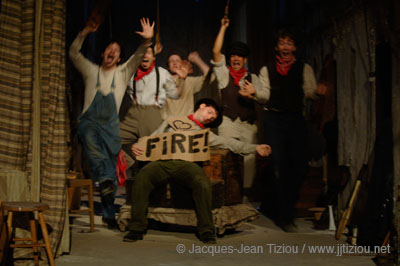
Let me invoke that image again.

weave string

I like this picture a lot.

It’s from a show I created in 2010 called SURVIVE! It isn’t the flashiest photo from that show. Not by a long shot. It’s not the one I use in work samples. But I think it illustrates what I should be doing.

This photo is a moment between performer and audience that is totally spontaneous, unique, and above all live. Each person in it has a totally individual perspective of the experience that will be different from every other time this scene is performed. Each person has a tactile relationship to the object being shown as well as to each other. Each person is necessary from the story to continue and plays a part in what’s happening, regardless of whether they are actor or audience. Each person has to constantly re-negotiate the contract of participation to continue forward.

And because of that, this tiny moment that might be occur between just three people does something that no movie can do.

Theater can do THIS moment better.

– A

PS – Thanks to JJ Tiziou for taking that amazing picture. http://www.jjtiziou.net

Maybe we’re just doing it wrong

Day one: I try the best I can to try and articulate a huge looming dark cloud of a feeling.

Day two… is a little harder. So I’ll start basic, with a mission statement. This is, in theory, where the work begins, right?

Swim Pony is committed to the creation of unique live performances that are joyful and defy tradition in order to bring contemporary audiences beyond their experiences of the every-day.

It’s not perfect. It sounds a little frou-frou fancy, right? I don’t know that I always feel like the things I make really do connect beyond the fact that they happen to be things I find interesting one year to the next. I also wonder sometimes if the need to define and explain causes us to create boundaries on our work that ultimately inhibit it. But that’s another essay, so for now, let’s proceed.

When I re-read that statement, these are the parts that stick out as mattering the most:

Swim Pony is committed to the creation of unique live performances that are joyful and defy tradition in order to bring contemporary audiences beyond their experiences of the every-day.

If there’s a reason I choose THEATER over some other way of expressing, it’s that I want it to matter that it’s LIVE and that it’s that goes BEYOND every day life.  Without the first it could be recorded and without the second I could just experience it directly.

This gets me to my despair with naturalism.

What do I mean with that term? Well, (and I’m going to have to generalize here) I’m mostly talking about plays that:

–       Use a fourth wall to pretend like the audience isn’t there

–       Focus mostly on interpersonal dysfunctional of relationships, families or work environments (aka people talking to other people about the things they do everyday)

–       Tend to be set in a realistic, often domestic, space like a house, workplace or social setting

I gave a talk once about devised theater and to prove a point, googled something like “best new broadway drama” or something like that (I don’t remember the exact search so don’t get all fact-checky on me with this) and this is the image that popped up:

play play

People talking to other people in a domestic setting behind a fourth wall

You have all seen this play.

It had a beige couch and a couple talking about how upset they were. Oh, and everyone is white and not too terribly concerned about money. They just have a really shitty relationship. It centered on two people who were movie stars. And The New York Times review probably called it “a searing drama.”

I’m exaggerating. But you know what I mean.

Searing as these performers might be, is there anything about this experience that isn’t better served as a movie? I mean that totally sincerely. If I turned this into a movie I could much more easily make sweeping visual transitions between realistic spaces, get much closer up and intimate with the performer’s faces (especially if I’m comparing to a massive broadway house), and create a far more “realistic” setting. I’d even go so far as to say that the world I’m asking you to buy into (by dimming the lights, by telling you to be quiet) is a lot easier to jump onto when I know that it’s going to keep going whether or not my cell phone accidentally goes off. And to boot I can get it out to a hugely larger number of people.

This shortcoming is not the fault of a single actor or director or set designer.  This is a shortcoming of the entire community that engages in the medium of theater. Someone, please convince me otherwise. Because some days I feel crazy, like we’ve all just decided to ignore what seems obvious. And by engaging that denial, we’re actually ignoring the things that theater DOES do that movies can’t.

The pretending the audience isn’t there. I need some help! Please, make it okay again. Something has flipped in my brain and I can’t go back. It feels like in a world that allows so many opportunities for us to disengage and isolate through technology, what a waste, what an incredible missed opportunity to create community or ritual or just connection by including them. By seeing them. By taking advantage of the moment to say, we are all here, together, and we are all going to pay attention to one thing, because how often does that happen? And you are NECESSARY for that to happen.  But I mostly feel like I could be there or not. Or that if I don’t laugh or audibly sigh I’m the problem. And the effort it takes for me not to notice the guy next to me coughing is not worth it because almost always I’d rather just watch the conflict of him and his cough instead of what’s on the stage.

Why is it always the moment when the play goes OFF script that the audience sits up and takes notice. We know this phenomenon and share these stories. When the lights went out and the play finished by candlelight. When the comedian cracks up and just can’t bring it back. When the set falls down. Two weekends ago I saw a show (out of town) where a guy did a spit take and hit a woman in the audience. BEST MOMENT OF THE PLAY. Is it possible that immediacy of moment, that moment where we are connected in surprise or discovery, that moment of being united together in how to navigate this journey can BE the whole thing? I still find it in rehearsal, but so rarely in performance. And for the record, I hate audience participation. But it’s mostly because I feel like that role has been predefined and if it goes poorly, I have failed the show, not the other way around.

I know, there are people who still prefer the old way to receive a story. And of course I have seen amazing naturalism performances. And of course the people who do this well are incredible talents. But there are fewer and fewer people who want this kind of experience and they are increasingly rarified a niche of the population. Are the theaters that do these plays like people who staunchly insist they only need a landline phone? There’s nothing morally wrong about that choice, but it’s going to mean you are working against a giant cultural tide that everyone else is riding. And slowly, are you making yourself obsolete to a large portion of people? Try and tell me that theater is as relevant a medium as it was 100 years ago before recorded film existed. I just don’t buy it.

I think I’m at the limit for today.

Tomorrow: looking at what theater superpowers I think it might we might have forgotten.

A

15,000 Words

Are we all playing the harpsichord?

Are we all playing the harpsichord?

Why make theater?

I’ll be honest – I have doubts. A lot of my friends have doubts. There seems to be something in the air lately. A worry, a question, about what the hell we all are doing.

Sidebar: A few months back I was rehearsing The Giant Squid at Swarthmore College and ran into my former thesis advisor. For those unaware, I completed a degree in chemistry and I really liked the stuff. And though I ended up pursuing theater, I loved hard science. It had rules but still allowed for experimentation. I liked understanding how the world works at the tiniest of levels. On my shelf I still have the thesis on chiral binding properties of copper-porphyrin aggregates and ct-DNA to remind myself the word laboratory didn’t always just refer to experimental theater but that I actually once worked in, you know, a laboratory.

So back to Squid, it was a super strange colliding of worlds to introduce the man who taught me the finer points of circular dichroism spectroscopy to the actor with whom I’d just discussed the best angle to allow a giant tentacle to wrap around her 14 months pregnant belly pad.

He asked why I had returned to the college. I explained I was putting on a show for the student body.

“Oh yes! And is that what you are doing these days?”

And I told him that, yes, in fact I had a small company in Philadelphia that made original works of theater.

“Fantastic! Why, it’s everything you always wanted Adrienne. Congratulations.”

When I tell this story in person I deliver that last sentence as a punch line. I exaggerate the “Fantastic!” and pour on feigned gushy-ness for “everything you always wanted.” As if it’s funny, ridiculous even, to imagine that everything I always wanted was to run a theater company. And when I realized I was doing that, I also realized that there are lots of times when I talk about my work in this kind of diminishing way. That even though I spend so many of my waking hours advocating to others about what I do, I still find myself angry at my art form a lot of the time. And it’s a little scary, if I’m really honest about it, that as a person who does exactly that for a living, I ought be the last person who would want to make running a theater company sound like a laughable pursuit.

And yet…

As young creators, I think we spend a lot of time taking in information without really questioning: best practices of creating, tips about living a life filled with art-making, and information about systems that support the work we create. No one would deny that a life in the arts can at times be incredibly punishing. And while I deeply believe in the intrinsic importance of artistic experience as a concept, if I’m to keep at this particular mode of it for another 30 years, I need to know it’s worth doing this art, in this way, at this time. Because those same skills that I’ve honed to question my work to make it my best also keep me up at night asking: “Why do I make theater?” “Why do it this way?” “Why is it useful?” “Is the result worth the effort?” and “Do I even like it?”

I worry sometimes that I’m playing the harpsichord. There’s nothing bad or wrong about that instrument. It’s just not terribly useful or relevant to a vast majority of people in the world. So in the last few months I’ve been trying to pick that instinct apart. Figure out whether it’s conventions that I think the form has gotten stuck in, its place in a changing and increasingly technological society, the non-profit system that surrounds it, the harsh under-capitalization it suffers from, all of these, none of these… And in trying to figure out how to reconcile myself, I thought it might be interesting to share these thoughts and elicit responses from other smart people thinking about the same kinds of things. So for the next month, I’m going to write at least 500 words every day for 30 days to see if I can define what I really think about theater and how I make it. And after 15,000 words of my own (and hopefully a bunch from other people in response) it might be possible to get to the parts of live performance that are amazing and transformative so that I can cut out the other crap and really concentrate on making what matters.

Either that or make a quick pivot back to research chemistry so I can stop playing the harpsichord before it’s too late. (#stopplayingtheharpsichord)

See you on the other side

– Adrienne

Swim Pony’s Adrienne Mackey featured in GPCA Portfolio

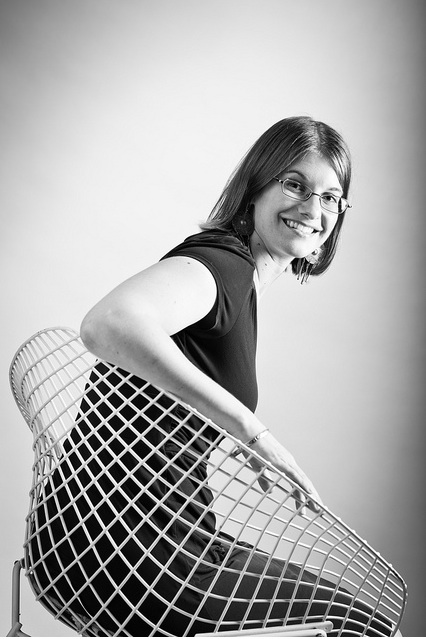
Swim Pony’s Artistic Director Adrienne Mackey was featured as part of the Greater Philadelphia Cultural Alliance Portfolio – one of the most respected data and statistical analyses on the arts sector in the country. She was chosen as one of just fourteen artistic heads of Cultural Alliance member organizations.

Check out her snazzy photo:

Image

Read the issue (and check out page 53 for Adrienne):

http://issuu.com/philaculture/docs/2011-portfolio


And read more about Portfolio here:

http://www.philaculture.org/research/2011-portfolio