How do I do this?
The Revolution will be Fiscally Sponsored
Sometimes you don’t notice massive tectonic shifts around you. Sometimes they’re so slow and gradual it’s only in retrospect you see that neon and slap bracelets for example are no longer the height of fashion.
Other times, you can. You can feel the slow but steady momentum of a major change happening and once you become aware of it, it’s hard not to notice how it is all around you. Once you begin to see it, it’s hard to do things that feel like they’re working against the advancing tide.
Ten years ago, if you were an artist arriving on the Philadelphia scene and you wanted to create structure to make your work, you formed a non-profit.
My guess is that ten years from now, no one under the age of 40 will imagine taking that step.
This is the wave that I see rolling over the artistic landscape. Across the country young and emerging artists look at the standard non-profit with dread. We see dwindling funds going to a fewer and fewer number of large entities. We see our own artistic mentors unhappy at having to spend so much of their time running an organization that doesn’t allow them time to make their own work. We see ourselves needing to learn bookkeeping, taxes, scheduling, payroll, and marketing if we are to follow the traditional “in house” model.
We see massive non-profits that get a massive portion of the funding out there and see them as the place that many in cultural landscape look to. We see mid level ones that receive a middling portion of the pie and demanding a mid-sized level of attention. And we see small non-profits that get small chunks of change and equivalently modest voices in the larger picture.
And then we think, “There just isn’t room here for any more organizations.” In cities like Philly, ones that have had a resurgence of art and culture in the decades just before you arrived on the scene, there is an especially conflicting feeling – one in which you love the arts scene for the people that have come before you, nay may even be in the city because of those fore-runners, but are simultaneously fearful that you will ever find foothold exactly because of the people that have had success before you got there.
Is the answer to simply find the next city on it’s way up? Duke it out as a non-profit somewhere that hasn’t yet peaked? (Baltimore, I’m looking at you…)
I don’t think so.
A few months ago I read an article: THIS ONE
The message in it struck a chord with me. For years I’ve been toying with whether or not to take my work from a solo produced project to project endeavor to a non-profit. A lot of people encouraged me to just find the board, get the paperwork filed and take the plunge. For years I kept saying “At some point. But not now.”
Why?
For a long time, I couldn’t really articulate the fear. And in practice, I saw a few friends take the plunge and really have little change in “business as usual.” And yet, I just couldn’t see where Swim Pony would fit as another non-profit in 10 or 20 years. As much as I admire companies like Exile or the Lantern, I didn’t see space in which my version of a non-profit could grow. Plus, I didn’t want my own office with my own copier, my own space, a full four-show season every year. At the end of the day I went into the arts to be in rehearsals not to worry about filling the toner cartridge. And I was even more nervous about the idea of handing control to a board of directors. And I worried that a non-profit would put pressure for every show to be a success, or the same style, etc etc etc. And as I started talking about this to others, it seemed like a LOT of people were in the same boat.
I think there was a time when the regional theater model was a necessary step in the expanding of the arts across the country.
And I think that time is over.
I think the creators that will survive the next few decades are the ones that have already start to accept that the model that they studied and saw as they grew into their artistic homes is one that will not work for them. Just as the idea of what a “job” is has changed radically, so much new artists rethink structuring the administrative side of their art practices.
This is the new revolution of artist as entrepreneur. And that revolution is going to be fiscally sponsored.
Fiscal sponsorship refers to the practice of non-profit organizations offering their legal and tax-exempt status to groups engaged in activities related to the organization’s missions. It typically involves a fee-based contractual arrangement between a project and an established non-profit.
If you don’t know about it now, you will soon. And I think the reason for this is that fiscal sponsorship is the first swing of the pendulum back towards allowing artists to hand off the administrative work they haven’t trained for to those that did and do want to do. Fiscal sponsorship is about streamlining. It’s not about building up, it’s about connecting out: finding ways to think of oneself not as an island needing to generate all of its resources but as a chain of interconnected aspects of a larger whole.
There was a time when most people thought of fiscal sponsorship as a temporary state that a new organization entered into on its way to “full” non-profit status. But as a 5 year fiscal sponsee myself, I can tell you, I think that for many, this will become a permanent way of life, a way to still take part in funding structures that haven’t yet caught up to the new way that art is being made, while refusing to join a practice that undercuts our ability to make it.
Because in reality, why would an artist run a theater space or marketing firm in house? The maintenance of a building or running of a PR campaign is actually a rather different thing entirely than structuring one’s next creative project. And simpler still: do I need a copy machine all to myself when I could split the cost across three or four other companies without any inconvenience? We can mourn the loss of sheer number of dollars in this brave new world of post housing bubble collapse. We might at first glance blame it for the fact that we don’t get to each build our own tiny kingdoms since there’s just not enough money to go around. But I think that what’s happening now was always inevitable. I think the shortage of money has forced into sharp contrast a tidal wave that had been steadily approaching for a while.
Some days I thank the great beyond for my chemistry degree. I thank for it because it reminds me that I’m smart, and on some nasty unconscious level, I think a lot of artists really believe they are incapable and unintelligent. That they can’t do the books and the taxes and the admin AND the art because they’re stupid.
First of all, no one can do all those things. Especially not without the training. Go ask your accountant to choreograph a dance and see how well he or she does.
Second, just because I can do those things, doesn’t mean I should or that I want to.
And I don’t. I went into the arts to direct and to create plays. And there are plenty of sacrifices – a certain level of money and status, to name two – that I’m ok to offer up because I love what I do. But not doing the art is not one of them. We need to learn to share our audiences, spaces, and stuff so we can be smarter about producing: by pooling resources and delegating the jobs that we don’t need to do.
And then maybe we can actually get back to making a greater portion of our time go to making our art.
So as one of those “emerging” artists on the horizon, I’d like to help foster the conversation about how we creators can be as innovative in the structures that support our work as we are in the work itself.
This is the first thought in what will likely be a series of many.
– A
PS – A quick shout out to the Wyncote Foundation, who I was able to receive funding from for this research thanks to fiscal sponsorship
Also so first resources for folks new to the topic:
1) A link to a talk I gave with another small company called “Don’t Start A Non-profit.” This is part 1 and you can find the second and third parts (which are mostly discussion with the large group) on Swim Pony’s Youtube channel.
2) Here’s a link to the power point from that talk: http://www.slideshare.net/SwimPonyPA/dont-start-a-nonprofit
3) A couple of “Fiscal Sponsors” (non-profit umbrellas) we talked about that I recommend:
– http://www.fracturedatlas.org/ (I currently use these guys)
– http://www.nyfa.org/ (Check out their website for lots of cool info like grant databases, etc)
– http://www.thefield.org/ (Know less about them but have heard good things)
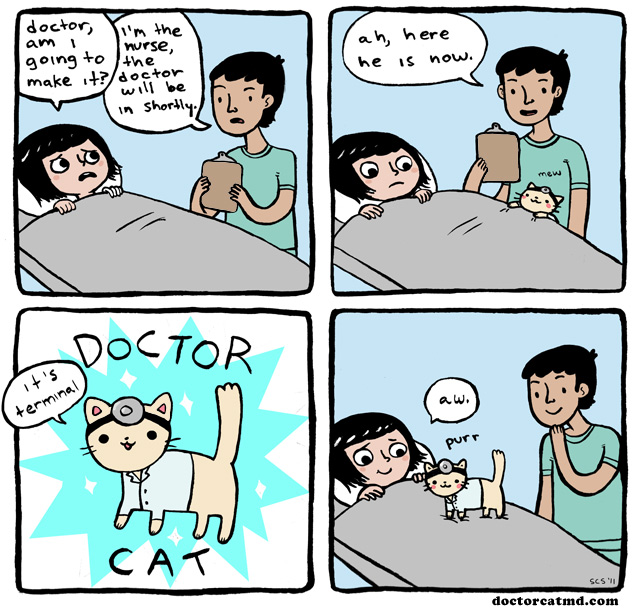
Cat Doctor
In order to pay my mortgage I currently still have to have jobs outside the creative sector. And the one that I work most often is for U Penn School Medicine’s Standardized Patient Program.
A standardized patient or SP is a person who portrays an illness or medical situation in order to allow medical students to practice their skills. So that for example, the first time someone has to give a life threatening diagnosis, it can be to an actor and not a real person. And the mega bonus of this system is that the “patient” can then come out of character and have a substantive discussion about how what just happened affected them. So that the medical professional to be can get some insight into the patient perspective. And in doing this they can start to see cause and effect – when you do this particular behavior it makes me feel a certain way, has this particular result.
It’s kind of satisfyingly scientific actually. It removes the judgment and anger from critiquing interpersonal skills and reduces it down to inputs and outcomes. Try this particular tactic to gaining my trust? I can tell you what the emotional output is in this scenario.
I like this job in part because it has taught me to listen. It has taught me the value of the subjective experience. It has taught me that intention is often not a useful tool towards substantive change. I can want to make you feel better but if my choice of words in expressing that is offensive or off-putting then my intention is a moot point.
When I train the performers I use metaphors of theater a lot. And when I get back into the rehearsal room, I have started using the tools of this SP trade in return. The language of linking action and behavior to some relatively objective measure of emotional outcome is really really useful.
Lately though, I’ve been noticing this trend in my day job that is puzzling. And it’s one that I’ve been subsequently trying to untangle in my theatrical work.
I’ll call this thing “Cat Doctor.”
Fact: I love cats. Love them. Seriously, if that toxoplasmosis parasite that makes you love cats is real, I have it. If there is a cat in a window, I will stop and talk to it. I literally want to smash the small furry bodies into my face.
And that’s weird. And very unique to me.
So if were in a doctor’s office and a cat in a little white coat and stethoscope walked into the room I would be overjoyed. I would be so pleased to be treated by cat doctor that I’d be a little beside myself.
But that doesn’t mean that cat doctor is a good doctor.
And so when I train my SPs I tell them that they have to watch out for the cat doctors – the students that they love for reasons that aren’t really anything to do with their medical skills. This can be because it reminds them of their best friend in 8th grade, or because the person is really attractive or has large ears and that’s just funny. Whatever the reason, when cat doctor syndrome occurs, I tell my SPs to be on double watch for their scores, because they need extra vigilance to make sure they can back up with substance why they are rating this person high.
I’ve been throwing this term around a lot in auditions lately. And I think about it in relation to collaborators.
Does the same cat doctor rule apply to the arts? If I see an actor who’s a bit of a mess, who’s a little bit off, but for whatever reason tickles my fancy, am I a fool to just trust that gut instinct? Should I resist casting the catactor?
If I love to watch them, can I trust that others will as well?
Every director I know has an actor that they love to work with that I just don’t see the charm of. Someone they just want in the room. Maybe they’re just blinded by some intuitive thing… Or maybe the particulars of an artistic process aren’t supposed to reduce down to objective quanta in the same way as a med school exam. And perhaps whether or not the audience can see exactly why, that cat doctor has a magic or influence that matters. They treat the problem with a strange and unconventional approach that just happens to work, even if it looks crazy.
Or maybe I’m just too distracted with the cuteness.
A
Where are you people?
The other day I was in a room with a bunch of other arts organizations. We were all there receiving money from the city but beyond that the only thing we all had in common was a Philadelphia location and some connection to the arts in some way.
A woman came up to me and introduced herself as the director of an arts education program in the northwest area of the city. We started chatting about our work. After hearing about the great things she was doing with the kids she interacts with I told her a bit about the theater work I’ve been making. She hadn’t heard of Swim Pony (not really a surprise) or the giant Festival in the fall that used to be called Live Arts (that one I found a bit more surprising) in which I would be presenting my next show The Ballad of Joe Hill. I told her a bit about the show – its music, history and spectacular location at Eastern State Penitentiary.
At the end of the conversation she said, “That sounds awesome. I totally want to see that show! How do I find out about it?”
“Uh… Well… You can… go to my website. In August. Maybe July. Or, look… for it… Live Arts, I mean, Fringe Arts, I mean, The festival… they always have a lot of marketing. You’ll see big signs and stuff on bus stops. I assume my show will have one, I think. Or get on my mailing list. And I promise I won’t send you a lot of spam. No really. And our facebook page! Please like us. And here’s my card! Take it!!”
Does this sound familiar to you?
Audiences are weird magical unicorns.
I really believe that my work is pretty great. And I think if people knew that it was out there, a lot of them would come. Every time I do a show, especially a funkier, out of a theater, more experimental thing, the people who come that ARE NOT other artists are the ones the most enthusiastic. And there is a small core of those people that come to Swim Pony shows, sometimes emailing me to see what’s up with us when it’s been a while since anything has been presented. But these folks are the rarity. (How did I even find them in the first place?)
So when I’m having trouble funding people, I don’t really think it’s the fault of the show, but of me getting that show to the people that might see it. I think this because every week my partner and I also sit at home on Saturday and wonder where to look to find something awesome to do. And when we don’t want that to be theater, which we know about because it’s our profession, WE HAVE NO IDEA WHERE TO LOOK.
The problem, I don’t think, is that there’s no one out there making stuff that’s weird and awesome. I think the problem is we spend so much time and energy making it that we can’t think about a lot else. And the super frustrating part is that right at the moment when we need to me THE MOST inwardly focused, THE MOST inside the process and devoted only to the work is EXACTLY the time when we need to be getting the word out about the thing.
And on top of that, in this time when people are bombarded with so much information, it is so difficult to be the thing that pops out in people’s minds long enough. I don’t think it’s cost. I don’t think it’s the difficulty of leaving one’s house. I think it’s getting the information that you are an interesting experience into the viewspace of that person that might come.
Facebook invites are over, yes? We all still create them, but we’re all ignoring them when they pop up in our notification tab in the upper left corner. There was a time when responding “yes” to an invite meant that you’d actually be there, but that time is over.
Reviews are no guarantee either. In fact, some of the shows for which I’ve had the best reviews of my life, I’ve had three people in the audience. One show, the first on which I spent a significant amount of my budget on a marketing firm had AMAZING press coverage and still couldn’t get butts in seats to save our life. In fact, the only times in which I’ve really had houses that counted in terms of size were when I’ve cozied into the audiences of another marketing machine: a festival, a theater company that’s been around, an event like a first Friday that’s got a built in base.
And because so few of us self producers really know how this brave new world of devising companies making a show or two a year can really keep someone’s attention, we’re all sort of schizophrenically operating on a variety of marketing platforms at the same time. We’re all trying whatever way we can to reach someone. A lot of us become PR machines – schmoozers to the highest degree constantly handing our stuff to anyone that comes near – and some just give up and plead irrelevance. A few luck into a snowball of awareness that gives some real and consistent support.
I don’t know what else to say about this other than that it is one tough nut to crack. I don’t know where to turn and it’s something that I’m increasingly aware will make the difference in my long-term success.
How do I find you people? There are a million and a half of you in the city proper and another five mil in the surround metro areas. If I could get just one half of one percent of those folks to see my show I’d have 30,000 people as my audience.
How do I get to you and you to me?
I know you’re out there.
A
Eureka
Yesterday I was out running when without warning my right brain exploded.
It began as I was listening to a piano concerto and randomly thought, “What if we had a toy piano in The Tempest?” And something about the concreteness of that image began to open up a series of others, piling on top of each other: from set pieces to staging visuals, ways to solve a problem moment in Act IV to songs that would completely underscore a given moment at the beginning. These ideas began to vomit up so fast, so rapid fire that I was actually afraid I would forget them before I was able to get back home and write them down. I spent the next fevered four miles trying to create a mnemonic to help me remember.
It’s things like this that make me angry at my brain.
For the past week I’ve been slowly and methodically working my way through a script, trying to come up with potential cuts and updating the text to reflect the cross-gender casting choices I have made. I wanted to make sure I understood all the language, the references, and that I would be able to speak intelligently about what the play was about. But more than any of those functional things, I was looking through this text trying to get to the heart of the thing. I wanted to know the texture of this piece, I wanted to find the essential flavors of the thing.
I think of it as tasting the play. Until I know that feeling in the mouth, until it is tangibly sweet or crunchy or spicy, it’s only surface level research. Until I can really bite on the qualities and chew them up, anything I say feels paper-thin and insubstantial – something from brain but without soul.
I can’t explain exactly how I know when I’ve found that texture. The form the inspiration takes is never the same. It’s been many things – a song, an image in a book, a color pattern on a building, a series of words in a script – but whatever it is, it’s some tiny thing that opens everything else up. It’s the trickle from which a stream begins to flow. When I find it, it seems like a dam breaks, like a tiny hole bursts in the wall between me and the piece. It’s a way that I can start to glimpse the other side. And rather than a feeling of randomly trying to move forward on all fronts, my direction finally has purpose and, well, direction. I can use that momentum as a vector to channel my efforts and start to chip away and the division. It’s the first step to getting closer to the thing I seek.
The trick is finding that crack. Without it, it’s just banging away at a brick wall.
Yesterday, while running, I felt something crack (“We split, we split!”) and I truly had the impulse to yell “Eureka!”
As if I were in some Renaissance laboratory with my alchemy agents. As if I’d just turned steel into gold. It felt like something had just been bequeathed to me, magically, divinely, I’m not sure, but totally random and out of my control.
“Eureka!”
This “Eureka” is not singular, there will be more to come. Always, one finds them multiple times throughout a production’s life, a random punch that busts through a plateau a given stage of the work has hit.
But weirdly, as grateful as I was for the ideas and their clarity – ones I had felt in desperate need of in order to tackle this play – it also reminded me of how out of control the whole process of inspiration feels. If I’ve found any pattern in the Eurekas I’ve had in the past, the consistent thing about them is that they’re frustratingly indirect.
I have committed myself to time and space to work with collaborators only to have the Eureka come in the last hours together. I have had them about a project I just finished during the project I should be currently working on. I’ve had them randomly and intensely about pieces that do not yet exist and that then vehemently demand themselves into being. I have had them in the midst of giving a interview about a piece, suddenly knowing I will shift things in a massive but yet untried fashion. I have had them on the bus while randomly chatting with someone about the play.
They are sometimes convenient. They are sometimes not. They are almost always unexpected.
In the shower, while running, cooking, traveling, whether I have pen and paper or not, whether I am able to remember them, sometimes in vivid nightmare, sometimes in distracted day dream, they come when they feel like it but never ever ever when I ask them to. And the more desperate I start to feel, the more intensely I crave the Eureka, the faster and tighter I try and grasp for it, the more elusive they are.
Ugh.
It makes me a little nuts that I can spend 20 hours in a week trying to pull the play apart and it’s only in the moment that I take a break that my brain floods in with the amazing perpendicular and unexpected ways of seeing the thing. It’s in the moment I’m thinking about something totally different that I start to make connections.
Gods of Eureka, I don’t mean to anger you. But I spent all week offering sacrifice of time and thought. Why are you so random? Why must you wait until I don’t have a pen and am really sweaty and out on Festival Pier?
It’s no longer is a surprise. And in some ways, I can see that the sacrifice of the research was not wasted, it was simply percolating. But it’s still maddening. It feels like I’m just doing all this work in order to distract myself. I wish I could just get to the meat of the thing head on.
I’m trying not to hate on this. I’m trying to just relax, and let it be, which probably helps the thing come quicker.
But it’s hard. It’s so hard when you put in effort and don’t see an equivalent result right away. I want to be able to just DO the thing, not do and do and then suddenly have the thing appear in front of me.
It’s hard to sit there hammering away at the wall.
A
Confidence
As I sat down to write my last essay I started thinking about a single word that could sum up what I wanted from this collaborator thing. And then I started thinking about the times when I have felt at my own personal best as a creative maker. I thought about the times when I didn’t know enough to know that something should have seemed impossible. And thought about the times when something seemed so easy, so obvious, and I totally psyched myself out and was unable to complete the task.
What’s the magic sauce of the first that is missing in the second?
It’s something to do with confidence, with brazenness, with daring with to use the very best of your abilities. It takes courage to believe that you can even if you don’t yet exactly know how.
More than anything for myself and for the people I make with, I want an attitude of:
“Yeah!!! I am TOTALLY going to do this. And if I don’t know how, I will TOTALLY figure it out.”
And:
“This challenge is awesome!!! It is exciting to me. And above all it is one I will find a way to be capable of.”
You know that feeling, right? The one where you are on top of the world and able to tackle anything creatively thrown at you? That’s what I want: people who believe in their own badassery.
And if you are like me you also know the opposite, the feeling where supposedly you should be able to do this thing you are tasked with, but for whatever reason you keeping messing up, or feeling blocked, or actually do fine but still feel like you escaped without others knowing you’re a poseur that is just skating by on luck.
What’s up with that? I don’t actually think that about myself. So what makes me feel that way? And more importantly, how can I avoid it?
There are some things that seem obious: We prepare. We study. We learn enough so that we are armed with the info needed to tackle the situation. Without that we might literally lack the tools to achieve our aims. This is the eager student who is handed an instrument he has no experience playing. No amount of “want” will make him know the fingerings on a trumpet.
But it’s not just that.
Because there’s that other end of the spectrum where we’ve been doing something forever and then suddenly, weirdly, we start to realize the mechanics of it. We start to over analyze. We choke. We guess and second guess our choices and things that were once easy are now ending up muddy and unclear. When we know we are smart enough why do we let our own selves get in the way of just doing it?
There was a daring and obliviousness in my early work that I sometimes mourn. That stuff wasn’t as clean, as well thought out, as cogently researched or thoughtfully put together, but somehow, that didn’t seem to matter a lot of the time. It felt like it just had a kind of “heart” in it that was going to come through regardless. And often these days in my theater making I feel myself getting bogged down or distracted by knowing every cultural implication of writing this particular line or so totally aware of the piles of books I ought to read before claiming something in that particular scene.
The more I learn the more I realize I don’t know. And it makes it that much harder to feel like that brazen “I know I’m right” confident creator I want to be. I’ve been burned with saying or displaying things I didn’t know enough about in the past. And I’m now smart enough to know that I might not always be right, know that not every choice is the right one. But in creating you have to act like it is. You have to choose and commit or you hesitate and end up doing even more damage than if you’d just gone ahead.
Sometimes I look at others and think, “How do they know they are right? How do they just continue to believe their art is so good?” I wonder where that magic ability, the one that allows them not to question whether they have made the right decision, comes from. And I want to know if I can have some of it.
I suppose there are people that might think the same about me.
Because I try very hard to look like I know what I’m doing. Sometimes I do. But there are plenty of times I have to make a decision or answer a question and I am simply flying by the seat of my pants. Or rather, feel like I am falling by that pants seat. I want to fly. I want to stop looking at the ground fast approaching and stop worrying if I’m going to hit it. I continue to want that confidence in the people I work with. I want it in myself. I want to be in a state of flow in which my high level of challenge is matched with an equally high level of prowess. I want us all to feel like the beasts of creation I believe us to be.
How do we do that? Literally, in a way that I can implement today, how do I start to nurture that? Do I ask more questions of the people that I think do know stuff so that I can steal their wisdom? Do I just assume that everyone is in the same boat and fake it until it feels real? Both? Neither?
I was talking to someone the other day about how I sometimes wish I weren’t a deviser. I said that I wished that there was a single method or cannon that I wanted to subscribe to. Wouldn’t it be awesome to believe that there was one way, one method, to pursue? To know what success looked like and how I could emulate it? To find the art in every finer and more beautifully crafted depth of a detail rather than starting anew with each and every project?
Then I started to think, maybe it’s a kind of an out, this starting over and over from scratch. Is starting from nothing every time a little bit like waiting until the night before a paper is due to begin?
“I would have researched and written a better paper but I only had one night.”
“I would have made a richer play but I’ve no one’s ever done this before.”
I do believe that it is important to question how and why we make the choices we make. I believe we need to make our work useful to contemporary audiences. But a little part, a hidden part, knows that a little bit of the thrill of starting from a blank canvas is that it’s an impossible task. Create something revolutionary that has never been done before. Defy everything that’s come before and do something richer, better and more relevant to today’s audience. And if one gives oneself an impossible task, any success, even a partial one, is a win.
And it’s in the midst of this that I sit right now heading into a summer project – The Tempest – whose measure of success will be just the opposite.
This is no Lady M. This is a straight up, no f-ing around with it, in the park, saying all the lines, Shakespearian drama. For the first time, I have to think about how to make a cut of a script that a lot of people know a lot more than me about. That’s not self deprecating, that’s just true. Think about it. There are people that spend their whole lives on this one play. There are people who study single lines for years. So when I decide to get rid of this or that, I’m claiming dominion over all that expertise.
Can I stress how different this is than in a work in which I am the originator, where the only person I answer to is myself and my co-creators?
I was reading a scene in The Tempest in which Miranda meets Ferdinand and I was looking through to see if there were any cuts I wanted to make. Then I read this line where she talks about her modesty being the jewel in her dower. Initially, I passed over it, leaving it in. Cutting it doesn’t really help shorten the play and the whole keeping her pure thing is a big undercurrent in their relations with each other and Prospero’s oversight of their courtship.
And then I stopped and said, “What the hell? Would I ever in a million years let a female character in a show I created tell a dude that her modesty was the jewel in her dower?”
No. Emphatically no. I think that is bullshit. I know it’s a historical text. But it’s a historical text that will perform in a modern world and speak on behalf of how I think it should be shared with a modern audience.
And then I started to think, “Oh god. But there’s probably a million scholarly reasons that thing is in there. It’s probably so important for reasons I am not noticing. And they’re all going to be upset if it’s gone.”
But the more I thought about it, the more I thought, I just can’t. I guess people will have to yell at me. Because if I am doing this play, I have to believe in its message. And leaving that line in is a tacit and casual agreement that the foremost concern in that young woman’s mind should be staying a virgin until marriage. And that’s not a world I want people to see, or a view I personally espouse. I want Miranda to be the weirdo, awesome, strange wild child of this island. The same one to whom it never occurs not to carry logs like a man when the guy she has the hots for gets tired.
Because while I want the benefit of others’ expertise and analysis, I can’t let it stop me from my own opinion. I can’t let it stop me from my own confidence, because that’s the thing that really makes me the artist I am.
A
Collaborators
Talking with someone who you are thinking about working on a project with is a little bit like dating. There’s a chemistry, a way of similarly talking about what you want and how you want to do it that is so tricky to define. Seeing someone’s work matters. But not always. Someone who can talk a good game is important. But it’s not everything.
Sometimes it feels like you just know. And sometimes you’re right. Other times you are super duper wrong.
I’ve been thinking about this a lot lately as I bring people on in various kinds of capacities for a whole host of projects. There are the collaborators I’ve worked with in the past, people who may not at first blush seem right for the thing I’m asking them to do, but damn it something just says, if you want them do it anyway. There are people that I don’t know at all, who might be crazy or unstable or un-collaborative, but something in my gut just says to do it.
There are people I have made things with that turned out really really well and for some reason the process just didn’t feel right. So even though the outcome was fantastic, something internal keeps me from bringing them back.
There are other people who feel like the open my brain up and make me see things that I could never have imagined. They are creators that I feel like talk the way I talk about work. As if I can be more honest about what I really want and how I want it. I still don’t know exactly what that feeling is or how it happens, but I know when it’s there. And whether it results in the best work I’ve ever made or not, I seek it hungrily.
And then there’s everything else in between.
It’s hard to know sometimes exactly what you’re looking for, and in what proportion: some combination of intelligence, kindness, initiative, talent, confidence. And of course the balance of these things in one person can often smooth out the deficit in another. It is a strange alchemy, this practice of creating something with a group of people. It’s a kind of cookery I’m often feeling just a step behind on.
In high school I co-wrote a musical review with my best friend at the time. We spent months in secret creating a script for “What We Did For Love” (remember that post where I said I could never go to a college without a musical theater program?). The show was a pre-Glee high octane rom-com high school musical fantasia with a loose homage to Shakespeare’s Twelfth Night. We were a phenomenal writing team. In fact, I don’t know that I’ve been quite as passionate and diligent about a co-collaborator. And recently, when I went back and looked at the thing I was still more than reasonably impressed with some of the snappy, silly, and oh-so heart-felt-edly genuine words we poured our efforts into.
As co-directors (the only time such a thing has ever been functional for me, btw) we were compliments of each other in an easy and comfortable way. While I preferred to look at the big picture of staging, structure and transitions, Tracey was super smart about the details that really mattered, especially when it came to the wry smile of our ingénue or the right delivery of the male lead. Nowhere was this eye for detail more needed than in casting. Which was unfortunate when Tracey came down with chicken pox and had to miss the entire audition process.
The leads we could convene on. These were folks we knew and had strong ideas about going in. But it was those smaller, bit roles, the ones that weren’t large, but really made our script what we imagined it to be. This is where we stalled. We talked, but there wasn’t any substitute when it came down to it, and she just had to go with some of my impulses. Some of which worked out, others not so much.
The problem with me, I think, is that when confronted with something, I am often swept up by imagining the potential of the thing or person rather than what is actually in front of me. I imagine what, given infinite time and ideal circumstances and a bit of luck, could be the best version of a collaboration. And in some cases, the more underappreciated I see someone to be, the more I really want to be the one to put that person in a position to really shine, surprising everyone with the potential I envision so that their undiscovered artistic superpowers might be brought out.
This works fantastically in some cases, especially when I am thrown into a situation where I have little control over the people I am involved with. I have often agreed to create with those I know almost nothing about and been open enough to discover a multitude of amazing and creative things about them. When I have to make the best of an unknown, I am generally pretty great at mining for the gold.
Sometimes though, that ability to imagine the possibility of such a discovery can get in the way of objective assessment. I often find myself in love with a strange or small quirk in a performer or potential collaborator. Many is the time I realize I am measuring them not against some impartial standard but against themselves. When I see them grow, it feels amazing because I have been on that journey with them. But this is not always the experience of the audience. They most often only see the end result, which may not seem so impressive without the context of the starting point.
There are days when I wonder if I’m a lucky fool. Or some kind of idiot savant. I have had the fortune to hook up with some amazing artists. But I don’t know if I always knew what I was doing. There are many times when I wonder if I actually know what “good” is.
Which is why I am often at such a loss for how to choose new co-creators. Which is why I like to stick so close to the chest and hold on to those people I know and love. I do think they are talented, but more than that, I know they are interested in the way that I happen to create. Which is a hard to define mix of forthrightness and listening. Which requires an open mind and relatively flagrant disregard for how things are usually done. A maker whose mode of making includes a hearty belief in their own artistry but is able to apply that in context of a group discovery and naïveté. I need each process to feel like we are finding it anew together. I need artists who know they will find something worth doing because they know they’re awesome. But for the result to be a real discovery, none of us can be sure exactly what that awesome thing will be. Which is perhaps why I so rarely begin in the usual fashion from a script. Which is why Swim Pony’s work is often me asking people to do anything except what I’ve seen them do before. Which is why I tend to like performers who tackle things from an odd angle that I don’t totally know how to deal with.
So back to Tracey. It was rough, and I didn’t like that I had to cast the show mostly without her. There was one, a kind of mannish gym teacher, role that I gave to a freshman. It was, in the end, not the most shining part of the play. And I realized halfway though the process that the person Tracey wanted would have been a lot better.
But I think I cast that freshman because I liked the idea of giving her space to be huge and loud and in charge. I wanted her to have a chance to be brash and funny because she wasn’t really that way in person. I liked the idea that she could, some day, be that character, even if she wasn’t right now. And It wasn’t the best in the moment choice, but it was a kind of long view tactic at creating a space in which people get to express all kinds of sides to themselves.
That kind of vision of theater requires community that invests in its creators over the long haul. It requires us to want to allow people not to display talent but develop it. To break the stereotypes of what we see people already capable of in the immediate takes time and a lot more leeway to give them room to grow.
I don’t know which is better.
But it’s why I continue to surround myself with lots of opinions, so that I have balance in the way I evaluate the people with whom I will work.
A
Ownership is not the same as owning shit
What does it mean to own our creative work?
Is there anyone out there who hasn’t had a moment of green rising proprietary “back off what’s mine” sensation when seeing another artist doing something just a bit too similar to something they have already done?
I have. “That was my idea.” I’ve said that a lot. In the last month. More than once. So trust me, I get it.
Our creative work feels like it is of us. It feels like a piece of us. And when someone seems to takes that piece, even if they change it up a lot, even if they interpret it differently, we start to feel a little nervous.
Why?
Is it because that new version reflects back on us in ways that we don’t want? Is it because we fear that they might do it as well (better?!) as we did? Are we scared that people will see this new version of our thing and forget that we got there first?
A bit of all of the above, most likely.
Most of my artistic career I have spent copying other people. Often wantonly and shamelessly. Ariane Mnouchkine, Julie Taymor, Joseph Chaikin, Dan Rothenberg, Whit McLaughlin, Jon Stancato my college boyfriend, Robert Johnson my high school director, Tracey Servé (née Deerfield) my best friend at 16. All of these other people’s styles and humor and tricks were things I vacuumed up and spun around inside of me and spat back out into new forms.
Early on I loved Mozart’s Magic Flute and Greek mythology. In retrospect I see this isn’t simply because I had a natural born affinity for the finer classical things in life but because I happen to get to see my voice teacher in the chorus at the Lyric Opera and because my 6th grade teacher had a bangin’ unit on the Greeks in which I happened to seriously dig on Hera. These are influences that planted in my forming brain and stuck there. So when I happened to get around to making some shit myself, it’s not surprising they dislodged and informed the things that started coming out.
At the time I had no sense of how the work came out of me, it just came. And as I started adding layers of influence, the studies in college, my own research, the new people I met and the things they had to say, it felt like my work kept getting richer and richer. All through school this trend continued and it felt like everything I saw could become part of the work: every word, every line of music, every movie, every image. These all had the potential to change how I thought about the things I was making.
And then a few years into working professionally, I made a show that I was really proud of and that show got a review and that review had a sentence or two that mentioned a couple songs I’d used and it was clear that they felt like I had no right to take this music and use it for my own purposes.
It sounds pretty naïve now, but it was the first time it ever occurred to me that I had to be careful with using other people’s material.
This is a tricky thing. There are times when we take the work of another and we do something to it that the original author might feel perverts the original message. That’s a tough thing. It’s tougher when we are farther and farther from the sources we appropriate. There’s a kind of cultural colonialism that can leave a bad taste in the mouth. This is something I think each artist needs to wrestle with. What is the story I am telling and why am I using this source? Only you can decide if you feel like you are doing so responsibly. Only you can decide if you are qualified to own that shit.
In this way, I’m glad to have become aware. I think it’s good to think, so long as it does not paralyze. It’s important to imagine how your interpretation of another’s creative output will affect you and them. Owning your inheritance is part of growing up as an artist.
But in another way, one that I think is quite separate from this first way of seeing ownership, I think we start to see our work as a commodity that we control.
The funny thing about the devising process, for me at least, is that it is a medium of association and collage. And the more I know, the more I start to see that every idea at some level comes from somewhere else. And the more I start to try and limit myself to the things that I can conceive of without “stealing” from another artist or person, the more I start to despair that any new work is possible.
I think that maybe there is no such thing as new ideas.
Lady M is Roy Hart voice on Shakespeare’s text and a lot of choral movement work I see in other directors
SURVIVE! is Radiolab mixed with a video game with Pay Up with Neal deGrasse Tyson.
Joe Hill is Hill’s folk music and Eastern State and historical re-enactment
The Giant Squid is “What if I mixed H.P. Lovecraft with Steve Zizou and site specific staging?”
These works feel the most unique to myself and my company. And they are all nothing more than a mash up of other people’s stuff. Everything I’ve ever made is just a mix of elements from other places that happens to come out in the particular measurements that are unique to me. And really, how else could it be? Is it really possible for anyone to have a totally unfettered and brand new idea? Really?
And if the idea of ownership and copyright were to continue to its logical end wouldn’t every combination of words or notes or movements at some point in the future become property of someone else? Creativity is a process of impulse and intuition. It is a process of meaning making in which we create image, story and metaphor by combining things in new and unique ways. That’s why we see other people’s theater, that’s why we study the masters as students. Because we want to learn and pick up things from those that have gone before us. We are supposed to be inspired by other people’s work. But I guess not too much, or too obviously.
Not enough so that you can see the raw materials we’re drawing from.
But isn’t that just the difference between an awesome piece of art and a mediocre one? Is the awesome piece of art really missing the same set of inputs that come from outside of themselves? Or is it just transforming them in a way that makes us astonished and awed and not really care where it came from, because of its so obvious newness in its combination?
There’s an article out there that I read once about how inventions arrive when the culture as a whole is ready to receive them. I’m too lazy to look up the exact link right now so you’ll have to take my word for it. But this makes sense, no? No one is going to create a light bulb until electricity has been invented. And similarly, a specific series of notes might not be possible until the culture of jazz or blues or funk or whatever has arrived to usher our ears into wanting to hear it.
It starts to feel a little arbitrary saying “This is mine” or “That is his” when really, we might both have never arrived there without the discoveries and forward motion of a million tiny pushes before us. People talk a lot about the kind of omnivorous consumption of influences in Shakespeare’s text. I wonder if such a writer could exist today…
This is why I think that taking ownership is different than owning our work the way we own a car or a book our house. Our work is a living, changing, shifting thing. It has meaning only in so much as we share it with others. And in sharing it, we need to know, need to hope!, that it’s going to matter enough to someone else that it’s going to stick in their brains and reappear and come out when they too start making shit.
I know it twists a little something inside when you see a character that looks just like the one you made. I know it hurts a bit to hear a melody that sounds too much like yours. These words and sounds feel like ours. But they aren’t. Not really. They came to us by virtue of the artists before us. If we’re truthful, if we really take a hard look, nothing we create is truly and totally our own. I don’t believe it can be possible.
And if we can give ourselves up to that, I think what we do is put the value on the expression of the idea, the form and context of the words, and the performance of the sound, rather than the thing itself. In doing that, we put the value not on the art but on the artist, on the producer and not the product.
Anyone can come up with a good idea. The trick is to execute them with brilliance. That’s where the real craft comes in. And ultimately that’s the value I want to create in the world: my worth as a maker, one who takes ownership over the influences I include and the messages I create of them, one who then freely gives that to anyone who’s aching to take it up so that they too might do with it whatever they will.
A
Seven hours
I have an aunt and uncle who are professional artists.
I have vivid memories of being a little kid and having sleepovers at their house. Almost all of those sleepovers included a trip downstairs out of their living space and into the studios they owned in the same building. Walking through those two adjacent rooms, seemingly filled to the brim with potential and possibility, I can still feel the part of my younger self that looked around in amazement and thought: “Woah. This is what ART with a capital A looks like.”
In this room we created beautiful things that I was genuinely proud of. Miniature paper dolls of myself and my sister that we dressed in wild and colorful handmade clothing. Bottles covered in extra bits of mosaic tiles that we designed, glued and grouted ourselves. Bas-relief clay carvings that we snuck our initials into that went into a real life public sculpture park on Chicago’s Navy Pier.
Surrounded by the incredible sculptures of my uncle’s nestled on every flat cabinet top or file drawer I developed a sense of how artists lived. Amidst the wall-sized design plans for my aunt’s next mural, I found myself thinking, “This is the kind of life I want to lead someday.” Art was never a distant concept to me, it was something that one moved through and existed within. It was a place one created for themselves. I sensed that there would be a time when I too had a room full of potential-ness that I would go to every day and create new and exciting things.
This was my idea of how art worked: You were inspired and you spent time playing and laughing and creating something would cherish for years to come.
My aunt, I now see as an adult, is also a serious academic and a leader in the national discourse on art education. My uncle not “just” a creator but the executive director at a leading public art non-profit. They are both deep thinkers about the way that art works integrate with the community they exist within. They are leaders in their fields. In so many ways I see them as I see many of the people in my own artistic niche that are a generation ahead of me: They are the people who have made the communities that I (and those like me) became part of. I thank them for it. I appreciate their immense efforts.
But…You knew (you had to know) a “but” was coming.
The thing is, when I was a little kid and I talked to my aunt and uncle about making art, all we talked about were colors and shapes and beauty and feelings and making. When I started seriously making work as a teenager and early adult we talked about ideas and influences and impulses. Now as a “career” artist roughly a decade into my work, almost all we ever talk about is professional development and money.
I wonder in retrospect what those two rooms was like when I wasn’t there. I wonder how often the spirit of freedom and play that I felt so strongly was still present when I wasn’t around.
Let me back up for a second.
I know this isn’t news to anyone. I know that it isn’t even a new topic to this particular blog forum. But it’s still the thing that continues to confuse and bewilder me.
How the hell do I keep the art in my artistic career?
I remember a few years ago this guy from NYFA, a nationally recognized fiscal sponsor organization, came to Philly and offered free one on one coaching sessions. I signed up and was encouraged to bring in questions that I wanted professional advice on. I think that what I was supposed to ask where things about taxes and health insurance. I think that’s what this guy was prepared to help with.
But I know that I can look up more info on that kind of stuff. By that point, I felt confident that if a business type problem arose I was capable of solving it. Not that it’s always easy, but at least it’s usually pretty concrete. There’s information listed on the internet about these things. Effort-full, yes, but in someways blessedly defined. And the truth was, I already had no shortage of the “business” side of stuff to do.
What I really needed guidance on what the panicky feeling that I got when I looked at the amount of time I spent actually making the work. Especially compared to the amount of time I was spending doing all the other stuff it seemed the work required. It was to the point where there were days that I sort of wondered if I even knew what making the work was any more.
What I asked this guy was, “How do I stop my administrator brain from ruining everything? How do I keep enough hours of artistry in my theatrical business?”
He looked at me quizzically and said, “You mean, how do you make sure you have time for your studio work? Uh… I mean… Just do it. I don’t know. Maybe I’m not understanding what you need help with. Scheduling? You could set up a calendar…”
The total unhelpfulness of his answer blew me back a little bit. I wanted to yell at him and say, “Really, buddy?! You have no idea what it feels like to have the business side of art start to eat up everything that you used to devote to creating? You’re telling me that it’s just as easy to find the energy to make stuff as you used to? The answer to how do I keep motivated is ‘Just do it.’ If so, I guess I’m just crazy then.”
Apparently, this guy had a similar experience with a whole bunch of Philly artists that day.
And then a really really tense info session following that.
It’s about as close as I’ve seen collected Philadelphia creators come close to a mob riot.
This past weekend during a round of auditions for The Tempest, even under the stress of time, I was struck with the sensation of how much fun it was to spend time with these actors and these scenes. When I made myself relax a little and stop worrying about auditioning “right” and really just have fun looking at possibility, I started to see how the play could become so many interesting variations on itself. I started to love the different versions of the characters people created and started to note all the little additions and interpretations they brought. I wrote down dozens of ideas that struck me or lines that could potentially open up in new ways I hadn’t imagined.
At one point it struck me that I was actually thinking artistically. It struck me how much I was enjoying myself and how long it had been since I felt that.
And then I went home and wrote a bunch of emails following up on 1099 tax forms, looked at the grant plan I created last week, thought about how behind I am on sending info about another set of auditions coming up, about prepping for 3 separate presenter meetings, the new class I need to promote so I have a teaching gig next term, the grading I need to do for the class I’m teaching now…
The list goes on.
With it out in front of me, I see that all the things on my “artistic” to do list are not art. Following up on funding, seeking new sources of income, thinking about how to use a new intern effectively, laying out budgets and schedules, even when I have figured out how to pay myself for the admin time, even when I’m diligent about not letting these thoughts infect the rehearsal room when I finally get there, I still find myself overwhelmed by a lack of time I have for the work itself.
We artists are constantly bombarded with “career” advice about updating websites, polishing work samples, cleaning up mission statements and promoting ourselves in the various medias social. There are so many lists I’ve made of people I ought to invite and promoste my work to. I think we all get a lot of professional development advice. And the people who tell us to do all these things aren’t wrong. These things are important.
But we need to remember that they are not the work. They are tools, useful ones, but they cannot be the focus. They are not the work. They are work. But they aren’t the work. They are effortful and time consuming and attention demanding. But they will only matter if you remember that your work is thing that creates the need for them and that they are extra and will be only useful if they support of that central core goal of art making.
It’s got to be a daily mantra. You have to keep reminding yourself. Your work is the work. And if the other stuff takes a few years more to get in gear because the work is still the work, well, maybe that’s fine. The other stuff will get there. There’s always time for that. The thing we most cannot afford is to lose touch with the thing that drives all the other things.
We have to make time for it.
The funny thing is that now, as an adult, I have a room in my house like the one I always imagined. I wake up many days with an open calendar and room to laugh and create and grow as I always imagined I would.
But I often don’t. Sometimes, I feel like I have forgotten what the room is for.
And when I think back to that guy from NYFA, misguided as he might have been, I think there was a weird kind of truth to his “calendar” statement. In fact, I’ve been thinking lately about how transformative it was for me to know that I had to commit the 60 to 90 (120, 180) minutes a day towards writing in this space. Now that I am not officially “required” to write something it is a choice each day whether to write anything. And I wonder if it isn’t time to actually require creativity every single day.
I wonder if it’s time to force myself to make a commitment to even just an hour every single day of some creative effort – researching, writing, sketching, conversing, whatever – that moves my theater work forward in the same systematic and “professional” way that the money and administration seems to require.
Maybe it is time to set up such a calendar.
So I think I’m starting with 7 hours. An hour a day. 7 hours every week that go into written form on my schedule in the same way meetings with producers and grant deadlines do. Because if it isn’t as solid as that meeting, how can it stand up?
A
It’s never what you think it is
Sticking with it: it’s where we separate real artists from the people who used to make art.
Because real art making is not about your amazing idea. It’s about not stopping. Real art making is about learning that ideas are only worth their executional salt. If you only dream it, if you never do it, you haven’t actually made anything.
And that’s as it should be, no? A cook who dares not near a stove can’t really claim his title. A swimmer who never hits the water doesn’t have much credibility. And plumbers are only made so by, well, plumbing things.
Do you feel despair, my dears, as I do between those long stretches of making anything? It’s because until you create again, you are just another person who used to make art. It’s because you can feel that impulse, that inertial force, that ease in which you just might stop and give up. Unless you’re making some art, you aren’t actually an artist.
And isn’t it just the bitterest of pills to swallow?
I look at the people younger than me and I want to ask them: How many of your fellow artistically minded graduates really hunkered down and decided to make a life in the arts? How many incredible creative compatriots decided to do something else? How sure are you that you’ll never give up?
I look at the people in my own age bracket and I want to yell: Think of all the people you’ve made work with in the last decade? How many of those people are still doing it? Isn’t that scary?! Aren’t you tired like me? Do you worry that you will keep going?
I look at the people a generation ahead of me that are still doing it and I want to inquire: How? How are you still here? Can you promise me it gets better? How did you make it work? Do you still worry about giving up?
In those times between being someone who used to make art and being an artist, how do you keep summoning up the energy and effort and love and vulnerability?
I don’t mean to say that if you aren’t cast in a show you don’t count. Art work is not limited to the opportunities that others afford us. Our work is so much more than the moment of performance in front of an audience. Our work is reading about the subject we want to create from. Our work is learning a new monologue or asking a friend to come and read our freshly written scene. Our work is discussing an idea and creating a plan of action. It’s searching out objects and finding inspirational images or writing 500 words a day to figure out what kind of stuff we actually want to make.
Our art is so much more than just an outcome. But it also must be more than just an idea.
The art in our mind – the play imagined, the painting visualized, the text to be written – is always perfect. And the actual work we make is always something short of that ideal. Ideas are not art. Art is when the wheel hits pavement and starts to generate friction. It’s when reality begins to pierce the perfection.
Want an ever bitterer pill?
Your good ideas and intentions simply won’t matter if they never get implemented.
Your beautiful dreams are of no substance if you do not hang out long enough to get them done.
There is a new push in teaching and child development to stop telling kids how smart they are and to instead praise how hard they work. Turns out that when someone is praised for being good at something, they are incentivized to keep this image of themselves intact. If you think you are smart, if you want to keep this idea of yourself intact, doesn’t it make sense that you won’t want to put yourself in a situation that would prove otherwise? And it turns out that when you tell children they are “smart” they are a lot less likely to try something beyond their current capacity to succeed. When you are afraid of failure, you play it safe.
What to do? Tell them they are good at working really hard. Teach them that they will get a lot from trying really hard. Tell them the amount of effort and work they put into something will reap an equivalent reward. The difference between being smart and working hard is that one is a state to maintain and the other is an action to perform. Which one do you think is more productive?
You young ‘ens, with your amazing and fancy new ideas! Oh! How can I express how much I know where you are? Your artistry is like clay in your hands. You feel its heft and weight and shape. You know you are capable of making it into whatever you need it to be. You are strong. You are artistic potential incarnate, if only you could just get started. You know you can make awesome things. You just don’t have the right tools yet to shape this beautiful raw material. You just haven’t been given the opportunity to present what you can do.
Forget that opportunity. It’s never coming. Just throw that clay on the floor and start making whatever you can in the best way you know how.
I spent a year out of school waiting for the moment to become the artist I knew myself to be. I worked for others and held my own ideas tight inside myself. I waited and waited for the right place to display myself, to unveil what I knew I had to say. In that waiting I kept thinking “Oh how surprised all of you will be when you see what I really am!” In that year that I waited and dreamed and hid myself I wasn’t just less than the artists I wanted to be, I just wasn’t an artist. And it took me realizing that I’d spent a year working in a coffee shop and a cheese store (and that this was NOT going to be the sum of my very expensive education) to realize I needed to stop waiting and start doing.
That play you’ve been half working on for the last six months? You know, the one that you’re already not that excited about? You know that essay you have been meaning to write but just can’t get into? That painting that’s already a little underwhelming?
All those works of art, the ones that feel like they are already imperfect and kind of one dimensional and boring and maybe I hate them and this isn’t the art I was really meant to make…
Go finish it.
Not because it’s going to be good. (It probably won’t be.) Go finish it because it teaches you how not to give up. Go finish it because it teaches you to soldier on in the face of your own limitations. Go finish it because it teaches you the value of “working hard” and not “being smart.” Go finish it because this kind of work is the lesson that will teach you the most about what it really means to succeed, which is not leaving the work undone and unfinished.
I defy you to show me any company that you love, any artist you admire, whose cannon does not include some seriously stupid and poorly executed crap. I look back at the things I’ve done and I cannot help but wince at over-long and flowery writing, at “dramatic” directing choices that now simply read as amateurish and scene work that I intended as intense but simply came off as inane. There are essays I have written in the course of this writing project that I seriously hate, but I published them anyway. And truth be told, the ones that I deemed most perfect are not the ones that have flown into people’s hearts. They are often the ones I might have sat on if I hadn’t forced myself to put it out there.
Folks a bit further on in your careers, correct me if I’m wrong here, but as far as I can tell, the need to succeed only gets worse. As you develop better taste, you’re that much more aware of the gulf between what you want and what you actually are.
But isn’t that better? Would you actually want to know that there is some pinnacle of artistic prowess and you’ve achieved it? That what there is to learn is something you’ve already gleaned?
Artists that survive are not the most brilliant or the most talented or the smartest. They are the ones who don’t let the idea of their work get in the way of the work they’re actually doing. They are the ones that do not look at failure as referendum on their worth. They look at process and see if they did they best that they could do. Artists who are successful are the ones that keep making art.
Here’s a hint: some of your work will suck. No matter what you do, some of those babies you bring into the world are big fat ugly stinkers. And even if they aren’t, even if they’re great, even when they’re earth-shatteringly groundbreaking, they’re likely never as good as they were in your head.
Let me repeat that for emphasis:
It’s never going to be as good as it was in your head.
We all might as well get used to it now.
(I’m looking at you.)
Stop making excuses. Stop waiting for the impulse to appear. Stop waiting until you are as capable of execution as your idea is worth.
Stop waiting. Start making.
A
PS: You folks who’ve been around the artistic block a few times, help some of us feel better. What’s the worst thing you ever made?