making

Spirits…

O the heavens, we are in the thick of it. O, yes, we are.

I often wonder what exactly I must look like in rehearsals.

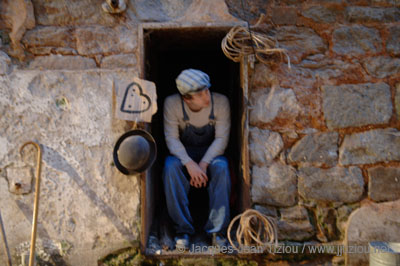
The best days I am blessedly unaware of myself, seemingly like the spirit in this play I’m laboring on, a mostly un-embodied ball of energy that floats in and among the room’s inhabitants, sending thoughts and energy to and into them. I am aware of only the echoes of shape and motion – a sweep of the arm, a pacing back and forth, a note scribbled quickly in a book. In this form I feel massive and all encompassing, a thing of air and energy.

The worst days I see myself far more concretely, feel myself sitting on the floor or see the words almost tangibly come out of my mouth. On these days I am small and desperately trapped – by body, by brain, by the limitations of time and gravity. In these moments I often see a room staring at me and in the space of a breath or pause quietly ponder at the insanity of them to have followed me here.

I try to look at them squarely. I try not to shrink under the glare. I try to tell the truth of unknowing while still believing that I (for it is never they that have brought us here) can lead us out of the tangle and wooded thickets we have ventured forth into.

When in directing mode senses come into sharper contrast – sounds either exalt or oppress, the room can be a nest in which to cozy in or an overbearing push that squeezes down on the work like a trash compactor.  It’s like the sensitivity dial is jacked up to its highest point. Even clothes can suddenly itch and scratch with a fervor that seems sudden and unwarranted.

Am I alone in this? Is this why there are nights I toss and turn? Is it why I cannot help myself but to apologize again and again in the room for such sensorial dissonances, whether not I am the cause? I don’t know if it is also the purgatory of other artists to feel this way, to know you must open yourself so wide and full and then chafe at the rough hewn bits that pass through your fingers. To know that the only way to make them smooth is to sit in that roughness and work it out.

In working The Tempest at this moment, I can’t help but feel a little bit of Ariel in myself. I’ve agreed to be here, sought out this particular form of servitude. And I take delight in the use of my powers to create shape and spectacle, to send the inhabitants of this island running, hair up-staring and all aflame like reeds, in many places and then bring them back to meet and join.

But unlike that dainty spirit, I’m sometimes less perfectly certain that I can perform the task to every article, that I can do such worthy service, and do so without giving over to grudge or grumbling. Like this production’s particular version of that entity, which takes its shape not in human form but appears in and about our space’s fabric elements, I am finding that pushing too hard or getting stuck too long forces the magic to be lost. I see how the promises made and kept earlier in this process are no guarantee for pay off and that there is plenty more toil to do.

But when I sit and ask myself on this morning why undertake this service, I cannot help but believe that unlike that spirit, that when it comes to the end of all this I will not gladly demand my liberty. That for me, the strive towards freedom from this earth-bound form is the freedom. That it is not in the finishing of the task, but in the doing of it that we mere humans glimpse at the capacity for magic. That like another in this play, I will miss it well and be sad in giving this work its freedom, even when I know well the necessity in completing the contract to do so.

The time twixt now and the end will be spent by us all most preciously…

A

Art crush

Hello my friends. It’s, again, been a few days. And this rhythm, perhaps once or twice a week, is likely where I’ll be living for the next few months.

I don’t say that because I think you’re upset about it, I just like to keep folks informed. Because the truth is I’m back in rehearsals, and that changes the tempo, the rhythmic pace, of one’s existence. It gives me such a different perspective on all these things I write about.

It’s a kind of amnesia, getting one’s feet back onto the floor. It’s as if all of the sudden I’m remembering a feeling that I’ve forgotten. There is a kind of: “Oh! This! I remember this. I love this. Why have I been doing anything else but this all this time?!”

This is always how it starts.

All those things we later don’t understand ourselves putting up with. All those indignities that in stark recollection we are surprised at our ability to tolerate. The long hours, the strange spaces, the running from place to place, all of it.

Last night I had people rolling on the ground outside covered in wet and dirty spandex while it rained.

And when it’s good (and right now, it’s very good) it all seems totally worth it.

A new work, for me, is a little like falling in love. And like falling in love, the moment when we surrender to an emotion that has the capacity to make us feel bigger, fuller, than we had been just the moment before, it is easy to allow ourselves to do anything to stay in that place. It is easy for the feeling, which can be so ecstatic and full, to feel like greater compensation than any amount of money ever could.

It is a constant surprise to me that this can continue to stay true even now, ten years into the doing of it.

I was chatting with a friend the other day about this: how the process of making something can feel like someone opens a door and on the other side is something amazing and incredible. And when you have to close it for some length of time it’s hard not to just yell at people who don’t care about the door, hard not spend all your time just waiting to open it again, hard to recapture the image of what’s on the other side.

An artistic love, like any affection, is a process of revealing oneself to an another, an unknown, and finding how you fit into it, into something larger than yourself. It is an amplifying mirror – reflecting one’s image back to themselves in bigger and sometimes stranger ways than we usually see ourselves.

Like love, it causes me to panic, simultaneously scared and excited to meet this new thing I’ve temporarily committed myself to. And the newer that love is, the less known, the more it throws me into paroxysms of emotion. Ups and downs between wanting to commit the rest of my life to this thing and feeling so silly and small and unsuited to this task, waves that come and go over days, hours, sometimes minutes.

I, for one, still struggle to be in it.

Even when I know the agitation, the terror, the butterflies, the inability to sleep as the mind races through images at night, even though I know all these things are part and parcel with the joy, I sometimes don’t know how to just release and let them in. And for me this manifests in extremes of doing and not doing. I spend  hours creating detailed, printed, minute by minute plans for the day, which are often tossed aside within the first hour. And then later, exhausted, I sit and stare out windows or listen to the same song over and over again trying to get it to reveal artistic secrets to me.

This cycling between manic outward production and preoccupied inward energy gathering, like love, binds us to the thing we cycle around in a way that, like love, can feel so specific and special that it’s hard to believe that other people can share this passion. It’s sometimes frightening to think that even the others involved might not care for it as deeply as I do. And like love, the feeling can make one feel enmeshed and alone all at the same time.

I have these dreams about rehearsals. Both waking and asleep. Nothing in them is ever sexual or explicit in any literal way. But they feel like romance dreams. And in recalling them, they pull on the same strings deep in the center of my chest. It is a love ache that these thoughts elicit. I think about a rehearsal’s scene or sound like a person’s offhand joke or their dimple. And like a giddy teenager I can replay the moments again and again trying to recapture the rapture they engender.

Let’s call it what it is.

It’s an art-crush, this.

And like a new love, I worry about letting the feeling take over me. I worry talking about it too much. About putting too much faith in its newness. About giving away all of myself to it before I know it will catch me.

But really, there’s nothing to be done but to just be in it.

To try take it in so we do not deny ourselves the pleasure, with an eye or two on the rest of the world so we don’t too totally lose touch with reality.

To endeavor to be honest with our new love, so that we do not lose our sense of selves in an effort to fit inside it, but stay supple enough to let it change and open us in ways we might not have known possible.

To keep our sense of fairness and standard and integrity, so that even if we could give everything of ourselves so thoroughly away, we don’t, because later, when our love tempers and perhaps even fades, we’ll need it.

– A

Gasping

Progress in the speed of real time is hard to see.

For years when I thought of the person I was back in college and the first early years out, I just imagined the same person I am now, maybe a little smaller, a little poorer and a little blonder (I was using Sun-In, one of the greatest follies of youth). Essentially though, I believed myself to be the same. I’d look pictures of the work I did at that time and imagine me in the work just the same as now. Some days it could feel frustrating to see myself stuck in sameness, not feeling the same clear progression I used to have demarcated by an academic calendar. This was partly the impulse for a return to such a place, where the promise of measurable and specified growth is inherent in the enterprise.

Yet… There are hints to the contrary:

  • Re-reading my directing notebook from The Ballad of Joe Hill as I prep the return to the piece now in 2013 I think about the fear I had that the work would all come crashing down around me. I realize how much more I’ve learned to love and trust intuition as a guiding force in my work.
  • Re-visiting my alma mater to teach or share work, I find myself talking with students and seeing more starkly the different between where they and I each are.
  • In a moment of fretting about someone else’s perception of something I’ve done or am doing, I catch myself, let it go, and think about times previous when that wouldn’t have been possible.

But mostly, I think our awareness of change is commensurate with its actual occurrence, meaning we acclimate to our new selves in the slow and steady forward tempo they are created. So our evolving selves seem to us a constant, even though someone who leaves and returns to us might be amazed by the effected change on us by life.  Easy to see in others, hard to catch in yourself except in passing or in shadow.

And because of this it gets easy to get frustrated with growing, easy to miss the reward of experience (which seems to have been so clearly a fixed part of who we are) and mourn the vigor of youth and the promise of potential. This happens big (looking at the major arcs of our careers) and small (looking at what we have accomplished in a week of work). We go back and give our younger selves the benefit of the intelligence gained and then find fault in current ourselves for not having the future predicting foresight to avoid new mistakes, forgetting that the old ones got the current knowledge to us in the first place.

It’s a fallacy, just as much as the perfect unformed, undone, artwork whose imagining will never be tarnished by the reality of actually doing it. But fallacy or no, it works on us. And here at Swim Pony, I like not only identifying a problem or trend, but trying to alleviate the problem.

It just so happens that last 7 days have found me at home working mostly on my own. Tracking the progress of anything is hard, doing so in a bubble with no outside contact even harder. So nearing the end of the week I found myself saying, “I’ve done a lot. I swear I’ve done a lot.” With less and less conviction. But happily, near the end of the week I stumbled on a lucky accident that I wanted to share.

I am a semi-luddite, with a dinosaur phone and an instinctual late-adopter policy on technology. My to do lists are one area in particular that has stubbornly resisted updating from analog. Which is why each morning for the last week I’ve started the day with a sheet of legal paper (it’s longer) folded in half, a pen and a highlighter. I re-write the things left uncrossed from the previous day’s list onto the clean paper, add anything that has since arisen, and then highlight the things that are most urgent for the day’s doing.

Day to day, this tool is functional, helping me keep track of what’s come up and what should be on my radar and the priority in which I should be aware of it. And day to day, this list is a kind of metaphor for my growth and progress on the larger scale: taking in new info and removing things completed or learned. But unlike my larger progress I was left at the end of the week with a tangible record of each day’s doings, each step along a week of accomplishments.

Last night I stopped for a moment to take stock of this catalogue of agendas. On first glance, I was a little disappointed to see that the list size from day one to seven was roughly the same and that the number of things removed from each day was also just about equal across each list.

But then I looked closer.

I saw how things I’d thought I needed were taken off based on new information. I saw things I had delegated to others to share the burned of work. I saw things listed early in the week too vaguely had broken down into specific steps that I could (and did) complete. I saw that each day had been a small piece of progress on a multitude of fronts that added up to some big advances in the larger scheme.

And then, just to see what would happen, I went back to the first day’s list and crossed off all the things that I’d managed to finish in the 6 that followed and I actually (if you can believe such silliness) gasped at my desk.

But for one task, everything I’d wanted to achieve at the start of that week, I’d completed.  What struck me so completely was that, yes, the lists were the same size today as they were last Tuesday, but my wants kept updating with the days’ lists as well. And a little posting here day after day, we add to the finished pile one piece at a time realizing only at the end that each little step does add up to a whole body of work completed.

Perhaps it’s worth taking such moments of stock once in a while. Perhaps it might be useful to record the state of the self, to define one’s wishes and ambitions and current capabilities as they are and then compare them with the same measures from the past. So that we do not only, as we are often encouraged, measure our current selves against the prospective ones we hope to be, but also see that we have become “future” selves, ones who can take a moment to go back and gasp and be proud of how far we’ve come.

– A

Learning vs Doing

You know that feeling when something just… bugs you?

In that way where it’s not a huge deal, not enough to really even know exactly what about it irritates, but it a fact just rubs you wrong each time you hear it?

I get those little inklings once in a while when I hear about certain artistic projects happening out in the Philly sphere. It’s hard to pinpoint exactly which ones will they will be. But they are things that from first mention just make me itch. They leave a sour taste. They make my nose wrinkle. And recently I’ve tried to unpack those little pin pricks a bit to figure out what it is about them that creates that feeling.

Ok, long intro aside, I’ve been writing here long enough that hopefully you readers know that I care a lot about the art that happens here in my community. And if you read this blog you know that I am, almost always, for more work from more kinds of people. But there are just some projects that I hear about and get this negative vibe from. My guess is that anyone with a high level of skill in an area has feelings like this about certain kinds of creative endeavors.

Mine come when I hear about companies that are creating new devised or generative works for the first time. This is almost exclusively linked to full productions from companies that have not established themselves as devisors in the past. When I hear that company X that usually does this or that semi-traditional cannon work is doing a “devised” show I have this weird itch. It’s a gut feeling and it makes me turn my head to the side and squint a little.  It makes me just a bit annoyed.

I don’t get upset in the same way when I hear about companies doing killer work I wish I were doing. I don’t get that way when I hear about new up and coming companies fresh out of the box. It’s something to do with relatively established, usually working the traditional mode, folks who out of the blue decide they’re doing this thing that I do all the time.

Why is that? Is it jealousy? Competitive fear? Haughty condescension?  I don’t claim to be above any of those things. But I really don’t think that’s what it’s about.

Here’s what I do think it is: There’s learning and then there’s doing.

Learning is for us, the makers. Learning is the way in which we experience ourselves opening, vulnerable and hopefully awakened with a new methodology. It is the space in which we find room to grow. Learning is mostly a private affair because the real beneficiary is us, the learner.

Doing is the opposite. Doing is the ways in which that thing that we have learned and grown is implemented and displayed, put forward and adorned in front of an audience. It is about skill and virtuosity and execution. Doing is performance. And doing is about the viewer because we’re doing it for them.

In every artistic endeavor we are likely engaging in a bit of both. When we start out, we are doing very little doing and learning an awful lot. And the doing we do is mostly in service of the learning. In these early stages, when we do the doing for people, they know we’re just starting, it’s generally understood to view the thing through that lens.

As we grow older, as we become “professionals” there are fewer spaces for learning. We become doers, sometimes to a deadening degree. It’s understood that what an audience sees is doing without quotations. We take that caveat off our performances. And that means an audience can look at the thing with the understanding that this is mostly for them.

I am for learning. I am a believer in continuing the educational process. And In almost all of my creative works I build time set off from the making (the doing) of the play for the group to explore uncharted territory. This is usually called exploration, but it might as well be called learning. It’s the time when I give us room to grow that new growth without having to support the weight of doing it for a viewer.

In other words, when I start a new project, I make sure to find time for us to learn before we have to do.

I do that because devised work, by its nature, is a learner’s game. The piece does not exist. And in the same way a playwright needs time and space to learn about the world he’s writing, generators in a room together when they first start doing something, need way more time to learn what’s happening, what they’re going to do.

And I like the idea that people would want to engage in that process. I want more theater that is made this way. Which is why I especially like inviting in people who’ve rarely created that way to do it with me.

What I do have trouble with is when learning is sold as doing. And this, I think, is where the itchy feeling comes in. While I always include some amount of learning in a process, I know that I need less of it than I used to. Because I’ve been doing it long enough to know when I can accelerate or anticipate certain things I’ve learned about doing. And I have a pretty good guess when others can’t.

The thing that’s tricky about trying something new that is similar but not the same as something you’ve been successfully doing is remembering that the new thing is actually new. That it’s a thing you don’t know how to do as completely, that you haven’t yet learned all the ins and outs of doing.

That the ratio of learning to doing that you’ve been operating on with the thing you do know how to do is not going to be applicable for the new thing you’re learning about doing. And that means that you need to give yourself more time to be in learning mode before you start doing it in front of people. And I think the itchy feeling comes when I sense that a project hasn’t made enough room  for the learning. I know how hard devising is. I know how long it takes. I have a pretty good sense of the effort and skill needed to actually do it. Which means that I can sense when something is about to be shown as a thing “done” that is actually a thing that is still being learned.

It’s not just that I don’t want to see bad work (which I don’t). But I see bad work all the time. No, in this case the niggling feeling is tug of the mama bear. I am feeling protective of my craft. And I think generative creation really is a quite different skill than interpretive theater. Making a thing and enacting someone else’s thing are not the same. We cringe at a movie in which a basketball player mistakes sports fame for an ability to do any craft that involves performance in front of an audience. And in the same way, I sometimes worry that people don’t realize when they decide to devise that what they’re doing is a learned skill.

In the learning of my craft I have had so many opportunities to be a beginner. I had so many tiny steps along the way, small showings, little audiences, chances to build my skill incrementally. I don’t know any serious deviser that began with a full-fledged production. And I fear that those who attempt to do so will think the fault is in the medium and not in the desire to jump to the end of a series of steps in a developmental learning process. I fear people will assume that these methods new to them are not as good as the ones they’re used to without realizing that it may be because they are not as good at using them.  I fear it will sour people that might be open to learning such things away from doing them successfully in the future.

I fear that not only will creators misunderstand, but that audiences will too. That they will see under-prepared, under-qualified work and think this is doing when what they are actually seeing is pretty raw learning. And I fear that because there’s no one to explain  what they’re seeing it will do a disservice to the work on a larger level, make them ask for the same old “play plays” the company did last season.

I have been in devised work that did not get the allotted time or skill to be successful. And because such work demands that everyone be involved a lot more closely, I think it’s that much more painful when it fails. I hate hearing people talk about such disasters.  It brings me close to saying things like, “Those people shouldn’t be doing this kind of work.”

Which isn’t totally true. They can. Eventually. If they take the time to learn.

There are actors who are so effortless in their doing, so complete in their learning that it seems like magic. It’s easy to imagine an unknowing audience member who might think that they too could simply get up and do it. But we “in the know” can see the skill, the deep learning behind what they are doing. And we can be chaffed a little each time someone off-handedly intimates that they could just step into our work with the ease and élan of that same skillful performer.

If that audience member tried to just “do” that same thing, they’d learn rather quickly how much they don’t know.

And I think that’s about the most apt comparison I can make for the itchiness I feel sometimes.

I know there are companies that will try and do it all right out of the gate. And I know that they’re not doing anything maliciously, that they just can’t see the effort that it really takes.

But still. 

A part of me just wishes they wouldn’t go doing it until they’ve learned a bit more about how.

A

On Valuing Age, On Appreciating Wisdom

I find my thoughts drifting these days to my almost three year old niece and the fact that any day now she will become an older sister. She’s decided on her name for the impending baby. I imagine is as excited as an almost three year old can be about such a thing, understanding it about as much as an almost three year old can.

I keep thinking, “Man kid. You have no idea how much everything is going to change.”

Then: “You are about to feel so grown up.”

When my thoughts drift this way, I think about how much my identity as an older sibling has meant to me, shaped me, and shifted who and how I am. My earliest memories start around the time my own sister was born – at that “almost three” age. So for as long as I’ve had a remembrance of myself, it’s included the sense that I was older and more experience than at least one person in my little world.

It had a profound effect.

It meant that even when I was a “little kid”, I was still the “big girl” in the family. It meant that I always saw myself in the light of being the first to pioneer new frontiers. It meant that I linked being older with being wiser, stronger and more powerful. Getting bigger meant I would be that much more the holder of experience that I could pass along. It became a deep value of mine, the acquisition of such wisdom, and it’s become a huge part of who I am and what I want out of my life. So I’ve always reveled in  “grown up-ness” and deeply appreciated what each increasing year has given me. And I still look forward to getting older with excitement and anticipation.

Of course,  there are plenty who would tell me I’m a young pup. Which, of course, I am in many respects. While many days I feel like I’ve done a lot and lived a fair amount, there are certainly times when I see myself in context of those that are ahead of me and feel young and inexperienced indeed.  But unless you have just been born NOW! or are Jiroemon Kimura you always have someone younger and someone older than you. And that means that you always have the ability to view your identity in the context of being more youthful than someone ahead of you, or further along than someone behind you.

The arts in general (and the performing arts in particular) aren’t always the best contexts for celebrating experience. While we pay some token homage to great masters, anecdotally it feels to me like we tend to reward the promise in a young savant painter, the grace and beauty of a youthful dancer, and the charisma of the impish new actor far more than we do the earned and learned skill of decades long practitioners in these same mediums.

And really, that’s too bad.

I think fetishizing the early work of artists is damaging to art as a whole. Not that such young work can’t be beautiful and moving but it’s often much simpler and straight ahead than the stuff we make later on. In art as in life life, we generally learn that things that seemed so black and white once upon a time are much more complex and mysterious. Things that we held positions on in unilateral unyielding ways we start to see shades of gray in. Things we never ever believe we were capable of, both good and bad, we suddenly realize we have completed. Our creations cannot help but reflect our deeper and more multifaceted views of the world.

So though I can appreciate the promise in the early works of a budding artist, it’s usually in their mid and later stuff that I think you really discover the complexity and depth of what a creator has to offer. It’s in the complexity that you see what these makers are really made of. It’s these kinds of works that may not be so easily digestible that challenge me to be a deeper and better art viewer. It’s in the stuff that reflects all the life that others gained that I see the kind of artists I want to be. I believe we should be treating this like gold.

And I try to remember this when I sometimes fantasize about my early creation, try to caution myself from forgetting its value. I try and stop idealizing an approach and attitude that lacked the decade of making I now have and remember how easy it is to forget what was tough, rough and messy.

I’ve had the luxury of re-working shows that I started creating 3, 5, 7 years ago. And with each of them I have had a moment in rehearsal where I think:

“I am so so much better at this than we used to be. We are all so so much better now than we were before.”

Not everyone gets that chance and sometimes a slow building of skill and experience can seem to have always been there. Which is why it’s so important to remember not just what you have learned but that you have learned, that value of age and experience.

The arts are a punishing field. If you’ve lasted a while, you must know something that others who haven’t stuck it out don’t. But there aren’t enough voices out there that tell you that.

Recently, I’ve seen a number of companies with variations on apprentice/young professional programs. I’m often struck when I see them in action by the distance between the actors with years of well earned experience and where these fresh faced folks currently are. I jokingly say that I keep seeing babies on stage. Sweet, wonderful, babies. But babies nonetheless.

These lovely eagerlings are the promise of artistic potential, but they are often not the delivery of that craft. At least not yet.

And that’s a great thing, so long as the attitude of our community is that as an early career artist, the work ahead of you should be what you have to look forward to. It’s a wonderful place to be so long as you know you will be rewarded as your depth and skill and knowledge increases from here. It’s a lovely path to look ahead to when it means that someday you can turn back to the road traveled thus far with pride and not a sense of burden.

It’s important to remember.

I don’t want to be part of a profession where people don’t need to wish they were babies again. I want to be part of medium that rewards me because I want to keep growing up.

– A

How the other half lives

Right after I finished college, during my “anthropology experiment” phase of online dating I went out with this guy who was going to Wharton.
 
I was worked at a coffee house off Rittenhouse square near his apartment which was about the extent of what we had in common. So usually, I’d finish work, we’d go to some bar nearby and sit there staring at each other a bit bemusedly and ask each other questions. Usually our conversations went something like this:
Guy: So ok, let me get this straight: You got this incredibly expensive education and a degree in chemistry. You could be going to med school or grad school.
 
Me: Yeah. But I realized that I wanted to do something else that meant more to me.
 
Guy: So instead you’re working as a barista?
 
Me: Well, for now. I’m making money so that save enough to take time off and pay for stuff to do what I really want to.
 
Guy: Which is?
 
Me: Make plays.
 
Guy: So you’re working a crappy job that doesn’t pay you much so that you can take time off and work more on something that doesn’t pay you at all?
 
Me: I guess. I don’t really see it that way. And eventually I’ll be making some money doing theater, not a lot, but enough to live.
 
Guy: Weird.
 
Or if I was asking the questions, it would go something like this:
Me: So ok, let me get this straight: You don’t really like finance. But you’re going to this school for business. And the plan is that someday you’ll move to New York and get this job that works a million hours a week.
 
Guy: Yeah but it pays a TON of money.
 
Me: Will it be interesting? Will you like the work or find it rewarding?
 
Guy: No. But I can retire really early and do whatever I want.
 
Me: And what do you want to do?
 
Guy: Astronomy. I really love that. It was what I majored in when I was in college.
 
Me: But you could just DO that! That’s a job.
 
Guy: Yeah but I’d have no money.
 
Me: Weird.
On and on like this.
 
Perhaps the two of us were a bit more forthright than most – I about the grim specifics of a life in theater and he in turn about working on Wall Street – but I would wager that this dicotemy is one that a lot of people have to choose between. And when you land on one side of the line, sometimes it’s tough to imagine being on the other. This guy and I dated each other for a while. Longer than you’d think given how little we had to talk about, how much we thought the other person was sort of bizarre and had their priorities mis-aligned and especially how much my sister really hated him. (Dale, you’re right, he was kind of douchy). I think it was really just the fascination with how the other half lives, how people make choices totally different from your own and seem to carry on totally confident in them. At least that was true for me. 
 
I’m not trying to be glib about this. It was genuinely strange to think back on this time when I was bumping up this very specific and particular way that I live my life against another person my own age. I’d go to social functions with him and people would flock around me. I am not a social butterfly, I don’t do small talk well. But I think the fact of me in the midst of these people was an anomoly. I was a weirdo doing weirdo things. And those weirdo things were different enough to make a lot of people ask me questions about what I did every day – working at a cheese shop, the piece I was planning on, etc – the things that to me seemed awfully banal. 
 
At this point, it’s been a long time since I had a significant person – friend or significant other – that wasn’t involved in the arts. The only ones left are my family and the few folks in my non-theater jobs that aren’t performers. These folks are mostly acclimated to what the artist’s life is like but there are still times when I feel a little alien trying to explain what I do and why I do it to them. I think it’s important for us artsy types to remember that there’s a difference. Not to alienate ourselves or imagine that no one understands us, but to remind ourselves that it’s likely not intuitive to the average person what the particular concerns of an art maker will be. Remind ourselves of all the choices we take for granted. Remind ourselves the things we gain for all the losses we sometimes perceive ourselves needing to adopt. It’s not an excuse for the arts to be impoverished, but it’s an important reminder why anyone would persist in them when such a lack of recompense is potentially part of the deal.
 
Think about the fact that artists, as general rule, are always looking for more work. This instinct is so ingrained that often we need to remind ourselves not to take jobs that don’t pay or don’t pay nearly enough. How many janitors do you see considering coming in on off days just to get some exposure to the craft? Beyond simple economics, I think that artists take on lots of work because they love the work they do. And indeed they are often evaluating that work not simply on metrics of money but on the level to which the work challenges, engages, and uplifts them. This force likely plays a role every time we decide to start a new project and it means that we have to evaluate and make meaning of our income source ALL THE TIME. This is rare in the outside world. Don’t underestimate that power.
 
Artists make their own schedule. Ok, not all. But many. As generative creators this is sometimes a strange paradox: no one stops you from doing whatever you feel like. (No one forces you to do anything either). Even when you are a gun for hire, we still get to decide if we take a job. And though we often view that instability with fear, it is a real power to say yes or no to work, to determine whether you deem an institution worthy of you. And at the end of the day, you can always go entrepeneur. Nothing stops you from making something yourself.
 
You get to work with so many people and form deep deep bonds with them in short periods of time. I worked in an office for a summer. It was boring and I barely talked to anyone. One of the things I love about rehearsals is that suddenly I feel like I’ve rediscovered a whole new group of friends. In fact often, I like to work with the same folks simply for the pleasure of their company. Making a play is like going to war without the war – all the comradery, none of the bloodshed. And when you really hate your boss or your co-worker, you know that you only have to deal with them for a few weeks or months. If you hate your boss, you can even quit and know that it only affects the next few weeks of your salary versus the rest of your life. While temporary-ness can be tough in some ways, you also know that you can take risks and try things others might not be able to if it meant a commitment of forever.
 
You get to make things that matter to you. Not always, not perfectly, but in general if you’re in the arts you aren’t there to please others. The world of theater especially is just too punishing. If you didn’t find something meaningful in the words you write or say, the movement you create, the songs you sing, the stories you are telling, you’d leave. If you make your own work this is doubly true. And this is why we are willing to put up with jobs we really don’t care about, because the thing we really do is what we really want to be expressing about ourselves.
 
And finally, Artists like what they do. Let me repeat that. We like what we do. This one still flabergasts me. That there are so many people in the world that literally hate the thing they spend most of their waking hours doing. That they are biding their time and counting down the hours until they are free.
 
You are already free. I know sometimes it doesn’t feel that way. But you really are.
 
And that is a serious luxury.
 
A

What’s old is new again (?)

The 2006 Philadelphia Live Arts Festival and Philly Fringe

Coming home…

Sometimes a piece of art in early stages is filled with a certain kind of special newness.

It’s a fluttering, butterfly feeling, a buoyancy that fills me with brilliance and space. It feels like being full of something delightfully lemony and bright. It feels like opening a door a crack and peaking into a possible future full of light.

It can be with a person – an actor or co-creator. But it just as easily could be a bit of writing, a song, an inspiration, the kind of process you’ve just discovered.

It’s a creative crush, this affinity and affection. I think of this thing, the who or what I’m falling for, and it starts to feel like a piece of me. Or rather, it feels like I am beginning to know it, and I like it, and I want to be even more a part of it. It feels like it could become a piece of me, lifting me up and making me better. I want to mesh these two separate things – the work and myself – into a single whole.

In the wanting to be filled up with this deliciousness I treat my memories of this bit of text written or character choice. I do it over and over. I listen to the same snippet of music or replay in my mind this or that scenic choice. I take it out when I’m blocked like a secret piece of candy, mining this tiny taste of sweet for sustenance. And through this replaying of little moments, obsessing and relishing in the details like a gushy teenager, I think of where this thing might go in the future. I think about our potential happily ever after.

It’s sort of like falling in love. Falling in love the way one would with a potential lover, but instead with my work, with my own capacity for creation.

And while it does feel that way, like love, I think that love is not exactly the right way to describe this feeling. I think it’s closer to desire, infatuation. Closer because the feeling gives a glimpse at something perfect and mysterious without letting one in on all the arduousness of specificity, of actually having to do the work of completing the promised outcome.

Perhaps in art as in life, infatuation and love feel confusingly similar, but are not quite the same.

Desire, need, infatuation are emotions based in hunger and lack. They are shadows, mere glimpses at potential. And I think it is only possible in absence of the whole where one can maintain an imagined perfection.

As I once heard someone say, there are two kinds of art works – perfect ones and finished ones.

Love is something different. It grows out of actually weathering through the test of stress and time. It is a gathering. Of knowledge. Of familiarity. Of fault. Of history. It is precise in a way that infatuation cannot be, because it is built on actual details and shared experience.

I think that our artistic work is like a romantic partner. It is a relationship we have to manage over time. And I think that in our art, as in our personal lives, we need to define what kind of partnership we believe in having with our companion. Do we seek a turbulent but intense bond that is unknowable and always elusive? Or do we work our way to a cozy if duller comfort?

Perhaps this is where the myth of the wild art of youth comes from. The work of our 20’s is like the kind of boyfriends one had right out of college. They are a bit messy and dangerous. They hurt you and teach you where you need to keep yourself protected. But they mean so very very much. They have moments that seems so impossibly intense and lovely that even if they turn out terribly, you love them for their failures.

Are these early plays the ones we settle down with? Or do we instead slowly grow into our art? As we grow we begin to revisit things we initially passed over because they weren’t shiny enough. We tackle subjects and modes of working that we couldn’t quite grasp the depth of in the first go round. And we stop trying so hard to impress and begin to steep ourselves in tenderness and support, in a making that is deeper and perhaps more lasting…

Is one better? I don’t know. But I’ve been thinking about this a lot lately.

The first full piece I premiered in Philadelphia was a show I created called The Ballad of Joe Hill. I made that work in 2006. And this fall I will be presenting it again after seven years.

This seems a little impossible – seven years for a work to come to fruition. That a thing I started during a time in my life that was intensely uncertain will find a new form when so much of who I am and what I do is now known. This piece, which is one that examines what a life is worth and how we make it so, is one that began a relationship with so many of the people I now think of as home. And it is one that I have often looked back fondly on for the sheer creative ineptitude and blind luck and intuitive spirit that guided its creation. It was a piece born out of those infatuated seeds. It was a piece I wept and worried and laughed over at every step of its creation. And in watching it again, in thinking about what was there that first go round, I see so many things that still lift me up with light. And I wonder what it will mean to go back there.

Can I find love within this thing borne of infatuation?

Or perhaps I’m simply framing this all wrong.

If desire is steeped in anonymity and vulnerability and love in recognition and protection, perhaps my question ought not to be whether one is better than the other. Perhaps I do not need to assume that the thing must be one or the other.

Maybe my question should be whether they must be mutually exclusive.

A

Context

The other day I spent my lunch chatting with a group of apprentices from Interact and then immediately went and had a meeting with a soon to be graduated student from a small liberal arts college. In both cases the conversation centered on navigating a career as a maker and producer of theater. In both cases I had plenty of concrete advice about resources to look for, things that I had tried in the past and either found successful or not, and how to keep a hold on the reasons one starts making art in the first place. I found myself repeating this phrase a whole lot:

“I’m not sure if it’s like this everywhere, but I know that here in Philadelphia…”

This combined with the recent discussions in relation to grad school and collaborators has me wondering how environment affects our work. A bad rehearsal space can hinder creation. An underwhelming performance locale can limit the scope of one’s imaginings. But what about a city? These smart young women I met last week have all had to weigh the question of context. They are all in the midst of deciding if this city is fertile ground from which to plant their artistic seed/selves. And I started thinking, “Why?”

Why Philly or why not? What does this city have to offer an artist and how does that offer change as they grow? I started to think about how I have been shaped by the place in which I now live and create my work. I started wondering how the daily backdrop of Philly and the people within it have made me the artist I am.

I’m interested in what questions a city can raise. What thoughts and ideas does it bring out of us? How does being here in particular color us as creators?

For the record, I didn’t intend to live here. I moved to the east coast for school and always thought that eventually I’d go back to Chicago. Somehow everything in the east coast cities I visited felt like it had a little less breathing room than back home. My family was there and at heart I felt like a Midwesterner. People here seemed a little harder, a little more closed off. I didn’t want the scale and exhausting competitiveness of New York. Boston seemed too small and insulated. And Philly was… a little off-putting.

I knew very little about this place before I came here. In college the entirety of my sense of the city was limited to taking the R3 from Swarthmore and bumming around South Street. I thought Olde City was cute but small. I had a few bewildering encounters with Fringe shows. I capped every expedition with a wait for the train in Market East. In short, my sense of the whole place was a bit gritty, a little dated and a lot dirty.

I see it differently now. That one-year gig after college turned into more. I grew up a lot while being here. I found a strong and supportive community. And something about this place now feels like a familiar if sometimes frustrating kind of home. So here I am. But going back to the initial questions – what influence does the city have on its artists? If it had gone another way, would I still be the same?

So for those new folks, looking to weigh the city on its artistic-potential inducing merits, here are a few observations:

Philadelphia feels like a small city, at least artistically. “Philadelphia County” is listed 5th most populace US city.  We’re bigger than Dallas according to 2010 census data. But I don’t think most of us think of this place as having a big city feel. The areas of Philly you move within are likely rather confined. It feels like a city of neighborhoods and we tend to stay loyal to the areas we inhabit. The artistic community in particular feels small. This can be great to be so familiar, to watch people grow and change, but it can also be limiting, difficult to be honest in critique. With the web so interconnected each shake or tear carries more weight.

This place feels like a family in the best and worst ways. It is hard to define oneself entirely out of context of the artistic family members that one is surrounded by. Sometimes it feels like funders are like parents with only so much love to go around. As a second generation experimentalist there are times when I feel like a second sibling who will always be in the shadow of those who came on the cultural landscape earlier than myself. I can’t help but wonder about those that will come after me. Will they have any room?

Philly is a place of genuine artistic fraternity and support. The arts are where the real brotherly love lies. I have shared stories with friends of mine in other communities about the help and mentorship I have received here. They are often jealous or astonished. No one can believe me when I tell them that things like Artist U are free. I have been amazed at the kindness of those ahead of me in sharing their knowledge, skill sets and literal stuff. It makes me want to do the same. We are a familiar folk, we Philadelphians, and in general we pay it forward and want to love and support each other.

We are also a city with a lot of history and legacy. It creeps into works in small and big ways. We employ a lot of theater folk in our historic cultural centers. We make stuff in sites of history. We have stuff that’s older than most US cities. There have been lots of “Philadelphia”s – from Ben Franklin’s to Rocky’s. We are still figuring out how to blend them together both in life and our work.

We are a relatively cheap city that feels like it’s on an economic upswing. An artist can own a house here. Let me repeat that. An artist can own a house here. Do not underestimate how radical that is to people living elsewhere. You can get space for cheap or free. There’s a bit of breathing room in a city that isn’t so expensive. People are easier with giving things away. You hustle a lot less. Art is more of your actual income. And at the same time, it doesn’t feel like that is at the cost of the city falling apart. Even in the midst of the worst housing crisis, many neighborhoods (mine included) have not lost property value.

There’s that Quaker thing. Maybe it’s because of my Quaker college that I feel so aware of it, but I do think there’s something about the large presence of Quakerism in the early history of this city and the quiet witness it continues to bear here that raises a sense of consensus and social justice in its people.

In a similar vein, we are a city surrounding by academic institutions. There are those obviously in its borders (Temple, UPenn, Drexel, Jefferson, PCOM, UArts, St. Joe’s, Pierce, La Salle, University of the Sciences, PAFA, Curtis, Moore, Chestnut Hill, CCP) and all the ones within the city’s reach – Villanova, Bryn Mawr, Swarthmore, Haverford, Arcadia, Rowan, Rutgers, Ursinus, Cabrini, Eastern (I know I’m forgetting some). This is an insane number of schools. And all these are places we create our work, teach, attend and learn from, make money at, borrow resources from, use the libraries of, connect with students from. Whether you personally work or study you are still the beneficiary of the many intersections of these institutions with the arts community.

Philly is dirty. What is up with all the trash? In both 2011 and 2012, TRAVEL & LEISURE put Philadelphia in near the top of “America’s Dirtiest City” list, for having the most unremoved, publicly visible litter, selected and voted for by both magazine readership and city residents. What does that do to our sense of aesthetic? How does it change our relationship to beauty in our work?

Philly has a higher than average rate of crime for a city our size. As sensitive people, we take in our environment. Ask most artists and they have multiple stories of witnessing or personally being the victim of crime. That stuff can’t help but come out in one’s creations and the more it happens, the larger it weighs in your work.

It takes a long time to get anywhere. “SEPTA. We’re getting there.” Is this the most unintentionally accurate slogan ever? And given the small size of the city and the high number of artists that use public transport, this matters a lot. I think it holds us back as a metropolitan community. I think makes our city seem less professional and unapproachable (as do we, its artists, by association). I once had to give an NYC playwright friend directions on taking a Philly bus. Just one, in a straight line from the north part of 4th street to the south. I had to make sure she had two dollars, exactly. I had to promise a bus would come to the directed corner even though no sign would indicate such. I had to tell her to go 10 minutes before the schedule said because you can’t trust what’s printed (but then it might be 10 minutes late, sorry it’s cold outside). Thank god she didn’t need to get from south Philly to the Museum district.

We are a city with a deep racial divide. Last April I was lucky enough to be sitting in the “grantee” section at a Knight Arts. As I flipped through the book of other winners I noticed another listing for Theater: $20,000 for GoKash Productions to expand the Philly Urban Theatre Festival. It amazed me that here was an award winning company creating original works and an ENTIRE FESTIVAL that I had no idea existed. I thought it amazing that such a company has survived without support from the traditional funding sources and, as far as I know, with little support so many other small companies enjoy from the larger theater community. There’s been a lot flying around the major theater blogs recently about how get people of color to the theater. I thought of GoKash. They’ve already done it. How many others companies like them are out there? Why are they disconnected from the community I am connected to? What is my responsibility in that? More recently, as I gathered data for my women in theater posts, I noticed a trend, especially among larger companies, to produce a single “diversity” play in a season with a relatively small (if existent) number of actors of color throughout the rest of the year. I thought a lot about how I feel about all women shows  – incredibly protective of their importance but at the same time nervous about being set apart. Racial division is a backdrop to our lives. How can we become smart and aware about its influence in our art?

It’s not as easy as you’d think to be a solo creator. Though we have a lot of them, solo creator artists don’t have the easiest time. The funding structures in this city are pretty company (aka non-profit) oriented. Despite a few high profile grant programs, we are overwhelmingly deficient on residencies and grants for individuals. Most foundations won’t let you apply until you have the tax exempt status and a certain level of size. There are precious few folks past their 30’s still making their own work without having gotten the 501 c 3. Which means in general, if you want to make your own work in Philly you not only need to be a creator but a producer as well. This is not the case everywhere else. We are in desperate need of curatorial institutions. Yes, we have Fringe Arts. And they do a lot. But we need more than one voice. Where are our PS 122’s, La Mama’s, and HERE Arts spaces?

We have some crazily bizarre liquor laws. Alcohol, like it or not, is a huge part of how most people socialize. I’m going to guess that’s even more true for the coveted 20 – 30 something age range, one that theater in particular has a hard time reaching. Imagine a band in a place where no drinks were served. And while some people get around this, I think that it cuts out a huge social lubricant and money-making avenue for smaller theaters (who could never afford the insane liquor license fees) to access.

And finally, when I step back, I see that we are not actually one artistic community. We aren’t even just one kind of theater community. There is a dividing line in town between the generative artists and the interpretive ones. Between “straight” theater and devised. Between the experimenters and those who find meaning in tradition. But as different as we are, there’s an open curiosity that I see around me. What I like about Philly is that this division is, as the cell biologists say, a permeable membrane. I’ve found real growth in interacting with actors who have never written their own lines before or created a scene. It reminds you to questions your assumptions. I’ve learned a lot by jumping out of my usual role and ADing a super “play play.” And as I grow, I find that more and more useful, to seek out opportunities to watch how other people do what they do. And there’s a trust and respect that Philly fosters that allows that to happen. And if there’s anything that’s kept me in this place, that’s it.

A
It’s never what you think it is

Sticking with it: it’s where we separate real artists from the people who used to make art.

Because real art making is not about your amazing idea. It’s about not stopping. Real art making is about learning that ideas are only worth their executional salt. If you only dream it, if you never do it, you haven’t actually made anything.

And that’s as it should be, no? A cook who dares not near a stove can’t really claim his title. A swimmer who never hits the water doesn’t have much credibility. And plumbers are only made so by, well, plumbing things.

Do you feel despair, my dears, as I do between those long stretches of making anything? It’s because until you create again, you are just another person who used to make art. It’s because you can feel that impulse, that inertial force, that ease in which you just might stop and give up. Unless you’re making some art, you aren’t actually an artist.

And isn’t it just the bitterest of pills to swallow?

I look at the people younger than me and I want to ask them: How many of your fellow artistically minded graduates really hunkered down and decided to make a life in the arts? How many incredible creative compatriots decided to do something else? How sure are you that you’ll never give up?

I look at the people in my own age bracket and I want to yell: Think of all the people you’ve made work with in the last decade? How many of those people are still doing it? Isn’t that scary?! Aren’t you tired like me? Do you worry that you will keep going?

I look at the people a generation ahead of me that are still doing it and I want to inquire: How? How are you still here? Can you promise me it gets better? How did you make it work? Do you still worry about giving up?

In those times between being someone who used to make art and being an artist, how do you keep summoning up the energy and effort and love and vulnerability?

I don’t mean to say that if you aren’t cast in a show you don’t count. Art work is not limited to the opportunities that others afford us. Our work is so much more than the moment of performance in front of an audience. Our work is reading about the subject we want to create from. Our work is learning a new monologue or asking a friend to come and read our freshly written scene. Our work is discussing an idea and creating a plan of action. It’s searching out objects and finding inspirational images or writing 500 words a day to figure out what kind of stuff we actually want to make.

Our art is so much more than just an outcome. But it also must be more than just an idea.

The art in our mind – the play imagined, the painting visualized, the text  to be written – is always perfect. And the actual work we make is always something short of that ideal. Ideas are not art. Art is when the wheel hits pavement and starts to generate friction. It’s when reality begins to pierce the perfection.

Want an ever bitterer pill?

Your good ideas and intentions simply won’t matter if they never get implemented.

Your beautiful dreams are of no substance if you do not hang out long enough to get them done.

There is a new push in teaching and child development to stop telling kids how smart they are and to instead praise how hard they work. Turns out that when someone is praised for being good at something, they are incentivized to keep this image of themselves intact. If you think you are smart, if you want to keep this idea of yourself intact, doesn’t it make sense that you won’t want to put yourself in a situation that would prove otherwise? And it turns out that when you tell children they are “smart” they are a lot less likely to try something beyond their current capacity to succeed. When you are afraid of failure, you play it safe.

What to do? Tell them they are good at working really hard. Teach them that they will get a lot from trying really hard. Tell them the amount of effort and work they put into something will reap an equivalent reward. The difference between being smart and working hard is that one is a state to maintain and the other is an action to perform. Which one do you think is more productive?

You young ‘ens, with your amazing and fancy new ideas! Oh! How can I express how much I know where you are? Your artistry is like clay in your hands. You feel its heft and weight and shape. You know you are capable of making it into whatever you need it to be. You are strong. You are artistic potential incarnate, if only you could just get started. You know you can make awesome things. You just don’t have the right tools yet to shape this beautiful raw material. You just haven’t been given the opportunity to present what you can do.

Forget that opportunity. It’s never coming. Just throw that clay on the floor and start making whatever you can in the best way you know how.

I spent a year out of school waiting for the moment to become the artist I knew myself to be. I worked for others and held my own ideas tight inside myself. I waited and waited for the right place to display myself, to unveil what I knew I had to say. In that waiting I kept thinking “Oh how surprised all of you will be when you see what I really am!” In that year that I waited and dreamed and hid myself I wasn’t just less than the artists I wanted to be, I just wasn’t an artist. And it took me realizing that I’d spent a year working in a coffee shop and a cheese store (and that this was NOT going to be the sum of my very expensive education) to realize I needed to stop waiting and start doing.

That play you’ve been half working on for the last six months? You know, the one that you’re already not that excited about?  You know that essay you have been meaning to write but just can’t get into? That painting that’s already a little underwhelming?

All those works of art, the ones that feel like they are already imperfect and kind of one dimensional and boring and maybe I hate them and this isn’t the art I was really meant to make…

Go finish it.

Not because it’s going to be good. (It probably won’t be.) Go finish it because it teaches you how not to give up. Go finish it because it teaches you to soldier on in the face of your own limitations. Go finish it because it teaches you the value of “working hard” and not “being smart.” Go finish it because this kind of work is the lesson that will teach you the most about what it really means to succeed, which is not leaving the work undone and unfinished.

I defy you to show me any company that you love, any artist you admire, whose cannon does not include some seriously stupid and poorly executed crap. I look back at the things I’ve done and I cannot help but wince at over-long and flowery writing, at “dramatic” directing choices that now simply read as amateurish and scene work that I intended as intense but simply came off as inane. There are essays I have written in the course of this writing project that I seriously hate, but I published them anyway. And truth be told, the ones that I deemed most perfect are not the ones that have flown into people’s hearts. They are often the ones I might have sat on if I hadn’t forced myself to put it out there.

Folks a bit further on in your careers, correct me if I’m wrong here, but as far as I can tell, the need to succeed only gets worse. As you develop better taste, you’re that much more aware of the gulf between what you want and what you actually are.

But isn’t that better? Would you actually want to know that there is some pinnacle of artistic prowess and you’ve achieved it? That what there is to learn is something you’ve already gleaned?

Artists that survive are not the most brilliant or the most talented or the smartest. They are the ones who don’t let the idea of their work get in the way of the work they’re actually doing. They are the ones that do not look at failure as referendum on their worth. They look at process and see if they did they best that they could do. Artists who are successful are the ones that keep making art.

Here’s a hint: some of your work will suck. No matter what you do, some of those babies you bring into the world are big fat ugly stinkers. And even if they aren’t, even if they’re great, even when they’re earth-shatteringly groundbreaking, they’re likely never as good as they were in your head.

Let me repeat that for emphasis:

It’s never going to be as good as it was in your head.

We all might as well get used to it now.

(I’m looking at you.)

Stop making excuses. Stop waiting for the impulse to appear. Stop waiting until you are as capable of execution as your idea is worth.

Stop waiting. Start making.

A

PS: You folks who’ve been around the artistic block a few times, help some of us feel better. What’s the worst thing you ever made?

Efficiency

Quick note : for those interested in the women in theater conversation there’s more coming your way. I am trying to get some more data together and want to also include some thoughts about the data that I’ve already put out there, so stay tuned later this week for that.

But for today: Something I’ve been thinking about lately is efficiency.

On some levels one could say that theater isn’t efficient at all. There’s nothing easy about creating work, in fact the easier the work is to create, the more rote or robotic, the less I personally tend to be interested in it. This is efficiency for efficiency sake alone.

This is not what I mean when I ask, “Can we be more efficient?” No, I am asking if we can be more streamlined in the path to the goal we strive towards.  In other words, how can we be most efficient at the need we are sating?

And to do that let us first ask: why do we do it, what is the base need to create artwork? I think it’s something to do with our own necessity to express and the need of others to listen. We are telling stories, making music, and moving bodies and in experiencing those things our audiences uncover something about themselves. It’s like a communion of infinite variety – magically shifting the experience of one into the bodies of many.

On one level, the standard four week process is rather efficient, isn’t it? We all know what to expect, when things will arrive, how the art will progress from start to finish. There are, of course, deviations but there is a kind of simplicity in knowing how the process is supposed to work. But is it efficient at delivering this communion? Does this process get us closer quicker to the ability to give a piece of ourselves with those that might take it in?

I don’t know.

Increasingly, in this time when many theaters are losing funding and audience base, I hear stories of shows with rehearsal process that are condensed to three (two?!) weeks of rehearsal. There is this way that we say, there’s simply less room, less resource, less money, so we have to be more efficient with our time. But. But. But… Is it? Is it more efficient? We have shortened the time we take, we have lessened the money that costs, but have we made ourselves more efficient at the ultimate goal?  Many days I look at that model and wonder if there’s actually a palpable difference in the outcome. Or is this simply a more efficient means to create something?

I don’t think so.

I think we can feel the difference. I think the audience can too. Even if they can’t articulate why, I think they just know when someone has just started working out a first good idea instead of the third, forth, eight, tenth, deeper and more realized choice. I think this kind of efficiency gets the “job” done, but to what end? I think it prizes the output over the process. I think it makes the external trappings of the product the parts that we place the most value on.

Naïve. Simple. Dreamer. Call me what you want. You can tell me that I don’t know what it’s like to work in the “real” world.

But I wonder if we all have to define “real” art in the same way. I wonder if we haven’t all deluded ourselves into accepting a much narrower definition of our form than is necessary.

When you started creating theater, what was the context?

Was it in a flashy space? Was it with hugely expensive surroundings? I doubt it.

If you’re like me it was in a class in a basement without any stuff. You fell in love with that first moment you saw an actor really transform into a character. You swooned a bit when a designer took a single light and flashed it across a wall in a way you’d never seen before. You adored the director that first changed how you thought about a scene. One found grandeur in such tiny things, and that somehow in all this nothing, something was able to emerge. It is in the midst of this dingy room with its banged up chairs that we find our capacity to create.

And that, I think, is the real efficiency. It’s that with nothing that is tangibly expensive or valuable we create beauty or pain, feelings that are deep and real and genuinely meaningful. We make something so real out of things that are so obviously made up.

The traditional stage with set and lights and sound and costumes and velvet curtain and seats and air conditioning, and lobby and box office – is it efficient?

I don’t think so.

What is theater? Ask yourself. Is it a script?  Is it character? Is it telling a story? Is it moving people through space? Is it visual splendor? Is it interplay of light, sound or object over time? Is it some combination of all of these things?

If you know what theater is to you, then ask yourself if you are getting there most efficiently?

Is that other stuff getting in the way of actually getting to the real thing?

Is that push towards “professionalism” actually pulling you from making the thing you desire?

Is it possible that theater is at its core something more basic, more internal, more directly accessed than we’ve made it out to be? If so, can we be brave enough to do it more efficiently?  Can we shed some of these trappings for efficiency’s sake and preserve what is most needed?

The past few months, I keep thinking about this question, about whether I could take all that money I spend on building things that I will tear down in a few weeks, and instead create something in a space that already exists. I wonder if I need to budget for all that stuff. I wonder if anyone would even miss it if the work was good enough. It seems so much more efficient. What if I could create a theatrical experience in which the audience interacted directly with the performance? What if I didn’t even need “actors?” What if I could put a “play” into a box and hand it to someone? Is that possible?

I don’t know.

But I feel like I need to ask the question. I feel like I need to find out.

A