Author: Swim Pony

Swim Pony: Loud, strange and never seen before on earth! Swim Pony is committed to the creation of unique live performances that are joyful and defy tradition in order to bring contemporary audiences beyond their experiences of the every-day.

This is it, I guess. It’s happening now.

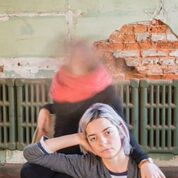
young me now me

Quit romanticizing whatever you had then. Whatever it was, you can always get it back again…

Several weeks ago I was on the phone with my sister.

She lives in Knoxville and among other things runs a business in which she sells delicious pastry treats under the aegis Dale’s Fried Pies. Her pies, I think, are something like my plays. They are the most obvious manifestation of what she does with her days. They, semi-imperfectly, become a container for her myriad of interests. They become a vehicle for the underlying questions she wants to explore. Anyway, Dale and I were on the phone several weeks ago. She was in prep stages for an official opening of a new building she and her husband purchased, renovated, and turned into a professional kitchen, office, art gallery and community space called The Central Collective. I was just coming off of opening The Children’s Hour at Ego Po and was readying to head into another tech this time at Drexel for some Halloween Lovecraftian silliness with my student cast for From Beneath It LurksDale told me about the myriad million little things she was discovering one needs for a building about to open to the public in a shmancy ceremony complete with a mayorial ribbon cutting: paper towel dispensers and garbage cans for example. I told her about the emotional drain of gearing up to head into another weekend of 12-hour days and lots and lots of light cues.

At some point, Dale said to me, “I mean it’s good. It’s not hard, really. Just busy. There’s just lots and lots to do. But it gets done, right? In some way it gets done.” At least, this is some approximation of what she said, to the best of my memory’s ability to recall.

And, in the best of my ability to remember my response, I stepped off the curb at Tasker and 10th as I walked to the subway and replied, “Yes. I mean, all the times I have down time and I’m dreaming about doing my work. All the times I’m imaging the future utopia I’ll be in when I’m making the art… This is it, I guess. It’s happening now.”

When I think back to the projects I enjoy the most in retrospect, the only thing I regret is that at the time I was so busy in the making that I often forgot to remember that I was there in the present tense moment. I’m so often imaging back to a bygone time when the work I made was younger, simpler, more directly created somehow or thinking ahead to a day when I’ll be making that ideal project in that ideal way with all the support and resource I don’t currently possess. It’s a comfort in some ways, this imagining that at some point in the past or future there’s this amazing thing. But it also means that that amazingness is never actually happening.

Has there ever been a milestone that when actually achieved felt solidly like the end of something, like a destination?

Maybe you all are better than I am but if I’m honest the answer is: Not for me. Too often by the time I’ve gotten to the thing I set out to do in some “back then” moment, I’ve already defined a plan and a road map to some other future moment when for sure this time it’ll really be the thing I need and actually feel like I’ve landed.

When was the last time you stopped for a second, a minute, an hour, and thought about the fact that the thing you always say you’re waiting for is in some way happening right this very now?

What if in that brief sliver of time we just all stopped to relax and enjoy our work in its present tensity?

For today, this is my mantra, however humble it may be: “This is it, I guess. It’s happening now.”

In Progress/Process

Recently, Swim Pony began work on a new project called THE END. Designer Maria Shaplin, Sam and I all gathered together to start imagining how we start a conversation about what it means to die. It’s rare that I write publicly at these earliest stages of process. Normally, this time is something protected, delicate, and I worry about exposing it to the light of the outside world.

When I write grants for THE END I start by saying things like this:

THE END is a blend of theater and game.

THE END is a personalized journey.

THE END is a meditation.

THE END is a performance for an audience of one.

THE END begins with an invitation:

An elegant letter arrives in the mail. It offers instructions for the first contact (“Sit in a quiet corner for three minutes in silence, then email the address below with the first sentence that comes to mind about mortality.”) At the bottom of the paper is a date and these embossed words: “This will be THE END. What happens between then and now is up to you.”

This kind of writing exemplifies the state of mind that I am in when I first begin a project. I start by defining the very biggest containers I sense the work will fit into. I write what I think I know to be true. I state what I hope the work will provoke. These large scale definitions, things like “meditation” or “journey,” help me define the texture of what is to come. I often talk about creating a litmus tests for the work generated: in the earliest phases I want to know if the play should taste like lemon, feel like sandpaper, or sound like the wind. At the other end of the spectrum live tiny moments, flashes of a stage image or the feeling of a particular moment for the audience, that I sense must fit in somewhere even if I don’t quite yet know how. This is how I can sense that I must create a fancy invitation or include a particular piece of music.

The work that follows these initial impulses is the slow meeting of the largest and smallest imaginings. The process is the slow and steady progress of filling in the middle.

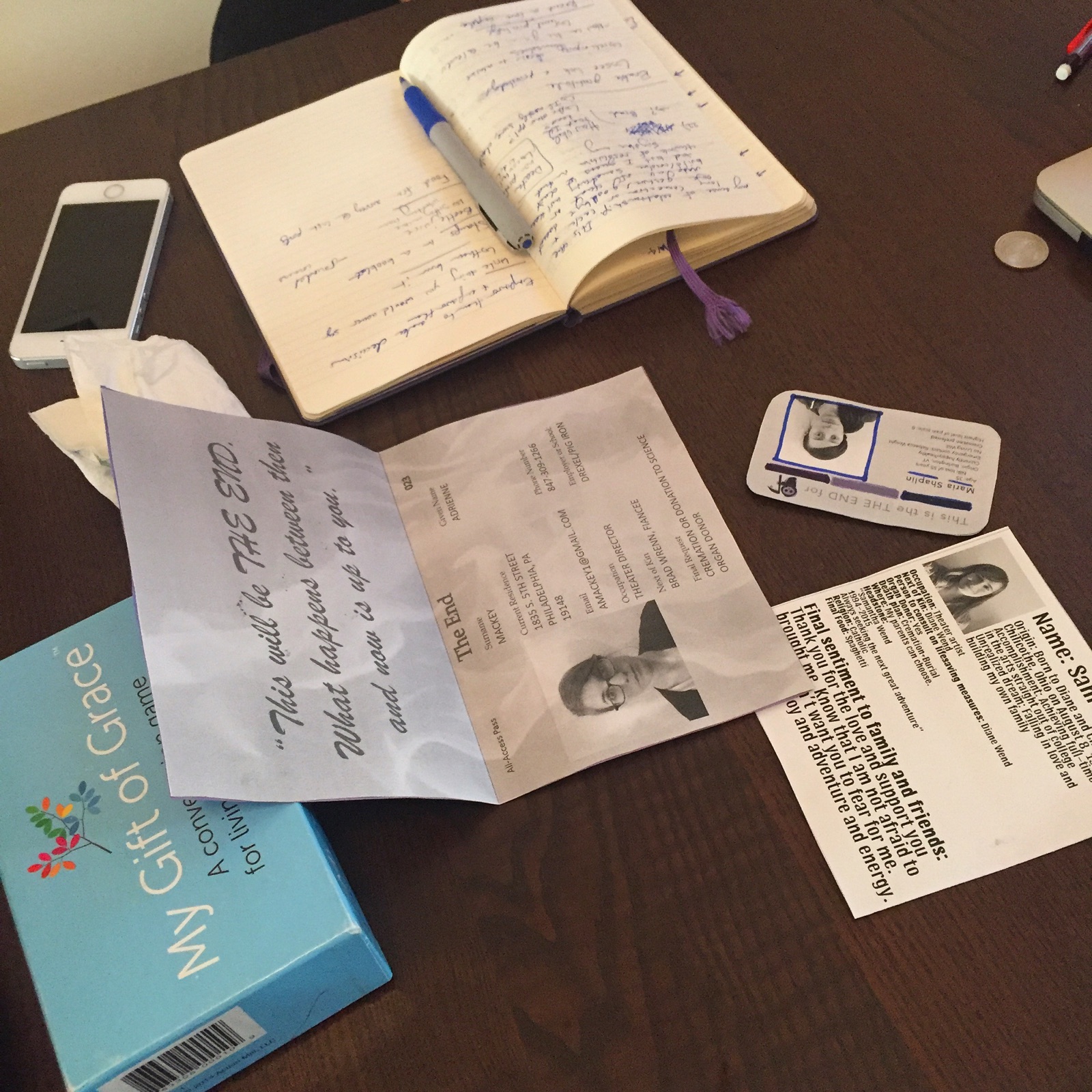
My collaborators and I begin by playing a game called My Gift of Grace. In it, we ask each other questions ranging from what fears we have about playing the game to what we want done with our body after we have died. The questions provoke conversations. They spin off into wild forests of feelings and beliefs. We can never manage to get through more than 7 cards in a sitting. There are 47 in the deck and we have made it to #23.

We write about death in 30 minute increments. The topics range from friends who have passed away to our beliefs about the afterlife. I recall the experience of seeing Paris’ Catacombs and nearly having a panic attack. I pull out the journal I kept at the time and transcribe words from six years ago:

It felt like palpable fear. Mostly, I just wanted to leave. I wanted to think of something ready to say about it (a real skill and crossbones, SO MANY FEMURS!) in case asked but mostly I wanted so much to be out and away. I simultaneously wanted to be close to the people I love most, to hug them, mesh into them, to prove we are in love and vital and alive and life seizing and at the same time throw away everything, my family, my relationship, all of it, and find something more REAL, to embrace and confront any doubt I’ve ever had and know that I’d feel more secure having been willing to give everything up to find the truth.

Later I make a list of all the things in my life that I remember dying, roughly in order:

  • My father’s father
  • My mother’s grandmother
  • My mother’s other grandmother
  • A kitten named Diva (hit by a car)
  • The class rabbit Thumper (in our backyard while we had him at home for the summer)
  • A caterpillar we wanted to grow into a butterfly
  • Another kitten named Diva (sick when we got her)
  • Two girls from my middle school killed in a fire (we sang for them a song in the choir concert)
  • Two green anole lizards whose names I don’t remember
  • A frog
  • Several fish
  • A cage of gerbils
  • A mouse
  • A boy from my high school (committed suicide)
  • My iguana Iggy
  • The plants in my college dorm room
  • A girl from my college (car accident)
  • My childhood cat Koko
  • My childhood dog Barkley
  • The plants in my first apartment
  • My childhood cat Jojo
  • The plants I planted in my south Philly backyard
  • My partner’s father
  • My partner’s grandmother
  • My partner’s childhood cat Mandu
  • My partner and I’s cat Tallulah
  • My childhood cat Bill
  • My mother’s mother
  • My partner’s grandfather
  • My father’s mother
  • My mother’s father
  • My mother’s sister

We play with spending 5 minutes in silence just allowing ourselves to think about a particular aspect of this topic and then writing in online dialogue with each other from different spaces.

passportsWe create questionnaires that try to capture the information one might need if they were to take a journey into such a land and create passports for confronting the underworld. Like some kind of Olympian god deciding the fate of an adventurer, we are uncertain about whether the player should be assured a road back out.

And by the end of these hours of initial work we send an invitation out to others to come and see some of what we’ve made. Tomorrow we’ll find out what works and what doesn’t, what gaps we made a little progress in closing, and which need more work to bridge all that space between the largest and smallest known quantities.

This is the way the work gets made, not in single genius leaps but in tiny incremental progress.

In process.

In practice.

In slowly figuring out how to take what is inside and make it manifest in the world.

– A

Let Me Tell You Why

Some days I wake up in the morning feeling excited and refreshed.

Take this morning for example. I sat down for my daily check in with my fabulous company associate Sam. We chatted about upcoming deadlines and big picture project dreams. I made myself a list of things to work on today including rehearsal plans for my new work with a phenomenally funny group of students at Drexel. I put together some notes for an upcoming grant. I wrote a letter to a collaborator from my recent directing freelance gig for Ego Po.

I was doing things that were adding up to a happy and productive art-maker’s day. Things that would never lead me to think about the fact that being a female creator might put me at a disadvantage in my community. Too bad then that I had to go and read the Inky’s review for Luna Theater Co’s current production of Animal Farm.

I’m not linking to it because I don’t want to drive up the readership stats but I’ll summarize and quote here the relevant stuff. If you really want to find it, you can look it up online.

The review begins with an overview of Orwell’s story and then follows up by saying that the production’s performances (carried out by an all female cast) are genuinely terrifying and display a “startling physicality.” It cites some issues with direction and overall vision. It says that two of the performers Michelle Pauls and Tori Mittelman are both “brilliant” in their ability to “contort themselves by gait, posture, tone, and expression into pigs.” The review rounds out this first half of the review by stating that the “six actors craft stunning physical performances.”

I haven’t seen this show. I have no idea if these are accurate assessments of the directorial issues the reviewer hints at. I have no idea if the performers are “stunning” or “brilliant.” But I do know that up to the halfway point I was reading an article about a classic work performed by an all female cast that hadn’t yet cast aspersions on the quality of the project simply based on the performers’ gender rather than their unique and individual abilities to carry out the roles for which they had been assigned.

Some days I read about productions doing things like this and I see reviewers manage to actually see female artists taking on roles traditionally walled off from them by the default power of the canon just as “artists” that don’t need to be defined by gender. Some days I see such reviewers not remark or wonder whether female performers are equally capable of taking on such roles. Some days I think, “Gosh, maybe there is hope to finally just erase that Smurfette Principle “men will always and forever be the default” thing. Some days I start to think that maybe we don’t need to just wholesale throw out the canon because maybe I’m thankfully wrong in my fear that it’s just too hard for people to re-imagine stuff that comes from a time of straight white cis-male privilege into a world where we all see that straight white cis-male privilege should no longer be the case.

Today, alas, is not that day.

Because after citing the power of these particular performers for several paragraphs the reviewer gets to the crux of his review. After stating the terror induced in the audience through the performances the reviewer begs a question:

The only question is: Why?

And following that question there are a lot of other questions. There are plenty of these I have no problem at all with. There are plenty of these that I think are great questions to be asking a contemporary theater artist making a modern adaptation of a work from the past. Questions like:

Why create one disturbing moment after the next without offering more than the horror of slaughter?

And:

Why unleash Pauls’ fear-inducing portrayal to prowl the stage, appear at random like a spy, direct the atrocities, if only to terrify in the abstract, and point no real or allegorical fingers at modern targets?

And some days I might have read this review and its thoughtful questions been able to move on. But today that series of questions also had to include this one:

The only question is: Why?

Why cast all women as animals clearly identified as male in the book?

Perhaps I might respond to this particular rhetorical question with a bit of rhetoric inquiry of my own:

  • Why do you need to lump useful negative criticism about directing choices and staging with a comment on casting choices that create more inclusivity and space for female creators?
  • Why question such casting when you just called their performance abilities “stunning” just a second ago?
  • Why are you subtly implying a director ought not cast people with “brilliant” acting ability for a particular role simply because they do not posses the talent-irrelevant attribute of being a dude?
  • Why would I bet a million dollars that you would never ever ever ever have commented on an all male casting even if it meant a cross-gendered Muriel the goat and Clover the mare?
  • Why do pigs and cows and horses and donkeys need to be so obviously gendered to be performed well?
  • Why does a pig’s gender even matter when animals are clearly being used as an allegory anyway?
  • Why do I have to sit here for an hour and wonder if this stupid random sentence is an emblem for the embedded anti-female sentiment that runs deep in our creative community?

Back to that original question:

Why cast all women as animals clearly identified as male in the book?

Because if we don’t fucking figure out a way to get women’s voices and perspectives into stories from the past that previously excluded them then as we inevitably progress to a more equitable and just society where female voices are no longer marginalized we will have to ditch this shit into the garbage bin because apparently you’d rather do that than find a way to modify such works to be more inclusive.

That’s why.

That tiny line, one in an otherwise unremarkable and potentially totally relevant review, bothered me enough to take an hour out of my day to write this. That’s an hour that could have gone to raising money or researching or admin upkeep or even just farting around on the internet. Instead it went to venting frustrated feelings so that I didn’t feel like I had to just sit there and take casual undercutting of female bodies being represented on the stage.

Some days I wake up in the morning feeling excited and refreshed. Some days I manage to put my nose the grindstone and define my work path and get shit done and make some amazing art. Some days I manage to do all those things without someone making a comment in a public paper of record that makes me stop and write a blog post about how much better we’d be as a creative community if they didn’t make an offhand comment about how my gender isn’t as useful a default as the male one.

Today, alas, is not that day.

– A

The Awesome Lady Coefficient

When I was growing up my mom, a family therapist, used to talk about the problematic representation of women in The Muppets.

I’ve felt a lot of ways about this at different points in my life. On the one hand, I totally get that it’s super crappy to have the extent of a gender be portrayed as mean/bossy, blonde/ditzy or chicken. This is why I advocate so hard for gender parity versus representation. Some women are blonde and ditzy or mean and bossy or chickens. But when you have so little room in our cultural narrative space, when this is the only version of women we see, these limited categories that appear again and again get really problematic. This “tokenism” and its cousin The Smurfette Principle are pernicious and pretty widespread in many parts of our cultural consciousness.  So in that sense I am one hundred percent with my mom.

On the other hand, The Muppets.

And this is the thing. It really sucks to be the person who has to fight the silly, sublime and nostalgic force that is this thing that Jim Henson made. It’s so freaking difficult, in the face of something that you agree is wonderful in some ways and that you see is wildly commercially successful and popular, to try and fight for conversation space about the other ways in which it’s hurtful and plays into larger forces that harm women and misrepresent them. (Shout out to Katherine Fritz who wrote a lovely essay about this.)

Harder still, is the moment you have to decide if you want to be the proverbial Smurfette. Or direct her in a show. Or sign on to light her. Or whatever your part in the larger creative system might be.

This is the sticky place where our theoretical desire to stick to our Awesome Lady principles is put into real conflict with our day to day artistic and professional goals.

It sucks.

There’s misogyny for you. Pouring a big bucket of suck on everything.

And part of that bucket of suck, part of what sometimes happens, is that it’s super hard in the moment to figure out how to balance those two conflicting considerations.

Obviously, if there’s a project where you make a million dollars starring in the most artistically fulfilling role but there’s a tiny imbalance in the casting ratio (let’s say 5 dudes to 4 ladies), you might figure it’s still worth it. And just as obviously, if there’s a crap no-line female part with no pay and no audience and the play is about how stupid and terrible women are and the director likes to point out how much he thinks this is true, you might realize there’s really no reason to do this horrible thing.

Actresses out there, can you feel the tiny niggle inside of you that is still considering that second option?  Just sayin’…

I think this instinct to jump at any and all work is part of how a perceived lack of agency pressures us into doing things that are against our ethics, don’t give us artistic fulfillment, and don’t even pay us. It’s as if any work is better than nothing at all.

I don’t buy that.

I think there is a reasonable estimate we can make of the artistic and/or professional merit in a potential project. I also think that it is possible for the problematic ethics of something to outweigh that artistic and professional merit if the problematic nature is problematic enough. What we need then is a living artist’s guide to figuring out how to measure those relative merits and ethical levels of importance – within ourselves and for individual opportunities – and come up with a way to help us gauge the overall worth.

Which brings me to the most recent meetings of The Awesome Lady Squad.

We started with exactly this question. We have internal values we want to uphold. We have a lot of factors to consider – factors of age, demand, opportunity, etc. that all play into how we make choices.

So we began by trying to define a methodology for determining the merit of a project divorced from our Awesome Lady ethics. We looked at Neil Gaiman’s great speech that includes the metaphor of a “mountain” that artists are climbing. We tried to come up with concrete categories for this inner intuitive sense about whether a project is taking you “up the mountain” or down. We chatted about the ways that different things matter at different times in one’s career, how a solid day job may make the “money issue” shift, and how we each differently balance the relative weight of artistic merit versus professional development.

We came up with four factors that any opportunity can be evaluated under:

  • Professional Development (P) – i.e. street cred. Will this be a high profile gig that leads to more work? Is it with a big name company that will look good on the resume? Is it an internship that might not pay well but will give you access to a desirable new skill set?
  • Financial Compensation (F) – i.e. money. Does it pay well (especially when broken down by the amount of money for the total time you will work)? Is it a job that might bring in income over a longer time frame?
  • Artistic Merit (A) – i.e. art. How much do I respect and get behind the vision of this work? How much does it allow me personally to fulfill my artistic expression?
  • Interpersonal Dynamics (I) – i.e. people. Do I like my collaborators? Who is in charge and how much do I trust them? Is this company one that’s easy to get along with? Are there non-artistic partners I need to interact with and do like them?

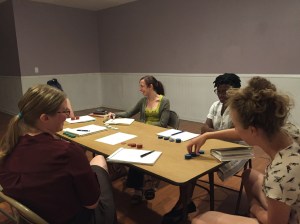
We had everyone rate the relative importance of these areas for themselves at this moment using 20 “value” points to create relative weights for each aspect of influence. We each used 20 poker chips and had to divvy them into piles for each category. The total chips in each pile became coefficients (i.e. fixed numerical values) that were used later in our larger equation.IMG_5033
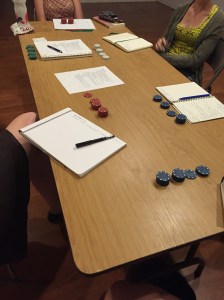
Even doing this caused some of us to rethink. I thought my artistic merit category would be far and away the highest. But when I really thought hard about choosing a project, I realized that personality and chemistry with my collaborators is nearly as important and that I feel like I can’t get to that artistry without an ability to groove and talk to the people I’m creating with. Either way, these numbers gave us constants that would stay the same, standing for our core values when it came to evaluating a project.

Armed with this info, we talked about people’s actual upcoming opportunities and tried rating them in each of the four categories. We used a scale from 1 (perfectly advantageous) to -1 (totally detrimental) with 0 being neutral. While it was easy to freak about what we didn’t know, we made our best guess with the info we had. In some cases it also spurred the person to see where they really needed to find out more (about fee or the company’s street cred) to be able to make a more informed choice. We found it helpful to start from the middle and move up or down based on subjective factors you consider.

And then we created an equation that uses these numbers and pops out a score. To do this yourself multiply your four personal value numbers for each area (each some portion of 20) with the specific project’s strength or weakness (from 1 to -1) and…

Voila! An objective measure of whether you should do this thing or not! Like a pro and con list on steroids. For you math heads, here’s how we wrote it as an equation:

(P * P’) + (F * F’) + (A * A’) + (I * I’) = Overall Project rating
NOTE: In the above P = Professional Development value to you generally and P’ is the value for the specific project.

And then we came up with a scoring system:

  • Negative: Don’t do it unless you can adjust something to bump the result positive
  • 0 – 5: Only nominally worth it. Might be worth considering saying no if you’ve got a lot of these on your plate so you don’t end up at burn out.
  • 5 – 10: Decent. Barring another great project this is likely worth your time, so long as it’s in balance with other stuff and your life.
  • 10 – 15: A pretty sweet spot. This is where the work is satisfying and sustainable.
  • 15 – 20: A mountain-climbing fast track. Chase this stuff as fast as you can.

“But, wait!” you might be saying. What about all that Muppet and Smurf stuff from the start of this blog post? Where’s that factor for Awesome Lady ethics? How do we include the value of projects that advance or detract from our Awesome Lady principles?

I thought about one project in particular, the statistic project I did a while back analyzing data on female creative professionals in the Philadelphia theater community. This project, if looked at only in terms of the equation, would be massively negative, a definite no-go. It made me no money and took time away from finding projects that might. It offered no professional advancement because if anything I was a little nervous it might put people off of working with me if I’d criticized them. It had no interpersonal reward because I was all alone and had no obvious artistic merit because it was all admin.

Using my value numbers and the equation I came up with a -5.  A total no, right?

Well obviously (Awesomely) not. I loved this project. I talk about it all the time. It is still super meaningful to me as a female creator, even if some part of me saw that it took time away from all those other things. At the moment I did it, advancing the Awesome Lady cause was front and center in my mind. I was doing a lot of writing. I was feeling really frustrated. I felt a strong need to make a dent in the artistic world for Awesome Ladies.
ALS 07.21Clearly there’s something else bumping my equation into strongly positive territory.

And what about companies where the people are nice, the money and professional advancement is good, and the shows have lots of artistic merit in most respects but you just can’t help noticing that all the folks running things and all the writers being produced are male, most of the designers and actors are guys and the voice of women in the artistic process feels shut out? Clearly, even though there’s lots going right in a situation like that, there’s something else that needs to weigh in to reflect this complicated picture.

How do we rate such a thing?

By using the Awesome Lady Coefficient!

Without it, a max score for an opportunity is 20. This is a project where everything is perfect. So let’s say you are in a theoretical world where you rate the project a 20 in the money, professional development, artistic merit, and interpersonal categories, but the project is undeniably misogynist. If you could shut your eyes to that one aspect, you’d love doing this, but the message, the gender makeup of the cast/crew/production team, the way that females are paid compared to men, and/or all the little ways we subtly make female creators feel less than their male counterparts is glaring to the maximal degree.

The way we’ve defined the Awesome Lady Coefficient (ALC) is to say that at its maximal level, a project at a perfect 20 when confronted with the maximal frustration of gender inequity and discrimination becomes neutral. In other words, the max of the ALC is 20. And you can rate a given project or opportunity on that same 1 to -1 scale. When you add it into the equation it looks like this:

(P * P’) + (F * F’) + (A * A’) + (I * I’) + (ALC * ALC’) = Overall Project rating including assessment of project’s gender equity ideals.

Knowing how to factor in your desire to make that ALC value something specific and as quantifiable as money is important. It allows you a chance to look clearly at the hidden cost of projects that make you feel like you’re compromising your ethics. You may not rate the coefficient at 20. For a lot of people they might want to but find that doing so is just too tough right now. We’re not here to judge, but we do think it’s useful to note that if a project doesn’t come up positive unless that coefficient comes down near 0, there’s some thinking to do. And if you are consistently in a place where you never raise that ALC number into positive territory but say that you’re an Awesome Lady ally then there’s some thinking to do there as well…

It also means that if you REALLY want to say yes for the other reasons, maybe you might have a conversation that shifts the project or your role in it in a way that helps raise up the ALC factor so it’s more agreeable. That might be requiring conversations around problematic stereotypes in rehearsals or with audiences, asking to audition for a part that doesn’t include a rape scene, requiring a female AD or dramaturg to be a part of the show’s development so there are non-performer female perspectives in the room.

And maybe, sometimes, it’s a way to help justify the saying no to something that seems so logical but for the fact that it really messes with your internal sense of ethics. It’s a way to validate that inner voice that often gets sidelined with other people’s “rational” choices.

It’s a way to help yourself clean off that bucket of suck and grab back your own agency.

Even in the face of powerful forces like Muppets.

Or Shakespeare.

Or artistically stellar companies that overwhelmingly produce male playwrights.

It’s a way for you to own your own values and figure out what part of these complicated legacies you want to be a part of.

Just another day’s work for the Awesome Lady Squad…

– A
PS – We’re thinking about expanding this into an interactive app that will let people adjust these numbers and calculate the math automatically. If you know of someone that might be interested in designing such a thing, hit us up at swimponypa@gmail.com

Week 6: Sharing “Drawing Sounds”

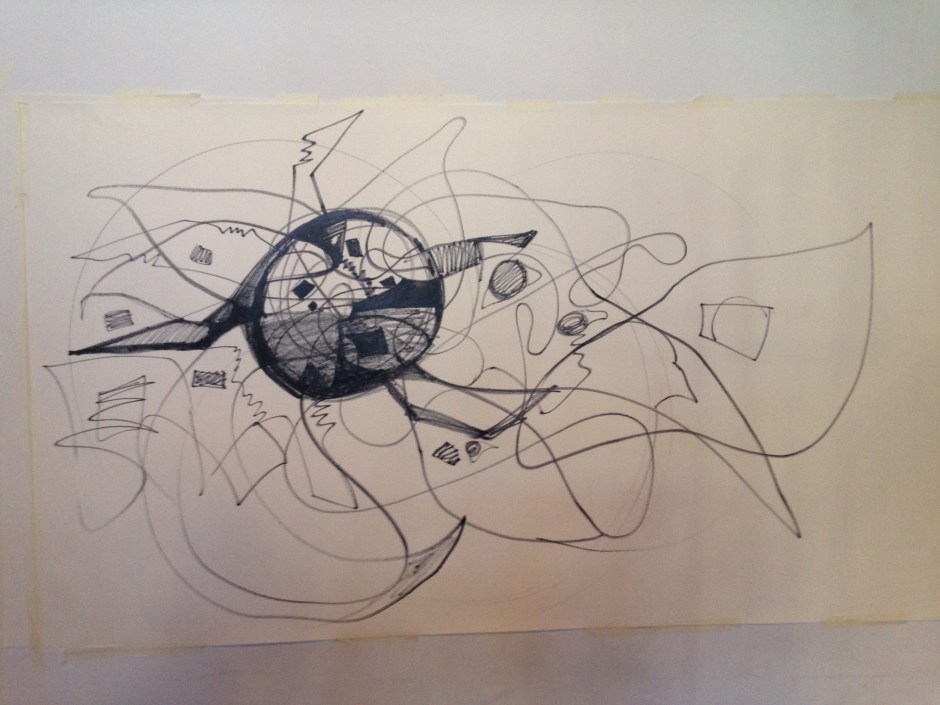
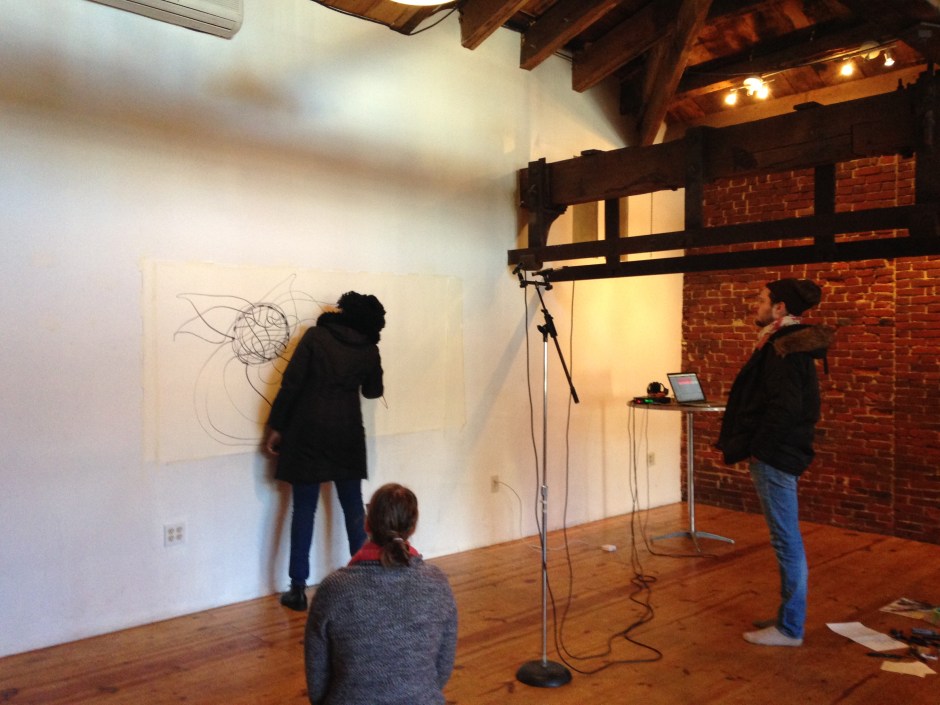
Below is the digital sharing from Lyric, Mike, and Adrienne’s collaboration. Enjoy the binaural sounds of this drawing best by listening with headphones.

This digital recording was made during the creation of this image:

IMG_1099
IMG_1095

If you’re interested in reading more about Lyric, Mike, and Adrienne’s work together you can check out Arianna’s short essay “Seeing Sounds, Hearing Shapes,” or Adachi Pimentel’s photography. If you’d like to learn more about the collaborators, check out this page.

Week 8: Sharing

Below you’ll find the digital sharing of Jaime, Magda, Chelsea, and Adrienne’s week together. It’s titled Shame, and features pictures taken by everyone in the group as well as an original story by Jaime. We recommend you view this book by maximizing this pane on your screen, and scrolling.

If you are interested in reading more about this week’s collaboration, check out Arianna’s short essay, “Exploring Shame” or take a look at Adachi Pimentel’s photos from the residency. To read more about the artists you can check out their profiles here.

Week 8: Exploring Shame

Jaime Alvarez, a multimedia artist and photographer, Adrienne, and Magda San Millan and Chelsea Murphy (aka Magda and Chelsea), dance and performance artists, came together for a week to think about the performance of shame and depictions of shame in art. How do we document shame? How can we recreate the feeling of shame or inspire it in others?

Early in the process, the group came up with the idea to create “still life images of shame,” brainstorming ideas about specific gestures or situations that might communicate that emotional state through art. Examples included images in which people were laying face down on the floor, hiding their face, or looked as though they were “caught” by the camera. The group was also interested in creating images of things that “might feel shameful” while making them feel “soft or inviting [by] diffusing them with pleasure.” Interested in experiments that would integrate elements of vocal improvisation, performance, movement, and photography, they set out to find ways to expand their own perceptions of live performance and photography. As a witness to this process, I will offer some insight into the exercises they performed during the course of their research, as well as what was going on just outside of the frame of some of the photographs captured in their sharing, here.

A brief critical context might help frame the experiments they conducted throughout their collaboration. Conversations throughout the week coalesced around the differences in both temporality and subjectivity between live performance and photography. Live performance disappears as it is happening; those exact moments in time can never be recreated or repeated. Photographs, however, are indexical signs of the past – they capture a moment “as it was,” preserving it precisely and in perpetuity. Similarly, as a medium, performance capitalizes on the subjectivity of individual performers while photography has the power to objectify and reproduces subjects. These distinctions prompted them to explore how they might combine live performance and photography in ways that challenged the traditional intersection of these two mediums: bad PR photos. What could they do instead of using photography to document or prove the existence of performance?

As a way through this question, the group experimented with “translation.” What if a photographer listened to a violinist, then used photography to recreate that music without capturing the actual violinists’ performance? As much of Jaime’s previous work proves, photography can be used to create art that is non-literal and non-documentary. The group brainstormed ways to use photography as an instigator, and end-in-and-of-itself.

The early exercises the group worked with were movement and vocal improvisations. Magda and Chelsea lead the group in exercises that required a leader to influence the movements of their follower with touch, and later, sound. Leaders would translate an impulse they had into the body of their follower, concentrating on different touch and sound qualities. A brusque or rough touch might inspire a skeletal or jerky movement, while a deep sound may encourage a follower to sit down or plod forward in a heavy way.

The group continued to explore the interactions between live performance and photography, creating movement-photography duets. One person was directed to move or complete a series of actions, while the other would follow with the camera.

Chelsea and Magda created a movement piece in which Chelsea moved throughout the space while Magda followed her with the camera. It was fascinating to observe this documentary dance, noticing the ways in which the framing impulse of the camera influenced Chelsea’s movement in the space. At which moments was she most conscious of the camera’s gaze? How was she responding to Magda’s efforts to frame the photograph? Magda’s dance as she maneuvered the camera was not captured by the camera’s lens. Instead, her movements are recorded by the perspective of the images in this series. This photo series is the translation of a movement impulse into a photograph.

Screen Shot 2015-07-06 at 9.51.20 PM

Another translation exercise required everyone to think about what they are ashamed of and prepare a self-portrait. Chelsea drew a picture of herself, titled “Vapid Teeny-Bopper Portrait”.

IMG_1199

Here’s what she had to say about the drawing:

Chelsea Murphy: I am small and I’m cute on the outside, but on the inside I’m not cute. Sometimes I don’t even feel like a girl. I am bigger than that. I’m like a young boy and a grandma. I counteract my outside by taking up more space. I’m really afraid of being called stupid or ditzy, I make my voice lower. I try to own the bigness of me.

Arianna Gass: Why did you draw such big eyes in your photo?

CM: I feel like big eyes make me look like a little stupid girl.

AG: And the headphones?

CM: That’s a teeny-bopper thing. The thing I’m shameful of is that [this picture] exists in me. I didn’t expect to feel shame [while] taking these photos, but I totally did.

Taking her drawing as inspiration, the whole team worked together to create a “shameful” scenario for Chelsea. We had 90s pop music playing loudly, we gave Chelsea some gum to chew, Magda chose her dress, and everyone shouted encouragement as she posed for the photograph. Here’s one of the shots:

Chelsea

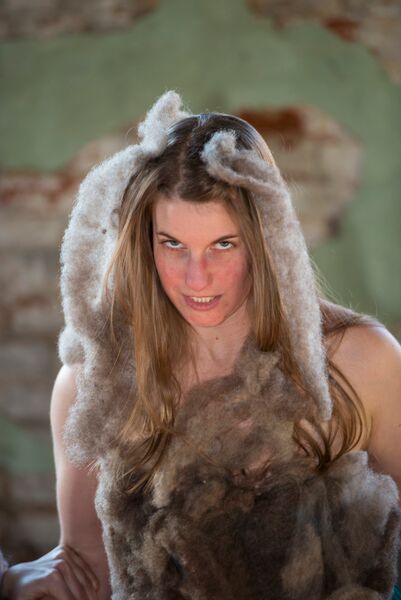
Sometimes, these shameful photos took more than just a scenario. Adrienne’s shame portrait was about being “afraid that I’m a huge giant that crushes things, that I’m too big, I make big sounds.” She had brought in an assortment of objects that evoked shame, including a box of jewelry she had broken on stage while performing as The Truth. Magda commented that if Adrienne was afraid of being too big, she should pose in a “barbaric” way. As we had with Chelsea, we costumed Adrienne and got her to pose in front of the camera, but a costume, some music, and encouragement weren’t quite enough. As Jaime captured the photographs, Adrienne started to sing opera. Soon, Magda and Chelsea hung off of her arms, just out of frame. We had Adrienne bang loudly on a drum. It was not enough to create the situation – she had to perform it.

AdrienneBarbarian

As the group continued to work together, they experimented with more photo series, both posed and improvised, that included aspects of shame and the translation of musical or movement impulses into photographs. Photographs of Kewpie-doll Magda; hair, both chest and pubic; bare bellies and butt-cracks were the results of this work, and they all proved that photography could augment live performance, working in more than just the traditional documentary realm.

In several photographs, they demonstrated the ways that photography could capture what was never really there, or erase what exists.

blue cloud

no head

They also showed ways in which photographs could tell a story, and how the modern dance structure of accumulation could manifest itself visually.

Screen Shot 2015-07-06 at 10.44.29 PM

Screen Shot 2015-07-06 at 10.45.11 PM

This residency week culminated in the creation of a “story box of shame” – a series of photographs and one transcribed story that evoke and invoke elements of shame. The box is like a Flux Kit: a mixed-media experience that encourages participants to excavate their own feelings about shame. Shame is a floating blue cloud or disappearing white glow. It is exactly how dumb we look when we are dancing, or moving, or singing, or smiling. It’s what we fear we are, or know we aren’t, but still think about sometimes. The box (or digitally, the PDF) is more than a record of this collaboration. Its a short performance, an uncanny dance of those things that we hide away, that make us blush, that beg for a second look.


Arianna Gass is a recent graduate of Vassar College. In addition to documenting Cross Pollination, she is the Program Manager for Drexel University’s Entrepreneurial Game Studio. Her own art practice is located at the intersection of digital and embodied play, and her scholarship focuses on feminism, performance studies, and game studies. You can find more of her writing and work at www.ariannagass.com.

Coming Soon: The Summer of Play Play!

There’s this term I use for plays that I think epitomize the passive theater experience: Play Plays.

In the past, when I’ve used the “play play” term I‘m generally making fun of a kind of play that exists in a very narrowly defined idea of theater one that, in my opinion, doesn’t makes the full use of the superpowers of a live medium. I’ve been thinking a lot about the word “play” in the last couple years and in particular about the ways our “plays” contain very little “play” for the people we invite in to experience them. I’ve been looking to games as inspiration for how theater might learn to do things a little differently. Lately, I’ve realized I need to do more than just read about these ideas, I want to put them into action.

So! This summer Swim Pony is going to re-define it’s own snarky definition.

We’re launching “Play Play”: an exploration of theater and games in collaboration to find whatever engaged and play-full experiences might be possible. We’re inviting anyone interested in the intersection of games and theater as an avenue for play (play) to join in on an open-source six week research and exploration project. What exactly does that entail?

Throughout June, July and August the Play Play team will meet up six times for 2.5 hours, the first half for research and discussion and the second for on the ground trial and error in the real world. This is pure research, no final products in mind here. We’re just interested in learning more about what’s out there, and conducting some simple experiments in real time. Swim Pony will offer up a meeting space, some snacks and a little cash if an idea simply needs some resources to come to completion. Meetings will be lead collectively and topics of interest decided together.

So if you’re already looking into game and theater hybridization or if you’re just intrigued by the idea look at the dates below and email swimponypa@gmail.com with your name, preferred email and a few sentences about why you’re interested.

Participation is free and selection will be first come, first serve-ish. (What does that mean? Mostly, if you email first you’re in! That said, we want to create a balanced group, ideally with a variety of perspectives and experiences so we’re just being upfront that we reserve the right, if we have to cap, to pull from responses with an eye for group diversity.)

Can’t take part! Have no fear. We’ll chronicle the work and share a post on each week’s discoveries on the blog.

THE NITTY GRITTY DETAILS

DATES: Mondays June 22nd & 29th, July 13th & 20th, August 3rd & 10th. All from 10am – 12:30pm. YOU MUST AGREE TO COME TO AT LEAST 5. Everyone gets one off but the idea of this is to get a running convo, which isn’t possible if it’s too hodge-podge attendance-wise. If you need to miss one please indicate the date in your email.

LOCATION: TBD depending on size. We’ll let you know.

Best!

A

8 Steps To Actual Actual Innovation in Arts Funding

A few years after I first started working in theater I ADed under a director who used this phrase that I love. When he was trying to uncover something about a moment, get at what the character was doing, he would say something like, “So what’s actually actually happening is…”

I love this turn of phrase, actually actually, because I think it speaks to the layers of honesty with which we communicate. There’s a way in which we might say we’re doing something but actually actually we’re kind of doing something else. Like when I say that I’m working all day on a grant but actually actually I’m equal parts answering grant questions and distracting myself with games on my phone or reading emails that I don’t really need to look at. It’s not malicious, this uncovering of my real activities but it does show the ways in which we label our actions in ways that aren’t always inclusive of all the forces working on us. I’m not on the internet because I don’t want to write the grant, I do, I just also am tired and really enjoying unlocking the secrets of Dwarf Complete.

Actually actually is a manifestation of our actions in the most literal and concrete sense of themselves. It strips them of their highfalutin’ intentions and gets down to the nitty gritty of their real intents and their actual (actual) effects. It shows that our motives are often more complex and human than their purest descriptions.

Sometimes I wish I could ask arts funders to tell me what they actually actually want.

In my anecdotal experience, when people give away large amounts of money there’s what they say they want in their beautifully crafted guidelines and then there are the means by which these funds are dispersed. And a lot of the time, the stated want isn’t actually actually best engendered by the means in which things are executed.

I don’t, truly, honestly, think this is malice. I know as artists there are times it can actually feel that way. But I really don’t think it is. That said, I think it’s useful for us to remind ourselves of the difference between what is said and what we feel like we actually actually see. It keeps you sane. It keeps things in perspective. It allows you not to get caught up in rage when you feel like you are held to a standard or desire that’s not always what is shown on the surface.

This isn’t true across all my experience, and it certainly exists at a lot of levels of divergence from that first actually to the second. The one that most gets me though, the one I find the most often frustrating, is the call for “innovative” art. Innovation is a tricky work. It is grounded deeply in risk. It requires, by definition, newness and the encountering of the unknown. It is something encountered for the first time. All of which is very hard to explain in a clear and delineated narrative six months, a year, two years before the innovative thing is going to take place, before its component pieces are thoroughly explore and identified, before its map has been charted, before experiments have been conducted to test hypotheses. By the time these kinds of things are known, the actual innovation is already over.

You can court the unknown, or you can have a steadfast plan carried out without alteration. You can scientifically journey into unfamiliar experimentation or you can seek the rigorous and practiced craftsman to execute his skill. These are both interesting and potentially worthy things. But in actual actuality they are a non-overlapping Venn diagram.

I understand the desire to know things, I do. But you can’t have it both way my darlings. Or rather, you can, in a way, if you pretend it’s possible and leave it to those actually executing the thing to try their damnedest to pull those two circles toward a tiny space of intersection. It’s a lot of work, that pulling, work that I’d say is better served elsewhere, like actually actually implementing some innovation.

My guess is things won’t change soon. But if someone else’s giant pile of money were up to me, here’s how I’d actually actually propose to get there:

 ADRIENNE’S LIST OF FUNDING PROCESSES FOR ACTUAL ACTUAL INNOVATION IN THE ARTS

1.   WHAT: Give $5,000 to the first 25 people under the age of 30 that ask for it. No questions asked.

WHY: First off, in the grand scheme of things, this is nothing. This is one not that large Pew grant. For reference, my very first show, THE BALLAD OF JOE HILL, was made with $1,500 and it launched my career into an entirely new orbit. Think about what 25 upstart artists could do with 5K. Plus, if they ask first they’re likely the most shit-together folks of this age set.

2.    WHAT: Rent a rehearsal studio space for a year and give away 20 hours worth of time to anyone that asks for it.

WHY: Space is one of the first thing that starts costing you money fast and it’s especially hard when you are at that stage where you’re in total blank canvas mode. It feels decadent and wasteful to sit in a room you paid for without a plan so often this time, which is actually the most important, happens in the cracks and spaces between “real” rehearsal.

3.    WHAT: You want fancy video work samples for grants? Hire a staff videographer and pay for them to shoot and edit the work of people in the Philly arts community.

WHY: The cost of a staff person like this is likely akin to one big grant to a large organization. Pay for this instead and you will get better work samples. You won’t have to keep telling artists we’re not spending enough on videographers. You won’t have us waste our time developing the skill set of videography and editing when we could be making stuff.

4.    WHAT: Democratize the grant writing process. Hire a staff that crafts the language submitted to the panel or board for every applicant. If you need to offset this cost have them work on a commission basis commensurate with budget size.

WHY: It is true that an individual artist might have a project as worthy of funding as a huge non-profit. But the chances that a solo creator has a whole paid staff of grantwriters is nil. So in essence, a huge part of what you’re actually measuring in the grant process is the monetary reach of the applicant and not the actual artistic ability. This is campaign finance reform 101. If everyone has the same writer, then the projects will actually be presented in a fair and equal way.

5.   WHAT: Fund an entirely “research” based phase with no require showings or products other than to document what happened and share that with the artistic community.

WHY: This is the thing that the academic weight of science has over the arts. People believe that research for research sake is valuable WHETHER OR NOT IT BECOMES A VIABLE PRODUCT. Scientists know this. They know negative results aren’t failures. I think artists know this but they get so beaten down about it that they forget. What if we got to go and sit in on rehearsals for each other or read papers about the questions other companies are asking and the methods they use to do so? What if we had a peer to peer exchange system the way that the scientific world does? I bet we’d all be a lot artistically richer for it.

6.   WHAT: No project grants. For 5 years. Only operating support.

WHY: Seriously. You all know. I don’t even need to explain this one.

And while I’m at it:

7.     WHAT: Stop dictating how to spend the money. No required areas. No explaining if you have to shift money from one place to another.

WHY: Do you know about these folks: https://www.givedirectly.org/operating-model.html? Their aim was to benefit the extremely poor across the globe. There are lots of charities that decide how exactly poor people across the globe ought to make their lives better and allow people to give them a cow or build a school, or whatever. In most cases the funder is telling the person who could use the funds what method would be best for the person to improve the person’s life. Sound familiar? These folks thought to themselves, “Hey. Who knows better than the actual person how they could best make their life better.” In other words, they assumed that person was as intelligent and capable as they were, just in need of the funding. I think we need to start imagining a world where artists just get to use money for their art in the way that they see most efficient towards making their art. Because if we believe they are smart and capable creators, why would we assume they don’t know where the resources toward their work ought to be best used?

And lastly:

8.    WHAT: One year, forget about trying to define “excellence” and just give all the money out by random lottery.

WHY: It was a real lesson in what a little but of status can do when my recent War of the Worlds collaboration was picked up as the mayor’s selection into the Bloomberg Public Art Challenge. Comparing the way people talked about the project with my collaborators and I before and after someone decided it might be worth a million dollars showed that so much of the perception of “value” and “quality” is intensely subjective. If we could just try democratizing this for a year, we might end up with people that would never ever seem like they would deserve that money, but absolutely blow us away with what they are capable of.

I’d even propose that if we took one major funder’s pool and did this instead of what they currently do, we wouldn’t even need more money. But I bet we’d have a whole lot more actual innovation

That’s all for now…

A

A Million Female Gandalfs

Today I had my final class of the semester at one of the schools I teach at. For the final of Voice for the Stage, I ask my students to perform a monologue they’ve worked on for several weeks in the large mainstage theater in front of each other. They pick their monologues themselves; I allow them to be from movies or television, from a favorite play, anything that they are genuinely interested in. I do this because it’s a chance for these learners to test their abilities, honed over the last 14 weeks, to offer up the stories they’ve chosen to tell via their bodies. I want, and encourage them, to choose words they feel will be thrilling for them to inhabit. It’s a chance to see if the class has helped them in transmitting those narratives’ feelings and emotions out of their imaginations, through their voices and out into an audience.

Today a girl stepped onto the stage and performed a monologue from Lord of the Rings, playing the wizard Gandalf.  I think about the fact that a year ago I was watching another girl performing another Gandalf monologue during this same culminating performance day and that earlier this semester I also saw another female Gandalf at a different school.

I think about how every single year there is a female Gandalf.

Last week, I sat in my living room and heard six fast and sharp pops from somewhere to the south and west of my window.

Oh no, I thought. I know what this sound is. I hope it’s something other than what I think it is, but if I’m honest I know exactly what this sound is, and still I keep working, hoping somehow that I’m mistaken until minutes later I hear the parade of several sirens in the distance and I can’t pretend any longer that what I already knew I knew wasn’t true.

In the moment I’m afraid, I’m scared, and I’m sad.

I think, I should call Brad and make sure he’s ok. Even though I know he’s at the theater, having left nearly 40 minutes ago, I should still just check and make sure.

I walk to the window and I see two police cars parked on the corner and several police walk into a mini market. Moments later I see several people, males of varying ages from teenager to thirty something adult, all walk quickly out of the store. They’re all African-American. They’re looking at their phones. A microsecond-long thought passes through my head, “What are the police doing? Why aren’t they stopping these men? What if they need to question them? What if they’re involved?”

This is the first thought that instinctually comes into my head. That they are guilty. It isn’t one of reasoned or rational thought. It’s gut reaction. It’s fear. It’s instinct. It’s the first story that comes to my mind.

A moment later I’m examining that thought, the first that flashed in my mind and I feel disgusted with myself.

In that moment I say, literally, as in actually I saw to myself out loud to the room, “What is wrong with you Adrienne? Why would you think that?”

I think, Why is the first narrative you’ve built around these humans who are leaving a store and looking at their phones one that assumes their guilt? What is it about them that makes you think this way before you even have had a moment to think? Why is the story you instinctually tell one of guilt and violence and implication? Why is the story you tell not one of a person scared and wondering if the people they know are alright? Why is their act of looking at of phones something that nonsensically becomes something nefarious instead of appearing innocent because it’s the EXACT SAME INSTINCT you yourself had?

And of course it’s because they are Black.

And in this moment, it’s painful to realize this.

And in this moment, it’s painful to realize that I do not want that impulse inside me.

And in this moment, it’s painful to realize that even though I do not consciously believe it, something about the world I live in has made this my gut instinct.

And in this moment I hate the world and I hate the gut instinct and I hate myself and I feel privileged and stupid and small.

I think, Why on instinct don’t you assume that these fellow humans are going to their own friends and families and making sure they are ok, that they hurry from this place because they too are scared and worried and want to feel comfort in a moment of stress and tension and possible tragedy?

I think, Why, why, why on earth is that not the story you instinctively picture?

I think about how quickly that terrible default story appeared in my mind. I think about the fact that I’m a storyteller by trade. I wonder about whether I’m telling stories that make it easier or harder for this kind of terrible default story to emerge.

I think about all this and I’m ashamed.

There is a darkness in you, I think. There’s something dark and sticky and terrible and it’s not something you put there on purpose but it is part of a much bigger problem that’s so so so terribly hard and sad and needs to be changed. I think about the color connotations of the words that my brain has just used to think about the problem, again the ones that simply came to mind. I think about how these too are problematic tropes that assume fault based on color and that they too infect the stories we tell.

This is not darkness, I think. You cannot think of the terrible thing that feeds the bad kind of stories as darkness. You are not allowed to equate darkness with that kind of evil and hatred.

I’m ashamed in that moment of the story that emerges from my brain without my asking it to appear. I hate it and I stand at my window and I look at the people walking by and I do my best to imagine a new story. In my new story I finally see the lines of worry in their faces. I think, You need to step back and work harder to see the world better. You need to work harder to get those other instinctual stories out of yourself, to find their roots and pull and pull and pull. You need to keep working on new stories that are better, you need something else to plant in their place.

Today between the myriad of moments in which I smile and clap and laugh with the group there’s a different kind of moment, one in which I pause and purse my lips for a moment and feel very very sad.

I’ve seen female Gandalfs and female Jack Nicholsons from A Few Good Men. I’ve seen Black students play Abraham Lincoln and Tom Cruise and Liam Neeson (saving his daughter from kidnappers) and Liam Neeson (fighting wolves in the woods). Today I see two girls with long black hair, girls who are Mexican, playing Carrie Bradshaw and Gretchen Weiner from Mean Girls. I’m sad that between the very occasional For Colored Girls… monologues there’s so much Lindsay Lohan in The Parent Trap and Macaulay Culkin from Home Alone.

I’m sad because every year I see a female Gandalf.

I’m sad because there are a million female Gandalfs, it seems. I’m sad because I’ve seen students choose to play sponges and mutants and demons and even a human embodiment of a font, and though every year I see SO many of my female students find power and depth in speaking like Ian McKellen pretending to be a bearded wizard I have never, not once, not even one single time in seven years of teaching, seen a male student decide that they’d find something exciting and inspiring about speaking words originally intended for a woman.

I’m sad because this must mean we are not doing well enough in the stories we have for my female students.

I’m sad because the first story that comes to my mind when I see a group of Black men reacting to a gunshot is the worst kind of story. I’m sad because this isn’t the story that should be brought to my mind. And because it is, we’re clearly not doing well enough in the stories we have for them either.

I’m sad because I know that I get so tired hearing stories about women that conform to all the stupid and terrible gender norms. I’m sad because I get so tired of having to hear these same stupid stories that are such a tiny part of the larger whole of what being feminine can mean. It hurts me that there aren’t a larger number of better stories for the women who stand on that stage.

I think about the times someone has created a story for me that I do not want to be a part of, of the effort it takes to remove this story from myself. I think about the way that I am doing the same to others without even realizing it, without wanting to, and that I need to keep striving to find a way to stop.

I think about the stories we as a culture force on people without their consent. I think about how we also allow those stories to be attached onto people, to dictate how their lives are told, while apathetically doing nothing. It makes me think about the way that stories about thugs and gangs and riots are used to distract us from the larger more terrible and oppressive stories about the world. It makes me think about the way that we shove these stories into the brains of children who don’t have the ability to judge these stories for the garbage they are. I think about all the work we are now responsible to do as adults in order to pull those stories out of ourselves.

I think about how we are literally wasting people’s lives by casting them in these shitty stories, how even a million female Gandalfs can’t create enough force to invert the imbalance.

And I think that this rooting, this active undoing and this need for rewriting for the better must be the job of our lives as artists. If we aren’t doing this, what good are any of the stories we go on to create? At this moment, as storytellers, we must take responsibility for the telling. For what other kind of magic can we possibly be here on earth to do?

– A