The Infinite and Four Words

-2

Staring at infinity again…

Recently, I attended the National Performance Network conference.

Did I mention that I am the worst at networking?

I have learned (for professional survival) how to hide it, but I am deeply introverted at my core. The amount of time that I can spend alone is staggering. I have deep-seated angst about having to do things like call strangers on the phone. And the ultimate trial of my life has been trying to act like a functional human being at a cocktail hour.

Even thinking about it right now makes me a little shaky.

I have always had trouble understanding how other people work. When I was ten my mom consistently had to remind me that other people didn’t see my emotions so if I felt strongly about something, I had to tell them. It never occurred to me they wouldn’t know. Right around the same time it flashed into my mind that if other people couldn’t see my feelings, they might also have ones that I couldn’t see either.

That one still trips me up.

But in a weird twist of fate, I have chosen a professional that requires by its very nature, my constant and vigilant attention to try and decipher how and why people do what they do (so I can show it onstage) and what they will think about seeing someone else doing it (so that I can gauge the audience offstage). Perhaps it’s my own unconscious mind’s attempt at self-correction.

Anyway, I went to this conference and between the awkward conversations over bad drinks and boxed lunches I found myself slowly winding down. Like a phone battery losing power, over the course of three days I worked really hard to stay interested and upbeat and try to charm and chat my way into the hearts of presenters across this nation. I looked over the booklet to see which breakout sessions I should watch for and selected them for maximum pay off potential. But by the last day, around the moment I was thinking, “Ugh, I am so very happy I don’t have to do this any more”  I had to mentally gave myself permission to stop trying so hard.

And on the very last day, after the very last session, in the very last hour I thought I would have to talk to people, something happened that totally caught me off guard: I found myself in a genuine conversation.

A few of us locals – Ben Camp, Shavon Norris and Jen Childs – were sitting near each other after the end of a discussion session about the function of comedy in theater. We started chatting about grants and funding and making a living in theater and so on and so on. This guy comes over and started chatting with us. His name was Adrian Danzig and he was a theater artist in Chicago and he too was pondering these kinds of questions with thought and care.

If you aren’t aware, Adrian Danzig is a mother fucking bad ass of a clown.

He is someone who I spotted early at the conference and thought, “Four words, Adrienne Mackey. You need to get over your anxiety enough to say four words. ‘I love your work.’ And then you can walk away.”

And here I was suddenly, with no effort, talking about all the things I care and think deeply about with my peers and one of the very people I wanted to meet at this thing: everything from how non-profits drive and change our work, to the trickiness of collaborations, artist versus administrator brains, to the need to value the time and energy we spend.

We were kicked out of the room and moved to a lobby to then tackle sustainability in the arts and how one grows up and into (or out of) a company and the work it takes to make a life in the arts that means something and doesn’t squash the things that matter. The experiences that shape that meaningfulness and how to create new ones for the future. Why to make new, mutable, imperfect, ever changing work in the face of the great classics (favorite quote of the evening “The best clowning is in the future”).

At one point in the middle of conversing we hit upon the new and amazing program that the Doris Duke Foundation has started. The award provides a lot of resources to really talented people and in one of the other sessions the program officer was telling the gathered group that even the Board of Directors was at first skeptical about this idea of handing artists a ton of money.

I commented that it made me sad to think that even this collection of people, those who are at the very forefront of what it means to value the art making process didn’t trust our capacity to be responsible. To which Shavon replied that she didn’t think it was a lack of trust. It was simply a lack of understanding. That the people who were on that board were likely not artists. That the artist mindset is so different from the way almost everyone else in the world makes money.

Most people work really hard to make enough so that some day they can spend all their time doing what they really want to do. Artists begin by spending all their time doing what they really want to and then work really hard to make enough money to keep doing it.

Of course the board was suspicious. When the average person wins the lottery what’s the first thing they say they are going to do? Quit their job. Logically, the board should worry that if they give artists a ton of money they’d act like most people.  And quit their jobs.

And after hearing that I thought, I’m ten again. I have no idea about other people at all.

Somehow at the end of all that talking we landed on the deep and primal nature of vibration and its ability to connect us to everything else that exists in the world. We started at money and ended at the infinite. Which is really the way that conversation’s direction ought to flow, don’t you think? Too often it feels like talking about art heads in the other direction.

And at once we hit the entire universe the conversation was done. We all got up to go. And just before he walked away, I managed the courage to run up and say something to the effect of:

“OhandbythewayIreallylove500clownandI’mfromChicagoandyouguysareawamazingsothanksand… I love your work.”

And then I walked away.

It takes a bit of work to remember that to choose a life in the arts is to offer yourself the gift of doing what you want to do. Artists eat their fulfillment as main meals instead of saving it like life’s dessert.  In the daily doing of it, you can lose sight of that fact.

Some days, the infinite and four words is all it takes to remind yourself.

A


PS – As per usual, JJ Tiziou (www.jjtiziou.net) for the photo
Superstar!

Image

Sometimes you can’t predict the things that change your life

Yesterday I posted an article on the Swim Pony facebook page.

I’m not going to summarize it. I just drove six hours home and I’m tired. But there’s a question in there about how we first fall into our art mediums. In it the author talks about feeling ashamed of his “middle brow” gateway into his art. How he felt ashamed about the kinds of things that first inspired him to jump into theater.

I can sympathize. You want to know what made me want to direct? There are of course many little leans along the way. But when I look at an experience that shaped my vision for spectacle, music, an inventive approach, was a show that I probably wouldn’t have realized. It’s a big ass musical. Andrew Lloyd Weber at that.

I admit it. Jesus Christ Superstar changed my life.

I was Herod’s wash girl in a community theater production the summer after my sophmore year of high school. It was hands down one of the best experiences of my life.

This production was probably the place I decided that high concept theater was for me. I watched the director of the production do so some things that at the time seemed like impossibly daring choices. I watched him convince us all to do these things. He asked us to dare. He asked us to try.

The overture would not simply be a chance to sit back and hear the strains of music to come, oh no. We performed a modern dance interpretation of the John the Baptist story as a prelude to the events to come. I gyrated both on my feet and on the ground in what amounted to a supped up burlap sack and watched as a temptress revealed a head on a plate.

We chorus members ran from the stage down the side halls of the building up to the balcony to breathlessly sing Hosana over top the audience’s heads and then back down to the main doors to fling ourselves down the aisles with hands filled with wheat stalks (is that what those were?) to wave back and forth…

The trembling bass of the guy they cast who a could barely get out “We need a more permanent solution to our problem.”

I can remember the exact vibrating anticipation sensation of my single line as I ran out screaming “Crucify him!”

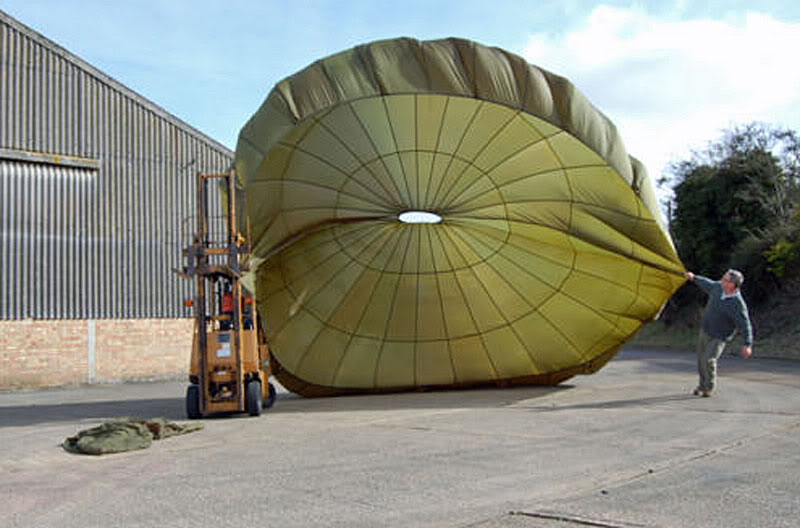
We made great use of a giant army green colored parachute. I remember multiple of us chorus members scrunched inside it slowly oozing across the stage in an amoeba blob depositing Jesus for his next scene.

It returned in the penultimate moment to, you guessed it, parachute up and down as the entire cast held the edges. It billowed and filled the stage in gusts of wind, finally falling down its last time as the actor playing the title role ran under just in time to get his head in that tiny hole at the top.

The effect of him spread out across the stage, hands outstretched towards all of us, his followers, grasping at the edges of his robes needing him to sing to us and filling him with music at the same time. He looked at me in our second to last performance, paused, dropped his eyes for a moment and smiled.

God, I still love Jesus Christ Superstar.

I do not want to direct musicals. I spend most of my efforts trying really hard to resist my impulses towards cheese. But there are things that show did to me that I still carry with me.

I remember the passion with which the people around me attacked this project.

I remember watching my director deep in conversation with the actors, asking them questions, trying to think through a moment.

I remember hearing these crazy ideas to dance wildly or run down a hall or get under a parachute and feeling like we were discovering something.

There was an invitation to step into a new way of seeing. It didn’t matter if I liked the idea on first presentation. It was my job to try and occupy a concept that I’d never considered.

I’m still trying to do that today: trying to get my plays to be that big green parachute: fucking huge and full and trying to wrap up the whole place in themselves.

A

Do Grants Make Our Work Worse?

doofy-lion

Write a grant. Is this what you get?

Everyone has felt that moment when the idea for a thing you’re going to create passes at just the right angle and you get a glimpse of the whole. The inspiration is a shadow. It’s a search and rescue party.

At the start the work it is mutable and infinite. Waiting to be formed. It’s impressionable like silly putty, waiting for an imprint to be pressed upon it. It’s a delicate place and I love it there. For me, it’s the very best of places.

In such a moment I feel myself a sculptor standing in front of stone. Any move, any blow, will change the course the future statue in front of me will become. These early hits are the most important, not because you know what you are making, but – in fact – because you are most open to discovery, because you can revel in the NOT knowing.

Artworks are made through intuitive decision making processes. Sometimes in creating a scene or writing a line of music, it’s difficult to explain what sources I’m drawing upon. I’ve learned to trust the instinct to just do it and figure out why later. I’ve come to trust that when I hit that marble there’s something in the hammer that knows better than my mind about what might happen, a chemistry between the thing and the person who shapes it. That the thing has as much to say, as do I and only in trusting this can we stumble forward into being. It’s often only after I finish a piece that I have any ability to go back and articulate the variety of influences moving me while the creation process was occurring. If I was paying that much attention at the time, I’d probably have gotten distracted from the doing.

Which brings me to that lion.

King Frederick I of Sweden gets a lion. It dies. He loves it and wants it stuffed so he can look at it for eternity. Sadly, the taxidermist gets only the pelt and the bones of the beast to work from. And, lacking Google image search or Wikipedia, he takes the stuff and does the best he can to guess. What you see above is the result.

That lion is not the product of a million potential strikes on a piece of marble. That lion is an ill-fitting jigsaw puzzle. The man who put him together never saw a lion. But he knew he HAD to make one. Someone sent him a bunch of lion pieces and said he needed to add them up into an animal. He’d never observed it live. He’d never visited its habitat. Never saw it catch prey or watched it stretch in the sun. He didn’t know how it lived. He only knew he was limited by the skin and bones he had in front of him.

There’s no room to add to what a lion is. The pieces are all you get to use. But lacking more info the taxidermist uses his own experiences and influences to help shape the pieces to create this unknown thing. The lion is a strained mix of creative inspiration and someone else’s pre-defined boundary.

Like an animal we’ve never seen, at early stages, we cannot know our work entirely. We don’t know its habitat or function. We’re just seeing it’s shadow in the wild. We need to be careful of defining too strongly what the limits of a lion should be. We shouldn’t be in such a rush to say, “this is where the mouth goes and this is the femur” before we really know how it moves.

There’s a study I read a year ago by a psychology researcher named Timothy Wilson from the University of Virginia called “The Disruptive Effects of Self-Reflection.”

In it they set up a station in which female college students selected a poster for their dorm room from five choices. Two were “good” art (van Gogh and Monet) and three “bad” art (as Wilson says “a cartoon of animals rising in a hot air balloon, a photograph of a cat perched on a rope with the caption ‘Gimme a Break’ and a photograph of a cat standing at a fence with the caption ‘One Step at a Time’”).

When subjects picked without explaining they went with the good stuff 95% percent of the time. When they had to write down why they made their choice only 64% of people picked the creative master over the kitty cat. Which means that 31% of people chose the simple stuff, the things that were easier to talk about because they had to explain why they were making those choices.

Kitty cats looking for a break are much easier to explain than Monet. And it would appear that when we confront an inability to rationally explain why we’re doing what we’re doing, sometimes our pre-frontal cortex encourages us to change that thing we’re doing to make it easier to line up with explanations we’re trying give.

The study also said “When telephoned a few weeks later, however, [the choosers of “bad art”] were significantly less satisfied with their choice than were subjects who had not analyzed reasons.”

This is what over-articulating can do to us.

And this study only measures blunt brush strokes. It can’t say what percentage of people considered a cat poster more heavily than they would have. Or if it made them appreciate the masters less because they felt confused or inadequate when asked to talk about them.

I worry that a grant is a recipe for cat posters.

A grant proposal for a work of art is by its nature, not a description of a whole finished thing. It’s not a novel, it’s a book jacket. Not even a book jacket. A proposal for a book jacket. How could it be anything more than this? The book isn’t built yet.

And yet, funding sources in the non-profit granting sector require an incredibly explicit and articulated vision of a final outcome, even when a project is at its earliest stages. Is it possible that in the same way a college student might pick a simpler poster when they need to explain their decision, the very act of saying what you think you might do in a creative process has a significant impact on the ways and kinds of work that ends up getting made? In my own anecdotal experience, the general trend of art-makers over their careers tends to move from non-linear associative storytelling towards more logical and narrative based presentation. I’ve always assumed that this was a function of a kind of “growing up” in artistic identity and output. Now I’ve begun to wonder if that might not also be a function of the ways that companies fund their works as they gain more professional stature.

I know I’ve gotten much better at grant writing as I’ve practiced. You learn not to try and explain the entire messy complexity of what you’re making. You define a narrow slice that becomes a representative of the whole. You leave out the nasty bits. You tell yourself that you’ll come back to them. It’s the parts that you CAN articulate cleanly that you share for someone else because the other stuff is still unknown to even you.

But a grant is a footprint. It’s a promise that there’s a whole animal out there that you’re going to capture. To describe in words is to encapsulate and confine. It’s not so simple to write and write and write about a thing and then go back and give yourself permission to diverge from everything you’ve written. Those pathways form in your brain whether or not you want them to.

If van Gogh wanted to explain the sunflowers in words, he probably would have written an essay. You know, with words. The whole point of that painting is that there are things we experience and feel and cannot explain in any other way In trying, it’s possible we diminish it. Force it into a single dimension that it doesn’t easily occupy.

Messy stuff is hard to talk about. And I see my work get cleaner as I get older. I used to think that was craft. But what if it’s not? What if cleaner isn’t better? What if it’s just easier to get funded?

I felt so strongly about this a year ago that I wrote the guy. See:

uva psych

He’s really nice. You should buy his book.

I recently sat down to try and write a grant for a project in the earliest of stages. It is currently an impulse more than anything. I began a list of elements that I think might become part of it. As I tried to tie them together, things kept popping out. The grant writer in me looked at that language and said, “This doesn’t make sense. You need to clean it up.” And when I started to do that, when I started making some logical connections between the things I’d listed, the artist in me could feel the thing shrinking. I could feel it beginning to solidify. I could feel that lion’s smile growing.

So I stopped.

I really would like some money to fund the exploration of this project. But what became clear is that it would be a choice. I could write something that could get me money or I could chip away at the marble and see what was in there. But I couldn’t do both.

At least not right now.

A

What is it good for?

snow

This is where I was today

I’ve been driving around back roads in upstate New York during this holiday season. Today as I headed towards Lake Placid to go ice skating, I saw a series of dilapidated houses and I couldn’t stop thinking about the people who live there. I kept wondering, “Has anyone in that house ever seen theater? Does it mean anything to them?”

I think about this a lot at home. I see someone coming out of their south Philadelphia row home just a block away from me and I think “Is there any play that I could make that guy would want to go to?” I wonder about what kind of thing I could create that this dude might pay money to go and see. It’s a little hard to imagine. But I want to think that’s possible. That the thing I make could be useful to that guy.

What percentage of people in the US saw a play last year? I can’t find any data on this in my 10 minute online search. But it has to be really small right? 10%? 5%? 1%?

What’s the equivalent number for people that have watches a television show in the last year? 95% Probably more, right? 99%? 99.9%

Can I make plays for people that aren’t exactly like me? Because that’s most theater audiences. For these folks in out in the boonies there closest performing arts center is 40 – 90 minutes away. That’s where they can see Theater with a capital T. With lights and sound system and people performing the latest Broadway tour. What does theater mean to them? Is it Broadway? Is it red velvet seats? Is it Edward Albee’s Zoo Storey?

But is that actually “theater”? If not than what is theater? Who is it for? What is its core?

Mostly, it’s citified urbanites who like to take in high culture? It’s people who can afford a seasons subscription. It’s a beautiful lobby in a city center with printed tickets and programs and a snack at the intermission. Is this who I making this stuff for?

I spend a lot of time defining what my art is. I spend less time defining who I want my audience to be. In theory we all use bloated language and talk about the universality of our message but that’s a lot of crap. My theater is mostly useful to well educated people. People like me. Probably not racially diverse. Probably liberal. And likelier than not a fair bit older than myself.

I know that the people seeing my plays are NOT my neighbors. Or the folks out here in the sticks. And that’s a little worrying. If the apocalypse comes and movies and television are over will I still be able to make work without a fancy light grid and sound system? Will what I do carry on? What’s at the core of the thing I want to share?

Ugh. I don’t know. It’s the day after Christmas and I just wanted to go ice-skating.

This is at the center of my confusion lately: what theater is good for and how to make it the most “that” that it can be. But then I think, man, can’t I just make the play I feel like making?

Ok, how about a dictionary diversion: What is “theater”?

You can read the web page. But let’s dissect it quickly:

Numbers 1 – 3 define it as a structure or place. Which makes sense. Traditionally, we do think of “Theater” as a building, a structure. But, beyond the place I think there’s something deeper than that to explore.

Number 4 uses “dramatic literature” and specifically “plays” as a definition of what theater is. And again, this might be a part of what it is, but for me I think there’s something more than that. The second part of #4 says “dramatic representation as an art or profession (aka ‘drama’)” which starts to get closer.

I think my favorite piece of the whole thing rests in the fifth attempt to explain the word theater which I will quote in its entirety:

5 a : dramatic or theatrical quality or effectiveness

b : spectacle: something exhibited to view as unusual, notable, or entertaining; especially : an eye-catching or dramatic public display

c : entertainment in the form of a dramatic or diverting situation or series of events

Isn’t this last definition what we hope all of our “theaters” might be? Something heightened in its dramatic quality or effect, eye catching and entertaining in its display?

It’s a feeling, a connection, an experience of event – something that occurs between humans regardless of place that helps us process who we are. And that should be possible whether or not I have a performing arts center with a booth and a grid and dressing rooms right? That should be possible whether my audience is 10 or 10,000.

It should be possible to create a moment of dramatic effectiveness that isn’t dependent on a place or a script, that is about an intangible need to connect, to create and to share.

It should be something that I can share with my Philadelphia neighbors, right?

I want to believe in a theater that can be useful, even up here.

More on this later…

A

Gifts for 2013

We’ve made it through the mountain of presents. We’ve gone sledding with the niece. The family just tore through two giant plates of my Christmas nachos. And now we’ve all retreated to our respective corners to play with our stuff, fall asleep, or make good on a random promise to write an essay every day. But it’s holiday law you have to eat a massive meal every 4 to 5 hours so I don’t have a ton of time.

I’ll have to make this quick.

I don’t buy myself a lot of stuff. I’m the “I won’t buy new shoes until the current ones are literally coming apart on the street and even then I’ll feel bad shelling out more than 30 bucks” type. This actually happened to me recently. I was walking around a city looking at a potential grad school and the heel of my boot fell out of the back of the shoe. And I didn’t throw it away. I brought it home and tried to sew it back in.

If it’s for work – a music download for a show I’m working on or a book that I should read as research – it’s a lot easier to justify. I have a hard time giving myself “gifts”: things that are for purely aesthetic pleasure, things that whose function is an indulgence, things that don’t “do” anything. I have the same trouble in my art making.

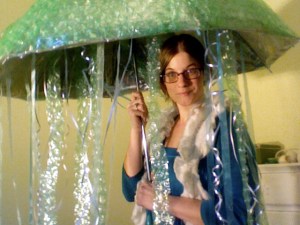
Once in a while I have an excuse to do something artistic that isn’t “real” – aka it has no potential to become part of anything I’m working on at a professional level. Like this Halloween when I spent a full day and the equivalent of a week’s food budget making a jellyfish costume I wore for 4 hours:

Photo on 2012-10-31 at 17.35

But chances are, if I don’t think something has the potential to turn into a “real” project, I let it go pretty quickly. I rarely commit a lot of energy beyond a passing daydream to ideas unless I can see them morphing into a fully realized production. This is why none of you have heard about my “South Philadelphia Cat Tour” fantasy. (Someday world, some day…) I’m not in the habit of offering myself the gift of spending a little artistic capital just for the hell of it, because it’s fun, even if it’s not “useful”to my career.

What’s the old saying: Bread and roses? Maybe even in our art practice, we need a little of both.

Here’s a list of creative things I want to do and I can’t see the obvious use of. There’s no grant that needs to get written for this and I have no idea how any of these make it into a single project I’m planning. But they are some artistic gifts I’ll try and “buy” in 2013.

I want to:

–       Spend a few days making something with a person in Philly I’ve never worked with

–       Sing with a choir

–       Work with a visual artist

–       Make something for an audience of less than 10

–       Look up a bunch of Norse mythology

–       Make a piece that’s no longer than 5 minutes

–       Learn a lot about wine

–       Work with (in?) water

–       Play the piano

–       Create something performed in another language

–       Get onstage myself

–       Make a meal the central focus

–       Work on a scene from a play I’m not producing, just because its fun

–       Read a lot about something I never got to take a class on in college

–       Give myself permission to stop something in the middle

–       Take a dance class

–       Contact a person I’d think would never respond and ask them for coffee

–       Write something creative without a second author

–       Watch another person’s process

–       Create a board game

That’s mine for now.

What are yours? Throw them in the comments.

Happy happies and merry merries to one and all.

A

Lessons learned from past work: recitatif

20070430a_recitatif_0074-1

Some things you just can’t reach, no matter how hard you try.

In my theater work I often find myself in the middle of a process saying “Damn! This happened last time. I wish I’d remembered to – ” or in the midst of making a choice and saying “I will never ever put myself in this position again!” It’s such a frustrating moment to realize that we are replaying the past in the present. And unlike works of art whose products can be held or seen, theater is so intangible, so transitory, that I often crave ways to hold onto these lessons from one project to the next.

Lately, I’ve adopted a “Lessons Learned” concept for myself as a way to try and hold onto these experiences, take forward the meaning and leave behind the unnecessary. I’ve started keeping a document at the end of each process of all the things I wished I’d done differently, suggestions for improvement, or stuff just to keep in mind.  My notes can range from very functional details (“Remember that this grant’s work samples ALWAYS take twice as long to prep as you think they do.”) to thoughts about collaborators (“They’ll never go for the flashiest choice. It’s a strength and a weakness.”) to big artistic process stuff (“Tech is an artistic exploration as well. Give it the same kind of time to make mistakes”).

These notes are mostly functional in nature – things that I can easily identify and change for next time. What I tend not to record are some of the really big shock waves in a process that have changed me and my outlook on art but also on life. Some of these things I didn’t even totally realize until I sat down to write this. Since the holidays are a time of thinking about the people we surround ourselves with, the ones who affect and change us, the people who shape us into the selves we become, I thought it might be interesting to look at one work that taught me many lessons, some hard, some that I’m still processing.

recitatif was the first piece I ever presented in the Live Arts Festival. It was about two friends, one African American and one Italian American, who meet as children in Philadelphia. The story follows them as they grow and eventually part ways in college. It is about the ways in which they are both outwardly similar and also how hard it is to be different. It is about trying to understand another person’s perspective both with and without the lens of race.

Elements I remember: curly hair, jump rope rhymes, gospel music, opera, overlapping text, religion, the color red, lines, pulling, falling, dreams, and memories.

It was a collaboration between myself and two close college friends. It was written as a largely autobiographical piece from the perspective of the two actresses that performed it. It was their stories (mostly, sort of) and I was in charge of shaping them. We had worked together, deeply and passionately, before. We had the best of intentions to tackle a very difficult issue. We very rarely agreed on anything. We spent almost a full year creating it and presented it three times. After it was over I never spoke to one of those collaborators again.

It wasn’t just the play, by the way.  It was a lot of messy complicated personality and lifestyle dynamics stuff too.

But the play was a big part of it. It’s one I think back on and dissect with some unease and with much longing. For a way to have had things turn out differently, mostly, but simultaneously feeling like I can’t see changing any of the choices I made.

20070430a_recitatif_0251

This is the one I still talk to, just in case you were wondering.

I think I am glad I worked on this play. It was very hard. And it made me sad for a long time. But it also showed me that vulnerability in a leader is tolerable and that it is not the same as weakness.

So, without further ado, Lesson I Learned from recitatif:

–       It showed me that I love doing creative work early in the morning. Because we had such conflicting schedules and were young and still be open to crazy proposals we went through a phase where we began rehearsals at 7 am. I would do that again in a heartbeat.

–       It taught me how to listen. Even when you don’t want to. Even when all you want to do is defend yourself.

–       It made me believe a lot less in the potential of art to change one’s most deeply held beliefs.

–       It made me a less confident director. Which isn’t necessarily a bad thing. It’s meant that I question my choices a lot more.

–       It make me realize that in a group of three someone will always be the odd man out and it will probably be you at some point.

–       It taught me you can feel like you know someone very well, learn more about them, and end up feeling like you know them very little.

–       It taught me you should never live in the same house with your co-creators.

–       It made me question what a director is really good for.

–       It instilled a sense that there are some topics about which my opinion is never going to matter, things in which it is simply my job to listen.

–       It made me question if you can ever work with personal stories in a useful way.

–       It made me realize that who is in your audience is matters a lot. And that you need to think about that from the moment you start making something.

–       It taught me that sometimes getting what you want is different than someone understanding why you’re right.

–       It taught me that there are some experiences you can try and sympathize with but that you will never actually understand. Even if you want to. Even if it would be good for you.

–       It taught me that I love actors and I want to be a director that empowers and respects them.

–       It taught me that you are responsible for your choices even if you don’t understand them or all the impacts they may have.

–       It taught me that deep emotions on the inside of a scene are great, but they don’t always translate into meaning for anyone else. And the more you can’t conceive letting go of them, the less likely they are to be useful to the experience of art by another.

–       It taught me that sometimes actors are not doing it for you or the audience.

–       It made me learn that you cannot let yourself gang up against a fellow creator.

–       It undercut my ability to take an absolute position on anything.

–       It made me learn that losing a collaborator can be as heartbreaking as losing a lover and just as bitter.

–        Above all it taught me what it means to listen and actually try to respect a difference of opinion. It taught me how difficult that is, and how much work it takes to do.

A

PS – Again thanks to JJ Tiziou (www.jjtiziou.net) for the photos.

What do I do?

arms

But I don’t want to WANT to be an administrator

If someone asks me what I do I say I’m a theater director.

But is that what I actually, literally, do?

Well, I’m also a self producer. And I run a small company. Which means most days I’m not in rehearsal. Most days I spend a lot of time doing a lot of non-creative things. And the more success (read money) I seem to find for these works, the more it seems like that’s what I do.

An average day “working on my art” includes:

Answering 30 – 40 emails, reading trade blogs (generally 3 -5 a day), reading email listservs that might contain relevant into to follow up on, making lists of important people I should contact, making lists of places I could tour my work, working on an upcoming grant or updating my calendar of grants I could be working on, writing potential presenters to please consider my work, looking over budgets, asking people for money, writing press materials, and scheduling.

Maybe if I’m feeling really ambitious I make get to compiling some directing research, but that’s maybe, if I get around to it and I’m not feeling too brain-dead to think creatively.

This is essentially the job of an administrator.

That is what I actually do most days.

What it feels like I’m doing less and less is writing and dreaming about rehearsals. When I was balancing chemistry classes like I was in college or working a million day jobs like when I was 23 I still found time to let my brain wander on strange and new ideas. The rough thing for me these days is that I when set aside time to be creative I have a tough time turning off that administrator brain.

Some honest statistics:

In 2006, I presented my first major work in Philly. It was a show called The Ballad of Joe Hill a 6 actor play with music about a labor organizer and songwriter. We did it at Eastern State Penitentiary.

The 2006 Philadelphia Live Arts Festival and Philly Fringe

Some basic facts, it was:

– A loose (read ill defined) collective of artists: no contracts or formal definition of what one’s “job” would be if they participated

– No one got paid

– Largely self funded, though we did have a small amount of donations using local fiscal sponsor

– All cash based, or went through my personal bank account

– Totally illegal. I mean, you know. It’s what happens when you first do stuff. IRS, please don’t read this.

This is a pretty standard type of first self-producing effort. You make a lot of mistakes. You learn a lot. You beg, borrow and steal everything. It’s pretty exiting and overwhelming.

For me and my co-producer the whole thing cost about $2,500.  And roughly estimating I’d say 10% of time was non-artistic work.

A few years later I made a show called SURVIVE! which was a choose-your-own-adventure installation about humanity in the universe. It’s looked like this:

sand stars

This one, a big jump up in terms of scale of self-producing had a lot of differences from Joe Hill. It:

– Defined group for duration of project and worked hard to explain what everyone was responsible for. We wrote contracts for the first time and everything.

– Used fiscal sponsorship as a way to legitimize the finances of the project. This cost money. It also meant I had to keep financial records that I wasn’t embarrassed to show to someone else.

– Had a mix of self funding, small grants, and a first major foundation source

– Paid everyone (designer, actor, SM, and director alike) a stipend of $1,200 for time spread out over 9 months. I don’t want to calculate the hourly income. It would make me sad. But it was a start.

– Forced me to figure out how to deal with 1099s and required people to declare this income on taxes (not to mention get my own in real working order).

It was a big show. A massive show. Thousands of square feet of space with audiences in multiple places at once. Simultaneous sound and light that all had to sync up and time exactly. And we did it without a production manager (WHAT?!). I’m still a little amazed we made it.

And given all that, we still only spent a total of $23,000. And in that project, 50% of my working time was non-artistic.

In 2011 I worked on a feminist re-imagining of Shakespeare’s Macbeth with a lot of awesome ladies. It was presented at the 2011 Live Arts Festival after a year of work as a Live Arts LAB Fellow and starred the awesome Catherine Slusar.

309288_10150280162417043_26984287042_7997399_3197437_n

I was coming up on the end of the 20’s decade with this piece. I felt like I needed to get serious. So I buckled down and:

– Offered a much larger and more realistic salary for myself and two of the major collaborators on the piece. I also upped designer fees.

– Made my first attempt at weekly pay for the ensemble

– Wrote grants like a machine. LIKE A BOSS.

– Because of stipulations of Live Arts support did my first show in “real” big ass theater with a high level tech capacity

– Opened a Swim Pony bank account, got an EIN, and hired a suite of management staff for the duration of the project

That show cost about $110,000. It was two years from start of planning to production. It was exhausting. Rewarding, but exhausting. I felt like a CEO. And when I estimate, about 90% of time was non-artistic

This pattern continues on in my work. I made a promise to pay a higher weekly artist salary for every project I do. For The Giant Squid, a recent co-collaboration with The Berserker Residents, we were able to do the equivalent of eight weeks of work at $450 a week. That felt insane to say when we started. I know plenty of small companies in town that don’t manage that pay grade. On almost every level, my co-producers and I have gotten much better at producing.  It’s basic neuroscience right? The neural pathways you spend time on get stronger.

And just for reference, I did some calculations for comparison. Next year, I’ll be presenting a new version of Joe Hill at Live Arts. It’s a re-working with new tweaks to the plot and structure as well as updated historical research. It’s the same size cast, scope of design and will still be performed at Eastern State. We’ll spend about the same amount of time in rehearsal, maybe just a bit less. I just submitted a grant proposal with a budget of a little over $120,000.

Remember in 2006 when I spent $2,500?

The scale of professionalism is catching up to artistic process. This is what I should have been doing all along. And it takes 90% of my time to make that happen.

That’s what I am doing these days 90% of the time. I don’t want that to be the case forever.

What do I do to change that? Still figuring it out. A few things that help:

– If I decide to stop working on grants and start trying to write a rehearsal plan sometimes I’ll change clothes. I try and put on my “artsy-est” outfit.

– I also take a shower in the middle of the day if I need to get out of admin brain. Water is creative magic, for whatever reason it clicks in the right brain.

– I’ll give myself a fixed amount of time in morning to do whatever I want on any creative project I feel like (the morning is my best creative time) since I know the other stuff will expand to fit the time I allot to it.

– I’ve actually tried to tone down the production scope on projects, focus all the money on people, to keep the overhead low and the creative content high.

– I’m researching people I can hire to take some of this off my shoulders.

I’ll keep trying to come up with answers.

I’d love to hear some of yours.

A

PS – Photos thanks to JJ Tiziou (jjtiziou.net)

Responsibility

Taking-Personal-Responsibility-001-Personal-Responsibility-ChrisMower.com_

A friend of mine who works for a well known video game design company recently posted a thoughtful article on violence in video games. Reading this got me thinking about responsibility in art making.

I’ve been contemplating grad school recently (another essay! Oh my god another essay!) and something that kept popping up in these info sessions was this idea of the artist who is responsible for their art. All these schools are looking for “responsible” directors. What is such a thing? It’s directors who, in the words of one prestigious New England based institution “are not afraid to take risks, and they take responsibility for the philosophical and political implications of their work.”

Yes, on some level, I know practically you can’t just make something and then claim no accountability for what you just said and did. But what exactly does it mean to take responsibility for the work we create? How much are we held accountable for what our audiences take away?

Everyone has had the experience where an audience member reads something into your work you never considered. Audiences carry their own valences of meaning that they place on top of the stories we tell. We can craft, but we cannot control. In my personal opinion, I think most theater works too hard to try and limit the take away of an experience to a singular narrative or idea. In my own work I have been trying to take some lessons from our compatriots in dance or visual arts about how we can let go of the need to make every moment bite sized enough for the audience to digest it easily.  That’s what I feel like makes better art. But is it responsible to hand over so much of the meaning making in my work?

A quick detour.

Do you remember this horribleness with a woman who killed herself over a prank phone call to Kate Middleton?

I know, I know. I hate this crap too. And I would never bring the thing up except that a few days after this thing threw up all over the media I was listening to the radio, and some horrible commentator on NPR was going on and on AND ON about how terrible these two DJs were, chastising them and the station for this horrific prank, and how dare they, how dare they, they SHOULD HAVE KNOWN, and even if no one had died this would STILL be a crime because who thinks this is funny and it shouldn’t have happened ever ever ever, did you hear me ever.

And all I could think was “Lady, you are such a fucking liar.”

Twenty-twenty hindsight I say. Thousands, probably millions, of stupid pranks like this don’t result in tragedy. They end up as stupid pranks that some people laugh at. The higher caliber a famous person, a few more days floating around the internet. 99% of the time this is the outcome. It just happens to really suck for two people for whom it wasn’t. You can certainly argue whether the prank phone call these people made was “art.” (for the record I would argue a resounding no) but I think the point can still be made  that artists can’t always control how people react. This lady on NPR really thinks NO ONE ELSE IN THE WORLD would ever think this is funny or would consider doing something like this to a public figure? Apparently this woman has never listened to a morning radio program on a major station. And if you read this transcription it is about the tamest prank phone call I’ve ever seen.

Asides now asided, to my point. People do things they think are funny all the time. People make art they think is deep and impactful all the time. Some people agree. Some people don’t. Some artists want to make their audiences happy. Some want to offend. No one wants something like this. If these two moron DJs (who from the transcripts, do sound like morons) had any conception of this as a possibility they would never have done it. I think it’s hard to imagine it would occur to anyone to predict such a thing.

The universe is an incredibly erratic, random and irrational place. Who knows how many millions of prank calls to millions of celebrities’ underlings narrowly missed a random series of coincidences in which their actions lead to tragedy? Two Australians happened to hit the shit storm bull’s-eye.

You can argue if they did something stupid.

You can bet they will never have a sense of humor again.

But does that make them responsible for what happened?

If the answer is yes, that sucks. That seems crazy. It makes me nervous to invite people to my plays because I disagree with my audiences often. The critics are the most obvious and public responders, but there have been countless times I’ve been chatting in a talk back or after a show and thought “What the hell play did YOU see?” after a viewer talked to me about their experience.  Even the simplest of my works never mean just one thing. My GOAL is for them to mean LOTS of things.

Is taking responsibility the same as accepting blame for every person’s response to what I make? Am I accountable if someone sees my depressing play and gets really depressed? What if they get so depressed and quit their job and stop eating and hide under a blanket for a year?

If you produce a playwright’s play do you have to stand behind every word written in the script? Every reference or allusion in the text? What if that playwright has written another play, incredibly offensive, that has nothing to do with the one you want to put on? What if that playwright simply happens to public espouse opinions you find odious?

And what if someone reads something into a scene I never intended. Is that still my responsibility?

I once saw a production of a Shakespeare play in which the production’s sole black actress in the cast was hanging laundry for the ruling (white) lady of the house. The costumes, the staging, the text’s emphasis on difference in class all added up in my mind to a pre civil rights-era black servant.  The choice was jarring and threw the scene into strange contrast with everything else the director was doing with the production. I believe this was unintentional, just a random choice to use an African American actress in a 50’s style cleaning outfit and a haughty white woman yelling at her without thinking about the historical implications it might engender. I don’t know for sure. And I don’t know if that makes it better or worse that the person might have had no idea.

I know there is no single answer. It has to be a spectrum. And there’s not much to do but try and use your best judgment about what is okay and what isn’t.

But where do you cut the line?

Are there things that people think I’m doing that I have no idea about?

Probably.

<shudder>

A

Five to One

love-hate

Bad is stronger than good.

You don’t have to agree with me. But know that this is the generally accepted truth. It’s hardwired into us. A negative experience will always weigh heavier on our minds and hearts than a positive one. I’ve heard this in pop psychology, most especially prominent in John Gottman’s rules for relationships. I was interested if this idea could be applied outside of the construct of marriage. What if I wanted to test the strength of my LTR with artmaking? I wanted some data. So for the past few days I’ve been working my way through this: http://www.csom.umn.edu/Assets/71516.pdf

Before I read the article I thought, “Well that’s depressing to think about.” After reading it, I think “Oh god. It’s worse than you knew.”

To quote the first sentence of the article’s Concluding Remarks “In our review, we have found bad to be stronger than good in a disappointingly relentless pattern.” In just about every aspect of life (work, sex, relationships, learning, money, memory, emotions, development, trauma, our senses, even our social support systems) it would appear that negative experience vastly overshadows the positive. Check out p.338 for a particularly depressing study about the cumulative negative effect of a widow support group.

And the worst part is that this imbalance does not tip toward the negative just a little bit. How much more impactful is a negative experience than a positive one?

Five times more.

Let me repeat that: One nasty experience happens to you? You need FIVE positive ones to balance it out. You say something mean to your spouse? You need to do five nice things to erase your emotional debt. Lose $50? You need to get $250 back to feel recompensed in full.

Five to one.

This makes some basic evolutionary sense, right? One over-trusting instinct with a tiger affects the survival rate a lot more than being a downer about not wanting to try a new berry after the last one tasted gross. Or as a New York Times article about the review article said: “Negativity bias got built into our minds during millions of years of evolution because early humans who were oblivious to danger often got a brief, bloody lesson in natural selection.”

Anecdotally, though it’s startling at first, the more I think about it, the more I have a hard time imagining a world where this ISN’T the case.  Think about when you interact with a person who is needlessly rude or cruel. How many people does it take to reassure you that first person was an idiot asshole before you start to feel better? Easy to ignore those nice people. Harder to shrug off the jerks. Or, as Schopenhauer put it, “We feel pain, but not painlessness.”

In instances where we are particularly vulnerable (READ MAKING ART) this seems particularly germane. Write an essay, create an entire play, perform for 90 minutes in front of strangers and what you will focus on won’t be the countless moments of smooth sailing but the couple stumbles that overshadow everything else.

We even seem to naturally think people who say negative things are smarter than ones who are kind. We are apparently nature-made to give more credence to critical review. Take that literally for a moment actors, directors and designers. Do you remember the last nasty slight sent your way? Can you quote it? Do you remember its sting? Chance are, probably, yeah, you do. But do you have any recollection of the articles that praised and extolled your virtues? Science says probably not.

What the hell do we do about this?

Gottman, the same psychologist who first introduced the five to one ratio, proposes that  his patients in marriages place exaggerated emphasis on the positive in their home. The New York Times article cites a statistic that despite urban legend of asshole executives’ profits rising to the top, the most productive teams managed 5.6 positive interactions for every negative.

Back to the arts. I think we as a field suffer from a negativity epidemic. We thrive on investigating, deconstructing, even deifying our love/hate with what we do. The arts are sublime! But they make us feel crazy. It’s so hard to make, but if I’m not producing I’m worthless. We know that it’s the most meaningful thing in the world. But no one appreciates what we do. We are starving, after all.

And the problem is that even if we are equally vocal about the love as we are the hate (and let’s be honest that’s a really big if) here’s how the math starts working out:

Love/Hate  =

(Love)

(Hate + Hate + Hate + Hate + Hate)

2 x Love/Hate =

(Love + Love)

(Hate + Hate + Hate + Hate + Hate + Hate + Hate + Hate + Hate + Hate)

3 x Love/Hate =

(Love + Love + Love)

(Hate + Hate + Hate + Hate + Hate + Hate + Hate + Hate + Hate + Hate + Hate + Hate + Hate + Hate + Hate )

4 x Love/Hate =

(Love + Love + Love + Love)

(Hate + Hate + Hate + Hate + Hate + Hate + Hate + Hate + Hate + Hate + Hate + Hate + Hate + Hate + Hate + Hate + Hate + Hate + Hate + Hate)

5 x Love/Hate =

(Love + Love + Love + Love + Love)

(Hate + Hate + Hate + Hate + Hate + Hate + Hate + Hate + Hate + Hate + Hate + Hate + Hate + Hate + Hate + Hate + Hate + Hate + Hate + Hate + Hate + Hate + Hate + Hate + Hate)

I think I’ve made the visual metaphor point here. What I think when I see this equation is this: casual nastiness and off handed disgust with creative process isn’t cute. This isn’t amusing disenchanted snarkiness. It isn’t artsy ennui. It is a systematic way to destroy something you deeply care about.

I am no innocent here. I’ll be first to admit having long prided myself on my relentless dissatisfaction with my work, on my need to never ever ever believe I’ve done enough. To seek out only the audience members that have “the bad” to say. To talk about pieces I’ve slaved over as if they were far less that what they could have been. To ignore the growth they engendered and focus only on the shortcomings. To never be satisfied and constantly undercut what I did do with what I wished it had been.

I thought this perfectionistic tendency was a sign of a creator that truly cared about the quality of the product I produced, self-satisfyingly pronouncing my commitment to settle for nothing than the very best. I say I am hard on myself, on my collaborators, and on the work because I love it. That I have to be that exacting, that regimented and suspicious. Forget the compliments, they’re for suckers. I don’t want them, I don’t need them, just tell what’s wrong so I can fix it.

Five to one.

Do you notice, fellow creators, how much you love a new collaboration? How easy it feels? Even if you know somewhere inside that the work with your long term collaborators is richer, isn’t it just more immediately gratifying to get that fresh newness that comes with someone you still want to bust your ass to impress?

Five to one.

Don’t you love that new rehearsal, new company, new medium feeling, where it seems like a certain weight that you have to drag around with your regular partners is just lifted? And why is it that you find yourself more and more frustrated by the increasing list of little flaws in those you’ve been working with over the years?

Five to one.

Do you sit with your colleagues and bemoan the state of your work, your form, and your function in it? Do you spend hours dissecting what’s wrong with what you’ve made or what you’ve seen?

Five to one.

Do you trust that your co-creators know how much you value them, their time and efforts? Do you take on faith that all those things you told them you loved about them when you started working together are still stored away in their memories for safekeeping?

Five to one.

Stop for a moment and think about what you do and the people you do it with. When you talk about it, when you talk about them, what do you say and how do you say it? For every, ‘This is bullshit’ do you have five ‘This is exactly what I needed’s ? For every, ‘I’m just so fucking tired of -‘s do you have five ‘Thank god I have -‘s ?

Five to one.

It takes five steps in the opposite direction for every one towards anger, resentment and negativity. For every thing I find that I am frustrated by, do I have five things I can say that I truly love about what I do?

I should. I’m not sure if I do.

And if I don’t, is that the fault of theater, or me?

A

Hungry

theater gods

Dear Theater Gods. You definitely have no intention of smacking me down, right?

I miss being hungry for the work in an uncomplicated way: unadulterated and sparked from genuine interest. I crave to be un-tinged by the producer’s brain. I just want to want to make and make and make like I used to.

I fell into directing, mostly because I had looked at other people and thought “I can do that.” I didn’t have much ego about it, just said “Why not?” and did it. And then one day I realized that THIS was who I was and what I did, as if it had just been waiting for me to get there. That this was the thing I’d always been intended to do.

I had terrible taste. I picked plays that were overdone and  underwhelming. Things in anthology books that everyone buys at Barnes and Noble. Broadway hits from 20 years ago long since past their expatriation date. Chrisopher Durang. Steel Magnolias. Agnes of God. Late, tragic, Tennessee Williams. Characters’ whose tears and laugher were just under the surface, massively emotional and dealing with those emotions ALL THE TIME.  Uncomplicated nutbags that in retrospect seem like self-indulgent excuses for actors to cry. Stuff I would never do now. But at the time, at the time it was SO exciting. So electrifying. So full. So much.

During that time I created my first piece from scratch. It is funny to write this but the truth is that I have never had a project that has come close to the totally raw, completely maniacal drive with which I attacked that piece. I read anything I could think of. I devoured music, images and text compiling a massive overarching collage of meaning. Or rather, I read into every book I encountered my imaginings of this story. It seemed like every piece of music, every line of text, every image around me was destined and intended to fit in some way into this giant thing that was welling up within me.

I dreamt this work. It spilled into every spare moment. Filling the lines between notes in class. Creeping into my thoughts on the treadmill. Playing itself across the back of my brain as I walked across the campus. I was in love with this story. I fell in love with making this play. It was totally consuming and it seemed that I didn’t need anything else in life but to do more of this work.

The play was a meditation on the myth of Ceyx and Alcyone. You can look it up for more details but in brief: Ceyx begs his wife to leave the island out of a fear of never accomplishing anything. Alcyone is inconsolable knowing that the god Poseidon has a vengeance against her for rejecting him. He sneaks off in the night and of course, dies, leaving her to wait, pathetically, on the shoreline for years, singing to her husband starving and wasting. The gods, tired of her lamentations, send his body back to shore and as she runs to it, they both turn into birds, halcyons, to spend the rest of eternity together.

It wasn’t a clean piece. It wasn’t really much of a story. It was a series of meditations on an esoteric myth: a scene where two lovers dare each other to deeper and deeper levels of proclamations of “If you really loved me you’d –” ending with them drowning each other in a bucket of water:

pre drown

post drowning
There was also a scene in which Ceyx’s boat is made toy size and Alcyone watches from a far as a life sized Poseidon drowns it:

poseidon 1

poseidon 2

A pair of sails unfurled into a giant pair of wings. A man turned a woman turn into a bird and regretted it. A strangely large amount of mopping.

To me seemed like the earth had moved. It felt like I shared that with my performers. That we’d all given birth. My brain was on fire with ideas that weren’t mine, just channeled through me. I wanted to watch the thing over and over again. I played it in my head again and again. From the outside, I can’t really say, I wasn’t paying much attention. A Polish theater reviewer happened to be visiting the department giving me my first (and currently only) international review:

“Music surrounds us from all sides, perhaps a little too aggressive and accidentally chosen… But what acting – quite a few Polish actors would envy these twenty year olds for their abilities. The boy sitting next to me begins to cry buckets halfway through the second performance. I am not surprised: the unhappy Alcyone, shaken by spasms with every despairing moment of Ceyx’s sinking ship did not leave me unmoved either.”

My mentor saw it and said “You know, when you told me what you wanted to do, I thought, this is a play about break up. And usually when a student wants to make a break up play it’s almost always terrible. But this was actually very good.”

My mom cried after she saw it because she said she was sure that her getting divorced had ruined my ability to love unconditionally.

The funny thing was that I had no idea that any of these things were in the play that people saw. I was floored that anyone thought it was about the end of my first real relationship. I just thought I was digging around a Greek myth. I had no idea what audience watched. Or what the piece ultimately said. I didn’t have to. I never wrote a grant or pitched it to a presenter. I just made stuff. All that time, as I dreamed and thought and read and reacted I never had to explain.

I just tried to satiate the hunger.

The very next year I made another piece about another myth with more money and resources, more advice, and ostensibly more experience. Same cast. Bigger theater. Big disappointment.  Parts of it, many parts of it, worked. It was objectively a much “better” play. But it didn’t give me the raw, unadulterated heart of that first piece. I don’t know if an objective audience would agree with me. Maybe it doesn’t matter. Maybe even if they liked the second one better for its polish and care and craft, I’d still rather make the first one.

I don’t know what to do with that. In work, in life, in all the choices that matter. Do you run to the thing that feels sticky and rough around the edges, that because of its coarseness continues to catch at your clothing, pulling at you and requiring attention; or do you move ahead carefully, healthfully, allowing experience to change you, grow you, maybe temper or dare I say settle you?

I’ve spent a lot of years learning to feed myself, but I worry that I’ve forgotten how to be hungry.

A

PS – Thanks to Ben Camp, Kate Hurster, Felicia Leicht and Sarah Yardney for being in those photos. And Sam Dingman for being there in spirit.