In the interest of honesty, or, Can we all just agree to stop beating ourselves up?

It’s always this time of year, as the early cold and un-springlike “spring” gives way to the actual warmth and sunshine of early summer that I think back to my days at the end of college. I often think about this time with a rose-colored view of myself – highly engaged, copiously productive, and focused in a way that I often long for in the present tense.

I think back on the way I think I was back then and I get jealous. Of myself.

There are days now where I wonder what I exactly I’m doing with my time. There are days that I think about other artists and I am certain that they are getting so very much more done than I am. There are lots of days where I think that I am wasting the precious little life I have available to me by not doing more and getting more and being more than I currently am.

Are you an artist who thinks this? Probably.

Because chances are if you are a creator there are a million more idea seeds then there will ever be emotional, physical, mental resources to carry out those initial impulses to conclusion.

This, despite all emotional evidence to the contrary, is as it should be.

I was watching some show the other day on successful show runners for TV and listening to people talk about the insanity of that process. In one case a showrunner described the schedule for the creative product he worked on and then concluded by saying that humans have the capacity to do 90% of what he just explained. The last 10% were fumes and exhaustion.

You know what my first thought was after watching that?

“God you’re lazy.”

You know what my second thought was?

“You’ve only taught a class, written an essay, and spent 45 minutes on a creative project today. This is like a vacation day. Tomorrow you’ll do a real amount of work.”

Can I just say, what the fuck is that?

Because the other part of the show, the one that I think is the most perverse kind of pride, is the strange way that these creators talk about being miserable. They talk about loving the show so much that they sacrifice their lives, their loves, their actual in the moment living for it. What exactly is all of it for then? What kind of art will you make when you have no life other than art to draw from?

This is possible in short term bursts, perhaps. Maybe sometimes even preferable. But this is not a plan of artistic longevity. I don’t just mean that you’ll be tired and exhausted. I mean you literally will have no time to fill your creative research stores to make anything else worthwhile.

I don’t know about you but I want to be creating in 10, 20, 40 years. I don’t want to burn out at 35. To do that I’m going to need some opinions and stories beyond the ones I have now. If I miss all of my life and use up all the creative stores of inspiration in a mass and panicked frenzy of making, what will be left?

There is a complex, I think built in some part by our own internalized sense of worthlessness mixed with a Hollywood idea of fame and success, that tells us that the only version of productive creativity is one that exhausts the creator. We aim for the stay of constant producing, of being pushed to the very limit of what is possible, of working and working in a fevered dream state until we are used up and left empty husk shells at the side of our works.

This is the idea of creativity as inspired and frenzied genius – that it is something that possesses us, that we are nothing without it, that it is only through work that we can prove our value and work.

I know exactly zero people who actually work this way all the time.

I know about a million who work really really hard, then fart around watching bad television and doing nothing of “substance” for big stretches in between.

Of those million I’d say, oh, ALL percent of them feel shitty about the downtime.

Even writing these words, right now, I am thinking about the myriad of actual things I could be doing. I could be writing something that will go towards a brilliant novel. I could be practicing my piano and vocal improvisation skills. I could read one of the giant pile of books on game theory that I’ve amassed on my shelf. I could grade the mountain theater journals sitting next to me.

I could theoretically do all these things and if I try to weigh what I am doing in this moment against all the potential things and their potential values and usefulness, I will always always always come away thinking I haven’t done enough in enough time for enough people.

Does this sound familiar?

As you read this are you simultaneously saying, “Yeah, sure but she can say that because she’s actually doing a lot and I’m actually lazy” because my guess is you are.

I have been busier this semester than I have been in almost any time in the past 10 years that I can remember but I still watched a lot of bad TV. I still found time to fart around on the internet. I still found time to play video games.

And I think that part of the reason I was able to do so much wasn’t in spite of the down time but because of it.

We need to give ourselves a break once in a while.

It’s actually necessary for the work.

Seriously.

I look back at that person I was in college and if I am honest with myself I realize a few things. The first that I never worked as hard as I want to remember. There were long days of producing nothing, of taking time and cooking meals or searching match.com. I also know that I worked hard, but often far less smart. I spent hours and hours on things I can knock out in 20 minutes now. This is what comes with experience, the ability to get down to the heart of something and really do it and be done.

So in the interest of honesty, I’m going to stop pretending like it’s possible to work all the time. I’m going to stop pretending like a 30-minute lunch break is for quitters. I’m going to stop acting as if I don’t have phases where I just need to mess around on the internet. This is actually part of the way that the creative work gets made. The farting around is part of the work.

If I step back and really look at my body of work, I can see that boredom is a necessary part of the process. It creates room for new ideas to form. It allows space for us to consider something we don’t already know.

If you’re perfectly productive, you’ll never get bored.

So next time you think you should be making or doing something but instead you take a walk or a Netflix, don’t get so mad at yourself. I won’t.

Because if there’s one thing I really shouldn’t make time for in my schedule it’s the constant self-flagellation.

– A
Week 7: Writing Our Selves Together

“As a trio we’ve been moving between our own personal feelings/work and the creative space that is both solo and shared and those things are interweaving this week.”

The week between Omar, Katherine, and Adrienne consisted of a lot of talking and writing. They shared a lot of common ground as artists; all three write and all three have been involved with theater in some capacity. Omar has worked with the NY NeoFuturists, Katherine is a costume designer and artistic associate at Philadelphia Artists Collective, and Adrienne devises plays for her own company, Swim Pony. Perhaps because they share so much common ground, this trio really dug in to talk about themselves as creators and artists.

kalvin and hobbes

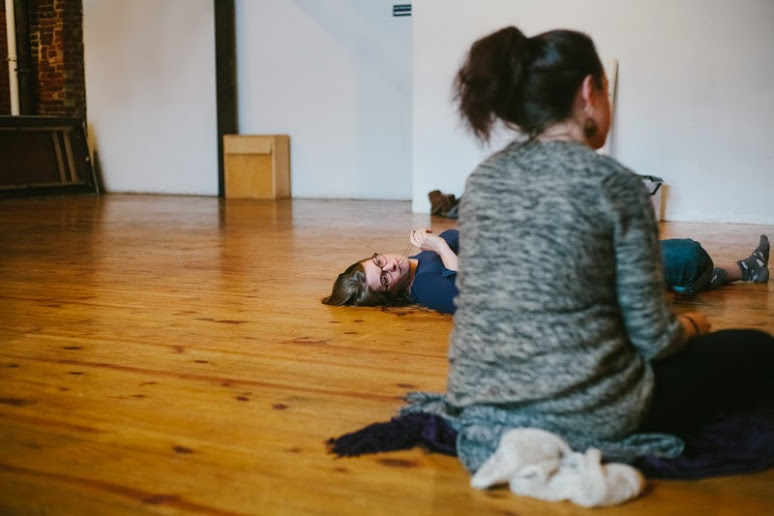
For the first few days of the collaboration they sat in the MAAS building talking about their lives, feminism, and “otherness” in theater. They talked about their fears, both professional and personal.

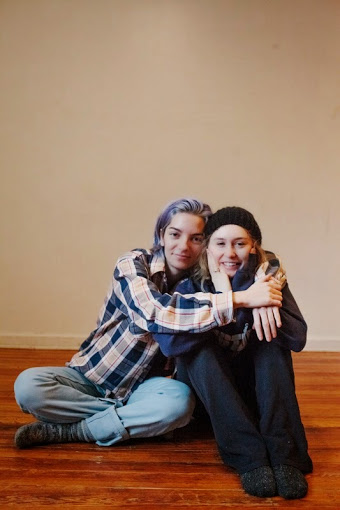
adrienne katherine Photo by Adachi Pimentel.

“Whenever you bomb [a performance], it’s like getting closer to god.” – Omar

“Was I supposed to go to law school and get married and have babies? Have I just been lazy this whole time?” – Katherine

“It’s interesting to notice the projects that have been satisfying to me: they have nothing to do with professionalism.” – Adrienne

“I started writing plays where I had to do something I couldn’t do.” – Omar

“I don’t believe that people are fundamentally ethical. Ethical systems are contextual and constructed.” – Adrienne

“I would be nicer to myself if I could do it again.” – Katherine

omar adrienne Photo by Adachi Pimentel.

This morphed into a conversation about what they wanted to make. They decided to start with some writing exercises; start from nothing, then swap writing somewhere in the middle.

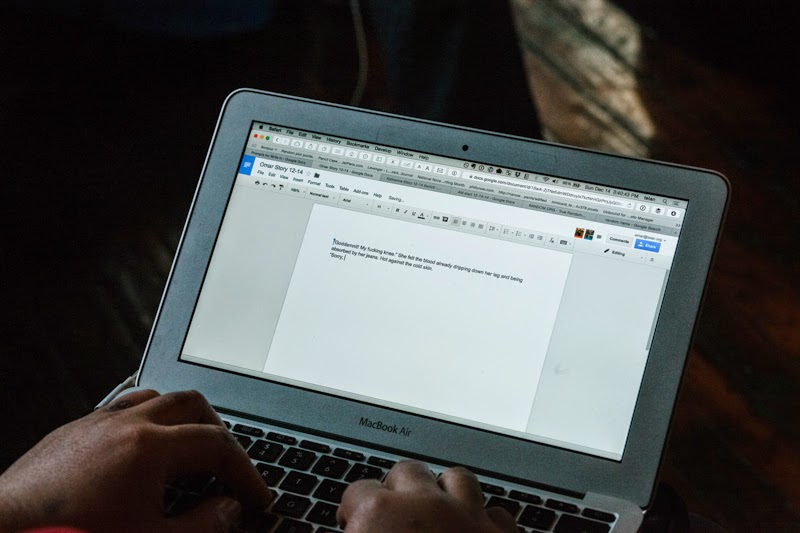
Sitting in the basement of Chapterhouse, Omar dared us all to complete prompts that challenged us to write something that would be challenging for us. We all doubled back and dared Omar to start a piece filled with unflagging optimism. We would switch writers after 20 minutes, then again after 30, and again after 40.

No disrespect to Mr. Cube, but I’m going to talk about a perfect day. Not just a good day. Perfect.

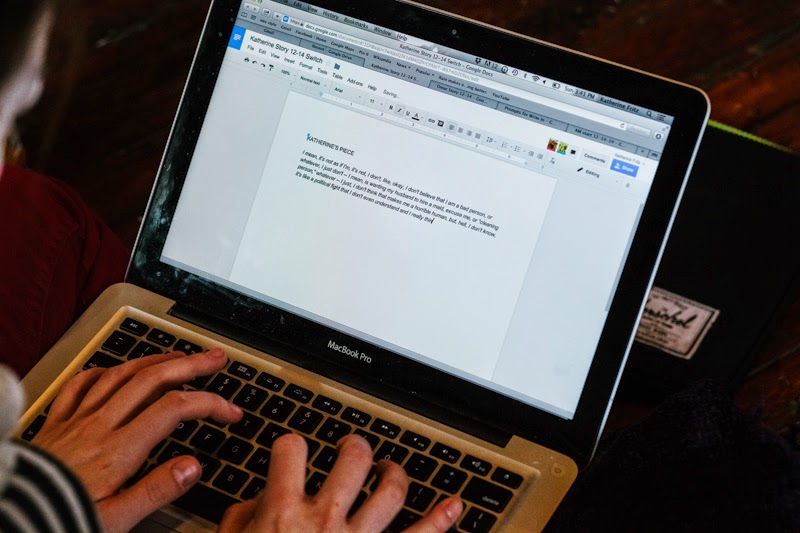
In MAAS, Katherine started a story about a boy that owned no books. A collaborative effort, the story seamless flowed between Katherine, Adrienne, and Omar’s prose.

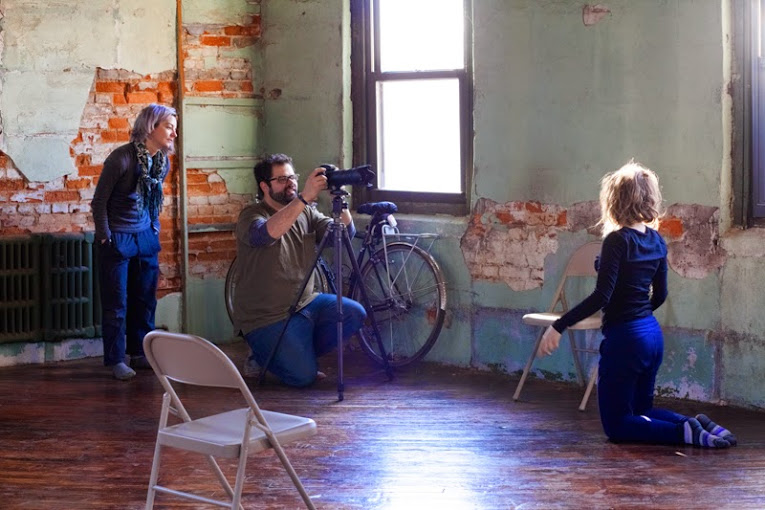
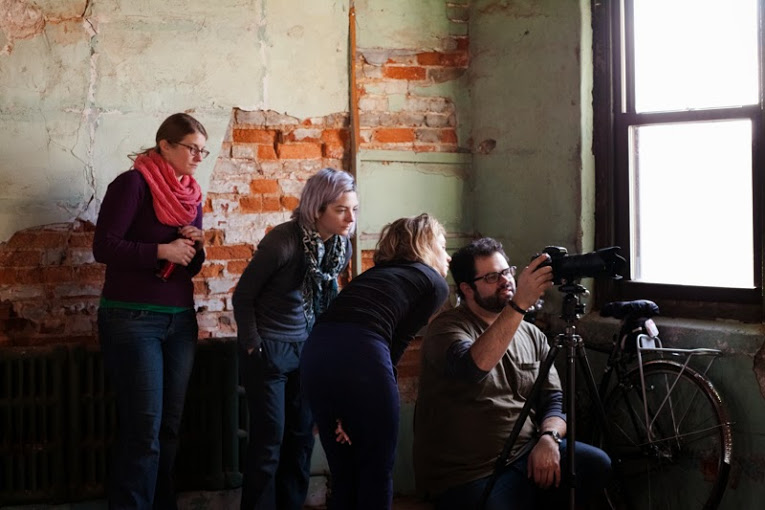
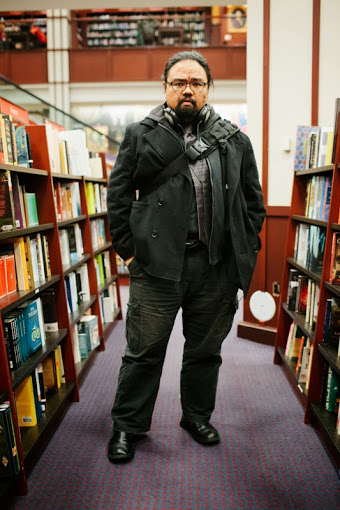
She took a moment to watch him. The black rim glasses, the full beard, flannel shirt. She couldn’t believe she was even considering this. She imagined that if magic existed, some crazy, old wizard was smoking some really good Hobbit weed, surfed to a fashion blog and decided to turn a single gear bicycle into a real boy.

Adrienne started a piece about Fox Mulder:

I want to believe that I am not, as they tell me, a 12 year old girl from Merrimont Middle School. That I am not merely a fan of some conspiracy theory laced television show. That I am not a “lovesick fan” or an “actor-obsessed teenager.”
I am an FBI agent. And believe I have been transported by an unknown technological force into an alternate reality program in which I am trapped.

And these writing sessions, focused on taking a piece of someone else’s writing and seamlessly blending your own style with that of the writer before you, devolved back into conversations:

Apparently, the game I mentioned was a game he had played a lot as a kid. I didn’t realize that his negative response was stemmed from the fact that he was feeling attacked. I needed to acknowledge the reason for his defensiveness. I didn’t realize I was attacking who he was.

Towards the end of the week, the trio was on a roll with writing exercises. Sometimes they gave each other prompts, sometimes they wrote from pieces of music or pictures. They started to figure out a way to bring other people into this writing practice. They would give people prompts and ask them to write, switching pieces after 20, then 25, then 30 minutes. Prompts included:

Begin with an argument on Facebook.
Write down as many words for one minute as you possibly can. Don’t think, just write. Now delete them all. Begin to write your story.
I didn’t think success would look like this.
You have nothing to be ashamed about.
It’s complicated to some but not for your narrator.
Murphy’s law as a person.
Try writing as a different gender, race, age, class, etc. Pick at least two different categories.

These prompts would help people dig deeper and examine the tiny voices and inner selves we all play host to. So much of the week with these artists was about writing deeper – exploring the places they might not go unprompted. Invitations were sent out to friends to join them in giving their inner voices free reign over their keyboards for a few hours. The goal was to write without judgement, respect the writer that came before you, feel free in your own ability to express yourself.

These writing exercises were like little exorcisms that allowed this other person to peek out from behind the curtain of our outer selves. One story was about a haunted room in a basement, another about a person someone used to know.

katherine hands

Who are the people we carry inside of ourselves, and how do they control who we are in the world?

adrienne hands

Do we hold these selves apart from each other? If so how do we reconcile these differences?

omar hands


Arianna Gass is a recent graduate of Vassar College. In addition to documenting Cross Pollination, she is the Program Manager for Drexel University’s Entrepreneurial Game Studio. Her own art practice is located at the intersection of digital and embodied play, and her scholarship focuses on feminism, performance studies, and game studies. You can find more of her writing and work at www.ariannagass.com.

Week 8: Jaime and Magda and Chelsea

Jaime Portrait

Jaime Alvarez is an artist living and working in Philadelphia. While his background is in photography, his work has involved sculpture and installation. He has exhibited work in
the US and internationally. For more information, please see http://www.jaimephoto.com.

Magda and Chelsea Portrait

Magda and Chelsea began collaborating in 2012 while studying at the Headlong Performance Institute in Philadelphia. Their pieces are composed of self-love, subversive humor, feminist spit, and sexual, angst-ridden cries against society. The genre of their work? Oh, somewhere between TED Talk, modern dance, therapeutic seminar, stand-up comedy, rock concert and abstract theater. Their first piece together: “Rooster and Snowball” has been presented through Jumpstart LiveArts, the LiftOff Festival at the HERE Arts Center, and won the audience favorite award from DanceNow at Joe’s Pub in 2013 where they also performed their second collaborative duet “Singer/Songwriter” in 2014. In December 2014 they premiered their first full evening length piece, “The Vulgar Early Works” at JACK in Brooklyn, also to be presented by FringeArts. The Vulgar EW is a premature retrospective, chronicling all of the work from their first 2.5 years of collaboration. Visit their website for more information: www.everybodygetinthecar.com.

Week 7: Katherine and Omar

Katherine Portrait

Katherine Fritz is a Philadelphia-based writer and costume designer. She is the creator of the viral blogs I Am Begging My Mother Not To Read This Blog and Ladypockets, which was hailed by the New York Times as “very funny.” Her words have been published in The New York Times and the Huffington Post, and her content has been shared on platforms such as Upworthy, Hello Giggles, Refinery 29, El Pais, and Bustle. She contributes regularly to MTV Style, where she writes about the intersection between feminism and pop culture. During her cross-pollination week, she was a guest on National Public Radio to discuss her viral post “Race Ya.” She is at work on her first book. In her other life, she is a costume designer and teaching artist. Recent design credits include: Signature Theatre (DC), Arden, InterAct, Pig Iron, 1812 Productions, Theatre Exile, Azuka, Lantern Theatre, Theatre Horizon, Act II Playhouse, FringeArts, Applied Mechanics, and the Philadelphia Artists’ Collective, where she is a proud Resident Designer and Artistic Associate. More about all of this can be found at katherinefritz.com.

Omar Portrait

F. Omar Telan shares a New York Innovative Theatre Award for Outstanding Performance Art Production for Too Much Light Makes The Baby Go Blind with the New York Neo-Futurists. A selection of his plays are anthologized in 225 Plays from Too Much Light Makes the Baby Go Blind. With Asians Misbehavin’ he has performed in the New York Fringe Festival, the Philadelphia Fringe Festival, and at Roundhouse Performance Centre (Vancouver). He directed “The Edge Of The World” which was performed at La Mama E.T.C. (NYC) as part of the Asian American Theater Festival.

His poetry has been published in “A Gathering Of The Tribes”, “Apiary Magazine”, “The Fox Chase Review”, “Our Own Voice”. He has read his poetry at the Poetry Project at St. Mark’s Church (NYC), the Kelly Writers House (Philadelphia), the National Asian American Poetry Festival (NYC), the Philippine Embassy (DC), and the Geraldine R. Dodge Poetry Festival (Waterloo Village, NJ).

He graduated from Emerson College and the Radcliffe Publishing Course.

Week 6: Seeing Sounds, Hearing Shapes

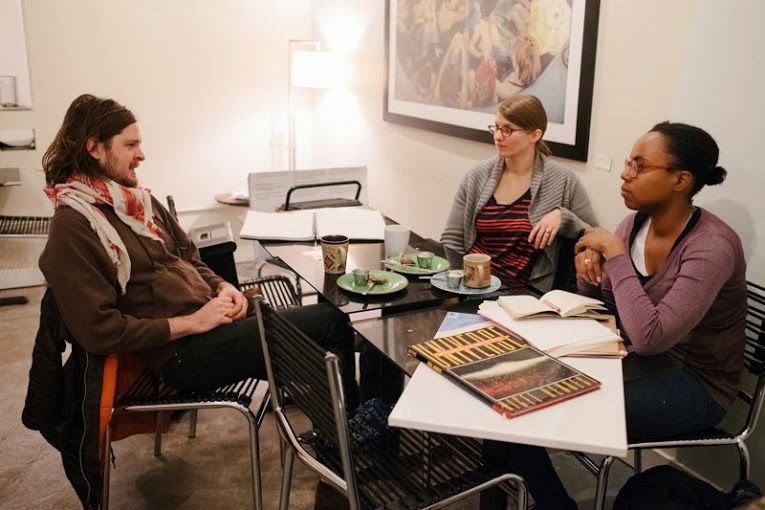
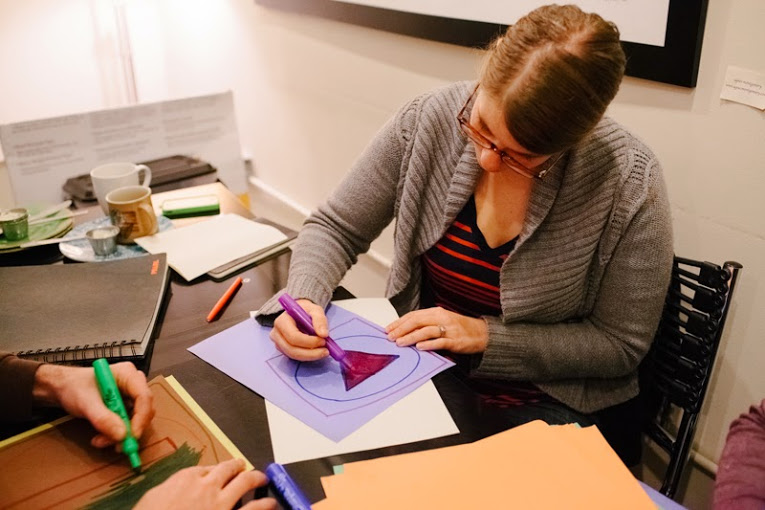
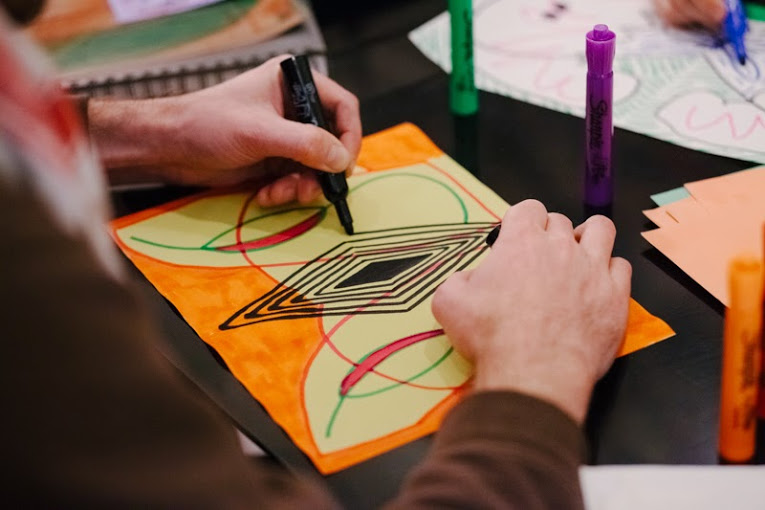
The residency week with Michael Kiley, Lyric Prince, and Adrienne Mackey started with small, childlike drawings on construction paper. Sitting around a small table in a café, Lyric guided Adrienne and Mike through drawings, replacing their drawing tools at random intervals. Lyric tasked them with creating symmetrical designs by drawing a pattern on one side of a folded piece of paper, then replicating the pattern on the other side. These small improvisations lead by Lyric “set the stage” for the larger, collaborative drawing improvisations that happened later in the week.

The next day, we started exploring the question endemic to Cross Pollination residencies – how do different kinds of artists tackle the creative question? Adrienne, Lyric, and Mike moved around the space, warming up their bodies. Lyric, hanging from the large metal beams of the ceiling, explained that her work happens when “emotion and image snap together.” Adrienne, lying on the floor, contemplated why her endeavors are often undertaken with an event in mind, a set due date. Michael, discussed his process in somewhat mysterious terms; explaining that he usually finds a sound that piques his interest and follows it to a conclusion. He admits to being relatively unconscious of the space between slogging through something and having a finished piece. Even though the three had really different means of accomplishing their creative goals, they all shared a mutual goal of bringing people together through their work. Adrienne values experiences that make people feel “bigger, connected, valuable,” Lyric hopes to unite people through her drawings and paintings with the universality of their emotion. Michael mentioned that he likes to bring people together, but often focuses on the vulnerability of sound, especially singing. He described the mouth as a particularly vulnerable part of the body. Opening our mouths and making sounds, particularly sounds that might not be classified as “singing” can be both uncomfortable and taboo.

I think it was this point at which Michael and Adrienne, who have done vocal improvisation together in the past, introduced Lyric to that practice. Starting with just a sustained note they each matched, they slowly started to challenge each other, using their voices and their breath to make unusual sounds. While this may have been a challenging exercise for Lyric, she rose to the occasion, just as Adrienne and Michael did to the task of drawing.

Regrouping, Michael posed a question to the group: could we construct a practice, both performative and transformative, that can be felt by a watcher and given more meaning by the watcher’s presence? This lead them into a conversation of differences between a time-bound medium like performance and a time-less medium like visual art. Various ideas for performances were mentioned, but the emphasis always came back to a practice – something that could be observed, but something that ultimately had intrinsic value to the performers themselves.

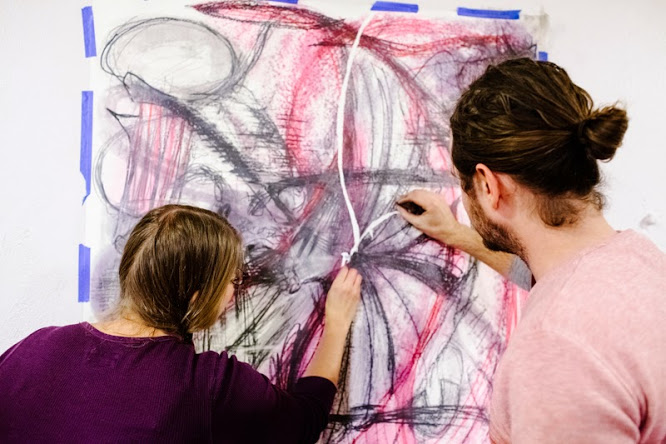
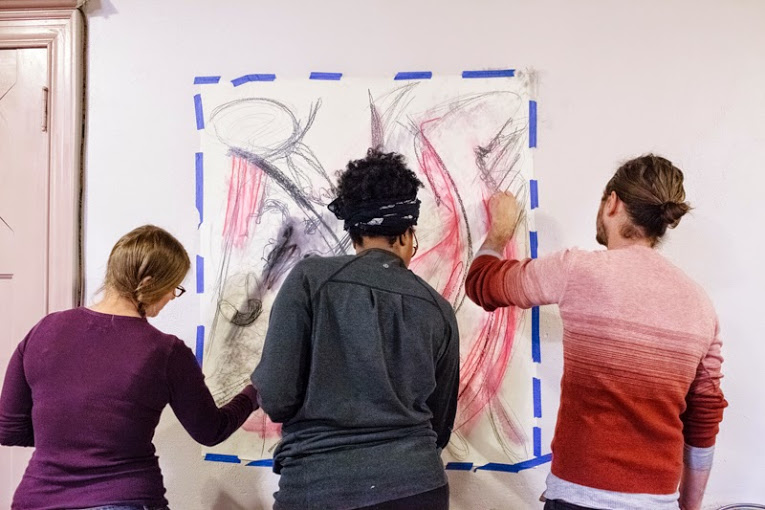
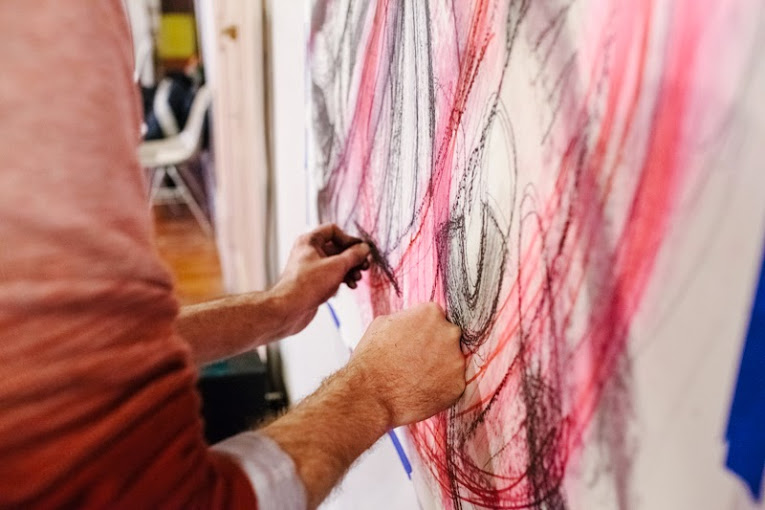
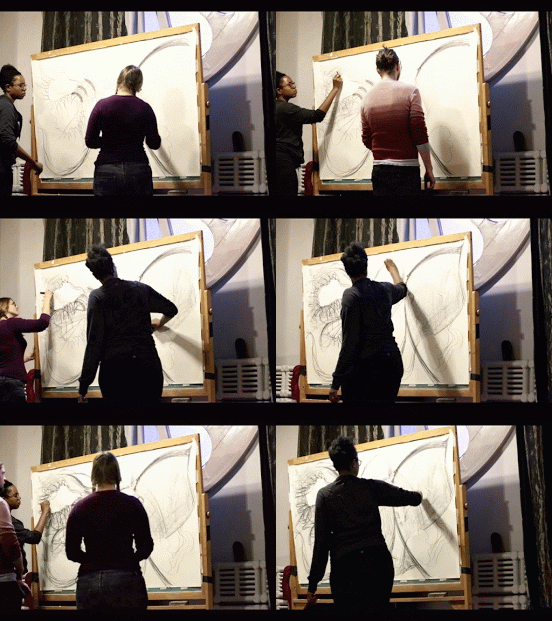
They agreed to move towards collective improvisations that would integrate aspects of vocal improvisation, sound, and drawing. They graduated from small pieces of construction paper to a floor covered with three-foot by two-foot post-its, eventually working on large sheets of fine drawing paper, four feet wide and six or seven feet long.

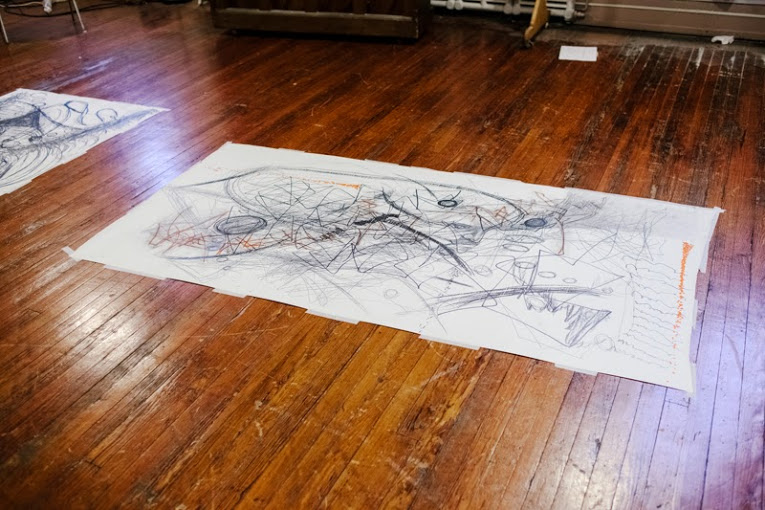
The first large-scale improvisation was created with graphite on a large piece of paper. It was abstract, but the three focused on creating balance and symmetry by echoing the shapes and sounds they saw and heard from others.

LyricMikeImprov1

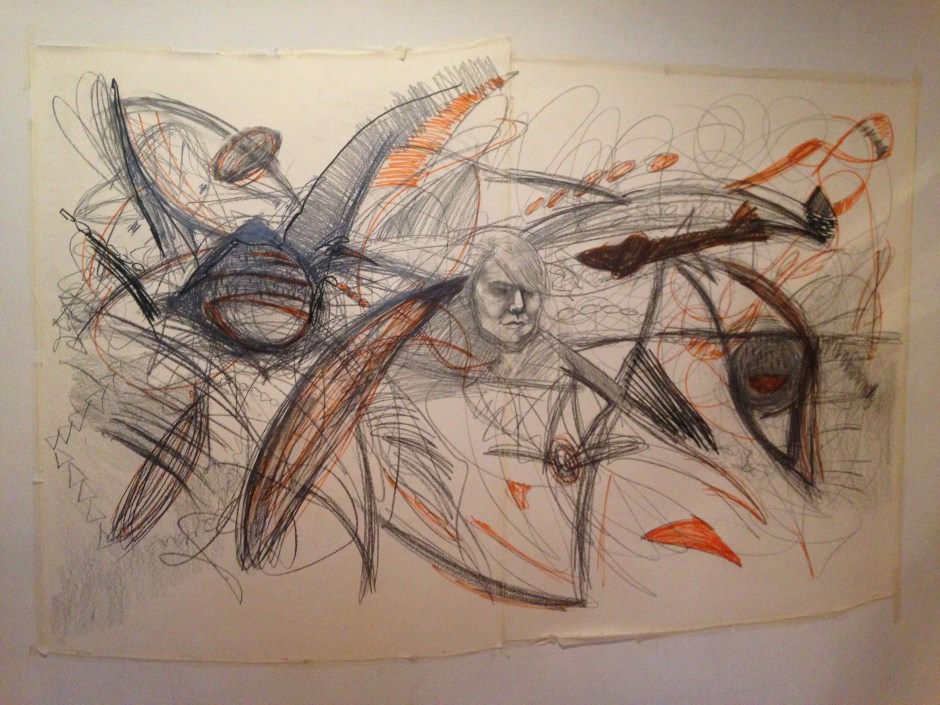
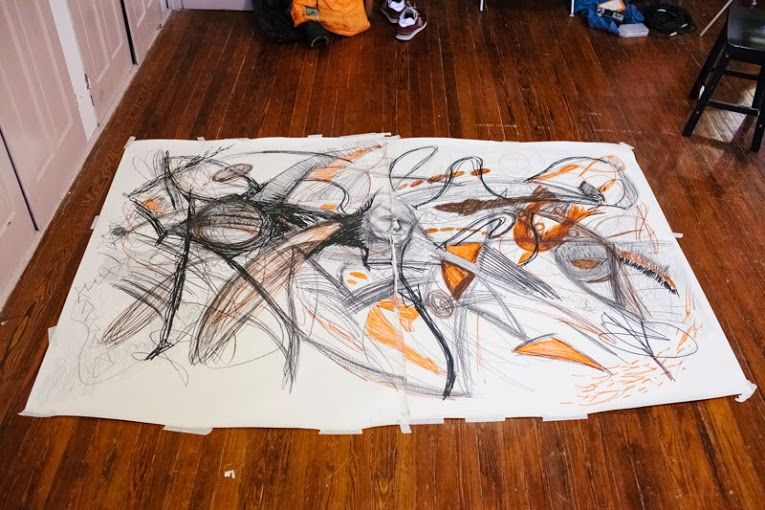
For the next improvisation they decided to integrate one color (orange) and a central image (a portrait of yours truly) into the composition. I got lost listening to this piece. I had never stopped to consider the rhythmic or tonal qualities of drawing, and from where I sat, the sounds of pencils drawing on the rough paper were unexpectedly melodic. Lyric, Michael, and Adrienne had started to use each pencil as a distinct “voice part.” Bold, soft graphite crayons made sweeping baritone sounds, while harder, thinner pencils yielded a piercing coloratura as they were dragged across the paper.

LyricMike2

This improvisation was one of our longest; close to an hour, and the only one that featured a non-abstract image. Regrouping afterwards, Adrienne talked about struggling with “naming” shapes. She realized one of the shapes she had been working with looked like a shrimp (see middle of the right side), and struggled with simultaneously wanting to and not wanting to make the shape more “shrimp-like.” The three agreed that abstract shapes made it easier to listen to the sound of the improvisation, while making representational images placed a premium on the visual aspects of the composition.

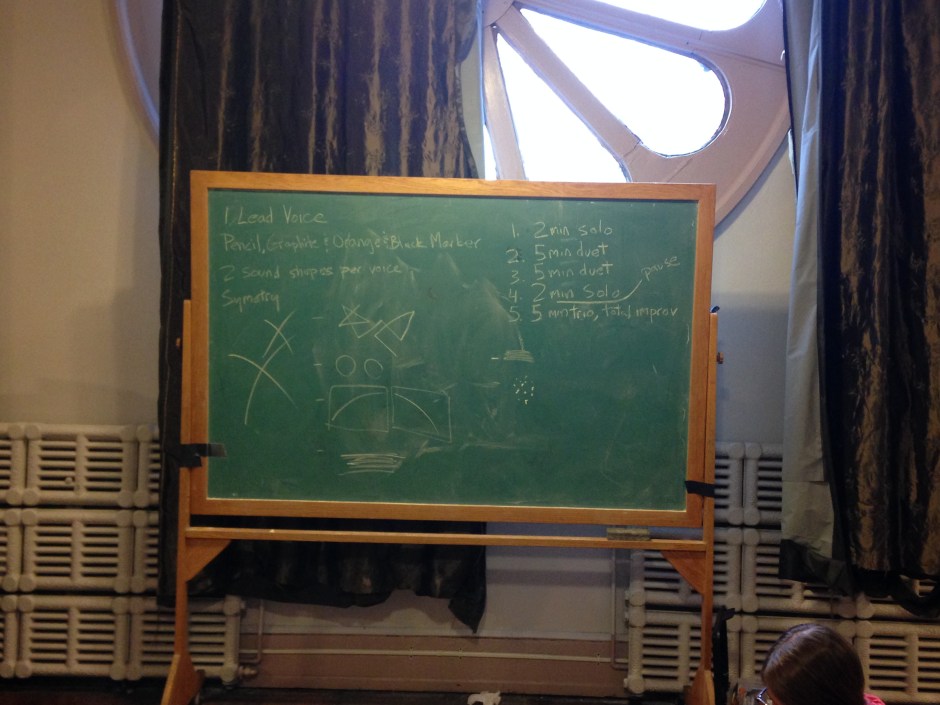
The next day, Lyric, Adrienne, and Mike started to get even more specific with their improvisations. Pencils did not just represent separate voice parts, they could also perform pre-determined shapes that yielded particular sound qualities. There were legato arcs and staccato dots, sharp triangles like a sforzando and shading that took on the quality of a vibrato. The picture below has an outline of the different shapes and the structure they worked with for their improvisations this day.

lyric mike 3

It’s a little hard to read, but the chalkboard says:

1 Lead Voice
Pencil, Graphite, & Orange & Black Marker
2 sound shapes per voice
symmetry

Below that are some of the shape/sounds they’d be using: arcs, x’s, circles, shading, and dots. To the right of that there is a general structure for the improv:

2 min solo
5 min duet
5 min duet
2 min solo
PAUSE
5 min trio, total improv

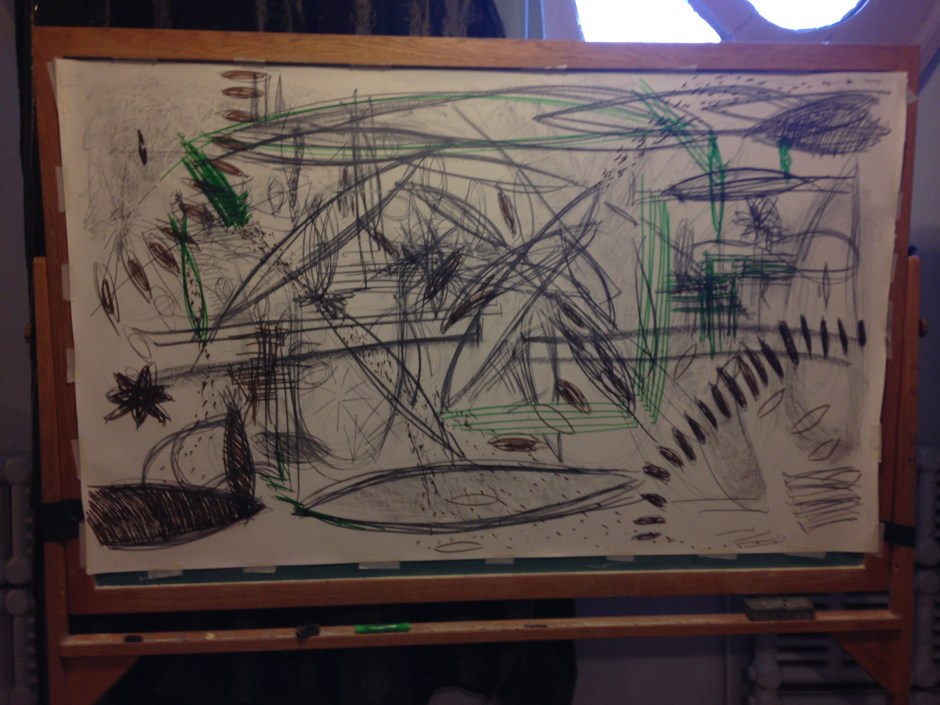
This structure yielded this drawing.

IMG_1077

Michael, Lyric, and Adrienne seemed less satisfied with the experience of this improvisation. It seemed as though the visual vocabulary the instituted was a little restrictive. The composition had a degree of symmetry and, therefore, balance, it lacked that extra something that made the previous day’s composition so special. [Also, an aside, I find the resemblance between this drawing and Marcel Duchamp’s “The Bride Stripped Bare by Her Bachelors, Even”  to be a little uncanny!]

For the rest of the day they continued to experiment, eventually adding techniques like smudging graphite with paper towels, using water to peel layers of paper off and create texture, and using erasers to leave faint outlines. Each of these techniques introduced a unique sound quality to these improvisations, which continued to take on unexpected musical qualities.

ripping paper

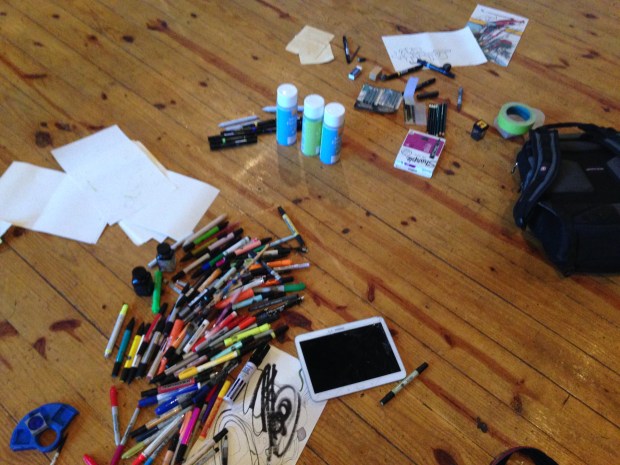
On our final day, we added a bunch of new “instruments” to the improvisation, including different kinds of erasers, markers in vivid jewel tones, several pieces of leather for smudging, and new pencils in varying widths and shapes.

IMG_1102

Together, they worked on integrating the research they’d done in the previous few days with vocal improvisation techniques. Using binaural recording technology, they created an image that was also a soundtrack. You can hear the recording of these shapes , but below you’ll find a short video of what the improvisation looked like from where I sat. In order to best observe this clip, I recommend watching it twice – once with your eyes closed, and again with your eyes open.

In a week Lyric, Mike, and Adrienne created a practice that likened drawing to musical composition. They found that visual and aural symmetry were useful tools in creating balanced and interesting compositions. As they got further and further from drawing shapes that corresponded to observable physical objects in real life, they found more unusual vocal qualities capable of echoing those shapes. The three learned to draw shapes for their sounds, improvising in a new, interdisciplinary jazz.


Arianna Gass is a recent graduate of Vassar College. In addition to documenting Cross Pollination, she is the Program Manager for Drexel University’s Entrepreneurial Game Studio. Her own art practice is located at the intersection of digital and embodied play, and her scholarship focuses on feminism, performance studies, and game studies. You can find more of her writing and work at www.ariannagass.com.

Week 6: Lyric and Michael

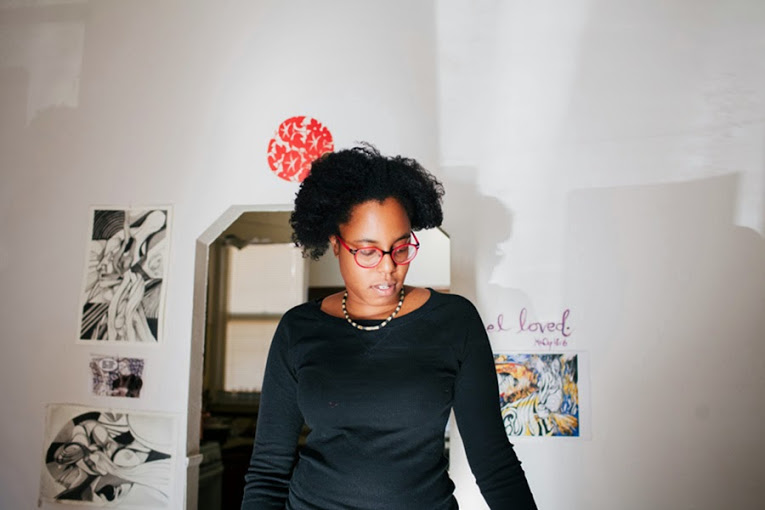
Lyric Portrait

Born and raised in Richmond, VA, Lyric Prince received her Bachelor’s of Arts from Saint Joseph’s University, and is currently studying artistic trends online as a part of her graduate studies in Science, Technology, and Society at Drexel University. Her past experience includes online and real-world public art installations, blogging, and drawing and painting large-scale works. She has also contributed her art to local art happenings and events in Philadelphia- notable productions include The Last Word Open Mike, the African American Museum of Philadelphia annual gala, and the Association for Public Art Candy Coated mural installation. She currently lives and works in Philadelphia.

Michael Portrait

Michael Kiley is a Philadelphia based composer, sound designer, performer and educator working in dance, theatre and public installation. Past collaborators including Faye Driscoll Group (NY), SubCircle, The ActingCompany (NY), Lars Jan (NY), Dan Rothenberg of Pig Iron Theater Co., Sylvain Emard Danse (Montreal), Luciana Achugar (NY), Magda and Chelsea, and Nichole Canuso Dance Company.

In addition, Michael creates his own work under the moniker of The Mural and The Mint (TM&TM). In 2010, TM&TM created As the Eyes of the Seahorse, an interdisciplinary performance of dance and live music which premiered at HERE Arts Center (NY). 2013 marked the release of The Empty Air and Animina, two soundwalk pieces as iPhone application which use Global Positioning Service to determine what the listener hears depending on their location within two separate public spaces in Philadelphia. Michael also released Kuerner Sounds in 2013, a commission by The Brandywine River Museum to be heard during a tour of the Kuerner Farm, which inspired painter Andrew Wyeth for his entire career.

Michael’s work has been supported by The Independence Foundation, The Pennsylvania Council on the Arts, The American Composers Forum, FringeArts (Live Arts Brewery Fellowship), Philadelphia Music Project (PCAH), The Hacktory, and the Wyncote Foundation through The Painted Bride. The Empty Air won Best of Philly from Philadelphia Magazine for Best Smartphone Application, 2013.