Motivation

Lonely

I know that often I write about art in a general way, one that relates to most of the people working in my field, and when possible to the arts as a whole.

Today I’m not gonna do that.

Today I want to talk about being a director. And for me that can feel awfully lonely.

A few days back I was giving a colleague a ride home from an Arcadia University gig out in the burbs. Both of us have been hired by said school to direct student productions (different ones, in case that’s not obvious) for the college. And on this day when we both happened to be heading home at the same time of night we ended up in a car together chatting about the experience.

After the expected pleasant inquiries about rehearsals and how things are going, we sat in a still silence for a little bit. We chatted about upcoming works on the horizon and exchanged a few war stories about the theater scene. It was a perfectly nice way to spend 45 minutes headed home. It was the kind of conversation I have with other directors a lot.

A few days later we ended up in the car again. This time, catching up rather quicker on the status of rehearsals we were left without some of the pat topics that usually pop up. And somehow we started talking about what it feels like to be in charge.

It’s funny, it doesn’t occur to me often that this is a specific facet of the way that I work compared to the other artists I work with. It doesn’t occur to me that often, through repetition and familiarity, that many artists don’t walk into a process with that mindset. I know that when I walk in the room, I’m expected to have a plan of what we’re going to do. I know that I am the only one of my kind there to carry out the role. And I never see anyone else do what I do and therefore I have only myself to compare with.

There is a very basic power differential. The caveat, of course is that there are lots of people that try and create a sense of communal responsibility and I am whole-heartedly one of them, but it is there. And that sense of responsibility is exciting and distancing. It means you are always a few steps ahead of the rest of the room. A simple illustration: it is hard to imagine a rehearsal in which a performer or designer walked in and stated the plan of the day or one in which the director could show up and look at the others in the room with an expectation of what they are about to do. I don’t think this has to be good or bad. But it definitely is. And unless you’re a company without a director there is likely a negotiation that’s been worked out either ahead of time or during the process in which that power is defined and bounded.

However, I’m getting off topic. That isn’t really what I want to chat about. I think there are interesting questions about what might happen if we tried to change this dynamic. It might show us why that structure is so necessary or it might open up new and exciting potential. But for me, who for better or worse, is working in this way almost any time I work, it makes me realize how lonely I feel so often.

I’ve heard a lot of directors say that every time they begin a show they ask themselves, “How do you make a play again?” I thought this might be particular to devisers so it was surprising and kind of heartening to hear that those who dwell mostly in the scripted experienced the same terror. It was interesting to hear that she too re-reads her old notes from shows past to figure out how that person from the past navigated the journey from nothing to something. And I was happy and sad to see that she too spends a lot of time feeling lonely in a process.

I wonder if that sense of “how did I do this before?” is something to do with the fact that you don’t share your process in the same way. So much of what we do is before and after the rest of the room arrives and leaves. And even with documentation, it can be hard to track all the discoveries and thoughts that by necessity are shared between actors and designers and stage managers with the people they work with. One reason I so often try and go back to my old books of notes is to sense the person who was able to do this thing before and catch some of her strength.

Another strange thing about being a director, that I think may be unique to the role: you never watch others like you work. There’s only one of you in a process. Designers and actors get to see other designers and actors. They see people like themselves develop their craft. And for better or worse they have to do this a lot. And there are times when I get jealous that in doing so they get to watch and experience other directors too. That they probably know more about the particulars of other directors than I do. I sometimes ask them “What did that other person do?” not because I have some desire to copy but because I genuinely just want to know.

My sense of myself in the work is kind of like an island. I know what my terrain looks like. I know how I traverse it. And when people who’ve been elsewhere come to visit me, they can share stories of their experiences, but I know that I really have no concrete sense of what’s going on in those other locales. And while many of the directors I know get the chance to observe early in their career, there is not the built in continuation of this practice as time goes on.

When I first started in school and was just out of it, I saw a lot of other directors directing. I was in other people’s rehearsals a lot. And it provoked thoughts in me about how they solved the problems in front of them. It made me think about my process and question what I would do in the same scenario. And some of my favorites were those that were quite different from my own sense of artistic aesthetic, not because I wanted to do what they did, but because it made me really need to define why I wanted to do it my way instead. In fact, I once had a director say to me as a fledgling AD, “I love the thoughts you send in your notes. I will use none of them because they aren’t the play I’m making, but I love them.”

I learned to be a director in a room full of directors. And since becoming one, it’s been a very long time since I saw another one in the wild.

I’d like to.

I wish I had the opportunity. To watch. To listen. To observe a bit.

To travel to another island simply to try and understand the way it works in contrast to your own.

A
Been a while…

Hey Friends.

So.

It’s been a while.

This summer has been a bit of a hiatus from this space. It’s been a lovely and hectic and busy time. And it’s filled me with lots of new thoughts about making and doing.

And I’ll be honest, at some point after being away for a while I started to feel a little guilty. This is par for the course with me. I like to do things perfectly or not at all, and once I start to get that, “I haven’t written anything in a while…” feeling, my first instinct is to find some kind of distraction – a stupid show or a silly game – that keeps my mind off the fact that I’m feeling a little overwhelmed because something I care about isn’t perfect.

This is the same perfection/ignore cycle that resulted in my mom threatening to cut me off if I didn’t call her to say hi during my junior year of college. Because once you feel a little guilty about not doing something it just builds and builds and builds.

Back then, I just worked more to keep that feeling away and at bay. And surrounded by other workaholics, that seemed like the norm, just what you did – put your personal problems on hold – so I never questioned the impulse. Now though, whether it’s because I don’t have the stamina (negative view) or I’m less able to give in to the self-destructive impulse (positive view) I just don’t tolerate the punishing schedule ad nauseum anymore.

Which isn’t to say I don’t work hard. I do. We all do. But it is not with the frenetic blind need from before. I can’t work and work and work if I don’t see the light at the end of the tunnel, if it seems like it’s working for working sake alone. And this summer has been an interesting case study. It’s one of the first times in years that I’ve had as many things going on. But it’s also one of the first times that I feel like I’ve given myself a process in which I actually have all the resources I need.

The Ballad of Joe Hill which is running currently at FringeArts has, in particular, given me some food for thought. The first iteration of this show had a kind of magic. It was brutal, produced on about $1,500 of cash and a whole lot of sweat and heart, begging and borrowing. There was a tiny core of people and we did everything. We carried each object into the space with our hands. We rehearsed in dribs and drabs when we could fit the time in between jobs. We changed where we performed. We hauled dirty, heavy risers in and out of tiny storage spaces. We printed fliers and begged the press to come. We made change for the audience and stored our money in a cigar box.

The stuff is still carried, the space is still dirty, but this time Joe Hill has a small army of folks – a full time SM, PM, riser and light crew and more. Our equipment was delivered. We have real bathrooms. Our box office is taken care of. I have not once had to think about marketing. We have had full 8 hour day rehearsals in lovely controlled spaces. And – and this really is the greatest of all the things – I haven’t worked a single other job since we started working full time.

If I had to imagine what I really needed for this show when I did it that first time, this is close.

And I have to remind myself of this. Last time, the crap that seemed out of my control the first time – the money, the resources, the time, etc – gave me a mental pass on making my best work:

“If only I had real money”

“If only I had everyone all the time”

“If only I knew someone with more expertise with lighting”

“If only I could just concentrate on doing my job”

“If only”

The problem with “If only” thinking is that it puts you in the past (“If we’d only had…”) and the future (“If I can only get…”) but never in the present. And theater in particular as a medium is about the glorious immediacy of RIGHT NOW. It’s our biggest superpower – the ability to require another human to “be” with you, right then and there. “If only” stops you from seeing what’s really there and instead what could have or might be if only you were a different person in a different place with different stuff.

I don’t have that pass anymore.

I have myself and the work.

And in a way, that makes this project a bigger win. Maybe even harder fought. Because it’s not a battle with tangible limitations. It’s just a battle with myself and all that empty space. If I fail, there aren’t other excuses to blame. It’s not because I didn’t have what I needed. It’s because of me.

So.

It’s been a while.

I hope to be here more often. And I’m going to try and not let myself get too caught up in the “If only I had more time to write this” feeling I’m having right now. I’m going to attempt to work through this lesson and simply do the work that I can do, right now, and let that be good enough.

– A

For the other

Fellow art makers, I ask you a question because I want to know if you feel the same.

I struggle to talk precisely about my relationship to my work, to making, to creativity, to all the things that are connected to and impossibly diminished into the imperfect word that is art. Even writing it, thinking it, it seems so much less significant than it feels.

To forgo sleep over art.

To lose oneself over art.

To cry and despair over art.

Doesn’t that sound so silly and small?

Like a child who cries when an imaginary playmate drops their tea. Like a teenager lost in their own emotional maelstrom and unable to see how little their problems are in the grand scheme.

Which is why I ask you: is it just me?

For you, creator/builder/music-maker/dreamer/poet/writer, it isn’t so small, no? For you it isn’t small at all. I want to know if you too feel a strange and entwined feeling.  Not just to a collaborator, or a particular work, or even an entire genre. But to some kind of entity, a large and all encompassing force that is both rooted to the very center of you and simultaneously massive and larger than you can hope to conceive.

It is a relationship that I struggle to put into metaphor.

It is some part romantic, some part friend, some part deity. It is in many ways connected to those with whom the work is created, at times weaving together disparate persons who under any other context would have no reason for connection. But it may also be a force of isolation, leaving one standing alone with their beliefs and their visions and vainly crying out and wishing they could offer the eyes through which they see. And while it can work through people and manifest itself there, it feels at the core that it is just me and it – the thing, the feeling, the intuitive relationship to the work/skill/force.

And lest I get all Bronte on you (but really, given the flowery and Romantic nature of this writing, aren’t we already there?) it is actually the deepest and most sustaining love I have ever known. It is the relationship for whom I have sacrificed the most, the bond for which I have been most willing to grow and change, the one that has redefined and required the most of me.

And while it is deeply personal, it doesn’t feel like it is one that I have with myself. I’m not battling with my own insides. I’m fighting to figure out how to be with and in this outside force. Like swimming in a current unsure if it is taking me somewhere I ought to be going.

The work and I are locked in step – sometimes in battle, sometimes in sync.

And because it is unlike any other relationship I can see and define, it is so hard to know if it is the work or me when I feel the friction between the two. Hard to know if I am wallowing and caught in a destructive undertow or leaving untreated the pangs of pain that come from when one is violating the core of the artistic impulse.

It’s why, my fellows, I’m asking you, do you have these moments of struggle as I do? It seems surely you must.

It seems that you too must have days when you fear it is more than you are capable of. It must be that you too must have times when you feel yourself alone and rage against not having more faculties to fix what is ailing. When everyone around you seems to see the path that eludes you. Days when you do forgo sleep, lose yourself, and cry and despair over the work, the art.

And on those days do you also, my friends, do you fear, for a moment, that the otherness with whom you wrestle isn’t all that you sense it is?

Or do you also wonder, as I do, if it is as large and full as you sense and that you are too small to encompass it?

I believe you do.

I believe it because I cannot see how else we could stay with it, in it, for years and years. If it is not as big as all that how else could we let it take up so much of our lives? How else could it work through us so thoroughly? How else could it light up our emotions so strongly? How else could something as silly as a song or a scene or a sentence mean so much to us?

How else could I be left sitting over coffee in the morning so uncertain about whether I have been enough for those I have striven to be there with?

I may be less than I hope to be. This is possible.

There may be more strength than I can currently see. This is also possible.

Perhaps it is neither.

Perhaps it is a thing that exists on its own course and runs on an energy that I cannot entirely see, a thing I cannot entirely control, a reigned beast for whom the tighter I try and hold it close the harder it will be to feel its push and pull.

Perhaps what I have given to nurture it most is only tangentially related to the particular worry and fear I feel at this moment.

And perhaps I can only get up from my table to disrobe and stand in the shower and do my best to scrub away the deficiencies in myself I feel.

Or perhaps instead let them fall over me, try my best not to fight them so they do not catch and block, take a moment to have them fully before they wash away.

Perhaps I let myself be in the fear of failure, even allow myself that the losses I feel are real, and that maybe, they are necessary part and parcel with that otherness with whom I am entwined.

And perhaps in a week or two when the thing has come and gone I will look back at myself and shake my head at silly tears. Smile sadly for the person caught in waves of doubt and wish I could tell her that she cannot really fail so long as she does not hide, does not shrink, and does not let the fear make bitter that great love, this love of her life.

A

On Valuing Age, On Appreciating Wisdom

I find my thoughts drifting these days to my almost three year old niece and the fact that any day now she will become an older sister. She’s decided on her name for the impending baby. I imagine is as excited as an almost three year old can be about such a thing, understanding it about as much as an almost three year old can.

I keep thinking, “Man kid. You have no idea how much everything is going to change.”

Then: “You are about to feel so grown up.”

When my thoughts drift this way, I think about how much my identity as an older sibling has meant to me, shaped me, and shifted who and how I am. My earliest memories start around the time my own sister was born – at that “almost three” age. So for as long as I’ve had a remembrance of myself, it’s included the sense that I was older and more experience than at least one person in my little world.

It had a profound effect.

It meant that even when I was a “little kid”, I was still the “big girl” in the family. It meant that I always saw myself in the light of being the first to pioneer new frontiers. It meant that I linked being older with being wiser, stronger and more powerful. Getting bigger meant I would be that much more the holder of experience that I could pass along. It became a deep value of mine, the acquisition of such wisdom, and it’s become a huge part of who I am and what I want out of my life. So I’ve always reveled in  “grown up-ness” and deeply appreciated what each increasing year has given me. And I still look forward to getting older with excitement and anticipation.

Of course,  there are plenty who would tell me I’m a young pup. Which, of course, I am in many respects. While many days I feel like I’ve done a lot and lived a fair amount, there are certainly times when I see myself in context of those that are ahead of me and feel young and inexperienced indeed.  But unless you have just been born NOW! or are Jiroemon Kimura you always have someone younger and someone older than you. And that means that you always have the ability to view your identity in the context of being more youthful than someone ahead of you, or further along than someone behind you.

The arts in general (and the performing arts in particular) aren’t always the best contexts for celebrating experience. While we pay some token homage to great masters, anecdotally it feels to me like we tend to reward the promise in a young savant painter, the grace and beauty of a youthful dancer, and the charisma of the impish new actor far more than we do the earned and learned skill of decades long practitioners in these same mediums.

And really, that’s too bad.

I think fetishizing the early work of artists is damaging to art as a whole. Not that such young work can’t be beautiful and moving but it’s often much simpler and straight ahead than the stuff we make later on. In art as in life life, we generally learn that things that seemed so black and white once upon a time are much more complex and mysterious. Things that we held positions on in unilateral unyielding ways we start to see shades of gray in. Things we never ever believe we were capable of, both good and bad, we suddenly realize we have completed. Our creations cannot help but reflect our deeper and more multifaceted views of the world.

So though I can appreciate the promise in the early works of a budding artist, it’s usually in their mid and later stuff that I think you really discover the complexity and depth of what a creator has to offer. It’s in the complexity that you see what these makers are really made of. It’s these kinds of works that may not be so easily digestible that challenge me to be a deeper and better art viewer. It’s in the stuff that reflects all the life that others gained that I see the kind of artists I want to be. I believe we should be treating this like gold.

And I try to remember this when I sometimes fantasize about my early creation, try to caution myself from forgetting its value. I try and stop idealizing an approach and attitude that lacked the decade of making I now have and remember how easy it is to forget what was tough, rough and messy.

I’ve had the luxury of re-working shows that I started creating 3, 5, 7 years ago. And with each of them I have had a moment in rehearsal where I think:

“I am so so much better at this than we used to be. We are all so so much better now than we were before.”

Not everyone gets that chance and sometimes a slow building of skill and experience can seem to have always been there. Which is why it’s so important to remember not just what you have learned but that you have learned, that value of age and experience.

The arts are a punishing field. If you’ve lasted a while, you must know something that others who haven’t stuck it out don’t. But there aren’t enough voices out there that tell you that.

Recently, I’ve seen a number of companies with variations on apprentice/young professional programs. I’m often struck when I see them in action by the distance between the actors with years of well earned experience and where these fresh faced folks currently are. I jokingly say that I keep seeing babies on stage. Sweet, wonderful, babies. But babies nonetheless.

These lovely eagerlings are the promise of artistic potential, but they are often not the delivery of that craft. At least not yet.

And that’s a great thing, so long as the attitude of our community is that as an early career artist, the work ahead of you should be what you have to look forward to. It’s a wonderful place to be so long as you know you will be rewarded as your depth and skill and knowledge increases from here. It’s a lovely path to look ahead to when it means that someday you can turn back to the road traveled thus far with pride and not a sense of burden.

It’s important to remember.

I don’t want to be part of a profession where people don’t need to wish they were babies again. I want to be part of medium that rewards me because I want to keep growing up.

– A

Sell Out

I wrote a bit last week about the difference that can occur between the way an artist lives their life and the way almost everyone else does. I’ve been thinking a bit more about that difference and what’s been hitting me especially hard is the strange and terrible relationship most artists have to money. I think this issue in particular – how we think about money, what it means in relation to our work, and how we decide to navigate that relationship – has a lot to do with why so many of us feel like no one understands how we live.

While it’s obviously simplistic to reduce an entire nation into one value system, in my own experience I can say that I often find myself a little at odds with the American context in which I exist. Ours is, and of course I’m generalizing, a culture that places a high value on earning as a measure of success. And because of that, it’s one that makes justifying the life of an artist particularly tough, tougher perhaps than countries whose wealth it exceeds.

I would wager that on the whole, the impulse to make and share our work is anti-monetary. Artist are in a rush to give away their product, especially when they first start making it. I would also wager that the impulse to “own” ones work like a product or thing is a learned skill. It’s something we find ourselves having to do, not something that is inherent to the thing itself. Of course this is not always true, and not always true of everyone, but for the purposes of this article, I’m again going to generalize and say that on the whole the artistic process is one that is at its core financially altruistic, and therefore at odds often with commodification. (Read Lewis Hyde’s wonderful book The Gift for more on this.) We do it because it’s what we really want to do. And for whatever reason, we’ve managed to value doing that higher than we value making it value driven.

Think about how radical a notion that is. Seriously.

For most, the conversation about how to navigate career is so thoroughly dominated by money that it’s almost hard to imagine how deeply strange it is to most people. No one is surprised that a doctor might choose a specialty that pays more, but we often feel guilt about picking a role or working with a company for the same reason. We make our work and then we are dying to give it away. We are inclined (and often do) so whether or not other people want to pay us. We don’t want to choose jobs on solely on income potential but equally (if not more) on artistic merit. The fact that you feel that at all means you have decided to step outside a value system that many people accept as a large guiding path in their entire lives.

And weirdly, because art does live outside of this metric in some ways, I think the oddity of such a thing, the mystery of how art can “charm” people out of this traditional way of thinking, becomes romanticized in its own right. We think about “poor” art as something that must be so enrapturing and enthralling that one would give up money to do it. Even I still bring forth the specter of the young impassioned creator in a terribly tiny apartment and having no money but loving your art so so so much that it’s worth it. This is in the cultural subconscious and it’s something we have to contend with.

But we’re not oblivious. There are tangible ways that money matters: it influences who has power and status, it can give us access to security and education, it feeds and houses us, and can give us cool stuff. Wealth can determine an artist’s path – to pursue art in the best way that the work demands or to make difficult choices about the kinds of personal investment they can leverage or the resources and programs they have access to. Frustratingly, training in the arts is almost always expensive. Compensation in the career is generally not. As creators we don’t want to care about it, but as citizens in this country we see we need it. We don’t want to make our work about the money, but we also don’t want the people we work (or ourselves) with to live in an unhealthful and unsustainable way.

This must be why some parents bitterly resist their children embracing a life in the arts. If you don’t have the experience of the intensity and depth of the artistic practice and experience, of course doing such a thing looks like a waste – like deciding to work at the GAP when you could be saving lives in the medical professional or running a business. Not all artists are poor. But in general, a great painter or theater actor or dancer is not making the same income as a doctor or lawyer. We are indoctrinated early that we do our work for love and not money. We are told ad nauseam by our society that “starving” and “artist” are nearly synonymous.

So as artists, we live daily with some pretty insanely contradictory attitudes and behaviors in relation to money. There are a lot of voices saying that we should want to make a lot of money if we’re good at what we do and there are a lot of voices also saying at the same time that if we are doing this art thing then it must be fulfilling enough to do for it’s own sake.

Take for example the phrase: “Sell out.” What’s your gut reaction to it? Is it good or bad? Well, it all depends on what context you’re looking at.

When you are mounting a new work there is this thing that happens when a show starts to “sell out.” This is true even outside of the self-producer realm, where you actually are counting the dollars that those ticket sales are bringing in. Yes, I’d say even in a straight up “actor for hire setting,” if you’re a “sell out” show there is a sense of accomplishment, of pride, of elevation in your work having reached a certain kind of level. That it’s something people connect to. Even if you receive not a single extra cent for the sold out-ness, it makes you feel better, doesn’t it?

What does that phrase even mean? Literally, that all the seats were bought. But it’s come to roughly equate with artistic quality. If all the seats are bought it must be valuable. And if it’s valuable it must be good or why would so many people pay for it? Conversely, there’s an unspoken pressure that says if a beautiful and amazing production has few buyers that something is wrong it. It’s a value system that isn’t concerned whether a piece happens to have picked a bad time of the year to perform. Or that the subject matter happens to have a smaller audience base but for that base the work is HIGHLY impactful. Or that your 3/4 full houses absolutely LOVE your show compared to the full houses for the work down the street that is merely entertaining enough to spend 20 bucks on. It’s a message that uncomplicatedly says more money equals better art.

Even if you know it’s not true, it’s still working on you somewhere in the back of your mind. So it’s worth sometimes saying out loud, even when it seems obvious, that small houses don’t mean you’re a bad artist. You might be, but the two aren’t necessarily related.

And weirdly, while on the one side we’re putting pressure on ourselves to be financially successful, we also have another voice inside telling us that making art for money is a cop out, a cheapening, a bastardization of the “true” impulse for creation. “Sell out” also has the connotation of the artist that is corrupted by money, who makes their work for financial gain alone and has lost touch with a “real” creative spirit. We tend to romanticize the bohemian life, both from within and outside the profession. It’s also a fallacy, this idea that our work without the pressure of money is “purer,” but it’s equally as potent.

It is strange, no, that the exact same phrase is both an indicator of our highest measure of success as well as a total debasement of the form. It is a frustrating dissonance that an art maker is trying to navigate all the time. And if we aren’t vigilant about what the goal is at a given moment we can end up in a kind of schizophrenic negativity where no matter what we do we’re coming up short.

Look, if we only made the work that made the most money, we’d probably cut out the most ambitious, and personally fulfilling projects. And yet, it’s also true that there are limitations on what’s possible with our work and those limitations are often determined by a project’s bottom line.

There are times I’ve looked back at works I made with a thousand dollars and felt wistful about the “purity” of my choices. I look at that work and think about how I did it just because I loved the art, that it was uncomplicated and “true” (or whatever). But, really, when I’m honest, that’s pretty BS right? The impulse for the work wasn’t actually less complicated by money, I was just making the same kinds of choices about how and where to allocate cash but on a much tinier scale.

I think that as we become more successful, we more obviously have to confront these questions – how does money work in out work, what do I spend it on, what kind of aesthetic am I after and how does cost play into that – but I don’t actually think they are new.  People who want to always spend all the cash on fancy stuff do it when they have a little. They do it when they have a lot. We just notice it more.

And troublingly, I have no good answers here. Just an observation that we, like everyone, have to figure out what standard of living we want and what we are and aren’t willing to do to achieve it. What we can do is not abdicate the decision to others but continue to make it for ourselves. You can argue whether you agree with the way that America equates wealth with success and decide how much you’re willing to let it influence your goals in life. You can create a work environment you believe in and pay people whatever you decide you want to and allow them to make the choice if the monetary recompense is equal to the task. Your project can lose money or knock it out of the cashola park. It can be the best thing your ever made or a total hack job. With every choice there are two assessment tools we need to use – one financial and the other artistic. And it’s up to you to decide which one needs to take precedence at this particular moment.

We don’t want to make money the value on which we measure our creations, so we should be wary of allowing it become an indicator of our success. On the same token, our ability to make work is predicated on the rest of our life being functional enough to keep the artistic part going. Money plays a part in that.

I don’t want money to drive my art making process.

I want to make enough money as an artist to live sustainably.

Two statements.

Two totally different standards of measurement.

So the trick is to remember that they have to be either/or and they don’t have to be correlated directly. They both are like spinning plates that I need to pay attention to in order to keep them in balance. Which might mean a little nudge on one for a while and then run back and push on the other a little.

And my guess is that I’ll always have to keep an eye on that balancing act.

– A

How the other half lives

Right after I finished college, during my “anthropology experiment” phase of online dating I went out with this guy who was going to Wharton.
 
I was worked at a coffee house off Rittenhouse square near his apartment which was about the extent of what we had in common. So usually, I’d finish work, we’d go to some bar nearby and sit there staring at each other a bit bemusedly and ask each other questions. Usually our conversations went something like this:
Guy: So ok, let me get this straight: You got this incredibly expensive education and a degree in chemistry. You could be going to med school or grad school.
 
Me: Yeah. But I realized that I wanted to do something else that meant more to me.
 
Guy: So instead you’re working as a barista?
 
Me: Well, for now. I’m making money so that save enough to take time off and pay for stuff to do what I really want to.
 
Guy: Which is?
 
Me: Make plays.
 
Guy: So you’re working a crappy job that doesn’t pay you much so that you can take time off and work more on something that doesn’t pay you at all?
 
Me: I guess. I don’t really see it that way. And eventually I’ll be making some money doing theater, not a lot, but enough to live.
 
Guy: Weird.
 
Or if I was asking the questions, it would go something like this:
Me: So ok, let me get this straight: You don’t really like finance. But you’re going to this school for business. And the plan is that someday you’ll move to New York and get this job that works a million hours a week.
 
Guy: Yeah but it pays a TON of money.
 
Me: Will it be interesting? Will you like the work or find it rewarding?
 
Guy: No. But I can retire really early and do whatever I want.
 
Me: And what do you want to do?
 
Guy: Astronomy. I really love that. It was what I majored in when I was in college.
 
Me: But you could just DO that! That’s a job.
 
Guy: Yeah but I’d have no money.
 
Me: Weird.
On and on like this.
 
Perhaps the two of us were a bit more forthright than most – I about the grim specifics of a life in theater and he in turn about working on Wall Street – but I would wager that this dicotemy is one that a lot of people have to choose between. And when you land on one side of the line, sometimes it’s tough to imagine being on the other. This guy and I dated each other for a while. Longer than you’d think given how little we had to talk about, how much we thought the other person was sort of bizarre and had their priorities mis-aligned and especially how much my sister really hated him. (Dale, you’re right, he was kind of douchy). I think it was really just the fascination with how the other half lives, how people make choices totally different from your own and seem to carry on totally confident in them. At least that was true for me. 
 
I’m not trying to be glib about this. It was genuinely strange to think back on this time when I was bumping up this very specific and particular way that I live my life against another person my own age. I’d go to social functions with him and people would flock around me. I am not a social butterfly, I don’t do small talk well. But I think the fact of me in the midst of these people was an anomoly. I was a weirdo doing weirdo things. And those weirdo things were different enough to make a lot of people ask me questions about what I did every day – working at a cheese shop, the piece I was planning on, etc – the things that to me seemed awfully banal. 
 
At this point, it’s been a long time since I had a significant person – friend or significant other – that wasn’t involved in the arts. The only ones left are my family and the few folks in my non-theater jobs that aren’t performers. These folks are mostly acclimated to what the artist’s life is like but there are still times when I feel a little alien trying to explain what I do and why I do it to them. I think it’s important for us artsy types to remember that there’s a difference. Not to alienate ourselves or imagine that no one understands us, but to remind ourselves that it’s likely not intuitive to the average person what the particular concerns of an art maker will be. Remind ourselves of all the choices we take for granted. Remind ourselves the things we gain for all the losses we sometimes perceive ourselves needing to adopt. It’s not an excuse for the arts to be impoverished, but it’s an important reminder why anyone would persist in them when such a lack of recompense is potentially part of the deal.
 
Think about the fact that artists, as general rule, are always looking for more work. This instinct is so ingrained that often we need to remind ourselves not to take jobs that don’t pay or don’t pay nearly enough. How many janitors do you see considering coming in on off days just to get some exposure to the craft? Beyond simple economics, I think that artists take on lots of work because they love the work they do. And indeed they are often evaluating that work not simply on metrics of money but on the level to which the work challenges, engages, and uplifts them. This force likely plays a role every time we decide to start a new project and it means that we have to evaluate and make meaning of our income source ALL THE TIME. This is rare in the outside world. Don’t underestimate that power.
 
Artists make their own schedule. Ok, not all. But many. As generative creators this is sometimes a strange paradox: no one stops you from doing whatever you feel like. (No one forces you to do anything either). Even when you are a gun for hire, we still get to decide if we take a job. And though we often view that instability with fear, it is a real power to say yes or no to work, to determine whether you deem an institution worthy of you. And at the end of the day, you can always go entrepeneur. Nothing stops you from making something yourself.
 
You get to work with so many people and form deep deep bonds with them in short periods of time. I worked in an office for a summer. It was boring and I barely talked to anyone. One of the things I love about rehearsals is that suddenly I feel like I’ve rediscovered a whole new group of friends. In fact often, I like to work with the same folks simply for the pleasure of their company. Making a play is like going to war without the war – all the comradery, none of the bloodshed. And when you really hate your boss or your co-worker, you know that you only have to deal with them for a few weeks or months. If you hate your boss, you can even quit and know that it only affects the next few weeks of your salary versus the rest of your life. While temporary-ness can be tough in some ways, you also know that you can take risks and try things others might not be able to if it meant a commitment of forever.
 
You get to make things that matter to you. Not always, not perfectly, but in general if you’re in the arts you aren’t there to please others. The world of theater especially is just too punishing. If you didn’t find something meaningful in the words you write or say, the movement you create, the songs you sing, the stories you are telling, you’d leave. If you make your own work this is doubly true. And this is why we are willing to put up with jobs we really don’t care about, because the thing we really do is what we really want to be expressing about ourselves.
 
And finally, Artists like what they do. Let me repeat that. We like what we do. This one still flabergasts me. That there are so many people in the world that literally hate the thing they spend most of their waking hours doing. That they are biding their time and counting down the hours until they are free.
 
You are already free. I know sometimes it doesn’t feel that way. But you really are.
 
And that is a serious luxury.
 
A

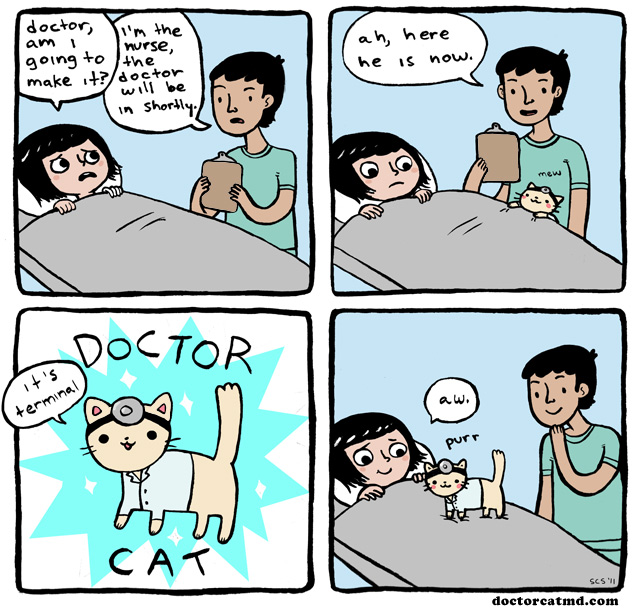
Cat Doctor


2011-01-10-doctor-cat

In order to pay my mortgage I currently still have to have jobs outside the creative sector. And the one that I work most often is for U Penn School Medicine’s Standardized Patient Program.

A standardized patient or SP is a person who portrays an illness or medical situation in order to allow medical students to practice their skills. So that for example, the first time someone has to give a life threatening diagnosis, it can be to an actor and not a real person. And the mega bonus of this system is that the “patient” can then come out of character and have a substantive discussion about how what just happened affected them. So that the medical professional to be can get some insight into the patient perspective. And in doing this they can start to see cause and effect – when you do this particular behavior it makes me feel a certain way, has this particular result.

It’s kind of satisfyingly scientific actually. It removes the judgment and anger from critiquing interpersonal skills and reduces it down to inputs and outcomes. Try this particular tactic to gaining my trust? I can tell you what the emotional output is in this scenario.

I like this job in part because it has taught me to listen. It has taught me the value of the subjective experience. It has taught me that intention is often not a useful tool towards substantive change. I can want to make you feel better but if my choice of words in expressing that is offensive or off-putting then my intention is a moot point.

When I train the performers I use metaphors of theater a lot. And when I get back into the rehearsal room, I have started using the tools of this SP trade in return. The language of linking action and behavior to some relatively objective measure of emotional outcome is really really useful.

Lately though, I’ve been noticing this trend in my day job that is puzzling. And it’s one that I’ve been subsequently trying to untangle in my theatrical work.

I’ll call this thing “Cat Doctor.”

Fact: I love cats. Love them. Seriously, if that toxoplasmosis parasite that makes you love cats is real, I have it. If there is a cat in a window, I will stop and talk to it. I literally want to smash the small furry bodies into my face.

And that’s weird. And very unique to me.

So if were in a doctor’s office and a cat in a little white coat and stethoscope walked into the room I would be overjoyed. I would be so pleased to be treated by cat doctor that I’d be a little beside myself.

But that doesn’t mean that cat doctor is a good doctor.

And so when I train my SPs I tell them that they have to watch out for the cat doctors – the students that they love for reasons that aren’t really anything to do with their medical skills. This can be because it reminds them of their best friend in 8th grade, or because the person is really attractive or has large ears and that’s just funny. Whatever the reason, when cat doctor syndrome occurs, I tell my SPs to be on double watch for their scores, because they need extra vigilance to make sure they can back up with substance why they are rating this person high.

I’ve been throwing this term around a lot in auditions lately. And I think about it in relation to collaborators.

Does the same cat doctor rule apply to the arts? If I see an actor who’s a bit of a mess, who’s a little bit off, but for whatever reason tickles my fancy, am I a fool to just trust that gut instinct? Should I resist casting the catactor?

If I love to watch them, can I trust that others will as well?

Every director I know has an actor that they love to work with that I just don’t see the charm of. Someone they just want in the room. Maybe they’re just blinded by some intuitive thing… Or maybe the particulars of an artistic process aren’t supposed to reduce down to objective quanta in the same way as a med school exam. And perhaps whether or not the audience can see exactly why, that cat doctor has a magic or influence that matters. They treat the problem with a strange and unconventional approach that just happens to work, even if it looks crazy.

Or maybe I’m just too distracted with the cuteness.

A

Heavy

35.9% of Americans in 2009-2010 were considered “obese” by the CDC. An additional 33.3% were categorized as “overweight.” That means at that moment, 69.2% of the country is heavier than “normal.”

When we go to the theater what are we looking to see ourselves reflected in the stories portrayed on stage?

If so, why don’t two thirds of them look like two thirds of the country? If not, are they the images we wish ourselves to be? Or are they simply supposed to be the strongest creator available for the role, and if that’s the case, why are so many more of them than us so much thinner?

Do you notice how carefully I’m wording things here? I do. Have you noticed that I haven’t used the “F” word yet? I do. It’s hard to write objectively about this. This is such a tricky subject. It is so sensitive. But it dominates so thoroughly the vision of our stages that I’m going to stop dancing around and just say it:

It is hard to be a fat actor.

It is hard if you are not fat, but a little heavy. It is hard if you aren’t fat but could be and fear becoming so. It is especially hard if you are a woman.

There might be a few reasons that don’t point toward malicious bias. Heavily dance or physicality based works are going to require a higher level of physical strength and endurance and result in a larger expenditure of energy.  While that does not exclude a heavier performer, I think it makes some logical sense that you’ll get a higher proportion of people who are thinner, which is probably somewhat correlated to long days of exercise and physical activity.

Being fat might make it harder to do your job… maybe. But it might not. And I think it’s rarely the full reason that certain kinds of roles are off limits to certain BMI’s.

Because that argument just doesn’t fly when it comes to a lot of theater. It is possible to be in tune with one’s body even with “extra” weight. And if the performer doesn’t limit themselves, why do we limit the roles that are open to them? Why are we instinctively so nervous about seeing certain shapes do certain things onstage? Are we grossed out, worried, upset? What is it? Forget the gender gap, the racial paucity; I defy you to find me a show full of “fat” actors in Philly. You will not be able to.

If you are doing Grapes of Wrath and everyone is starving, fine, I understand. But show me where it says that Emily Webb from Our Town has to be skinny. Yet I’d stake my savings that 9 times (or more) out of 10 the thin girl gets the role.

Look, I don’t pretend to be objective here.

I have a long and complicated history with weight, one that has spanned both ends of the size spectrum.  At 13, I probably weighed somewhere in the neighborhood of 180 or 190. I don’t really know, because I didn’t go near a scale if I could help it. My grandmother used to chide me with reminders like, “Fat girls don’t get married.” An aunt once remarked, “Adrienne eats like it’s war.”

By my own admission, I was not happy with my body. I hated it. And to compensate I retreated into my brain. I was at war with the free and uninhibited person I felt like on the inside and the tight, closed off and frustratingly clunky form I had on the outside. Which was why late in my 14th year my mom intervened, told me that she loved me no matter what but that if I wanted, she would help me develop a healthier set of eating habits.

Which I did. Sort of.

That summer I started paying attention to the things I put in my body. I stopped housing bags of Doritos absent mindedly. I started exercising on a consistent basis for the first time ever. I learned to really enjoy cardiovascular work outs. I realized that it helped allay my natural tendency toward anxiety. I felt better. I liked how I looked. I was proud of myself for doing it.

Then I went back to high school. I felt so much better, I was so much more excited to be seen. I got the only female lead, as a sophomore, in the first play of the year. I was bumped into a higher level choir and auditioned and was selected for the state competition. I got a boyfriend, which I’d never had. People suddenly paid attention to me. I got friends in the older kid crowd. I felt on top of the world. The change was so sudden and so total and so completely timed with the shift in outward form that it seemed impossible to extricate the experiences of that year from the process of losing all that weight.

The truth is of course not so simple. Yes my outer self had changed, and because of that I allowed more of the person I really felt myself to be to shine through. All the confidence and brazenness and smartness and silliness I always had suddenly seemed like it had a venue to be shown. I had just finally given myself permission.

But of course at the time I associated my new-found creative and personal successes with being beautiful. And I associated that beauty with being thin. And so when I had to wear a bathing suit onstage, I lost another 15 pounds. And when I played Wendy in Peter Pan and was told to try and look younger, I lost another 10. It became a game, the weight loss. One that I assumed would just continue to result in rewards, in a better and better version of myself.

I would go out with friends and eat watermelon for dinner to save on calories.  I worked out a couple hours after donating blood in 90 degree heat. (PS, I didn’t eat the cookies). I was obsessed with food and thought about it ALL THE TIME.  I fixated on my “big hips” which I couldn’t do a damn thing about because I had whittled them down to jutting bones. I want to look back at 18 year old Adrienne and say, “You actually can’t workout your way to a smaller pants size if you have a wide skeletal pelvis. Maybe put some of that energy into learning your lines.”

At my thinnest, I was somewhere around 104 or 105 depending on how much water I’d had that day.

I’m 5’6” by the way.

And that was the point at which my mom said I was done losing weight. If you consider the standard BMI measurement useful (which is super questionable) I started just on the cusp of officially “Obese” and plummeted down well below “Underweight.”

I got over it. College food helped. Learning to love weight lifting helped. I work hard to focus on feeling strong, quick and agile rather than simply thin.

This blog isn’t an autobiography. And I don’t bring up this story for sympathy, though I bet many people reading this who can sympathize. But my story is not the same as many others. There are people who are beautifully in tune with their bodies regardless of their body fat index. Who are graceful and flexible and could be called fat. In fact just this afternoon I was talking to a friend who said that gaining a bunch of weight after having a kid helped her to realize that her creative talent wasn’t dependent on her staying small.

The point is that I felt able to embrace and believe in a fuller vision of myself as a creative person when I thinned up. Until that point, I’d always loved theater. I participated in middle school and my first year of high school. I’d had lovely, nearly transcendent, experiences. But I didn’t believe that I was eventually going to be one of those seniors that got out front and center. Based on the things I’d been cast as before – Mrs. Hannigan, the mom in Music Man, Golem in the Hobbit, ensemble member in Godspell – I figured I’d find a niche in the strong character roles that I’d seen other heavy girls play.

When I came back that summer lighter, I was so upset that they’d switched the fall play from Arsenic and Old Lace to a Neil Simon romantic comedy. I knew I could kill at those funny old ladies I’d been practicing all summer. But it didn’t occur to me that my lovely voice, passion for acting and intelligent incisive attack of text could put me front and center.

I couldn’t be a leading lady. Not if I was fat. And in my head I still was.

I auditioned for that show’s sole female part – an ingénue role – with little expectation. But during the audition process, I began to realize that people saw me differently now. And no doubt, the confidence that blossomed that show, that year, had to do with the fact that for the first time, I believed myself capable of ANY kind of role, ANY kind of creation. I could make people laugh or cry or sigh. I felt like I had control over my creative destiny. And I assumed all of that had to do with the new exterior through which those things were expressed.

I believe with every fiber of my being that there is no way I would have gotten that part if I hadn’t been thinner than the year before. And some days I really wonder if I hadn’t lost all that weight if I would have believed in myself with the same vehemence and confidence. And without that, I wonder if I’d have bothered continuing with acting, found directing and do what I’m doing today.

Two thirds of people in this country are “heavier” than “normal.” How many of those people do we see on the stage? How many stories do we tell that can include that perspective? And more importantly, how many kinds of characters do we unconsciously limit the size of, regardless of the actor’s ability to embody the role.

When was the last time you saw a heavy Juliet or a pudgy Romeo?

I’m left with lots of questions and not a lot of answers. Is this inevitable? Who’s driving it? Why does it happen?

And if it bothers us, what can we do about it?

A

Confidence

As I sat down to write my last essay I started thinking about a single word that could sum up what I wanted from this collaborator thing. And then I started thinking about the times when I have felt at my own personal best as a creative maker. I thought about the times when I didn’t know enough to know that something should have seemed impossible. And thought about the times when something seemed so easy, so obvious, and I totally psyched myself out and was unable to complete the task.

What’s the magic sauce of the first that is missing in the second?

It’s something to do with confidence, with brazenness, with daring with to use the very best of your abilities. It takes courage to believe that you can even if you don’t yet exactly know how.

More than anything for myself and for the people I make with, I want an attitude of:

“Yeah!!! I am TOTALLY going to do this. And if I don’t know how, I will TOTALLY figure it out.”

And:

 “This challenge is awesome!!! It is exciting to me. And above all it is one I will find a way to be capable of.”

You know that feeling, right? The one where you are on top of the world and able to tackle anything creatively thrown at you? That’s what I want: people who believe in their own badassery.

And if you are like me you also know the opposite, the feeling where supposedly you should be able to do this thing you are tasked with, but for whatever reason you keeping messing up, or feeling blocked, or actually do fine but still feel like you escaped without others knowing you’re a poseur that is just skating by on luck.

What’s up with that? I don’t actually think that about myself. So what makes me feel that way? And more importantly, how can I avoid it?

There are some things that seem obious: We prepare. We study. We learn enough so that we are armed with the info needed to tackle the situation. Without that we might literally lack the tools to achieve our aims. This is the eager student who is handed an instrument he has no experience playing. No amount of “want” will make him know the fingerings on a trumpet.

But it’s not just that.

Because there’s that other end of the spectrum where we’ve been doing something forever and then suddenly, weirdly, we start to realize the mechanics of it. We start to over analyze. We choke. We guess and second guess our choices and things that were once easy are now ending up muddy and unclear. When we know we are smart enough why do we let our own selves get in the way of just doing it?

There was a daring and obliviousness in my early work that I sometimes mourn. That stuff wasn’t as clean, as well thought out, as cogently researched or thoughtfully put together, but somehow, that didn’t seem to matter a lot of the time. It felt like it just had a kind of “heart” in it that was going to come through regardless. And often these days in my theater making I feel myself getting bogged down or distracted by knowing every cultural implication of writing this particular line or so totally aware of the piles of books I ought to read before claiming something in that particular scene.

The more I learn the more I realize I don’t know. And it makes it that much harder to feel like that brazen “I know I’m right” confident creator I want to be. I’ve been burned with saying or displaying things I didn’t know enough about in the past. And I’m now smart enough to know that I might not always be right, know that not every choice is the right one. But in creating you have to act like it is. You have to choose and commit or you hesitate and end up doing even more damage than if you’d just gone ahead.

Sometimes I look at others and think, “How do they know they are right? How do they just continue to believe their art is so good?” I wonder where that magic ability, the one that allows them not to question whether they have made the right decision, comes from. And I want to know if I can have some of it.

I suppose there are people that might think the same about me.

Because I try very hard to look like I know what I’m doing. Sometimes I do. But there are plenty of times I have to make a decision or answer a question and I am simply flying by the seat of my pants. Or rather, feel like I am falling by that pants seat. I want to fly. I want to stop looking at the ground fast approaching and stop worrying if I’m going to hit it. I continue to want that confidence in the people I work with. I want it in myself. I want to be in a state of flow in which my high level of challenge is matched with an equally high level of prowess. I want us all to feel like the beasts of creation I believe us to be.

How do we do that? Literally, in a way that I can implement today, how do I start to nurture that? Do I ask more questions of the people that I think do know stuff so that I can steal their wisdom? Do I just assume that everyone is in the same boat and fake it until it feels real? Both? Neither?

I was talking to someone the other day about how I sometimes wish I weren’t a deviser. I said that I wished that there was a single method or cannon that I wanted to subscribe to. Wouldn’t it be awesome to believe that there was one way, one method, to pursue? To know what success looked like and how I could emulate it? To find the art in every finer and more beautifully crafted depth of a detail rather than starting anew with each and every project?

Then I started to think, maybe it’s a kind of an out, this starting over and over from scratch. Is starting from nothing every time a little bit like waiting until the night before a paper is due to begin?

“I would have researched and written a better paper but I only had one night.”

“I would have made a richer play but I’ve no one’s ever done this before.”

I do believe that it is important to question how and why we make the choices we make. I believe we need to make our work useful to contemporary audiences. But a little part, a hidden part, knows that a little bit of the thrill of starting from a blank canvas is that it’s an impossible task. Create something revolutionary that has never been done before. Defy everything that’s come before and do something richer, better and more relevant to today’s audience. And if one gives oneself an impossible task, any success, even a partial one, is a win.

And it’s in the midst of this that I sit right now heading into a summer project – The Tempest – whose measure of success will be just the opposite.

This is no Lady M. This is a straight up, no f-ing around with it, in the park, saying all the lines, Shakespearian drama. For the first time, I have to think about how to make a cut of a script that a lot of people know a lot more than me about. That’s not self deprecating, that’s just true.  Think about it. There are people that spend their whole lives on this one play. There are people who study single lines for years. So when I decide to get rid of this or that, I’m claiming dominion over all that expertise.

Can I stress how different this is than in a work in which I am the originator, where the only person I answer to is myself and my co-creators?

I was reading a scene in The Tempest in which Miranda meets Ferdinand and I was looking through to see if there were any cuts I wanted to make. Then I read this line where she talks about her modesty being the jewel in her dower. Initially, I passed over it, leaving it in. Cutting it doesn’t really help shorten the play and the whole keeping her pure thing is a big undercurrent in their relations with each other and Prospero’s oversight of their courtship.

And then I stopped and said, “What the hell? Would I ever in a million years let a female character in a show I created tell a dude that her modesty was the jewel in her dower?”

No. Emphatically no. I think that is bullshit. I know it’s a historical text. But it’s a historical text that will perform in a modern world and speak on behalf of how I think it should be shared with a modern audience.

And then I started to think, “Oh god. But there’s probably a million scholarly reasons that thing is in there. It’s probably so important for reasons I am not noticing. And they’re all going to be upset if it’s gone.”

But the more I thought about it, the more I thought, I just can’t. I guess people will have to yell at me. Because if I am doing this play, I have to believe in its message. And leaving that line in is a tacit and casual agreement that the foremost concern in that young woman’s mind should be staying a virgin until marriage. And that’s not a world I want people to see, or a view I personally espouse. I want Miranda to be the weirdo, awesome, strange wild child of this island. The same one to whom it never occurs not to carry logs like a man when the guy she has the hots for gets tired.

Because while I want the benefit of others’ expertise and analysis, I can’t let it stop me from my own opinion.  I can’t let it stop me from my own confidence, because that’s the thing that really makes me the artist I am.

A

Project: Write your own eulogy!

You know what sometimes makes me a little sad?

If you ride SEPTA you know the strangely accented woman who voices the stops on the Broad Street line. A couple years ago I became hyper aware of the particular announcement she gives just before the metal entryway slides shut and the car starts to pull ahead:

“Doors closing.”

Think vaguely Indian mixed with British, every time just as you are about to move on:

“Doors closing.”

I don’t know why, but I always have this tiny existential sadness slip into my heart when I hear that.

“Doors closing.”

Now when I make a big choice, one that feels like it’s going to determine the course of life for the next month, year or beyond, I think of that announcement. When I hit a major milestone I hear it too. Sometimes, I’m just sitting there thinking and I realize that at one point I thought I wanted to be a doctor and now I teach actors to fake illness for them instead. I think about whether I could, if I had the inclination, turn it all around and still go after that medical degree. And I think, maybe I could, but I probably won’t.

“Doors closing”

That announcement rings in my ears often, reminding me that I’m about to do (or already have done) something that will dedicate myself to one path instead of another. It’s a wistful thing, but not an outright depressing one. This is the price we pay for depth of experience, this loss of the breadth, yes? But it’s still a pinprick of wondering what might have been, if I’ve made those other choices.

Too often, I think we see ourselves in this direction, from beginning to end, thinking only of change as a series of losses we incur. Too little are we able to imagine ourselves in reverse, looking back at the slow gathering and gaining of life.  Would we do things differently if we knew better which path we want to be on, which doors we should be perfectly happy to let swing shut as we speed on by to our goals? This is for our careers, our artistic lives, but of course our artistic lives are inextricably entwined with our larger selves as well. They don’t all move ahead in step but shift forward and back in tandem creating the momentum for the overall direction we take.

“Doors closing” is sad because it reminds me I don’t have forever and I’m the one to make the best of the time I still have left.

Here’s a project for today: write your own eulogy. Take 20 minutes to imagine the kinds things people will say about you when you’re gone.

And don’t just write what you think might be possible based on where you are now. Write the fantastical “you” that you want to wish into being. Write about the art you want people to say you made. Write about the family you want to have been surrounded with. Write about the places you know you want to have seen, the people you want to have met. Write about your work in a way that makes you think proudly, feel flamboyant and believe in a future unchained by any expectations other than your own.

And then when you’re done, type it out and save it somewhere safe.

This is your map.

Let it rest for a few days or a week or even a month and when you’re ready take it out. And start to think about the distance between here and there. Plot your course. Do it concretely. Give yourself an estimate of time and fuel and direction and cost. Think about which doors you need to walk through and which ones you might even need to pry back open. Think about detours and tolls along the way that might pull you from the straightest path.

Know that you can always still get there, you just might have to be craftier.

Then think about all the routes you’re wasting energy on holding onto.

And if you don’t need them, let those doors close.

A

PS – Full disclosure: I’m stealing this from Creative Capital’s wonderful strategic planning workbook. But I think they won’t mind. And I hope you’ll enjoy.