Process

An interview with Adrienne

Hey all,

FringeArts did a nice little interview with me a while back about my current thoughts on art, projects in the Swim Pony mix and my hopes for sustainability over the long term of a long term career.

If you’re interested in reading (and seeing me sitting backwards in that omnipresent chair) check it out by clicking this picture:

Print

Enjoy,

– A

Cross Pollination Unveiled

spLOGOIs there anything lamer than quoting a David Foster Wallace commencement address to help make a point about artistic awareness?

Probably not.

Which I guess means I’m going to do one super lame thing today. And right after, do something else that’s super not-lame to counterbalance.

Ready for that quote?

“There are these two young fish swimming along, and they happen to meet an older fish swimming the other way, who nods at them and says, ‘Morning, boys, how’s the water?’

And the two young fish swim on for a bit, and then eventually one of them looks over at the other and goes,

‘What the hell is water?!’

The point of the fish story is that the most obvious, important realities are often the ones that are the hardest to see and talk about…

– David Foster Wallace

As artists, working in different genres, sometimes in sub-sets of genres, sub-sets of sub-sets of genres and so on, there are lots of givens about how we work that we take for granted. There are times when the way our work is made seems so self evident that it is almost as natural as breathing the air around us.

Sometimes our working methods can be like the water.

One of the greatest gifts that came from my time a few years back as a Live Arts LAB fellow was to have the chance to talk to my fellow fellows who were dancers. There were more than a couple sessions as a group where it actually blew my mind a little to learn that some of the assumptions I make about creating were totally different than theirs. Things that I take for granted were sometimes just not part of the conversation these other amazing artists were engaging with. Sometimes things were the same but employed in different ways. Sometimes the focus and priority were radically different.

There were times these conversations reinforced my assumptions about art, made me that much more sure in why I did things the way I did. Other times it inspired me to shift my own process and just try what it would mean to create without certain conventions about narrative or structure or audience responsibility. In all cases, these conversations made me more aware of the water around me. Gave me choice about what kind of givens I was swimming in.

I finished that LAB period thinking:

“Wow. If the creative process for two mediums that are almost identical in most aspects can be so different and thought provoking, what would it mean to have this conversation with creators who are even less alike?”

And also:

“Can a visual artist teach a singer something about music? Can a chef give a dancer a chance to unseat their idea of what it means to move? Can a light designer change the way a writer thinks about their words?”

And then finally:

“I really want to find out the answer.”

And luckily, thanks to the Knight Arts Challenge, I found a means to do just that. The result is something I’m calling Cross Pollination. It’s a project that actively seeks a way to dump water all over the floor. It’s a chance to explore without the pressure of a full performance or product. It’s a chance to get paid (and reasonably well, I might add) to open up one’s horizons and cross breed with another artist. It’s a chance to find some crazy mutt hybrid mash up that the world has never seen before. It’s a chance to find out more about the water you’re swimming in.

And I’m so so so excited to begin.

Want more details? Click below. It’s all in there…

Cross Pollination Artist Application

And if you ever need to quickly get to that application without searching the blog just CLICK HERE!

And of course a HUGE thank you to the John S. and James L Knight Foundation for making this amazing project happen.

Enjoy!

– Adrienne

3 years and $300,000 and I’ll fix it, for realz…

Alright, enough moping.

So remember how I said that the tough thing about talking about the issue of gender parity, the problem, wasn’t intentions, but a lack of culpability for outcomes.

In other words, how do you get people to not just think about doing the right thing but actually motivate them to do it?

Guess what?

Yesterday, I figured it out.

You just need some money.

You need a funding program that has nothing to do with intentions, because we all have the best intentions. What you need is a reward system that is entirely based on outcomes.

So.

Without further ado, I give you:

SWIM PONY MASSIVELY OVERHAULS THE STATE OF WOMEN ARTISTS IN THREE YEARS AND WHO KNEW IT WOULD BE THIS FLIPPIN EASY GRANT PROGRAM

Also known as:

AWESOME LADIES GETTIN’ WHAT’S DUE (ALGWD for short)

(With support from Pew Charitable Trusts

Or maybe William Penn

Or maybe The Wyncote Foundation

Or The Knight Foundation

Really who cares, someone has to fund this, right?)

Here are my proposed guidelines:

1)   The ALGWD team announces to the Philadelphia-area theater community that starting next season any company, of any size, with access to their own non-profit status or a fiscal sponsor is eligible for an award at the end of a three year period.

2)   The funding awards will be made in two categories:

  • $25,000 will be awarded to 5 companies with the highest percentage of women artists represented across three artistic categories (see below).
  • Any company that achieves 45% female representation across all three categories is eligible to receive $10,000.
  • PS – You have to hit the minimum in all three. No exceptions.

3)   Female artists represented will be calculated based on a statistics over three categories:

  • Number of women playwrights
  • Number of women directors
  • Number of women actors

4)   Other rules and guidelines:

  • Companies will submit their statistics and then have them validated by the grant committee in order to be eligible.
  • The statistics must include all artistic output by a company.
  • Artistic outputs included must be open to the public.
  • A company must meet a minimum of three public works to be eligible for consideration.
  • Funds are string-free. You can use them for whatever you want.

5)   And maybe we could also add this as a bonus:

  • A $1,000 in additional funds are available for any company that can also show an equal parity across all categories of theatrical design regardless of whether they reach the above minimums.

This means for three years there’s a looming pile of cash incentivizing the choice to bring women artists in. It’s not the only consideration, but it’s enough to help counteract a tiny bit of that un-intentional push away from a female artists in the other direction.

And happily, unlike calling someone out or making a stink, this grant doesn’t hurt anyone who decides they can’t or won’t be able to meet the gender equality minimum. You can do all the dude heavy, dude written, dude directed plays you want. It just means you’re missing out on the free money party.

Of the 12 companies I surveyed numbers on last year, a few were pretty darn close – Flashpoint, Simpatico and Azuka – but not one would have hit this minimum requirement across all three categories. But if there were $10,000 at stake, how much do you want to bet they’d tweak their selections just a tiny bit to nudge them over the line? If the next time the AD’s of these companies looked at their numbers and knew that hiring one more female director got them $10,000 do you think they’d think as hard about whether or not to do it? Do you think that the choice between a female playwright and a male one would be quite so agonizing if one picking the former meant they might be one of those companies competing for the top 5 slot?

For most companies, $25,000 or $10,000 in funds that aren’t project ear-marked would make a huge difference. That’s an entire person’s salary in some cases. That’s the budget for an entire show for the really small ones. And even if you’re a bigger dog, one where the scale you’re operating on won’t be totally transformed by this kind of cash, think about how hard you chase donors on this scale. You could just do the work you’re already doing AND save women artists from inequity while getting money handed to you.

The way I see it there are something on the order of 30 – 40 companies in Philly and the surrounding areas who’d be eligible. If I had to guess, right now, there are probably only a handful – 5 maybe – that potentially meet those guidelines already.  From rough estimation it seems like about half those companies could probably hit those numbers with just a bit of effort to add a few female directors or playwrights or plays with more female roles. If I were a betting woman, I’d guess the same half of those 30 – 40 would come out the other side of three years with hands outstretched for their $10,000.

Think about the impact that would make in this community:

  • 5 companies at the top x $25,000 = $125,000
  • ~16 more companies at the minimum x $10,000 = $160,000
  •  ~15 that also hit the design minimum x $1,000 = $15,000

That’s $300,000.

This is really not that much money.

Think about that Philly funders…  For a single upper limit Pew organizational project grant:

  • You could have an incredibly concrete means to measure the impact of your efforts by surveying the stats on gender before the award period and after.
  • You could incentivize not promises or discussions but measurable, quantifiable outcomes.
  • You could reward those companies already employing positive gender parity practices.
  • You could send a message that your organization cares deeply about the status of women artists and is able to take steps to do something about it.
  • You could create an art-making environment in Philadelphia that can be nationally recognized as the most female friendly in the country.
  • You could massively shift everything about the way this city works for women artists.

No hemming or hawing. No yelling or fighting. No pipelining. No apologies for what we intended to do but couldn’t quite make happen.  Just three years to make it happen or not.

Some folks will ask you for a whole new system and ten years or more to implement it.

I’m just asking for three years and $300,000.

Let’s do it now Philly before some other city snatches up our good idea.

– Adrienne

PS – Shout out to Brad Wrenn who dreamed this up in the car with me when I was having a shitty morning yesterday.

Connor’s Story

When I first started doing theater I was in 7th grade. It was a way for me to get out of my own skin, skin I wasn’t super comfortable in yet. It was a way to escape and be someone else. It was also a chance for me to be with other people, to find community. I liked having what felt like a secret club of people who got together to create something bigger than any one of us individually.

When I first started doing theater the stories I told didn’t really matter: Annie, The Music Man (twice) and Neil Simon’s Start Spangled Girl. But it was the act of telling them that made meaning for me of my experience, the act of being together with people. In high school, I wanted very much to be Bernadette Peters, to have big hair and a big voice and a fancy costume and to be very good at what I did. Somewhere in the midst of that time my desire transformed from simply wanting to be a part of something to wanting to be a part of something amazing, to create it at a high level of skill.  So I trained in music and acting and having always prized myself a very good student, I threw myself into that study with fervor and drive.

When I first started doing theater I thought that the purpose of it was to raise myself up to the level of the creators whose works I was enacting. I thought that playwrights and composers had some kind of magical skill. I thought that their works can from some nebulous place that was very different than the kind of place I pulled my own artistic feats from. And it wasn’t until I first found myself making a piece of my own that I realized that I too had that capability, that capacity. And it wasn’t until then that I was really really hooked.

When I first started doing theater, my experiences shaped my ideas of what the end product was supposed to look like: fancy, professional, expensive. When I first started making theater my experiences shaped my ideas of who the audience for that work was supposed to be: increasingly large and anonymous groups of people who come to see me and my works because of my skill and excellence. It was an impulse to impress. And when I first started doing theater I thought that my job was to try and tell the stories that matter to the most people. To try and create as universal a message as possible. To create a Great American Play.  To try and reach people I didn’t know and pour into them the experience of my greater artistic truth.

I don’t really think that any more.

If your plan is to see Welcome To Campus and you haven’t yet, don’t read this next part. If you’ve already seen it, or know you won’t make it, go ahead and proceed.

There’s a moment early in Campus where the student tour guides, who have been up to this point manically presenting Drexel in a shiny brochure-style intro, crack just a little. They are listing, as one ought as a highly school spirited representative, their favorite letters in the word DREXEL. Student Cami, a go-getter, chooses D for its primary position. Garth relates his choice of the E as the “workhorse” of the word. And so on through L and X. And then just after Dean has also chosen D (without which he would “just be EAN”) there’s an awkward pause. A sort of looking around and then realizing “Oh right…” kind of moment. And then Lexi breaks the uncomfortable tension with a plaintive, “Connor’s supposed to be the R.”

Through the rest of the play – a walking tour in which the students relate their actual college experiences in the locations in which they actually occurred – Connor and his obvious absence are hinted at and remembered. His return is promised and reiterated. And while we grow closer to Lexi, Carl, Cami, Garth and Dean, our sixth tour guide Connor remains an enigmatic mystery. The audience knows only that he seems to have been rather important to our tour guides and that clearly he isn’t going to be here.

The stories the tour guides tell (once having broken their shiny personae) do not relate to him really. They are stories about their experiences from their actual college lives. They are stories of a kind that no traditional tour will give. What the actors and I aimed for was to find a way to share the intimacies and strange details that really make up their experience of higher education. And yet, in these moments in between performances of the most awkward dates of one’s life or ruminations on feeling terribly alone in a new place, they all keep hinting at this other unseen person.

An outsider to the show might wonder what exactly the decision process was behind including such a motif through the show.

I could create a fancy and artistic sounding justification. But the real reason is this: there really is a Connor and he really was going to be a sixth tour guide. He also doesn’t  go to Drexel any more.

I taught a class last fall in preparation for this show. All the tour guides in the performance were part of this class. We spent 10 weeks together talking and playing and writing and reading and sometimes farting around trying to create an idea for a play. Over the course of this term we found together this idea of a college tour, an offshoot of an initial idea I’d proposed, one that included their own personal stories. And for their final I prompted them to give a theatrical tour of an actual moment from their lives in a non-theatrical space, ideally the actual location if possible.

One of the last ones we took was Connor’s tour, which happened in a large and scary building called Drexel One Plaza (Garden Level for those in the campus know). On a cold day late in the term we walked from the black box theater over to the building, tried the back door with no avail and then walked around to the front to be told by a security guard that the building wasn’t open to the public after 6.

We got in anyway; the group managed to sneak in through a side door after one of the students confidently declared he could find a way to get us in. When we did get in,  filled with excitement and giddiness at having outsmarted the proverbial castle guards, we walked through the empty building’s halls. And though I pretended not to notice the security cameras lining the ceilings, I did gently encouraged Connor to get a move on with his tour.

We walked through the strange windowless floor to a simple and unremarkable classroom. Connor’s story was relatively straightforward. It talked about feeling a distance from the Drexel. It talked about being displeased with the administration and academic environment. It talked about how his long distance girlfriend and her support was really the only thing standing in the way of him throwing in the towel on this version of the college experience. And then he told us about the day that she sent him a text message.

He told about a recent day he had been sitting in this classroom and how he had been looking at the board (the one we were now looking at just then) and how he had been holding his phone (the one he was now holding) and how he’d received a text message. He told us that reading the text he knew he would break up with his girlfriend later that day and how he knew when it happened he was going to have to leave Drexel.

It’s how I found out he wouldn’t be there next term.

And we all sat there. Sat and stared at him and his phone and the room and each other. Each thinking about the fact that this was the room where that choice had been made. The same way you stare at the walls of Versailles knowing a king used to sleep in a bed there. It was a weird kind of re-enactment, one where you become aware of just being. Aware of your being in a place where someone else’s being has just been.

As I was sitting with the class thinking about all this a security guard arrived and told us we had to leave. We giggled and pretended to be sorry for breaking rules we clearly weren’t sorry to have broken at all.

This is one of my favorite moments of teaching, ever. I still have trouble putting into words quite why.

I really like the play I’ve made with these Drexel students. I think that Welcome To Campus is a really lovely play. But it’s funny sometimes when I watch the audience. I think about the fact that to them Connor is just some name. That even though the actors and I went to the trouble of re-creating the whole thing – mentioning Connor’s absence, staging a security guard denying us entry to a building, building in a covert break in, telling the story of the text message, the sitting in silence and getting kicked out at the end, all of it – there’s some part of me that is sad that they don’t know that what they’re seeing is just a re-creation of the real moment that has stuck so hard with me in this process.

A few days ago Connor came to see the show and I got to watch him watch his scene.

This is one of my favorite moments from teaching, too.

I didn’t direct this play solely for this moment. There’s more in this piece than just this particular layer. But it felt like the right kind of full circle. That finally we had an audience member who really knew what the journey of this play had been. Because even though he wasn’t there when we built so much of the later parts of it, he was an insider in one of the moments that sits at its center. And now I could watch this insider see the thing as an outsider. See a creative voice get to be an observer of the artistic result.

Connor is the opposite of the kind of person I used to want in my audience. He knows more about the moment of his personal scene than I can, than I ever could, understand. But that scene feels like the kind of gift I feel my work needing to be – a way to see our own lives reflected back to us, to parse them out for meaning and beauty – through the help of the artistic process. And while I don’t want to deny the anonymous who see the work their place, for the few I’ve met have been lovely and effusive, I wonder in a piece like this if the point is not for this insular community to create a message to send to the outside world, but for us to use the work as a way to understand our place within it.

How do we open our process to an audience that will not only be our external viewers but our internal community? How do we bind them to the building of the thing? How do we share in the depth and power of expanding and filling our stories with shape and craft?

I don’t yet know. But it feels like the calling.

– A

52 Weeks, 52 Plays: Week 1

Back in high school my theater department’s office had a giant catalog of scripts. My senior year I decided that I would read a play every week for an entire school year. A lot of those plays I’ve forgotten, a few have burrowed into my brain very deep. But I think the real lasting impact was less any particular show, and more the fact that I felt like it gave me a concentrated bit of time to sit and ruminate on theater, on how I would stage that play, if I would stage that play, what I thought the playwright wanted and whether I would want something similar or different.

2014 has, at least nascently so far, been a year of initiatives.

A few weeks back I was thinking again about plays. Scripts, specifically. Being a deviser I so rarely read “finished” scripts. And I thought that it could be interesting to check back in with the writer-first world that most of my profession lives in. I wanted to know more about contemporary playwriting, what trends are out there, and who the outrageous creators were. But I also wanted that sense again, the time to look at someone else’s idea of theater and to just… react. So I put up a post on the old book of faces asking for play submissions, bound only by the stipulations that it should be something from the last 3 – 4 years with a bonus for female playwrights.  Happily, I got a ton of response.

The public-ness of this blog, another formerly nascent initiative of its own, was very helpful in  keeping me on track with getting writing out back in the earlies of 2013. A rule lover by nature, I liked knowing that I was in a little way publicly accountable for doing what I’d set out to. So I liked the idea of trying to catalog this idea of reading a play a week for the entire year of 2014. I made a list, started thinking about how to organize the endeavor and I start off the very first week with a copy of a play called The Noise by Rachel Bonds.

Here’s the thing though…  I don’t want to write a review of this play.

I am incredibly aware of how subjective a given random day’s awesome-ness or shitty-ness affects my view of a thing. I am also aware that reading an assessment of another’s work will bias future people about that work because you’re either reacting to or against their positive or negative assessment.  So while I don’t think I’m incapable or unqualified to read a play and assess it, I kept thinking, what end am I aiming for? I am certain that this project will not result in Swim Pony suddenly deciding to produce new young American playwrights. I also don’t particularly want the responsibility of advocating for or against another artist’s work. This space, for me, it feels like it’s really for something else.

So I’m trying to shoot instead the kind of feeling that I had back in high school: using a particular play as a springboard to jump start the way about the way I think about theater, what I want to make and see, and how it reminds me of the possibilities of what are out there and what I can imagine could be out there if I were to make it. So without further ado, Swim Pony musings from The Noise.

A synopsis in a just a few lines: The plot of The Noise centers on four characters – Ellie – a 28 year old math teacher who has lost her mother, Amos – a 30 something history teacher with whom Ellie becomes romantically entangled, Bert – Ellie’s father recently remarried and finding a sudden need to tend the garden his last wife once kept, and Janice – Bert’s new wife who is trying to deal with his blocks in processing his previous wife’s death. Ellie and Bert both work to try and deal with their feelings at the loss, Ellie by guarding herself against new love, Bert by an obsessive need to rebuild to the vegetal life his wife once tended. It’s a story about people searching for connections to each other. Added to this is an eerie/magical presence of The Noise – a form that emerges from darkness and beckons Ellie into the most quiet, silent and still places in the world and in herself.

This is in many ways, a play about grief – a daughter who has lost her mother, a man who has lost a wife. But for me it was equally as much a play that explores darkness and silence. I was captivated by this idea throughout the reading, how we can create a performance that invites an audience into such a deep and still place. I wondered as I read if it possible to ask the audience to do what The Noise asks of Ellie, to invite them into a “moment of utter and complete stillness.”

There’s a kind of anticipated rhythm of drama that I feel in most of the theater I see. Working in the field you can sometimes start to sense a kind predictable structure. Even in the messiest of emotions, there is a kind of arc that becomes ingrained – the anticipation of the lights going down, the building action of conflict, the perfect timing of a character coming to catharsis, knowing just when you’re supposed to cry or laugh as an audience whole. It’s funny how in a way this journey can become incredibly familiar, perhaps even to the point of banality. It’s why, sometimes, a person in the audience coughing can so thoroughly draw attention of everyone in the room – because such events stubbornly refute the tempo and timing we expect of the moment.

Such an occurence, pedestrian as it may be, is living by the pulse of some other kind of world. It rubs so coarsely against the slickness of a polished piece, it is so imprecise and un-theatrical, that it can stubbornly demand our attention.

Reading this play I wondered, how long could you ask someone to sit in the dark and close their eyes and just… be?  Talk of such stillness in concert with dialogue so sharp that it snaps (Which this piece has, by the way. If you want a scene for young actors that is smart and sweet, the first pages of this play are quite fitting.) such contrast highlights my hunger to really experience such a sensation for myself. What if you created a space where a room full of people were asked instead of watching someone listen for the most perfect silence possible, actually were invited to find it for themselves. Silence is of course, a kind of sound, one end of a spectrum, and as a creator who very often lives in my ears, I love the idea of taking a moment with a listener to turn off the lights and work at awakening this sense. The Noise is a play filled with the sense and absence of sound, with vibrations and reverberations that move in and through us, and as a director it makes me wonder how one might take this impulse even further.

The other element suggested in the staging is The Noise itself, a kind of fantastic presence that emerges from and pulls others into darkness. The playwright notes that she first imagined the presence as a girl (10 – 16) standing in a doorframe unmoving from a nightmare she used to have as a child (can I just say, I’d love to see this nightmare?). She instructs the reader to seek an ageless quality but not an overly heavy creepiness. Like Victorian child in a frilly dress. Which is funny because it’s exactly what the others who read the play mentioned envisioning.

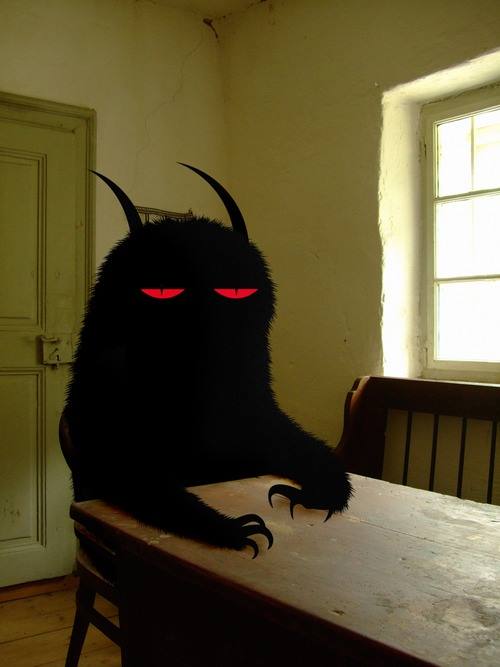
The Noise appears in the shadows of streetlamps with an unsettling howl. And though nothing in the play suggests it, for some reason all I could imagine was a picture from a friend’s facebook profile that looks like this:

The noiseI kept imagining the character one part jaunty animation and one part black oil from the X-Files. And it made me wonder how to create such a thing in a live performance setting. Made me want to try and create a presence out of the kind of things that theater does very well – where a thing that has no life or seems very ordinary transforms into a kind of magic.

And last, this play made me wonder about my taste for messiness.  It made me think about how strong the impulse to tie things up neatly can be and how perhaps our work, like our lives, might benefit from a bit of nasty bits left in.

So there’s week 1.

Here’s to another 51.

– A

PS – For those interested here’s her website and a bit of info on her recent work with the Arden Writer’s Room.

Getting to “Fuck It” Faster

If you’ve been standing within 100 feet of me in the last month or so, you’ve inevitably heard me go on and on about my most recent directing project.

It is, in essence, a project that does not adhere to any of the rules that I follow in my “real” work. It is one that I traveled almost two hours a day to get to and from. It is one that rehearsed at odd and tiring hours after full days of other work. It is one that paid me far less than the salary I set for myself in my own company’s work. It is one that I embarked on with little choice in content, space, personnel or schedule. Never in a Swim Pony project do I allow designers to be assigned to me. Never do I cast a massive ensemble based on a day’s worth of auditions. Never do I work in a tiny and oddly shaped theater space. Never do I do so many of the things that I did for this recent production of Midsummer Night’s Dream at Arcadia.

Yet, I can hardly recall a time in recent memory when I have been this excited to get to rehearsal, felt as free in pushing and playing with my actors, as wildly open to trying any and everything that my mind could conceive.  And ironically, I can also hardly recall a time when encountering things that did not go the way I expected where I felt so easy in adapting to the new circumstance and believing that success or no, it would all still absolutely have been worth it.

I thought about this yesterday as I semi-moped about my house feel post-partum performance let down. I thought about what it might mean that I have been so very happy these past weeks and what I might need to do to capture this feeling more often.  And as I was semi-moping I thought about the times in the past when the work has felt the most fraught and when it has felt the most free. And collage-like came a cascade of things people have said to me that feel strangely similar:

A written comment from a vocal jury performance: “Adrienne Mackey is a wall of sound”

A reader of this blog: “It surprised me to realize that you could be that vulnerable.”

The remark during a training session for Roy Hart work: “Adrienne, you are like a golden tank. Beautiful but bulldozing over everything in your path.”

In a therapy session recently: “Don’t take this the wrong way, but sometimes I find you very hard to read.”

And as these thoughts fell through my mind over the course of the day, they began to layer into the shape of something resembling a realization. Not an earth shattering one, in fact something that I’ve pretty much always known, but one that I realize I haven’t totally acknowledged as a problem: that when I really intensely care about something, especially when I’ve had the chance to stew about it for a long time beforehand, I often psych myself out of really enjoying it. When I really want to do my best, when I am trying my hardest to do that, I often over-think myself out of doing what I want and having a good time.

Often in school, in training, in life, in my work I have these moments where I want so badly to do well and I feel myself failing. And this failing becomes this nasty spiral where I want to do well so I push too hard or work too much and then feel the falseness of that work, feel the desperation of it, and end up falling farther down the hole. And so I try to relax and not care, but of course, I know this too is a lie, that I do care, that I want to do well, and so feel guilty about trying not to do and bounce back and forth between half measures of forceful pushing and uncommitted frustrating motions of trying to disengage from my angry and needing and deeply caring self.

Almost always when I get to an incredibly exasperated and dark place at the bottom of this spiral I say, “Fuck it.” And only then in hopelessness despair do I finally give up trying.

And this, inevitably, cliché-ingly predictably, is when I finally break the cycle and start making the stuff that’s really good, the stuff I wanted to make the whole goddamn time.

It is so recurrent that I can even know that I have to get to “fuck it” and in mind boggling-inducing meta levels of self-sabotage manage to try too hard at finding the feeling of “fuck it” until I give up even at this and rage at the gods with a hearty “fuck it trying to find fuck it!”

And then, of course, the work gets good.

Perhaps external measures of success have become so entangled with my own sense of worth, with my own sense of desire, that when I think about it I genuinely feel like I don’t actually know what I want. Maybe I am so often in my head that I start to game out every strategy ahead of time and this removes me from actually experiencing anything in the actual moment of its happening. Or possibly the key to really loving something is the delicate balance of knowing when it’s time to try hard and when to let go.

Maybe it is all of these things.

The real gift of the process I found with my students at Arcadia was that I walked in and had absolutely nothing to prove to anyone. I was doing a play with no one to impress in a style I have almost no expertise over on a subject I pretty much didn’t give a shit about. And somehow that gave me freedom to do exactly what I wanted. Which was lovely and freeing and incredibly important to me. And by the time I realized how much I cared about it, I had already found the permission to keep doing it. And in so doing, saw the freedom and permission that all of my lovely darlings gave themselves so that together we all set ourselves free.

This is what I thought about yesterday in the afterglow of a lovely process.  And sitting here now a day later thinking about those thoughts I think this:

What the fuck (it)?

Because, really, what the hell do you do about that? What do you do with the knowledge that when you try hard you are trying too hard? That when you try not to try you end up trying harder? That you’ll keep going around that until you despair and give up and then stop trying and then you’ll finally do it right? That this always happens unless you magically manage to end up doing something where you don’t realize that you care until its too late and you’re already doing a good job?

Ugh.

If I look back at my past, I see this pattern emerge everywhere. Beginnings are so often the most joyous place for me. The moment of beginning, the time before I know enough to know enough to know when I’m messing up is usually when I manage to subvert the work and get to “fuck it” faster. It is the moments when I don’t realize what I’m doing or I go into it not thinking much at all about it that I am able to just relax and really let rip.

This is how I discovered a theater of devising rather than scripted plays.

This is how I became a funk-a-delic back up singer.

This is how I started teaching new approaches to voice.

This is how I found myself loving so fully a production of Midsummer.

This is how a person who has intense personal space issues looks at a hoard of college students and cannot help herself but to hug them, to grab them about the ears and kiss their faces. How a person whose persona is thoroughly entrenched in wanting and needing and demanding respect in my field and from my peers can have no shame. How she who is so studious and careful in letting people in has no trouble showering these students with all the feelings that I am filled with when I see them in voluminous words unprepared ahead of time (so as to ensure they accurately describe the true depth of my feeling). And how in such total lack of preparation I find truer expressions than in the many times in the past I have tried with hours and days of writing and re-writing to say something right from the core of me.

Even here. Even in this space, it feels just a bit forced trying to pin it down in words after the fact. And I am trying as I write these very words not to hit the back button, but to allow myself the luxury of letting these thoughts tumble out just as they come.

And I don’t exactly yet know just how I will do it, but I think this is the work I must be doing now. Finding my way to “fuck it” faster. Figuring out how I can be as generous with myself as I am with them. How I can give myself the sovereignty over my artistic space, to do whatever I want simply because I want to, because it makes me happy, and believe that this happiness is the key to my artistic success.

– A

Sad truths about art, as imparted to an eight year old

The other day I was walking to the store to buy groceries. As I approached a park ahead on my right I heard a small voice emanating from the impending entrance and soon after saw that a young girl was standing on jungle gym equipment singing to herself.

She was maybe 7 or 8, the age before you’ve honed the full sense of shame and just how far your voice can carry in public. She clearly had no awareness that any passerby might notice her as she bent over in concentration swaying back and forth in pink high tops and purple pants to an almost trance-like beat within her. She raised her head to the sky and belted out words in her tiny voice as if her life depended on it. The song, a syrupy pop devotional, proclaimed a hunger for a romantic love that was clearly far past the understanding of someone her age. It was obvious however, that she wanted, nay needed, nothing else in the world but to feel that feeling that she sensed in the music. Her little voice strained to capture the fullness of an adult’s embodiment of love.

It was absurd and laughable, this. And also inexplicably cute. And I might have simply smiled to myself and kept walking had I not noticed something else. I might have kept going were it not for something that happened at the end of the phrase I happened to hear as I passed.

As this little girl made her way through a predictable downward cascade of arpeggiated notes – “So give me lo-ah-ah-ah-ah-ah-ove” – she hit a stinker. In this pattern mimicked from the radio or her sister’s ipod was one big nasty note that stuck out. I turned my head for just a second as I walked past and witnessed the full force of artistic anguish in this poor little girl’s face.

And that’s when I stopped.  Just past the gates, out of her sight.

She let some fifteen or thirty seconds pass in silence, just enough time for me to almost begin walking again, and then took a breath to sing the phrase again.

“So give me lo-ah-ah-ah-ah-ah-ove.”

Again a bum note, different this time, earlier in the progression, but unambiguously not part of the intended effect.

And from the sounds that followed I can only presume she jumped to the ground and stamped her feet in rapid alternation to the frustrated bleet of “Ugh! UGH! Gah! GAHHH! AGHHHH! I never get that riiiiight! I. Can. NEVER. GET. THAT RIGHT!!!!”

Stillness for a moment. And then crying.

“Oh no,” I thought. “You’re in for it.”

Little girl of 7 or 8 that I passed on the street who I do not know and who I caught singing bad pop songs in the on park – you’re doomed. Doomed because there’s a secret that no one tells you when you first start making art. It’s a dirty bit of knowledge those tattered survivors fail to impart on the younger set: this feeling will never go away. You think you can’t do it now because you’re small and new. And while it seems tolerable that your level of taste starts out far higher than your talent, the truth is it never quite catches up.

That feelings you have in the explicitly “learning” phases of life – the ones that say, “I know I haven’t quite mastered this yet, but I know that someday, I totally will be like the people admire and imagine have landed. Yes someday in the far distant future I know that I’ll know what I’m doing.” – you think that disappears.

Sorry, it won’t. In fact, you realize one day that you don’t ever get to get there, whatever you’ve imagined there to be. And then maybe just like now, you also will cry and stamp your feet because you feel like you don’t know how to do what you’re trying to do. Eventually, you just get better at hiding it. You might feel a little cheated that no one told you that the feeling of inadequacy that you think comes from being a student is something that not only doesn’t disappear, but grows. That feeling of faking it is something that simply become a fact of existence punctuated by glorious and terribly brief periods of belief that you actually know anything about anything. And that you too will likely hide in plain sight in front of younger artists who might even think you have landed and that you will perpetuate this facade.

Little girl of seven or eight, let me give it to you straight:

Imagine whatever you believe the end point to look like. Capture a distant island of “artistic success” in your mind. You think you can see a journey. You think you are building a boat to that island. But that too is a mirage. And by the time you’ve sailed your ship that far out to sea you’ll realize that there is no there there. There’s just you and an ever expanding horizon of what is possible. That note won’t satisfy you in the long run little one. For a moment or two, but not for a decade or more. There will be other notes you’ll get hungry for soon enough.

And were it not weird for me to presume that this tiny blonde thing needed my life coaching…

Were it not odd indeed for a professional theater director of ten years to stop a child on the street to give her advise on a life in the arts…

Were this little girl not likely to be justifiably scared of some adult woman stopping her on the street and projecting her own insecurities and fears and failures onto the song that she heard and liked and doesn’t understand but just wants to sing because she thinks it will make her feel good…

Were all those things not the case, I might have walked back a few steps and looked at her and said:  “Keep trying. You’ll get that note. And by the time you do, you’ll have found something else to worry about. And that is both the loveliest and most frustrating truth of the artist’s life – that if you really want it, you likely won’t ever really believe you’ve done enough. You will have pride and accomplishment and satisfaction. But you likely won’t ever feel like you’ve arrived.”

And then she would likely have looked at me and said:

“Lady, I just like to sing. And I’m eight. And you’re scaring me.”

She’d be right. But so would I.

But because it was odd for me to do all those things I just listened to her stamp her foot and start again. I thought of my day’s own frustrations and furious workings to beg a thing that seemed so obvious and simple to please already just come into being.

And I figured best to just continue on and buy some bread.

– A

Lonely

I know that often I write about art in a general way, one that relates to most of the people working in my field, and when possible to the arts as a whole.

Today I’m not gonna do that.

Today I want to talk about being a director. And for me that can feel awfully lonely.

A few days back I was giving a colleague a ride home from an Arcadia University gig out in the burbs. Both of us have been hired by said school to direct student productions (different ones, in case that’s not obvious) for the college. And on this day when we both happened to be heading home at the same time of night we ended up in a car together chatting about the experience.

After the expected pleasant inquiries about rehearsals and how things are going, we sat in a still silence for a little bit. We chatted about upcoming works on the horizon and exchanged a few war stories about the theater scene. It was a perfectly nice way to spend 45 minutes headed home. It was the kind of conversation I have with other directors a lot.

A few days later we ended up in the car again. This time, catching up rather quicker on the status of rehearsals we were left without some of the pat topics that usually pop up. And somehow we started talking about what it feels like to be in charge.

It’s funny, it doesn’t occur to me often that this is a specific facet of the way that I work compared to the other artists I work with. It doesn’t occur to me that often, through repetition and familiarity, that many artists don’t walk into a process with that mindset. I know that when I walk in the room, I’m expected to have a plan of what we’re going to do. I know that I am the only one of my kind there to carry out the role. And I never see anyone else do what I do and therefore I have only myself to compare with.

There is a very basic power differential. The caveat, of course is that there are lots of people that try and create a sense of communal responsibility and I am whole-heartedly one of them, but it is there. And that sense of responsibility is exciting and distancing. It means you are always a few steps ahead of the rest of the room. A simple illustration: it is hard to imagine a rehearsal in which a performer or designer walked in and stated the plan of the day or one in which the director could show up and look at the others in the room with an expectation of what they are about to do. I don’t think this has to be good or bad. But it definitely is. And unless you’re a company without a director there is likely a negotiation that’s been worked out either ahead of time or during the process in which that power is defined and bounded.

However, I’m getting off topic. That isn’t really what I want to chat about. I think there are interesting questions about what might happen if we tried to change this dynamic. It might show us why that structure is so necessary or it might open up new and exciting potential. But for me, who for better or worse, is working in this way almost any time I work, it makes me realize how lonely I feel so often.

I’ve heard a lot of directors say that every time they begin a show they ask themselves, “How do you make a play again?” I thought this might be particular to devisers so it was surprising and kind of heartening to hear that those who dwell mostly in the scripted experienced the same terror. It was interesting to hear that she too re-reads her old notes from shows past to figure out how that person from the past navigated the journey from nothing to something. And I was happy and sad to see that she too spends a lot of time feeling lonely in a process.

I wonder if that sense of “how did I do this before?” is something to do with the fact that you don’t share your process in the same way. So much of what we do is before and after the rest of the room arrives and leaves. And even with documentation, it can be hard to track all the discoveries and thoughts that by necessity are shared between actors and designers and stage managers with the people they work with. One reason I so often try and go back to my old books of notes is to sense the person who was able to do this thing before and catch some of her strength.

Another strange thing about being a director, that I think may be unique to the role: you never watch others like you work. There’s only one of you in a process. Designers and actors get to see other designers and actors. They see people like themselves develop their craft. And for better or worse they have to do this a lot. And there are times when I get jealous that in doing so they get to watch and experience other directors too. That they probably know more about the particulars of other directors than I do. I sometimes ask them “What did that other person do?” not because I have some desire to copy but because I genuinely just want to know.

My sense of myself in the work is kind of like an island. I know what my terrain looks like. I know how I traverse it. And when people who’ve been elsewhere come to visit me, they can share stories of their experiences, but I know that I really have no concrete sense of what’s going on in those other locales. And while many of the directors I know get the chance to observe early in their career, there is not the built in continuation of this practice as time goes on.

When I first started in school and was just out of it, I saw a lot of other directors directing. I was in other people’s rehearsals a lot. And it provoked thoughts in me about how they solved the problems in front of them. It made me think about my process and question what I would do in the same scenario. And some of my favorites were those that were quite different from my own sense of artistic aesthetic, not because I wanted to do what they did, but because it made me really need to define why I wanted to do it my way instead. In fact, I once had a director say to me as a fledgling AD, “I love the thoughts you send in your notes. I will use none of them because they aren’t the play I’m making, but I love them.”

I learned to be a director in a room full of directors. And since becoming one, it’s been a very long time since I saw another one in the wild.

I’d like to.

I wish I had the opportunity. To watch. To listen. To observe a bit.

To travel to another island simply to try and understand the way it works in contrast to your own.

A

Been a while…

Hey Friends.

So.

It’s been a while.

This summer has been a bit of a hiatus from this space. It’s been a lovely and hectic and busy time. And it’s filled me with lots of new thoughts about making and doing.

And I’ll be honest, at some point after being away for a while I started to feel a little guilty. This is par for the course with me. I like to do things perfectly or not at all, and once I start to get that, “I haven’t written anything in a while…” feeling, my first instinct is to find some kind of distraction – a stupid show or a silly game – that keeps my mind off the fact that I’m feeling a little overwhelmed because something I care about isn’t perfect.

This is the same perfection/ignore cycle that resulted in my mom threatening to cut me off if I didn’t call her to say hi during my junior year of college. Because once you feel a little guilty about not doing something it just builds and builds and builds.

Back then, I just worked more to keep that feeling away and at bay. And surrounded by other workaholics, that seemed like the norm, just what you did – put your personal problems on hold – so I never questioned the impulse. Now though, whether it’s because I don’t have the stamina (negative view) or I’m less able to give in to the self-destructive impulse (positive view) I just don’t tolerate the punishing schedule ad nauseum anymore.

Which isn’t to say I don’t work hard. I do. We all do. But it is not with the frenetic blind need from before. I can’t work and work and work if I don’t see the light at the end of the tunnel, if it seems like it’s working for working sake alone. And this summer has been an interesting case study. It’s one of the first times in years that I’ve had as many things going on. But it’s also one of the first times that I feel like I’ve given myself a process in which I actually have all the resources I need.

The Ballad of Joe Hill which is running currently at FringeArts has, in particular, given me some food for thought. The first iteration of this show had a kind of magic. It was brutal, produced on about $1,500 of cash and a whole lot of sweat and heart, begging and borrowing. There was a tiny core of people and we did everything. We carried each object into the space with our hands. We rehearsed in dribs and drabs when we could fit the time in between jobs. We changed where we performed. We hauled dirty, heavy risers in and out of tiny storage spaces. We printed fliers and begged the press to come. We made change for the audience and stored our money in a cigar box.

The stuff is still carried, the space is still dirty, but this time Joe Hill has a small army of folks – a full time SM, PM, riser and light crew and more. Our equipment was delivered. We have real bathrooms. Our box office is taken care of. I have not once had to think about marketing. We have had full 8 hour day rehearsals in lovely controlled spaces. And – and this really is the greatest of all the things – I haven’t worked a single other job since we started working full time.

If I had to imagine what I really needed for this show when I did it that first time, this is close.

And I have to remind myself of this. Last time, the crap that seemed out of my control the first time – the money, the resources, the time, etc – gave me a mental pass on making my best work:

“If only I had real money”

“If only I had everyone all the time”

“If only I knew someone with more expertise with lighting”

“If only I could just concentrate on doing my job”

“If only”

The problem with “If only” thinking is that it puts you in the past (“If we’d only had…”) and the future (“If I can only get…”) but never in the present. And theater in particular as a medium is about the glorious immediacy of RIGHT NOW. It’s our biggest superpower – the ability to require another human to “be” with you, right then and there. “If only” stops you from seeing what’s really there and instead what could have or might be if only you were a different person in a different place with different stuff.

I don’t have that pass anymore.

I have myself and the work.

And in a way, that makes this project a bigger win. Maybe even harder fought. Because it’s not a battle with tangible limitations. It’s just a battle with myself and all that empty space. If I fail, there aren’t other excuses to blame. It’s not because I didn’t have what I needed. It’s because of me.

So.

It’s been a while.

I hope to be here more often. And I’m going to try and not let myself get too caught up in the “If only I had more time to write this” feeling I’m having right now. I’m going to attempt to work through this lesson and simply do the work that I can do, right now, and let that be good enough.

– A

For the other

Fellow art makers, I ask you a question because I want to know if you feel the same.

I struggle to talk precisely about my relationship to my work, to making, to creativity, to all the things that are connected to and impossibly diminished into the imperfect word that is art. Even writing it, thinking it, it seems so much less significant than it feels.

To forgo sleep over art.

To lose oneself over art.

To cry and despair over art.

Doesn’t that sound so silly and small?

Like a child who cries when an imaginary playmate drops their tea. Like a teenager lost in their own emotional maelstrom and unable to see how little their problems are in the grand scheme.

Which is why I ask you: is it just me?

For you, creator/builder/music-maker/dreamer/poet/writer, it isn’t so small, no? For you it isn’t small at all. I want to know if you too feel a strange and entwined feeling.  Not just to a collaborator, or a particular work, or even an entire genre. But to some kind of entity, a large and all encompassing force that is both rooted to the very center of you and simultaneously massive and larger than you can hope to conceive.

It is a relationship that I struggle to put into metaphor.

It is some part romantic, some part friend, some part deity. It is in many ways connected to those with whom the work is created, at times weaving together disparate persons who under any other context would have no reason for connection. But it may also be a force of isolation, leaving one standing alone with their beliefs and their visions and vainly crying out and wishing they could offer the eyes through which they see. And while it can work through people and manifest itself there, it feels at the core that it is just me and it – the thing, the feeling, the intuitive relationship to the work/skill/force.

And lest I get all Bronte on you (but really, given the flowery and Romantic nature of this writing, aren’t we already there?) it is actually the deepest and most sustaining love I have ever known. It is the relationship for whom I have sacrificed the most, the bond for which I have been most willing to grow and change, the one that has redefined and required the most of me.

And while it is deeply personal, it doesn’t feel like it is one that I have with myself. I’m not battling with my own insides. I’m fighting to figure out how to be with and in this outside force. Like swimming in a current unsure if it is taking me somewhere I ought to be going.

The work and I are locked in step – sometimes in battle, sometimes in sync.

And because it is unlike any other relationship I can see and define, it is so hard to know if it is the work or me when I feel the friction between the two. Hard to know if I am wallowing and caught in a destructive undertow or leaving untreated the pangs of pain that come from when one is violating the core of the artistic impulse.

It’s why, my fellows, I’m asking you, do you have these moments of struggle as I do? It seems surely you must.

It seems that you too must have days when you fear it is more than you are capable of. It must be that you too must have times when you feel yourself alone and rage against not having more faculties to fix what is ailing. When everyone around you seems to see the path that eludes you. Days when you do forgo sleep, lose yourself, and cry and despair over the work, the art.

And on those days do you also, my friends, do you fear, for a moment, that the otherness with whom you wrestle isn’t all that you sense it is?

Or do you also wonder, as I do, if it is as large and full as you sense and that you are too small to encompass it?

I believe you do.

I believe it because I cannot see how else we could stay with it, in it, for years and years. If it is not as big as all that how else could we let it take up so much of our lives? How else could it work through us so thoroughly? How else could it light up our emotions so strongly? How else could something as silly as a song or a scene or a sentence mean so much to us?

How else could I be left sitting over coffee in the morning so uncertain about whether I have been enough for those I have striven to be there with?

I may be less than I hope to be. This is possible.

There may be more strength than I can currently see. This is also possible.

Perhaps it is neither.

Perhaps it is a thing that exists on its own course and runs on an energy that I cannot entirely see, a thing I cannot entirely control, a reigned beast for whom the tighter I try and hold it close the harder it will be to feel its push and pull.

Perhaps what I have given to nurture it most is only tangentially related to the particular worry and fear I feel at this moment.

And perhaps I can only get up from my table to disrobe and stand in the shower and do my best to scrub away the deficiencies in myself I feel.

Or perhaps instead let them fall over me, try my best not to fight them so they do not catch and block, take a moment to have them fully before they wash away.

Perhaps I let myself be in the fear of failure, even allow myself that the losses I feel are real, and that maybe, they are necessary part and parcel with that otherness with whom I am entwined.

And perhaps in a week or two when the thing has come and gone I will look back at myself and shake my head at silly tears. Smile sadly for the person caught in waves of doubt and wish I could tell her that she cannot really fail so long as she does not hide, does not shrink, and does not let the fear make bitter that great love, this love of her life.

A