Random

Cat Doctor


2011-01-10-doctor-cat

In order to pay my mortgage I currently still have to have jobs outside the creative sector. And the one that I work most often is for U Penn School Medicine’s Standardized Patient Program.

A standardized patient or SP is a person who portrays an illness or medical situation in order to allow medical students to practice their skills. So that for example, the first time someone has to give a life threatening diagnosis, it can be to an actor and not a real person. And the mega bonus of this system is that the “patient” can then come out of character and have a substantive discussion about how what just happened affected them. So that the medical professional to be can get some insight into the patient perspective. And in doing this they can start to see cause and effect – when you do this particular behavior it makes me feel a certain way, has this particular result.

It’s kind of satisfyingly scientific actually. It removes the judgment and anger from critiquing interpersonal skills and reduces it down to inputs and outcomes. Try this particular tactic to gaining my trust? I can tell you what the emotional output is in this scenario.

I like this job in part because it has taught me to listen. It has taught me the value of the subjective experience. It has taught me that intention is often not a useful tool towards substantive change. I can want to make you feel better but if my choice of words in expressing that is offensive or off-putting then my intention is a moot point.

When I train the performers I use metaphors of theater a lot. And when I get back into the rehearsal room, I have started using the tools of this SP trade in return. The language of linking action and behavior to some relatively objective measure of emotional outcome is really really useful.

Lately though, I’ve been noticing this trend in my day job that is puzzling. And it’s one that I’ve been subsequently trying to untangle in my theatrical work.

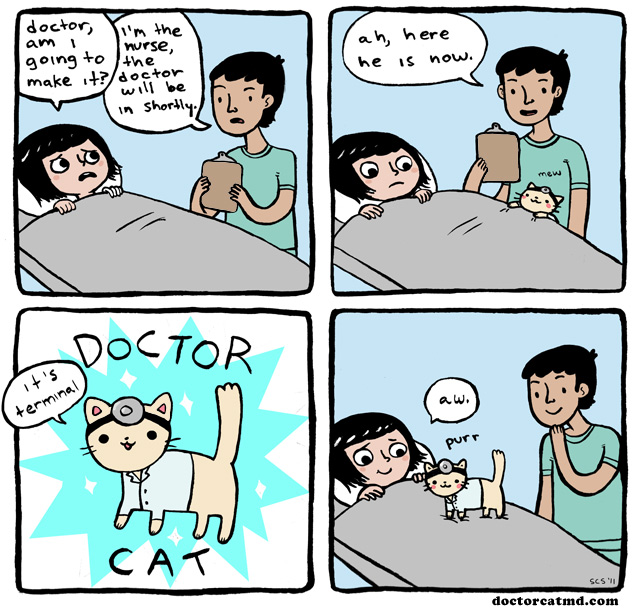
I’ll call this thing “Cat Doctor.”

Fact: I love cats. Love them. Seriously, if that toxoplasmosis parasite that makes you love cats is real, I have it. If there is a cat in a window, I will stop and talk to it. I literally want to smash the small furry bodies into my face.

And that’s weird. And very unique to me.

So if were in a doctor’s office and a cat in a little white coat and stethoscope walked into the room I would be overjoyed. I would be so pleased to be treated by cat doctor that I’d be a little beside myself.

But that doesn’t mean that cat doctor is a good doctor.

And so when I train my SPs I tell them that they have to watch out for the cat doctors – the students that they love for reasons that aren’t really anything to do with their medical skills. This can be because it reminds them of their best friend in 8th grade, or because the person is really attractive or has large ears and that’s just funny. Whatever the reason, when cat doctor syndrome occurs, I tell my SPs to be on double watch for their scores, because they need extra vigilance to make sure they can back up with substance why they are rating this person high.

I’ve been throwing this term around a lot in auditions lately. And I think about it in relation to collaborators.

Does the same cat doctor rule apply to the arts? If I see an actor who’s a bit of a mess, who’s a little bit off, but for whatever reason tickles my fancy, am I a fool to just trust that gut instinct? Should I resist casting the catactor?

If I love to watch them, can I trust that others will as well?

Every director I know has an actor that they love to work with that I just don’t see the charm of. Someone they just want in the room. Maybe they’re just blinded by some intuitive thing… Or maybe the particulars of an artistic process aren’t supposed to reduce down to objective quanta in the same way as a med school exam. And perhaps whether or not the audience can see exactly why, that cat doctor has a magic or influence that matters. They treat the problem with a strange and unconventional approach that just happens to work, even if it looks crazy.

Or maybe I’m just too distracted with the cuteness.

A

Fifteen years

I’ve been talking a lot in generalities lately. Big warm and fuzzy ideas that I think need to be guiding us as we make our way forward as creators. I think these things are important. I believe in them.

There are also times when the in your face, nitty gritty details of working in the arts hit me with a force and vehemence that is surprising and overwhelming.

Let’s get a little bit into the gritty and nitty today.

Last night I sat in the audience of a show. It was in a big high-end theater. I helped usher so I saw every single person that walked into the theater on that Thursday night. I exchanged pleasantries, I tore their ticket and I watched them walk into the theater.

I swear at least 80% of them were 65 or older. It’s probably closer to 90%.

I swear this is not hyperbole.

Of all the people I saw working at the theater that night (Literary manager, actors, crew, bartender) only one person that might be in that age bracket. All these young people working at the theater and a much older subset coming to the theater.

That’s weird, right?

Also, I did not love this play.

It was not, for the record, the actors’ fault. They were doing the job. They really were. They were doing their very best to justify some really horrifyingly inane stuff. Things that I took a lot of issue with as a feminist, as an artist, as a –

Look. I’m gonna stop there. I don’t want to rail on this performance. Because the particulars of what I didn’t like aren’t really the point.

The point is I came home fuming. I was mad at this thing. I was mad at the theater. I was sad for the actors that I saw that night, who probably got paid well for this gig, but who I doubt much like what they were saying up there. And I felt this looming thing, of the work that we make that we don’t totally agree with but we do anyway because we think it’s the stuff that audiences will like. I was upset that I feel like I see so many works that people are just slogging through for a paycheck. Work they have resigned themselves to because they don’t see any other way.

And I thought a lot how often I see so few other people that are my age in the audience around me.

Let me say right now that I am not trying to rail on people older than me. This is not an ageist argument. Because youth is not better. People who are younger than 65 are not better or worse people that those that are over 65. But they are only 12.8% of the population in the US according to the 2010 census data. So there’s no reason that they ought to be 80 or 90% of the patronage. I don’t think this is just the particular theater I happened to be at. I think this is mostly true across the non-profit theater world.

The average life expectancy in the US is currently 78 years. Which means that statistically in 15 years almost everyone in that audience I was in will be dead.

Something in theater needs to change.

Because if we don’t do something as an art form, we’re going to be dead too.

I’d like you to think for a moment about the example of Sleep No More.

I think what they’ve done with this show is a revolutionary achievement of a play. Not just because this is a massively successful experimental show. Not because it requires a ton from its audience and they can’t wait to participate. Because the night I went there were SO MANY KINDS OF PEOPLE SEEING IT.

Whether you like its particular style and form or not, and I had plenty of qualms with some aspects of it, you have to admire, support and love the idea that something so weird and avant-garde has managed to hit a chord in so people that has re-energized the desire to go to see a play, often multiple times. This thing has made it fun and exciting and cool and not just “good for you.”

Can we learn from this? Not that we should copy them, but that there is hope that such people are out there. We just need to get to them.

I think model of buying tickets and parking downtown and big lobbies and concession stands and long programs with dramaturgy notes and season subscriptions and paying a lot of money to leave a plaque on the seat is over.

I think it’s been over for a while.

I think there is an ever-shrinking base of people with more money than most that like this system just the way it is. But I don’t think they are our future.  Let me be clear: I don’t think they are bad.  And I don’t think everyone who is over 65 wants that old way of seeing theater. But I think more of them do. And I don’t think we should be making theater only for these kinds of people. Because if we do, I think we will exclude people who don’t care to take in performance this way. And if we don’t figure out how to get in those other people, soon we won’t have anyone left.

I think most of us kind of know this already. I think most of us are really afraid to admit it.

If you are a theater maker, for just this moment, be really honest with yourself: When you are in rehearsals making your art, who is the person you imagine in the audience? Are they like you? Do they think the way you do? Do they have similar interests and concerns? Do they look at the world from a similar perspective?

Is everyone in the room somewhere between 25 and 45?

Are those the same people that you see in the audience?

And are you ok with that?

Are the people you spend so much time courting, the people around whom we start to tweak and change our work for, the same people we most want in the seats? Or are they the ones that we think we are likeliest to get?

I’m not just talking about age. I’m talking about real diversity of audience. Of perspective on what performance can and should be. Of people who come to what we make from a variety of classes and income levels. People with a variety of facility in technology. People seeking different genres: action, suspense, horror, western, romance, comedy, science fiction, magic realism.

Is there a large swath of the country that simply don’t listen to music? No. Everyone listens to music. They listen to different kind of music. They take it in through different kinds of experiences. But they don’t avoid the genre of art as a whole.

We need to find a way to do the same with our performances.

We need to find a way to get more people interested in what we’re doing.

This is not an option.

This is simply a fact.

A

Three months

Some of you might remember that in mid December of last year I was feeling pretty low.

It was on that day that I wrote the first real article in this space, one in which I began to share the thoughts and feelings that had been building up for a while. I was pretty pissed at theater, pretty pissed with being an artist and pretty unsure about whether I was going to be doing it for much longer. After a rather abortive trip up to New Haven, I had officially decided that Grad school wasn’t something I was interested in either, at least right now. I didn’t have a rehearsal process in sight. I felt far from my art, far from myself, and more than a little out of control.

Three months later, where am I?

Still here, for one thing.

I re-read that post this morning and I asked myself, “Do I still feel the same way?” I tried to think about some of the concrete steps I’ve tried to implement since then – creating more structure in my free time, really requiring myself to leave space for the art making, defining my artistic practices, writing about the kind of work I want to make and asking myself if that’s what I’m doing.

Has any of it helped?

Yeah, in fits and starts. It has. By writing here often it feels like I’ve slowly started to realize that it is in large part up to me to continue re-defining my future in the arts. With each essay or exercise I remember that while no one is coming to save me, there’s also nothing stopping me from doing exactly what I feel like but myself. I realize that I have to look at the ideas and values I had at 22 and reassess. I realize that the idea of the artists we are and want to become has to evolve and change.

You know that play Proof that was super huge a while back?

I also realize that I hate that play.

I hate it because it reinforces this idea of genius and creativity that I think is super toxic. Take for example this passage between a mathematician and his 25-year-old daughter:

Catherine: I haven’t done anything good.

Robert: You’re young. You’ve got time.

Catherine: I do?

Robert: Yes.

Catherine: By the time you were my age you were famous.

Robert: By the time I was your age I’d already done my best work.

In realizing I hate this passage, I see that I hate it because it is an emblem of what so many of us unconsciously internalize as young creators. We as an American people love our youth. We love a prodigy or savant even more. If American Idol and its reality brethren teach us anything, it’s that talent is great, but it’s way greater if it comes from someone young or with no training. As if artistic prowess magically popped into them through sheer force of will.

Fuck that.

Fuck that because it’s the ideas like that which causes the mid-career artist to lose faith and despair. Fuck that because it’s that evil kind of thinking worming its way into your mind that says if you haven’t made it as big as a mentor or artistic hero by the time they did, you aren’t going to. Fuck that because it’s a thought process that says your best work is behind you.

It isn’t. Unless you let it be.

Three months is forever and no time at all. It is a blink of an eye if caught up in a rehearsal process or two. It is an eon when one has no place or space to express and make. In three months I went from feeling like I had no creative work to a whole host of projects that demand my active attention right this very minute. I went from feeling alone and small to sharing a deep and persistent feeling with so many in my community. In three months I began to see my creative self in a new way. In three months I began to realize that the difference between my 22-year-old creative self and my 30-year-old one was not a lessening of “I can do it all” energy or a push towards wimping out on the biggest kinds of risk taking. I realized that in fact I had fewer barriers in my way than ever before. And I realized that if I did everything I’ve done so far with the meager resources I had then, I must be capable of so much greater a body of work with the ones I have now.

In three months I realized that sometimes you forget you’re making progress. And that’s ok. But you have to keep at it. Because you are.

The problem with maturing is not that you are less creative. The problem is you have to deal with your success and wisdom.  These things give you a wider perspective, and the more you see, the more you realize the potential for failure, for risks not to pay off. Let that second sight help you when it can. But make sure it doesn’t stop you from doing what you know you really want to.

This must be your mantra: My best work is still ahead of me.

Do you have that prickle in your chest? Do you feel that little tug that pulls away from saying such a thing?

That is all the crap that feeds into your life telling you otherwise. All that stuff is wrong. Don’t let it eat you up. You tell that crap inside to shut the hell up. And then you think about the project you always wanted to make but didn’t believe was remotely possible and then you think about it being in the world someday.

Your best work is still ahead of you.

How can it not be? With all that accumulated experience? With all that added knowledge? How can you not continue to make better and deeper and truer stuff as long as you keep making what’s yours and not what you think someone else wants you to make?

Say it right now: My best work is still ahead of me.

It is. It really is.

Three months from now what do you want to be doing? What do you want to have added to your horizon?

Are you brave enough to write it down?

Because once you do you have this to look forward to.

A

Checking in

Two months ago it was Christmas. I was in a cabin and desperately trying to get in a bit of writing every day. One of those things was this post about some stuff I hoped I’d make happen in the coming year.

Well part of the idea of this writing as a public project was to make myself culpable, to make sure I had to tell people whether or not I was actually succeeding at the things I was hoping for. So here’s the list again and here’s where we are 2 months into the new year.

In 2013 I want to:

–       Spend a few days making something with a person in Philly I’ve never worked with:

Mmm… Debatable. Since that time I have gotten myself into a new project with Shakespeare in Clark Park where I’ll likely work with a fair number of people I don’t know. But I don’t think that’s the spirit of the thing, so I’m giving myself a “No” on this one.

Amy Smith! I’m looking at you.

–       Sing with a choir:

Nope. Anyone know of any?

–       Work with a visual artist

Talked to a few. No formal collaborations yet.

–       Make something for an audience of less than 10

This I actually HAVE made progress on. We’ll cross-file this under “Make a board game.” Watch for some first experiments coming in April.

–       Look up a bunch of Norse mythology

A teeny tiny bit. Did you know there’s a Norse God named Ull who is Thor’s handsome stepson and presides over snowshoes? 

–       Make a piece that’s no longer than 5 minutes

Some planning in process. Four words: Johnny Showcase Youtube videos.

–       Learn a lot about wine

No! And what’s up with that?

–       Work with (in?) water

Not yet, but again, plans for the summer production.

–       Play the piano

Yes! And I need to do more.

–       Create something performed in another language

No and I totally forgot I even had this on here.

–       Get onstage myself

Again, half credit. I’ve done this with Lefty Lucy Cabaret but since it’s something that I already have a history with, I don’t think it counts yet.

Amy, I’m looking at you again.

–       Make a meal the central focus

Some small experiments with this during Swim Pony game night but I think there’s more to come.

–       Work on a scene from a play I’m not producing, just because its fun

Not yet. Anyone have one they want to play around with?

–       Read a lot about something I never got to take a class on in college

Been reading about the history of domesticity “Home” by Bill Bryson, highly recommend it. Not full credit though.

–       Give myself permission to stop something in the middle

Does cleaning my house count? If not, then no.

–       Take a dance class

Not yet. Dancers, where should I go?

–       Contact a person I’d think would never respond and ask them for coffee

No. And I really should. I’m afraid of this one.

–       Write something creative without a second author

I think I wrote this in a slightly masochistic fashion. The truth is, I think of the writing I do in this space as very creatively satisfying. It works the same muscle as anything I’ve ever written that wasn’t non-fictional. It’s pointedly without a second author. Did I mean it had to have a beginning middle and end? It need to be a play or novel? In any event, I think I’m pretty good on the writing front and I’m giving myself a yes here.

–       Watch another person’s process

This one surprised me. I have talked a lot with others about their process but not had a chance to sit in and watch. Anyone have a rehearsal I can lurk around?

–       Create a board game

Working on it! Some early explorations this spring, a few residency applications thrown to the wind and a lot of reading. I’m feelin’ this one.

All told if I add up some half credit for things I’m in the middle of doing or have made some significant progress on I’m giving myself 3.5 out of 20 items or 17%. Two months into the year is about 17% of the way through 2013.

Ok, ok. That’s somewhat on track. Let’s knock a few more of these out in the coming months…

A

Interview (again): This time in a laundromat

Hey there.

Hey.

We’re doing this again? An interview with yourself?

Yep. I’m stuck for the next 45 minutes and need something to do. So here we are.

So what’s going on?

Well, I’m sitting in a laundromat washing spandex.

Umm… Dare I ask?

It’s for auditions tomorrow. I’ll be directing The Tempest for Shakespeare in Clark Park with Catharine Slusar as Prospero and Catherine Palfinier as Caliban. It’s the first time in a while I’ve directed for any entity other than my own. I’m excited and a little nervous.

So what’s with the spandex?

Well, during Lady M I had a lot of ideas about the witches materializing out of the set. A human body pushed into stretchy fabric creates an interesting shape – something clearly human but smoothed out. Like a neutral mask for the whole body.

In the first iteration of the show we didn’t really get to implement a lot of the experiments we explored in rehearsals. When thinking about Tempest I was interested in stage elements that felt genuinely magical. I really liked the idea that Ariel, the spirit imprisoned by Prospero, could appear and disappear magically by using this material in the set design.

Sounds fun.

Yeah. I’m pretty psyched actually about getting to come back to a previous idea I didn’t get to take to its fullest vision.

So, I have to ask. You wrote before about being really freaked about the audition culling process. How’d it go?

I know I had a lot of apprehension. I still don’t know how I feel about the cold call submission thing, but I have to say, there were some pretty amazing people that showed up for the first round. I’m psyched to see the folks that are coming to this next one.

So maybe auditions aren’t so bad?

Maybe. I always wish there was more time. And it reminds me how much scheduling sucks. But on the whole, yeah, it’s been awesome to see all the talented folks that I had no idea lived in this city. It’s a little humbling in a way.

How do you mean?

It’s easy as one starts to transition out of newbie status (oh the eternal emerging artist) to feel like you know everything that’s out there. It’s nice to remember that the landscape of the arts community is always growing and changing. That once I was part of that new groundswell and less than a decade later there’s a whole new “generation” of artists to discover.

So I get why you’re using the spandex. Why are you washing it?

Swim Pony bought all this spandex for SURVIVE! We turned a dirty basement into this:

green hub

(Thanks JJ Tiziou for the photo ww.jjtiziou.net)

Those light up walls? A million miles of spandex. Since then it’s been sitting in my basement. It’s not nice to make people roll around in smelly fabric.

And there’s no one else to wash it?

It’s a glamorous life I lead.

So what are you looking for from the people that come in?

Hmmm. I don’t know exactly how to answer that. It’s the funny thing about collaborators, if you knew exactly what you wanted you’d just go out and get it, right? But sometimes you just meet someone and you know that they have some quality that inspires or challenges you in a way that you need.

So when I think about what I’m looking for, I want to create some space for people to be as much of themselves as possible. To bring in whatever of themselves they are most excited to show. The rest will be the chemistry of how I do what I do with how they do the same.

Anything else?

Nope. The fabric is done and I need to go take it out of the dryer.

Lessons learned from past work: recitatif

20070430a_recitatif_0074-1

Some things you just can’t reach, no matter how hard you try.

In my theater work I often find myself in the middle of a process saying “Damn! This happened last time. I wish I’d remembered to – ” or in the midst of making a choice and saying “I will never ever put myself in this position again!” It’s such a frustrating moment to realize that we are replaying the past in the present. And unlike works of art whose products can be held or seen, theater is so intangible, so transitory, that I often crave ways to hold onto these lessons from one project to the next.

Lately, I’ve adopted a “Lessons Learned” concept for myself as a way to try and hold onto these experiences, take forward the meaning and leave behind the unnecessary. I’ve started keeping a document at the end of each process of all the things I wished I’d done differently, suggestions for improvement, or stuff just to keep in mind.  My notes can range from very functional details (“Remember that this grant’s work samples ALWAYS take twice as long to prep as you think they do.”) to thoughts about collaborators (“They’ll never go for the flashiest choice. It’s a strength and a weakness.”) to big artistic process stuff (“Tech is an artistic exploration as well. Give it the same kind of time to make mistakes”).

These notes are mostly functional in nature – things that I can easily identify and change for next time. What I tend not to record are some of the really big shock waves in a process that have changed me and my outlook on art but also on life. Some of these things I didn’t even totally realize until I sat down to write this. Since the holidays are a time of thinking about the people we surround ourselves with, the ones who affect and change us, the people who shape us into the selves we become, I thought it might be interesting to look at one work that taught me many lessons, some hard, some that I’m still processing.

recitatif was the first piece I ever presented in the Live Arts Festival. It was about two friends, one African American and one Italian American, who meet as children in Philadelphia. The story follows them as they grow and eventually part ways in college. It is about the ways in which they are both outwardly similar and also how hard it is to be different. It is about trying to understand another person’s perspective both with and without the lens of race.

Elements I remember: curly hair, jump rope rhymes, gospel music, opera, overlapping text, religion, the color red, lines, pulling, falling, dreams, and memories.

It was a collaboration between myself and two close college friends. It was written as a largely autobiographical piece from the perspective of the two actresses that performed it. It was their stories (mostly, sort of) and I was in charge of shaping them. We had worked together, deeply and passionately, before. We had the best of intentions to tackle a very difficult issue. We very rarely agreed on anything. We spent almost a full year creating it and presented it three times. After it was over I never spoke to one of those collaborators again.

It wasn’t just the play, by the way.  It was a lot of messy complicated personality and lifestyle dynamics stuff too.

But the play was a big part of it. It’s one I think back on and dissect with some unease and with much longing. For a way to have had things turn out differently, mostly, but simultaneously feeling like I can’t see changing any of the choices I made.

20070430a_recitatif_0251

This is the one I still talk to, just in case you were wondering.

I think I am glad I worked on this play. It was very hard. And it made me sad for a long time. But it also showed me that vulnerability in a leader is tolerable and that it is not the same as weakness.

So, without further ado, Lesson I Learned from recitatif:

–       It showed me that I love doing creative work early in the morning. Because we had such conflicting schedules and were young and still be open to crazy proposals we went through a phase where we began rehearsals at 7 am. I would do that again in a heartbeat.

–       It taught me how to listen. Even when you don’t want to. Even when all you want to do is defend yourself.

–       It made me believe a lot less in the potential of art to change one’s most deeply held beliefs.

–       It made me a less confident director. Which isn’t necessarily a bad thing. It’s meant that I question my choices a lot more.

–       It make me realize that in a group of three someone will always be the odd man out and it will probably be you at some point.

–       It taught me you can feel like you know someone very well, learn more about them, and end up feeling like you know them very little.

–       It taught me you should never live in the same house with your co-creators.

–       It made me question what a director is really good for.

–       It instilled a sense that there are some topics about which my opinion is never going to matter, things in which it is simply my job to listen.

–       It made me question if you can ever work with personal stories in a useful way.

–       It made me realize that who is in your audience is matters a lot. And that you need to think about that from the moment you start making something.

–       It taught me that sometimes getting what you want is different than someone understanding why you’re right.

–       It taught me that there are some experiences you can try and sympathize with but that you will never actually understand. Even if you want to. Even if it would be good for you.

–       It taught me that I love actors and I want to be a director that empowers and respects them.

–       It taught me that you are responsible for your choices even if you don’t understand them or all the impacts they may have.

–       It taught me that deep emotions on the inside of a scene are great, but they don’t always translate into meaning for anyone else. And the more you can’t conceive letting go of them, the less likely they are to be useful to the experience of art by another.

–       It taught me that sometimes actors are not doing it for you or the audience.

–       It made me learn that you cannot let yourself gang up against a fellow creator.

–       It undercut my ability to take an absolute position on anything.

–       It made me learn that losing a collaborator can be as heartbreaking as losing a lover and just as bitter.

–        Above all it taught me what it means to listen and actually try to respect a difference of opinion. It taught me how difficult that is, and how much work it takes to do.

A

PS – Again thanks to JJ Tiziou (www.jjtiziou.net) for the photos.