art

Adjuncts unite!

adjunct

Yesterday, I was sitting in the tiny and strange office allotted to adjunct professors at Rutgers Camden finishing up grading journals and responding to the questions and thoughts of my students. It was my first teaching gig of the day. First as in, the one before I wrapped up my assignment at one institution of higher learning and headed over to another totally different one at Pig Iron’s School for Advanced Performance Training. Two voice classes connected to the study of theater for two totally different set of students in two totally different kinds of learning environments, both taught in an hour and a half.

I do this a lot. Teaching. These past few months in particular I carried the equivalent of a full teaching course load (4 classes) as an adjunct across three institutions. The semester before I was at two others. I have no permanent status or relationship with these places, other than that I’ve come to care a lot about my classes and the students that take them. This is a journey I’ve mostly navigated alone – from course focus and intensity to the more mundane administrative stuff like direct deposit and getting the floor swept so my students can lay down for breathing exercises.

I happened to catch Aaron Oster in passing as I left Rutgers yesterday. And while normally, I’d be rushing out and on to the next thing, something made me stop and listen and chat. And we ended up having one of the first real conversations I’ve had in a while with another adjunct about what our work is like. We chatted about Rutgers Camden as a school compared to others we work at, what the students were like here and elsewhere, how we might tackle some of the challenges we encountered.

It wasn’t all that long – maybe 15 minutes – but it struck me as I walked away how rarely I do this. And then later after finishing my second class, I had drinks with Justin Jain and got into a second conversation about a student I’d been worrying over and how I might be able to solve a problem I’d encountered in class.

These two little tête-à-têtes made me aware of something I’ve increasingly noticed: that I think about my students a lot. That they take up a ton of emotional space in my life. That there are all kinds of things I see in them and the schools I work in. That I’m often wondering how this work feeds (or inhibits) the creative work I do professionally. That sometimes it sends my art in new and unexpected ways and that sometimes it zaps all the energy I have.

But most of all it made me realize how rarely I have a chance to share these thoughts with other people doing the same thing.

I’m interested in doing that. In sharing the sometimes funny and lonely and depressing and liberating thing about being this kind of a free agent in this way.

If you’re a working artist reading this who also teaches – a class here and there or the equivalent of full time – I’d love to hear from you. Feel free to share thoughts/experiences below in the comments. And if you’re Philly local, I’m going to try and organize an adjunct quorum sometime in the next month. If you want in, let me know!

I’m not sure what form exactly such a thing would take, probably just a hang out with some food and a chance to chat. Maybe its something that grows into a discussion of best practices for adjuncts, discussion of fair fee for time, or advantages and disadvantages of various schools in the area. Mostly, I’d just love to see and hear from others in this large teaching artist community.

Maybe I can even swing a little cash to swank up such an event….

I’ll have some free time again once the semester ends.

:)

– A


PS – Hey all! I am intuiting the forces of the universe. Robert Smythe has helpfully passed along some great info about a meeting you can attend TOMORROW on this topic. Check it out:

*Adjunct Symposium: Saturday, April 19th at Media Mobilizing Project*

4233 Chestnut St. Philadelphia, PA 19104

Meet adjuncts across the city and learn about United Academics of Philadelphia (UAP) at our adjunct symposium on* Saturday, April 19th from 9am till 3pm*, with a reception that starts at 3pm. The event will include speakers and panels on academic labor and more. This event is free and open to all.

UAP site:

http://uap.pa.aft.org/

UAP on facebook:

https://www.facebook.com/UnitedAcademicsOfPhiladelphia

UAP on twitter:

https://twitter.com/UAPhilly

It will be hard, but not in the way you think

hard

There’s this cliché that people always throw out to young artists, “It’s such a hard life. You shouldn’t go into the arts unless you have to. Unless you can’t do anything else.”

I hated that.

As a young person, telling me something was hard was just about the fastest way to get me to want to do it. Telling me something was potentially crushing and impossible was even more enticing.

I loved the idea of hard work – rehearsals for hours, going home and reading and writing about theater, studying and researching. This kind of all or nothing attitude towards tackling something was exactly what I wanted. I sought out to fill every corner of my life with my work in theater because I thought that this was what “professional” looked like.

After a bit more than a decade of an actual life as an artist I’ve slowly morphed into the thing that I used to detest. I’ve come around to this statement with new eyes. I think that incorporating an artistic sensibility is important for all people. I think having space to think and feel and connect with others is too. I think that there is great value in a creative impulse that is divorced from a need to sell things. That’s the value of the arts and I think everyone should take part in that. But I’ve also come to see that actually making this your life’s work and career isn’t something everyone is cut out for.

A life in the arts is very hard, but not in the way you think it will be.

Earlier this year I had an exchange with a young performer about tackling a project that I wasn’t sure they were up to. We went back and forth about what digging in “for real” would look like. I tried to explain that regardless of excitement and eagerness, that I was looking for a particular kind of bravery were I to bump them into professional level work. That for me this meant an ability to show the hard and nasty bits that few of us really like to admit are in there.

And I also said that at the end of the day, it wasn’t just about whether it was possible but that it mattered equally much that they wanted to do such a thing. Because being a professional means deciding the kind of art work you believe in making.

For those who would make this career their thing, my guess is your first encounter with artwork is exhilarating. It’s new and fresh and a little like young love. It feels big and exciting and makes the person inside it feel the same. And like young love it promises that if you give yourself over totally, this feeling, this participation in something larger than yourself will fill you up enough to sustain you forever.

And just like young love, you realize at some point that the imagined fantasy isn’t the same as slogging through the day to day. It’s like a long-term relationship – it deepens and changes and is hard hard work. When you know very little about something it’s easy to love everything about it. And just like young love transitioning into something more long term, it’s what happens when you hit the first hiccup or frustration and start figuring out how you are going to be something other than the enthralled and all consumed devotee that you learn whether or not you can stick it out.

This is why I chafe at most shows that depict the artistic process in sitcom or drama form. Underpinning a majority of the plot lines is a tacit assumption that if you love the art, if you are talented, and if you work hard then your initial definition of success will come to you.

It would be nice if that were true.

It’s not.

Talent is no guarantee of success and fame. Neither is hard work. Loving what you do so much it hurts, having feelings about your art that are so strong they are consuming, is even less a guarantee. In fact, it probably makes it harder.

Being that attached to your work makes that much harder to proceed when you have to sacrifice parts of it, radically change your conception of it, suddenly realize that no one cares about the aspect of it you do, or find that the version of it you like best isn’t the version you’re actually good at. (They say Moliere wanted his whole life to be a great tragic actor.  Good thing he didn’t stop writing comedies in the interim to never getting there.)

It means there will be moments you remember your young and uncomplicated idea of art and wonder whether what you’re currently doing is actually the same thing.

In my experience creative work is a marathon rather than a sprint. It is an exercise in sustaining over the long haul. To do that one learns new kinds of skills: Defining your own path, authoring an experience you want, requiring effort of yourself instead of it being demanded of you, pulling strength from way deep down to keep going. It’s also about figuring out that you have to be more than just an artist. That you need to develop a life that includes more than your work: things like family and friends and walking in the park and reading a newspaper and cooking meals.

With this young actor struggling over the role I talked a bit about the need to take control of one’s own artistic path, not based on eagerness or earnestness that gives away a point of view, but a willingness to get down in the dirt and make some personal imperfect choices.

And the answer that eventually rolled out was essentially, “I don’t know if I actually want to be an performer.”

I think about this a lot.

I wonder if I did the right thing.

If it’s my business to push so hard to get someone to see what the real work of the profession is.

I think so.

I hope so.

Just like everything else in this career, I just did the best I knew how.

– A

Are you a habitat or are you an animal?

animal-habitat-activities-for-kids

Are you an animal or are you a habitat?

Rambly Friday thoughts…

I’ve been pondering a bit about the last post on non-profit boards and the artists that do (or don’t) love them. Many of the response people have posted back on the old Facebooks have been rather positive (effusive even) on the ways in which the board has supported and pushed them further than they could have gone on their own.

Point taken.

For some, clearly, a board structure can work well. If you are an organization with an alignment of mission and artists within it and a board constructed in the right way, the power structure that worried me in the last post could be a non-issue, leading to a super helpful and beneficial relationship. So it’s nice to hear from these folks and take inspiration from what they’ve done that’s working.

There are, of course, examples to the contrary. (And I’d guess these folks are probably a lot less likely to proclaim it to the internet public.) And something I’ve realized that goes along with this question has something to do with the role of the artist in the non-profit sector more generally.

I think of it as the trade off between being an animal and being a habitat.

Ok, so first off, let me admit that I know that this metaphor was something I heard from someone else at some point in the past year. But for the life of me I cannot remember who or where and for the internet of me I cannot find a source to help reference. So fair warning that what you’re about to get is a rumination on someone else’s concept, possibly expanded or re-imagined out of its original context.

So back to animals and habitats. When we examine people involved with generating works of art we start to think about their place in the field by examining two extremes.

On the one hand we have artists: the lone writer slaving away on a novel or play, the painter in their studio, the choreographer crafting a movement sequence. These people are the animals – they are individual beings with individually motivated goals. Animals consume resources – they want studio or rehearsal or office space, they need money for their own time and possibly that of a collaborator, and stuff to make what they do like clarinets or clay or costumes – and mostly they only want those resources for themselves.

And on the other hand we have habitats. Habitats are places that animals occupy, sometimes for a short time and sometimes for their whole lives, to obtain the resources they need. We can think of an arts organization like a habitat – places artists occupy to get the resources they need to survive. The same way that a deer occupies the woods and takes advantage of the trees and streams and soft downy leaf beds, a doe eyed creator might plug into an arts org in order to get access to space and stuff. Audiences are also occupants in this imagined world in the sense that they come into the habitat to receive resource – namely the art that – as well. And for organizations that mix the arts with other kinds of services (social change, youth programming, education) there are likely other occupants with needs and influences on this place as well.

In the simplest scenario, a lone master painter (the animal) makes work and then a gallery (the habitat) exhibits and helps sell that work to the adoring public. A theater company presents a new ensemble’s work. A residency program houses a new novelist in the midst of their writing process. Animal gets resources to help sustain it and the habitat is made more vital through the animal’s presence.

So though they often work in tandem, it’s important to see that the larger goals of the habitat and the animal are different. The animal’s goal is to survive and get as many resources directed at it as possible to be comfy and well fed. The habitat’s goal is to support the ecosystem of all the animals and plants within it.

To extend this saccharine metaphor just a bit further, you can think of the non-profit board like a conservation club. They themselves enjoy the habitat and see the beauty and usefulness of it to the creatures in it even if they don’t directly pull resources from it. They may work actively in that habitat to keep it tidy and unpolluted. They may raise money to support and extend its boundaries. They may simply go and admire its worth and encourage other animals to take advantage of all the habitat has to offer. The board’s job is to make sure that the habitat is sustained for the many kinds of animals that interact with it.

The kinds of things a board does are good for the habitat as a whole. And generally that means it’s good for the animals in the habitat as well. But let’s say there’s a drought. It’s possible to keep the habitat from drying up completely a board would change the number and kind of animals it offers shelter to. If there’s an influx or if one kind of animal suddenly goes through a massive increase in its appetite, it may have to cut off a certain group for the good of the larder whole. They may even shift some aspects of the habitat to help ease the burden on some parts of it. In short, the goal of the board is to sustain the entire networked ecosystem into the future.

In my view, the vast majority of creators just want to be animals. But many of us at some point find that there are a scarcity of habitats in general or of ones that are hospitable to us in particular. And so we begin to start operating a little like habitats. Some people make that switch and realize that they actually like being habitats. Some even end up finding that the tired and constant scrambling life of an animal is happily left behind. For others, they are animals who don habitat clothing for a while in order to feed themselves in particular.

The problem with moonlighting in habitat world in order to support your animal self might now start to become obvious.

To run a habitat requires different skills than being an animal. To keep the habitat going you have to pay attention to the other animals that are interacting with your resource. And if you are one particular individual animal, the concerns of the habitat may or may not align with your own individual goals for survival and thrival. (I know thrival is not a word. But it should be, no?). To succeed at keeping the habitat going, you may end up making choices that cut off your own food supply. Your conservation league, with the best of intentions, may end up saving the habitat a little animal started at the expense of the animal itself.

Which is how, I think, some artists end up starting non-profits that feel like they lose their control over their work. Your aim to become more habitat-like to serve your individual animal self is for naught because you ended up killing the animal. These are the cases, I think, where artists can end up hating the boards that they serve under. It’s not that either is doing anything wrong. They’re just aiming at different outcomes. One is trying to sustain a place; the other is trying to sustain themselves.

The closer your goal is to being an individual artist and making work that is essentially the output of your singular vision, the less the work feels like a “public” good. What happens to you if your mission is to create works of a particular edgy theater or cultural dance style and you suddenly realize you want to start shifting your focus into something else? If you’ve built a habitat out of a mission, assuming you the animal will always belong there, you might find yourself frustrated and at cross purposes. And though one of the most wonderful things about the artistic impulse is its desire to innovate, change and grow this isn’t always possible in a habitat. And even when it is, it takes a far longer time and laborious amount of effort.

Which I think behooves the creator to really think hard about what they are trying to do before they sign that 501 c 3 paperwork.

Do you want to become a habitat or an animal?

And make sure you’re making choices that help you become that.

– A

Is there any artist that loves their board?

This is likely to be the first in a series of spewed thoughts about a super complex topic – the pros and cons for the artist of interfacing with the non-profit.

I’ll say two things:

1)   I am generally anti non-profits for the majority of content generators, especially for small ensembles and individual creators. I try to be as informed as possible but I am also sure I will say any number of uninformed things. I’m trying to parse through a larger number of still evolving thoughts about how money and the arts and sustainability and still having time to actually make work all intersect. In some ways, this is an attempt to elicit challenges to assumptions I have to help me get more info.

 2)   I’m on the precipice of possibly joining the board of a relatively large and impactful organization. I’m interested in joining a board to see what it actually is like to be a part of such a thing, and to see what kinds of art “organizations” do and don’t need such a thing.

So I want to start with a question I’ve had on my brain for a while: Are there any artists who, if given the choice, would actually want to keep a board of directors if they didn’t have to? I know that many of my peers have talked to me about learning to find meaning and usefulness and sometimes even joy in the people they’ve invited to be part of their non-profit board. But if they weren’t required to find a way to live with this set up, would they still do it?

This is the question that I wonder about all the time. It’s the reason, or at least a very large part of the reason, that I haven’t myself made the non-profit leap. It’s because I fear that at it’s core, the non-profit system really isn’t set up to serve the way that I personally make stuff. Here’s how I see it: a non-profit is an entity whose primary mission or core values are prized over the generation of profit in the pursuit of a given activity.

I think many, probably most, artists who currently exist in the non-profit sphere are down with this. We’re not in it to be millionaires. We’re in it because we believe in the necessity of the thing we do to be shared with others. If we had food and housing and money to raise kids taken care of, we’d probably give it all away for free. So the point is not that our entity can’t make a profit, can’t create a surplus of funds, but that in essence the surplus isn’t the point of the work. The work is the point of the work. And in the US this means that a non-profit can pay its employees and buy things related to the work it does, but that anything above and beyond this expense doesn’t go to some group of investors but stays within the entity to be used to make or do more of the stuff they make and do.

So far, I’m in. Now on to who’s running the show.

According to Foundation Center’s website a non-profit board of directors:

“Is the governing body of a nonprofit organization. The responsibilities of the board include discussing and voting on the highest priority issues, setting organizational policies, and hiring and evaluating key staff. Board members are not required to know everything about nonprofit management, but they are expected to act prudently and in the best interests of the organization. They approve operating budgets, establish long-term plans, and carry out fundraising activities.”

So think about this. In a non-profit the ultimate status and hierarchy lies with the board. At the end of the day they are the people most responsible for the running of the entity. It’s the board of directors in this set up that are tasked with ensuring that the people who are employed by the organization are doing just that – carrying out the mission of the company.

And it’s here that I really start to wonder if we are trying to put a square peg in a round hole.

Think about the work of an individual artist or small ensemble. What is their mission as a creator or group of creators? What are they trying to do, really, at the core? To make their work in the best way possible. To follow their own artistic impulses. When they define a “mission” it may have a lot of fancy words, like mine does:

Swim Pony Performing Arts: Loud, strange and never seen before on earth! Swim Pony is committed to the creation of unique live performances that are joyful and defy tradition in order to bring contemporary audiences beyond their experiences of the every-day.

But really, these words are just my attempt to try and explain what my personal artistic impulses are. They are my attempt to give name to the ever-shifting series of interests and impulses Adrienne Mackey has in making stuff. They are the way in which those impulses expand to include a variety of people who get involved with that vision.

Which means that were I to incorporate the mission my board would be responsible for is “To make Adrienne’s work the most Adrienne it can be.”

Here’s a scenario where I chafe a little: What happens when a company founded by an artistic director under what is in essence a single visionary’s work is at odds with its board?

What happens when Jane Doe Dance Company’s board says that Jane Doe is wrong about what upcoming project will best to uphold the standards of the Jane Doe mission? At the end of the day, in this structure, when push comes to shove the board has the power to tell Jane Doe that they know better than she does. They are empowered in this structure to tell an artist that they know better about how their work should be made.

I’m not saying that this happens often. Or that most people end up in this position.

I’m saying that’s the power dynamic that is structurally implicit.

And to me that makes no sense.

There are ways to still work within the system. But at its core I think this is the wrong dynamic. It’s the wrong delineation of responsibility. I am all for advising and contribution. I believe that artists should get input from the outside about how their work is best made and how it might be financially sustainable and responsible. But at the core, I don’t agree that the final responsibility for a creator’s product can be located outside of the creator.

Yes if it’s an organization that promotes a kind of artwork or genre.

Yes if it’s an organization that curates a type of work.

Yes if it’s an organization that is at its core a habitat for artists to plug into.

But I don’t think so when it’s an organization whose sole mission is the work of a single artist’s vision.

And if that’s true, I think we need to be honest that this is probably the wrong way to do it. That the non-profit structure wasn’t designed with this in mind.

Or maybe I’m wrong.

Help me see otherwise…

– A

Where we go from here

Hey all. It’s March 31st and the official end of my month of blogging here on the topic of gender parity in theater. I recapped the other day some of the projects that this month has inspired and begun, but I also wanted to say a couple things not only about those specific projects but about a few bigger picture things that have slowly amassed over the course of this month on a larger, perhaps more philosophical level.

One of the lessons I feel like I’ve taken away from this month of work is the sense that it’s important to keep perspective on two scales – the very small and personal and the very large and grand.

I find for myself that when I get too stuck in the minutiae of my own little world and my own little perspective on that little world, I can miss solutions or a sense of possibility. It’s easy when we are used to seeing something all the time to assume that it will always have to be that way. There are trends of inequity that have persisted for so long they have become banal and commonplace. And so in listening to other creators, in gathering voices of women artmakers en masse, by looking at my field as a whole and branching into other mediums as well, by looking at this problem not just as a personal one but a community-wide issue, I feel like I’ve gained a feeling of possibility, of mobility that I haven’t had in a while. Stepping back and looking at the larger picture has made me say more forcefully there are things I see in my community that are not acceptable even if they are common.

Simultaneously, I have also gotten better at tasking myself with small concrete things that I can do in and hour or two with a few people. I have become more able to say, “What can I do right now to make a step towards a larger goal?” rather than getting frustrated at an inability to fix everything in its entirety. I have felt easier in making a step forward, even if it is imperfect or not totally complete and saying that something good and finished NOW is better than something immaculate that takes months to perfect.

Another lesson learned is the power of a system that can handle multiple points of entry. One of the most awesome things about the Awesome Lady Squad is the fact that there are projects starting to gain momentum that I am not the sole driver of. Projects that I am appreciative of but may not have the expertise or immediate interest in prioritizing. If the Squad is to succeed I think our responsibility must be shouldered by many. Because the truth is some day I’m going to get busy with a project or a life event. Or there will be (maybe already is) more to do that I have time to oversee. And one of my core beliefs is that we will do so much more if we all trust each other to take your idea and run further with it than you knew was possible.

And last, I’ve realized that there is nothing more powerful that one human looking another human in the eye and doing your best to speak honestly and listen to each other.

That sounds mushy.

It is.

But man, is it also effective.

I’ve written thousands of words about these issues, spent hours trying to articulate exactly how I’m feeling and what I want to communicate. And yet, one of the most impactful moments I’ve had was when I sat down talked with some other creators about how their choices affected me and listened honestly and openly to their response.

If there is anything that I take from a month of work trying to advocate for female artists it is this: we have to be brave enough to start saying what we actually think and feel. To do so assumes that real and substantive change is possible. It assumes that our views are valuable enough to be heard and flexible enough to absorb response.

It is hard to tell someone, especially someone you admire and care about, that their actions might have consequences they do not intend. It also feels like the closest I’ve come to actually shifting the way someone will think and act in relation to this topic in the future.

And in this way, let me share where I go from here:

I will continue to work with The Awesome Lady Squad in the coming months. I’ll keep you abreast of those changes.

I will return to many of the questions about sustainability and how to engage in a long and happy life as an artist.

I will send some focus to other special interest groups and work towards a community that is aware and equitable in all aspects.

I want to encourage us, Philadelphia, to start engaging in these harder conversations. The ones that scare us. The ones that are uncomfortable. The ones that might mean we really have to rethink some of the ways we do things. These are the ones that will make us the city that others look to. These are the things that will create a more sustainable and strong community in the future.

Feeling the renewing possibilities of the imminent spring,

A

Recap

Something strange is happening.

In the last two days nearly 1,400 people have looked at this post about jealousy from nearly a year ago. I re-blogged it about a week ago where it was viewed a few hundred times through the re-post link and then all the sudden yesterday, when I expected lots of traffic for the Cross Pollination application, this post starts getting huge numbers of people visiting the page. From the original link. And they’re all getting referred from facebook I might add. But not, as far as I can tell from someone I know.

Weird.

Not complaining. But, weird, right?

If you’re responsible and you’re reading this: Who are you? How did you make that happen? Reveal the mystery!

Anyway.

Onto things of a more Awesome vein…

cooltext1368115366It’s March 27th and the month of writing about women in the arts is nearly over. For me however, I feel like the work is just beginning. And there have been a lot of beginnings that I’m hoping to continue working on throughout the next year. Part of that will be solo, a lot of it will be through the work of the Awesome Lady Squad. I know that for much of it I’ll want enthusiastic supporters to help take these ideas further than any single human is able.

So I thought I’d look back at this month and share some of the things that this writing has sparked and highlight some of the projects that have developed legs and started walking in the event that you might want to walk along with them. I give you:

STUFF ON GENDER PARITY THAT’S HAPPENED THIS MONTH AND WHERE IT GOES FROM HERE

–       The Awesome Lady Squad met at the end of February and created a document of stuff that we’ll be working on over the coming weeks and months

–       The Squad chose as it’s first project to create a Lady-Festo to define its core ethics and beliefs. Look for it’s final edited version in the next week or so.

–       I got to e-know a bunch of other advocates for female artists and am planning to meet up soon. I hope to create some kind of multi-city forum to share thoughts and methods.

–       I made lists of female directors and designers that folks who are looking for women to fill their artistic projects can use. This list may soon move to a permanent spot on the blog so that it can be accessed easily forever. Keep sending names, I’ll add them.

–       I threw out a proposal for a grant that would incentivize representation of female artists. It got a lot of positive feedback. It’s still in progress. But with the help of a few other folks it looks like we’re actually going to get this in front of the faces of some funders for consideration in the near future. And I still want to know ways you see to make it better.

–       I’ve started gathering stats for this coming season akin to the ones I found last year. If you want to help data tabulate, let me know. And if you notice an imbalance in companies you know and love, there’s still time to ask them to take action towards a season you believe in.

–       I’ve started wondering, hard, about what the legacy of canon means. I’m wondering if it isn’t time to start asking some hard questions about this kind of work.

–       I’ve started thinking based on some responses to posts about the definition of “Lady” and “female” and “gender” and have been wondering how that question can play a role in these conversations

–       I’ve had some private, tough, conversations with people who are honest in their pursuit of becoming Awesome Lady allies. They’ve inspired me and I’m working on how to share some of that process with you on the blog.

And finally, I’m continuing to look for ways to help share the many forward moving directions this work is taking. So if you have seen or read or thought about something in regards to this that you’re passionate about, wanting to help or maybe even take the lead on something I’ve outlined, LET ME KNOW.

Because a few words feverishly typed alone in my office every day can make this great an impact, I can’t wait to see how much more we can do as we expand forth.

– A

Cross Pollination Unveiled

spLOGOIs there anything lamer than quoting a David Foster Wallace commencement address to help make a point about artistic awareness?

Probably not.

Which I guess means I’m going to do one super lame thing today. And right after, do something else that’s super not-lame to counterbalance.

Ready for that quote?

“There are these two young fish swimming along, and they happen to meet an older fish swimming the other way, who nods at them and says, ‘Morning, boys, how’s the water?’

And the two young fish swim on for a bit, and then eventually one of them looks over at the other and goes,

‘What the hell is water?!’

The point of the fish story is that the most obvious, important realities are often the ones that are the hardest to see and talk about…

– David Foster Wallace

As artists, working in different genres, sometimes in sub-sets of genres, sub-sets of sub-sets of genres and so on, there are lots of givens about how we work that we take for granted. There are times when the way our work is made seems so self evident that it is almost as natural as breathing the air around us.

Sometimes our working methods can be like the water.

One of the greatest gifts that came from my time a few years back as a Live Arts LAB fellow was to have the chance to talk to my fellow fellows who were dancers. There were more than a couple sessions as a group where it actually blew my mind a little to learn that some of the assumptions I make about creating were totally different than theirs. Things that I take for granted were sometimes just not part of the conversation these other amazing artists were engaging with. Sometimes things were the same but employed in different ways. Sometimes the focus and priority were radically different.

There were times these conversations reinforced my assumptions about art, made me that much more sure in why I did things the way I did. Other times it inspired me to shift my own process and just try what it would mean to create without certain conventions about narrative or structure or audience responsibility. In all cases, these conversations made me more aware of the water around me. Gave me choice about what kind of givens I was swimming in.

I finished that LAB period thinking:

“Wow. If the creative process for two mediums that are almost identical in most aspects can be so different and thought provoking, what would it mean to have this conversation with creators who are even less alike?”

And also:

“Can a visual artist teach a singer something about music? Can a chef give a dancer a chance to unseat their idea of what it means to move? Can a light designer change the way a writer thinks about their words?”

And then finally:

“I really want to find out the answer.”

And luckily, thanks to the Knight Arts Challenge, I found a means to do just that. The result is something I’m calling Cross Pollination. It’s a project that actively seeks a way to dump water all over the floor. It’s a chance to explore without the pressure of a full performance or product. It’s a chance to get paid (and reasonably well, I might add) to open up one’s horizons and cross breed with another artist. It’s a chance to find some crazy mutt hybrid mash up that the world has never seen before. It’s a chance to find out more about the water you’re swimming in.

And I’m so so so excited to begin.

Want more details? Click below. It’s all in there…

Cross Pollination Artist Application

And if you ever need to quickly get to that application without searching the blog just CLICK HERE!

And of course a HUGE thank you to the John S. and James L Knight Foundation for making this amazing project happen.

Enjoy!

– Adrienne

Lady-festo is coming!

Hey all,

photo 1

Do you know what those giant sticky notes are? They are some incredibly awesome and hard work by a whole bunch of awesome ladies these past few days. We’ve made some awesome progress and we’re really close to a full on Lady-festo. And I wanted to share just a little of what we did in these two meetings, for those that weren’t able to join us.

As I prepped for it, I read up on a bunch of other people’s manifestos. And I thought, “What exactly is a manifesto?”

So I found a few definitions from different dictionary sources online:

A public declaration of intentions, opinions, objectives, or motives, as one issued by a government, sovereign, or organization.

A written statement declaring publicly the intentions, motives, or views of its issuer

The word’s root is Latin – manifestare – which means to be clear and conspicuous. To be unambiguously public in these beliefs. It’s the idea that if you share the view of the world you see around you others will also become aware of it. What struck me about this is that it is not a document about wishing or dreaming or becoming. It’s about what you know, deep down in a fundamental way, to be true. Which means the things that we define in our manifesto are not our future, but the things we already know in this moment.

It’s about asserting the things we believe to be true into the world around us: that women are not lesser qualified or weaker, that our work is not niche or in addition to. It’s knowing that there is a space in which those views are supported and those intentions are believed in. It’s a promise that if we are able to articulate it, others will eventually understand the beliefs we know to be true.

So we spent time articulating these ideas as beliefs. We tried to write down all the things that we know about Awesome Ladies, even if we don’t always see that reflected in the world. We tried to articulate those things as positives (“I believe X” rather than “I don’t believe Y”).

Then we shared those first ideas, clarified and honed them. We linked the things that seemed connected and then we worked to figure out how say them in the most simple and essential ways. We put forth great effort to get to the very core of our Squad’s essence.

And soon, I’ll get to share that with all of you.

I’m pretty psyched.

I think it will be awesome.

A huge thanks to everyone who made it out to one of (or both!) our Lady-festo nights:

  • Melissa Amilani
  • Hillary Asare
  • Dawn Falato
  • Arianna Gass
  • Colleen Hughes
  • Emily Johnson
  • Rebecca Joy
  • Gina Leigh
  • Jane Moore
  • Erlina Ortiz
  • Catherine Palfinier
  • Gabby Sanchez
  • Hannah Sandler
  • Meryl Sands
  • Catharine Slusar
  • Isa St. Clair
  • Sarah Schol

– A

Applied Mechanics gets an Awesome Lady Squad Commendation!

Hey friends,

Many, many things a brewin’ here at Swim Pony HQ.

I know I promised you Cross Pollination would unveil here today but this weekend was just too terribly full of fantastic awesomeness and I need just a couple more days. So Wednesday it will be! (This time I promise, for real…)

Awesome Lady Squad is in high-level action mode! We had the first meeting to for the Awesome Lady Lady-festo last night and I am humbled and awed at the fantastic minds of Philadelphia creators. Look for updates on that soon!

Today, however, I thought I’d share something new. While much of our attention in this space has been on shedding light on things I’d like to change, I think it’s also worth pointing out the amazing artists who are already modeling the kind of work that ALREADY gives voice and space to women creators (and gaining a stellar artistic rep at the same time). So every once in a while I’ll be asking some questions of folks doing just that so they can share how they are successfully getting their work into the world in a way that the Awesome Lady Squad commends.

Today, get a bit inside the mind of Applied Mechanics. I chatted a bit with Becky Wright (a good friend) to find out more. But first! A pretty picture of their work to entice you:
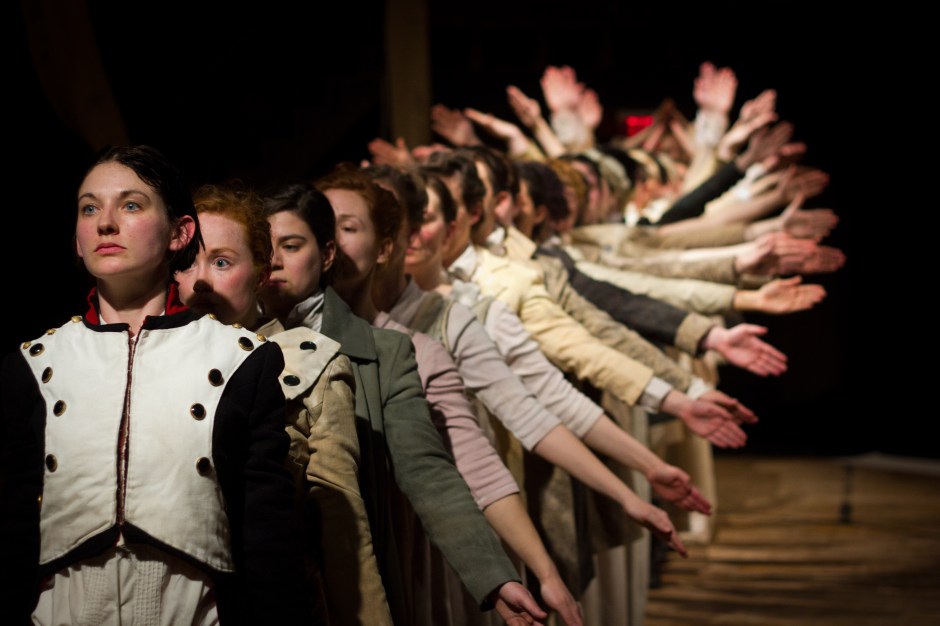
IMG_2378b

1)   How does gender parity and awareness of women in theater play a role in selecting your material?

We are a very collaborative company, founded by women, with majority female members and an alternative-model labor-sharing administrative structure.  Every piece we’ve ever made has come from an idea or a spark of inspiration from a company member, so in a sense the work is always reflective of the concerns of the group.  I think it’s safe to say that most of us identify as feminists and that our artistic motors have been shaped by our experiences as women in the world, as female artists—and, for our one male company member, his experiences as a gay male artist.  Collaborative art-making involves such intense processes of interrogation, exploration and reflection—so I’d say, overall, gender and female-artist awareness play a major role in everything we do.

To speak more specifically, we’re currently working on a piece inspired by [Russian feminist art/punk activist group] Pussy Riot.  This idea came from two company members who were following their story particularly closely at the time of their arrest.  We all intuitively leaped on this seed of an idea; as we began research and exploration (the early stages of our development process) we quickly discovered that a big reason why Pussy Riot’s story and the questions it brings up resonated with us so deeply is specifically because they are female artists.  Their story is our story.  And they have done these powerful, dangerous, earth-rocking things with their position as female artists, claiming that position as one of profound subversive power and gigantic imaginative and radical influence.  Our piece has expanded to encompass questions about contemporary feminism, its oppositional relationship to global capitalism, protest art, 21st century resistance, and the socio-historical qualities of a moment when artists’ voices are politically important. These questions are close to our hearts and central to our ongoing artistic project.

One thing that’s been really nice about working on this piece, the first of ours that takes on explicitly political content, is that it’s made us realize that we’ve actually been dealing with these questions all along: all of our past pieces in some way engage questions of power and control, allocation of resources, society’s power to shape identity, and the possibility of communities to affect change.  These questions are central to feminism.

Again, some brief specifics: in our recent piece Vainglorious, a large-scale historical fantasia about Napoleonic Europe, we had a woman playing Napoleon and a man playing Josephine (and lots of other cross-gendered casting, mostly in the form of women playing men, throughout the world of the piece.)  While we made this choice based purely on company members desires and personal qualities, we had to recognize after the fact that the choice “says something” about gender.  Embracing this allowed us a deeper exploration of the power plays and politics of that piece.  We’ve also made pieces with trans characters (Portmanteau), de-gendered characters (Some Other Mettle), and always always make pieces with strong, unusual female characters.  It’s worth mentioning, too, that our performers create the characters they play—so the women of Applied Mechanics, through engaging in our group authorship process, have a huge amount of agency in their theatrical and artistic output.

In all these ways, I’d say gender parity and women in theater are at the heart of our material.

A tiny post-script: I think there was a while in there where some of us in the group would worry about not having “enough male energy” in the company.  And then at a certain point we were like, “why are we worried about this?”  It’s amazing how pervasive the norms of the dominant culture can be.

2)   Does this inform your working and administrative structures in any way?

It does, actually.  We have worked really, really hard to cultivate an egalitarian working model that embraces all participants, distributes company labor, and values communication and consensus over hierarchy.  For me, this is a self-consciously anti-patriarchal model.   It looks at the ways most theaters run, the received narratives created in overwhelmingly large part by straight white men (and thus designed to reward male-socialized habits and aesthetics) and says: we reject that, and reject the goal of gaining access to it, and we claim the space to work in another way.  This is often difficult, and certainly does require a great deal of energy, presence, and mindfulness from all company members, but the result is that we have this thing, this company, that allows us a sense of shared ownership while granting us all agency and a supportive artistic home.

3)   Do you know your statistics (number of actors, directors, designers, etc) in terms of representation? Can you share them?

For several years, the company consisted of five women and two men.  It has now shifted to consist of six women and one man.

Of the 32 “outside” actors we’ve hired in our history, 21 have been women and 11 have been men.

Of the 4 guest designers we’ve hired (to work with company designer Maria Shaplin) three have been women and one has been a man.

Of the 5 stage management/production assistants we’ve hired, four have been women and one has been a man.

There are also an assorted bunch of folks we’ve hired for one-off work/labor calls; this is an estimate, but I think on those we’ve been about half and half women and men.

4)   What would you say to a female artist feeling discouraged about her place in the arts community?

It can take a while to find your people.  Don’t worry: you’ll find them.  All of my collaborators I met through working other gigs, going to see stuff, or coincidences born of just doing my thing.  It makes a huge difference to have people you love to work with.  It makes it easier to feel like, at least in some respects, you have your own place and your own community.

Keep your eyes open for folks you admire and are interested in working with or for.  It’s not that hard to track people down in this town, and it never hurts to ask for a coffee—or an assistantship.

And I know this will sound a bit “follow your bliss,” but—follow your bliss!  Don’t wait for permission to make the art you want to make.  Do what you think is cool.  Claim the space to do it.

Art life is a weird life without a clear path.  There is so much bushwhacking to do, and so much stumbling.   I think men and women tend to be socialized differently, and it can often be harder for women to access the kind of assertiveness and entitlement that’s so useful sometimes in getting gigs and attention and carving out a niche.  But I also absolutely think that self-doubt and failure and periods of frustration are natural parts of the artists’ life.  Finding a way to accept those stages of the cycle without being too self-punishing can make it way easier to fight the necessary battles—whether that’s about accessing particular kinds of assertiveness or asserting other ways of working.

5)   Anything else you’d like to add?

When Maria Shaplin and I started this company, it was because there was art that we wanted to exist that didn’t exist yet.  We realized we could make it exist by making it ourselves, and we realized no one was going to give us permission to do it.  So we had to just do it.  So we did it.  And we were incredibly fortunate (still are) to have access to a community of brilliant collaborative artists who were down to do it with us.  The company, which grew out of that initial project, consists of the people who stuck around and were excited about working on the artistic and organizational experiments that Applied Mechanics has come to pursue.  I don’t think that the experience of wanting to make art and having to give ourselves permission to do it happened because we’re women (it happened because we’re artists) but I think the lesson of claiming space and asserting new working models is vital to the feminist project.  I’m not saying it isn’t a worthy battle to fight for access to existing systems, but I also say it is a necessary battle to fight for new systems.  For me, this goes for both artistic concerns (structural, as well as aesthetic) and organizational models.

Thanks Becky!

You can check out Applied Mechanics bio below or their website for more info: http://www.appliedmechanics.us/

Applied Mechanics is director Rebecca Wright, designer Maria Shaplin, and performers Jessica Hurley, Thomas Choinacky, Kristen Bailey, and Mary Tuomanen, and stage manager Bayla Rubin.  This ensemble of artists collaborates to make work that challenges conventional ideas of theatrical space, narrative, and performer-audience relationship: they create visual landscapes for the audience to wander through, and multiple intersecting storylines for them to choose how to watch.  Their plays are immersive, multi-sensory, and choose-your-own adventure.  Their process is collaborative, democratic, and based on a commitment to organizational and artistic innovation.

Applied Mechanics’ pieces include the apartment plays Selkie and Ses Voyages Sauvages; It’s Hard Times at the Camera Blanca (Fringe 2009) which took over a Fishtown Bar; the invasion play Portmanteau (Fringe 2010) which, following its Philadelphia premiere, toured from Texas to Louisville to Maine; the dystopic environmental piece Overseers (Fringe 2011); and the large scale historical fantasia Vainglorious: Epic Feats of Notable Persons in Europe After the Revolution, which involved a cast of 26 Philadelphia actors and which  remounted to great critical acclaim in the Philadelphia International Festival of Art (PIFA) in April 2013.

Reframing

Sometimes when I spend a long time talking about myself as occupying a disadvantaged position it makes me a little depressed.

In writing about women in the arts I’ve found myself sometimes feeling frustrated this past month. And I think it’s because when you define yourself in this way – as a person who is being to subjected and trying to navigate a system that is not always set up to your advantage – you can start to see the problem in everything.

In the general sense, I do think women get less of a fair shake. On average, I believe it is true that we’re under-represented in almost all aspects of the field.

But I think we can probably all agree that thinking that way is no way to live. It’s just too tough constantly imagining oneself as a victim of an intractable problem. It feels too large, it feels to impossible, it seems pointless to even try, if you spend too much time in that mindset.

At least it does for me.

This, I think, is why some pretend it’s not a problem. They have to shut out any disadvantage and just keep plugging away as if things were totally equal because it would just be too depressing otherwise. I’m not chiding these folks too much, because I understand the impulse. No one wants to feel powerless. But I also don’t think that I can join them, because at a certain point I think most female artists just see too clearly the power difference.

A few years ago I listened to an interview with the famed brain scientist Oliver Sacks. I was surprised as he spoke to learn that he in fact suffers from a variety of neurological issues himself. I was even more interested in a statement he made that was something along the lines of this: I don’t know that I’d have been able to discover all the amazing things I had if I hadn’t had an abnormal brain myself. That interview made me think back to reading Jill Bolte Taylor’s book about how a stroke’s paralysis of certain kinds of “left-brain” style thinking gave her an appreciation for “right-brain” thought processes and a new outlook on life.  It made remember a friend of mine from college who was in a serious car accident and who said that she could feel the palpable difference between the kind of person who was “normal” and the way that her mind was now different, how she’d developed a sense of both the neurologically-dominant perspective and her new one as a recovering patient.

That interview planted a seed in me that’s grown into a guiding principle: I just have to believe that all the things that I believe are my weaknesses – my introversion, my status as a female artist, my lack of trust fund, my sometimes weird aesthetic impulses, my thorough dis-interest in classical works of the theatrical canon – all these things that sometimes make me feel like an outsider, are actually my secret superpower. These things that separate me from the dominant viewpoint are the things I can uniquely wield as weapons that those supposedly more in power can never hope to employ. These are the ways that I will be able to innovate. These are the things that will make my art works full of a fuller perspective. They are the things that will give me an angle in that others just can’t see.

This is nothing new, this idea. Lots of people know this. But it’s the thing that really helps on the days when the problems feel so big. When all I can see is how much harder the obvious road will be for me than for some dude with the same skill set.

Those are the times when I say to myself, “You just have to believe that in the long run this makes you stronger. You just have to believe in the long run you will be better for seeing differently.”

It’s the moments when I look at the obvious path and realize if I just cut through the bushes I might get to the top in a totally new way. It’s the moment I realize I have a machete in my hand and can start hacking at something new.

It is a problem in one lens, and I can jump into that perspective when needed to make progress on an issue I see.  But it’s something I can also reframe in my own mind to give me a sense of strength and destiny.  And while it might seem as if all this is a bunch of self-delusion, it’s those moments where I’ve really embraced the outsider in me, rather than just feeling frustration with it, that wonderful things emerge.

Things like a squad of awesome ladies, many of whom I’ve never met who suddenly are some of my most ardent supporters.

Things like creators in different cities who I am suddenly planning to meet because of our shared interest.

Things like an interview for a national theater organization because of my vocal views on an “outsider” subject.

Things like a renewed vigor for a writing forum that I’d let slide more than I wish in the past few months.

This onslaught of new and positive activity all came from just deciding to sit down and reframe an issue as one I can use as a leverage point rather than just being something that pisses me off. It’s become a power I can wield. And I like that.

Yes, it’s still a problem. Yes it’s one I’m solving all the time, and mostly likely will be the rest of my life. But it is also in my capacity to use it to my advantage.

Even on the days it doesn’t feel that way.

Especially on the days it doesn’t feel that way.

I see this as my chance to have choice.

– A
