change

A penchant for ladies designing

Last week I put up a post listing female directors in Philadelphia so that next time someone is having trouble coming up with some they know exactly where to look.

Today I’m doing the same for designers. These are folks that live and work here in the city (with a couple folks recently moved that folks I polled felt super strong about including anyway) and are ordered only by alphabetical last name.  I’ve divided the list up by category and put people in multiple places when they are multifaceted designers.

I’ll keep updating this, so feel free to send me more names.

And if you want a link to your portfolio or site, send that along too.

– A

Set:

  • Erica Hoelscher
  • Meghan Jones
  • Mimi Lien
  • Maiko Matsushima
  • Sara Outing
  • Cory Palmer
  • Maura Roche
  • Lisi Stoessel

Lights:

  • Kate Beutler
  • Madison Cario
  • Angela Coleman
  • Oona Curley
  • Alyssandra Docherty
  • Janet Embree
  • Lily Fossner
  • Shelley Hicklin
  • Amanda Jensen
  • Leigh Mumford
  • Maria Shaplin
  • Robin Stamey
  • Laila Kjørsvik Swanson
  • Jessica Wallace

Sound:

  • Susan Adelizzi
  • Elizabeth Atkinson
  • Tina Brock
  • Karin Graybsh
  • Ren Manley
  • Ashley Turner

Props:

  • Jen Burkhart
  • Ginger Dale
  • Natalia de la Torre
  • Amanda Hatch
  • Alisa Sikora Kleckner
  • Ren Manley
  • Amy Radbill
  • Gwen Rooker
  • Alice Yorke

Puppets:

  • Alisa Sikora Kleckner
  • Lorna Howley
  • Gina Leigh
  • Sara Outing
  • Martina Plag
  • Gwen Rooker
  • Robin Stamey
  • Danyata Ta

Video:

  • Janelle Kauffman

Costumes:

  • Ameera Ansari
  • Becca Austin
  • Meredith Boring
  • Marie Chimet
  • Kelly Cobb
  • Katie Coble
  • Rachel Coon
  • Natalia de la Torre
  • Kate Edelson
  • Mary Folino
  • Katherine Fritz
  • Jamie Grace-Duff
  • Colleen Grady
  • Millie Hiibel
  • Erica Hoelscher
  • Marla Jurglanis
  • Rebecca Kanach
  • Jillian Rose Keys
  • Alisa Sikora Kleckner
  • Maiko Matsushima
  • Rosemary McKelvey
  • Fiona Mulligan
  • Lauren Perigard
  • Julia Poisze
  • Regina Rizzo
  • Alison Roberts
  • Robin Shane
  • Susan Smythe
  • Janis Stefanowicz
  • Jennielynn Streed
  • Laila Kjørsvik Swanson
  • Charlotte Chloe Fox Wind
  • Amanda Wolff
  • Abbie Wysor

The more (of us) you know…

When you really start looking for something you start see it everywhere.

This is how I’ve been feeling the past few days as I draw my attention fully focused onto the topic of gender parity in the arts.

When you really start looking for something you start seeing it everywhere.

I’ve had more substantive conversations and been struck by more observations about this in the last 48 hours than I probably have in the last 48 days. And that’s really saying something, because I think about this a lot. But what’s most interesting and exciting? I’ve also felt freer and more invested in really trying to articulate the difficult honest version of my thoughts. I haven’t dumbed it down. I haven’t tempered my real feelings for the sake of the easier chit-chat. I’ve really tried to say what I believe and then listen back in a way that is open, non-presumptive and curious.

I want to try and capture some of those observations and conversations. I feel like talking in generalities gets us only so far. I really want to share and discuss real world examples here in Philly and figure out how we as a community feel about particular choices. I think this is the best way to really get into the meat of the matter. But I am also cognizant that part of creating safe space is making sure people don’t feel like they might say something to me and then see it online without having been consulted or that I’m putting really specific thoughts about their company in the public eye without being invited to the table.

So I’m gonna work a bit on those writings and I’m going to send them to the people they are in reference to, and my hope is that those folks will not only consent for me to share my thoughts, but possibly get in on the action.

So for today, instead, I’m going to start with what I know: female directors.

One of the things I catalogued last year was the number of women directing for companies in Philly. Female actresses and playwrights didn’t have it easy, but female directors (most especially at larger sized companies) had a rough go of it, especially if you factor out directors who occupy multiple directing slots in a season.

Part of the problem, I think, is a chicken and egg syndrome. More guys are directing which reinforces the idea of the pool of directors being more guy heavy generally and so when AD’s think about bringing in outside directors their first instinct is likely one of the people already visibly working.

Elissa Goethschius started an awesome thing on her website in which she literally just catalogs names of female directors. There is no plug or assessment of each particular person, just a list that shows the sheer size of the population that a person in a position of choice might choose from.

So in that vein I’d like to put out into the Philly arts ether a list, as comprehensive as I can muster of female directors/lead artist types (cause sometimes that distinction is fuzzy) who are working in theater (though again that line gets blurry) that I know of who you might consider to direct the next time you’re considering…

  • Abigail Adams
  • Krista Apple
  • Gedney Barclay
  • Samantha Bellomo
  • Suzana Berger
  • Deb Block
  • Cara Blouin
  • Carly Bodnar
  • Tina Brock
  • Karen DiLossi
  • Anne Marie Cammarato
  • Liz Carlson
  • Jen Childs
  • Candace Cihocki
  • Jess Conda
  • Ginger Dayle
  • Emmanuel Delpech
  • Amber Emory
  • Lisa Jo Epstein
  • Lee Etzold
  • Rebecca May Flowers
  • Charlotte Ford
  • Kate Galvin
  • Allison Garrett
  • Tamanya Garza
  • Arianna Gass
  • Brenna Geffers
  • Anisa George
  • Karen Getz
  • Amanda Grove
  • Jill Harrison
  • Allison Heishman
  • Jenna Horton
  • Candra Kennedy
  • Maura Krause
  • Kathyrn MacMillan
  • Manon Manavit
  • Deb Marcucci
  • Sarah Mitteldorf
  • Maria Möller
  • Sebastienne Mundheim
  • Gigi Naglak
  • Charlotte Northeast
  • Megan O’Brien
  • Erlina Ortiz
  • Malika Oyetimein
  • Michelle Pauls
  • Lizzy Pecora
  • Martina Plag
  • Harriet Power
  • Nora Quinn
  • Erin Reilly
  • Gwen Rooker
  • Jen Rose
  • Sarah Sanford
  • Chelsea Sanz
  • Rebecca Schaffer
  • Jessica Schwartz
  • Joanna Settle
  • Micki Sharpe
  • Catharine Slusar
  • Amy Smith
  • Eva Steinmetz
  • Elizabeth Stevens
  • Sam Tower
  • Meg Trelease
  • Mary Tuomanen
  • Daniella Vinitski
  • Meghann Willians
  • Becky Wright
  • Blanka Zizka

And of course me, Adrienne Mackey.

That’s it for today.

A

PS – I know there are more. Let me know and I’ll update. Also, I’ve only included in town folks for now, though I know there are many who work in Philly but may not permanently reside here.

Talking about talking

So I’ve been thinking a lot in the hours since my last post about how to have this conversation.

I’ve been thinking about how we can best begin to discuss issues of unequal representation in a way that both is honest and straightforward and is also productive and provokes dialogue instead of defensiveness?

In other words, I want to start by talking about how we talk about this.

I find it easy to provoke and push when the target seems large and imposing. I find strength in feeling myself becoming a David in the face of a Goliath. My guess, without having been there, is that this was the awesome power of what happened at #thesummit. It was a moment where the folks on the stage, the ones with some degree of sway and power and perhaps a degree of unknowing complacency, had to take in the might of opinion and feeling of the voices sitting on the other side.

But in a business as tiny as this, in a community where community is key, when networking and positive relationships determine your ability to get a job or a grant next week, month or year, it is easy in the micro-moments of inequity to excuse the tiny things. Too often any one moment or choice or thought seems isolated or small enough to swallow.  And as the distance between we and the “giants” gets smaller, the harder it is to see them as the Goliaths they once were. Little things amass because it’s sometimes hard to know what is and isn’t a battleground.

And let’s also point out that these are really hard conversations to have.

Because so often I see an cry to battle dissolve when it has to translate into the daily implementation of such ideas on the nitty gritty detail level. Based on the conversation in our few meetings of the Awesome Lady Squad I hear female artists find the balance of when and how and where to try and bring these issues up the biggest barrier to change. “Do I really want to make this tiny line or scene or interaction a soapbox?” “Do I want to be that actress today, tomorrow, through this whole process.” “Am I really seeing this or am I being overly sensitive?”

It’s exhausting constantly trying to parsing it out in the moment.

And even if you are sure and you do know it’s an issue, it is so so so so so so so much more difficult to say things that are tricky and sticky to people we know and care about. It sucks to be a watchdog. To be a nag. To feel like you’re stopping everyone’s fun. To put people on their guard. It can feel like the opposite of the artistic impulse, where we want to feel open and accepting of each other. And I think it’s so hard because to have that conversation is also to acknowledge that the ills of our culture, the biases and darknesses that float around us all the time, also make their way into our brains. That we are sometimes making choices with little pushes from beliefs or stereotypes we’d never support if we said them out loud.

I wrote a while back about a study that showed how academic scientists displayed preferential treatment of men when filling a position for a lab manager.

In that post I explained how candidates in the study were never seen in person and scored based on identical applications save for the gendered first name of the potential employee.  I underscored that this bias was shown in both men and women assessing the candidate.  And I made a particular point of noting that none of the decision makers felt their choice had been affected by the applicant’s gender in any way. They all felt they were being totally gender objective in their assessments.

In other words, you can display bias and stigma and stereotype even when you don’t subscribe to them, EVEN when YOU are the negative recipient of them.

It is scary to think that stuff is in us. Even scarier to come to terms with the fact that it can affect our actions despite the best of our intentions. And when confronted with it, defense is natural. From the outside it seems ignorant and bigoted. But my guess is that the real cause is that no one wants to find in themselves dark things they didn’t ask to be in there. So sometimes it’s easier to believe they aren’t.

And it is here I want to point out the latent superpower we are missing: Yes, this is hard. Yes, It is tricky to talk David to David rather than David to Goliath. But.  The closer we are, the more potential impact we are likely to have. The closer we are to them, the more likely we can get people to let that guard down. The closer we are to the offending source, the more likely we are to find a safe space to excise these demons with their hosts intact. And if we can win them to our side we grow our army of soldiers. The less it looks like a war and the more it looks like a conversion, I think the faster the battle will be over. If we have to kill them all, we may still do it, but I bet we lose much more time and resource and energy.

So I think we should begin with two assumptions, even if it may seem idealistic or naïve:

1)   No one intentionally wants to make harmful choices to women artists.

2)   Everyone imbibes some level cultural crap that will predispose him or her to doing so.

So when we look at the choices of a company, or another artist (or in our own work for that matter) and we see something that makes us feel squicky, our goal should be to remind them of #1 and help them see where they might be displaying the crap of #2 (pun by the way, totally intended).

To do that I think we start by asking these questions:

Is it conscious? – i.e. Does the person or company know and realize what they’re doing? Do they identify their behavior as a problem or are they truly unaware of it and its effect?

And

Is it conscionably contextualized? – i.e. Have they passively presented potential problematic material/decisions or have they taken steps (even if imperfectly) to justify them through dialogue or contextualization? In other words, do they balance a guy heavy Glengarry Glen Ross with another play with mostly female cast? Do they perform a problematic cannon text in context of a conversation series about historical representation of women in history to point out the potential in conflict with the morals we have today?

How we assess the answers to these questions will help set the stage for the modes through which we express our concerns and I think also help start to identify the solutions. And in tailoring it in this way, I think we get closer to coming to real understanding of what’s at play in each specific case. Because the devils really are in these details. And if we don’t treat all offenses alike, I think we’re likelier to find specific tailored solutions, likelier to find and commit the people who are ready and wanting to change but may not yet be brave enough or know how on their own to do so.

More on this tomorrow…

A

PS – For some other awesome follow ups to #thesummit look to this from babelwright and this from Tamara Winters

#thesummit

Look.

I am bad at twitter. I don’t tweet much or well. Call me twit-illiterate. It’s also been a heinously busy couple of weeks. Which is why it’s taken me a bit of time to catch up on #thesummit.

More than a few people have passed along thoughts about this. More than a few have asked my opinion. But I wanted to wait until I felt like I’d really read enough about it to have an informed opinion before responding. If you haven’t caught up check out this for an overview. And this for the much commented on tweets in-situ. And here’s the quote from Ryan Rilette quoted from the DC Theatre Scene article:

“It’s really hard, and here’s why it’s hard.  I think it’s hard because there’s not enough in the pipeline right now.  …There are a lot of new plays that are getting produced by small theatres that are by women.” 

He went on to discuss how there are not enough plays by women produced in New York City and not enough in London (although he credited London with doing a great job), and said that a theatre needs something that’s going to help sell any play they put on.  He said one can’t choose a total unknown, and that to find three plays a season by female playwrights would require them to have name recognition or something else to draw audiences, if one is not going to go the route of using star actors. 

He said there are “not enough yet in the pipeline” and that “it’s gonna take a couple of years… a decade… before it’s going to shift, but it’s going to shift.”

A decade. Wow. I’ll be in my 40’s then.

That would be awfully… depressing to have to wait that long for more opportunities to arise. Probably depressing enough to just stop entirely. Something I see an awful lot of my female counterparts begin to contemplate around this age. It would be something I’d contemplate if I actually believed it would take that long. If I really thought my female peers had to wait around for these folks to use that whole decade’s worth of time to see some progress.

But I don’t buy this. And I also don’t feel like waiting.

Which is why what’s far more interesting to me, and what seems to have shifted this forum out of the standard and unremarkable bias women artists see and deal with all the time, is the final provocation of the night from Elissa Goetschius from Strand Theater that included a series of statistics:

  • At Signature, since the 2005 season, only 10 of 90 credited writers have been women, with women directing 2 of 54 productions.
  • Since Ford’s reopened after renovations, 2 out of 29 productions have been directed by women – the same woman.
  • At the Shakespeare Theatre, since opening the Harman in 2007, they have produced 51 shows – none of which have been written by a woman. 3 were adapted by women, and 9 were directed by women.
  • At Arena, since the 1998 season, 44% of productions have been directed by women. However, three women account for over half of those woman-directed productions, while 49 different men have directed here. The plays and lyrics that have appeared on Arena’s stages reflect the work of 110 men, but only 35 women.

When I read that and I thought, “Sounds familiar.”

I’m guessing, like myself, she’s been having this conversation for a long time. And as I went digging into her online presence I found this from March 2013.

I went back and checked my own blog for my statistics project on representation of women in Philly theaters. The dates of these posts? January 8th, 2013 AND February 7th, 2013 AND Febraury 8th, 2013.

Just about a year… Just about a year those facts have been out there. Hard numbers that do not lie about the state of the art we are in. Mine in Philly and Ms. Goetschius’ in DC.  As a former student of chemistry, I really thought when I threw my info out there it would set something off in other people. But it’s been a year now and not enough is different. I still think numbers and data are useful; they are a tool to wield. But they are not, as it turns out, enough on their own.  I admire Elissa Goetschius for going to #thesummit with numbers but I believe it is her fortitude to require their presence in the conversation that really started the firestorm.

Is it odd, do you find it strange, that within weeks of my post about gender parity in Philly theaters last year that another female director in another large America city was taking up another numerical compilation project in much the same way?

I do not think this is incidental. This means that it is clearly time to be having this conversation. I think it’s a sign we are gearing up for the real deal fight. I think it means the troops are gathering the tools we need to start taking this on. The numbers are a beginning. And now it’s time for all of us to make the response to them a necessity.

Elissa, if you happen to be reading this, I want you to know we are having this conversation in Philly too.

Like you, I am not waiting 10 years. I’ve already waited one, and not enough has changed.

So, like you, I’ve decided we’re having it now.

Which is why in honor of last March’s statistics project, I’m devoting this entire March’s blog to this issue. Every day a new article.

Every. Day. A few hours of time devoted to thoughts or actions to tackle this shit.

Cause it is shit.

Which why it stinks so badly.

You can expect more updates from The Awesome Lady Squad soon.

You can expect more thoughts about how we can critique and work with critics to change the way we frame women in theater to our audiences.

You can expect more observations about the myriad of ways we undercut women in subtle and unintentional ways.

You can expect more on what we can start doing NOW to make next year look different.

And hopefully by the end of March, by the time my 3/30 birthday rolls around, I’ll get a big fat present in the form of some actual movement and change.

I’m not giving it a year to start moving.

I’m giving it a month.

Are you ready?

I am.

– A

PS – Also worth reading is the fateful final question-er Elissa Goetschius’ thoughtful response and Brett Steven Abelman‘s as well.

Connor’s Story

When I first started doing theater I was in 7th grade. It was a way for me to get out of my own skin, skin I wasn’t super comfortable in yet. It was a way to escape and be someone else. It was also a chance for me to be with other people, to find community. I liked having what felt like a secret club of people who got together to create something bigger than any one of us individually.

When I first started doing theater the stories I told didn’t really matter: Annie, The Music Man (twice) and Neil Simon’s Start Spangled Girl. But it was the act of telling them that made meaning for me of my experience, the act of being together with people. In high school, I wanted very much to be Bernadette Peters, to have big hair and a big voice and a fancy costume and to be very good at what I did. Somewhere in the midst of that time my desire transformed from simply wanting to be a part of something to wanting to be a part of something amazing, to create it at a high level of skill.  So I trained in music and acting and having always prized myself a very good student, I threw myself into that study with fervor and drive.

When I first started doing theater I thought that the purpose of it was to raise myself up to the level of the creators whose works I was enacting. I thought that playwrights and composers had some kind of magical skill. I thought that their works can from some nebulous place that was very different than the kind of place I pulled my own artistic feats from. And it wasn’t until I first found myself making a piece of my own that I realized that I too had that capability, that capacity. And it wasn’t until then that I was really really hooked.

When I first started doing theater, my experiences shaped my ideas of what the end product was supposed to look like: fancy, professional, expensive. When I first started making theater my experiences shaped my ideas of who the audience for that work was supposed to be: increasingly large and anonymous groups of people who come to see me and my works because of my skill and excellence. It was an impulse to impress. And when I first started doing theater I thought that my job was to try and tell the stories that matter to the most people. To try and create as universal a message as possible. To create a Great American Play.  To try and reach people I didn’t know and pour into them the experience of my greater artistic truth.

I don’t really think that any more.

If your plan is to see Welcome To Campus and you haven’t yet, don’t read this next part. If you’ve already seen it, or know you won’t make it, go ahead and proceed.

There’s a moment early in Campus where the student tour guides, who have been up to this point manically presenting Drexel in a shiny brochure-style intro, crack just a little. They are listing, as one ought as a highly school spirited representative, their favorite letters in the word DREXEL. Student Cami, a go-getter, chooses D for its primary position. Garth relates his choice of the E as the “workhorse” of the word. And so on through L and X. And then just after Dean has also chosen D (without which he would “just be EAN”) there’s an awkward pause. A sort of looking around and then realizing “Oh right…” kind of moment. And then Lexi breaks the uncomfortable tension with a plaintive, “Connor’s supposed to be the R.”

Through the rest of the play – a walking tour in which the students relate their actual college experiences in the locations in which they actually occurred – Connor and his obvious absence are hinted at and remembered. His return is promised and reiterated. And while we grow closer to Lexi, Carl, Cami, Garth and Dean, our sixth tour guide Connor remains an enigmatic mystery. The audience knows only that he seems to have been rather important to our tour guides and that clearly he isn’t going to be here.

The stories the tour guides tell (once having broken their shiny personae) do not relate to him really. They are stories about their experiences from their actual college lives. They are stories of a kind that no traditional tour will give. What the actors and I aimed for was to find a way to share the intimacies and strange details that really make up their experience of higher education. And yet, in these moments in between performances of the most awkward dates of one’s life or ruminations on feeling terribly alone in a new place, they all keep hinting at this other unseen person.

An outsider to the show might wonder what exactly the decision process was behind including such a motif through the show.

I could create a fancy and artistic sounding justification. But the real reason is this: there really is a Connor and he really was going to be a sixth tour guide. He also doesn’t  go to Drexel any more.

I taught a class last fall in preparation for this show. All the tour guides in the performance were part of this class. We spent 10 weeks together talking and playing and writing and reading and sometimes farting around trying to create an idea for a play. Over the course of this term we found together this idea of a college tour, an offshoot of an initial idea I’d proposed, one that included their own personal stories. And for their final I prompted them to give a theatrical tour of an actual moment from their lives in a non-theatrical space, ideally the actual location if possible.

One of the last ones we took was Connor’s tour, which happened in a large and scary building called Drexel One Plaza (Garden Level for those in the campus know). On a cold day late in the term we walked from the black box theater over to the building, tried the back door with no avail and then walked around to the front to be told by a security guard that the building wasn’t open to the public after 6.

We got in anyway; the group managed to sneak in through a side door after one of the students confidently declared he could find a way to get us in. When we did get in,  filled with excitement and giddiness at having outsmarted the proverbial castle guards, we walked through the empty building’s halls. And though I pretended not to notice the security cameras lining the ceilings, I did gently encouraged Connor to get a move on with his tour.

We walked through the strange windowless floor to a simple and unremarkable classroom. Connor’s story was relatively straightforward. It talked about feeling a distance from the Drexel. It talked about being displeased with the administration and academic environment. It talked about how his long distance girlfriend and her support was really the only thing standing in the way of him throwing in the towel on this version of the college experience. And then he told us about the day that she sent him a text message.

He told about a recent day he had been sitting in this classroom and how he had been looking at the board (the one we were now looking at just then) and how he had been holding his phone (the one he was now holding) and how he’d received a text message. He told us that reading the text he knew he would break up with his girlfriend later that day and how he knew when it happened he was going to have to leave Drexel.

It’s how I found out he wouldn’t be there next term.

And we all sat there. Sat and stared at him and his phone and the room and each other. Each thinking about the fact that this was the room where that choice had been made. The same way you stare at the walls of Versailles knowing a king used to sleep in a bed there. It was a weird kind of re-enactment, one where you become aware of just being. Aware of your being in a place where someone else’s being has just been.

As I was sitting with the class thinking about all this a security guard arrived and told us we had to leave. We giggled and pretended to be sorry for breaking rules we clearly weren’t sorry to have broken at all.

This is one of my favorite moments of teaching, ever. I still have trouble putting into words quite why.

I really like the play I’ve made with these Drexel students. I think that Welcome To Campus is a really lovely play. But it’s funny sometimes when I watch the audience. I think about the fact that to them Connor is just some name. That even though the actors and I went to the trouble of re-creating the whole thing – mentioning Connor’s absence, staging a security guard denying us entry to a building, building in a covert break in, telling the story of the text message, the sitting in silence and getting kicked out at the end, all of it – there’s some part of me that is sad that they don’t know that what they’re seeing is just a re-creation of the real moment that has stuck so hard with me in this process.

A few days ago Connor came to see the show and I got to watch him watch his scene.

This is one of my favorite moments from teaching, too.

I didn’t direct this play solely for this moment. There’s more in this piece than just this particular layer. But it felt like the right kind of full circle. That finally we had an audience member who really knew what the journey of this play had been. Because even though he wasn’t there when we built so much of the later parts of it, he was an insider in one of the moments that sits at its center. And now I could watch this insider see the thing as an outsider. See a creative voice get to be an observer of the artistic result.

Connor is the opposite of the kind of person I used to want in my audience. He knows more about the moment of his personal scene than I can, than I ever could, understand. But that scene feels like the kind of gift I feel my work needing to be – a way to see our own lives reflected back to us, to parse them out for meaning and beauty – through the help of the artistic process. And while I don’t want to deny the anonymous who see the work their place, for the few I’ve met have been lovely and effusive, I wonder in a piece like this if the point is not for this insular community to create a message to send to the outside world, but for us to use the work as a way to understand our place within it.

How do we open our process to an audience that will not only be our external viewers but our internal community? How do we bind them to the building of the thing? How do we share in the depth and power of expanding and filling our stories with shape and craft?

I don’t yet know. But it feels like the calling.

– A

Dispatches from the Awesome Lady Squad, #2: In which the ladies plan to meet for a second time

cooltext1368115366I’ve been feeling lighter lately.

I’ve been walking around with just a bit more bounce in my step.

I’ve been feeling, well there’s just no other word for it, rather awesome indeed.

I believe I’ve been feeling that way because for the first time in a long time it seems like change is imminent.  Over the past few years, I’ve spent a lot of time worrying about finding my place as an artist in the world. I’ve worried about whether I was doing the right thing. I’ve worried about whether a choice I made would get me on the right path. I’ve worried if I’d ever land in the place where I was supposed to be. But you know what? I think I’m finally, finally, finally, realizing that the whole idea that there is a right place, that there is one just path, that there’s even a standard of measurement that is anything close to absolute is a load of crap. And that realization is part of what I think is making me feel so awesome in particular about the Awesome Lady Squad.

After the last squadron meeting I felt the positive power of defining a new perspective. About refuting the idea that there is an absolute when it comes to what’s “normal or that there is a fixed set of disadvantages and that there are givens that stay given about the way that things work.

I thought about the way I run my theater company: as a hybrid artist somewhere between non-profit and individual who is able to make the kind of creative work that doesn’t fit easily into categories and still manage to pay my collaborators the same level as many mid-sized theaters in town. I’m pretty sure that if I’d asked my mentors first coming out of school if such a set up would be possible, they’d have all said no. My guess is that at that time they would have told me there wasn’t funding or structure or opportunity for such a different way of doing things.

At the time, there probably wasn’t an obvious route towards what I wanted.

Now, there is. But that’s only because I found it.

I’ve spent a lot of time in 2013 fretting about whether it’s possible to change how women are treated in the arts. And as one of the attendees from the last meeting said, it’s a feeling that has taken up a lot of space in my life. I’ve felt mad that things aren’t the way they should be. But at this moment, I’m a lot more interested in putting that energy towards actually getting them so they are.

Right now, the route to doing that isn’t obvious.

But after we do it, other cities can look to Philly and see that it was there all along.

The resolution I want you to join me on in 2014 is this: you have to know – not desire, not wish, not hope – but deep down truly know that there is a future world where the Awesome Lady Squad doesn’t need exist because we’ve solved all the problems we’ve identified. And we need to know that it’s going to become reality, and soon. Gathering people and realizing that you are not alone, that your perspective is one that is shared by many, that your view of the world need not be rage-inducing or isolating, that you can indeed find a space where every person around you also starts from the same set of ethical givens, this is the first step. It’s an important one. Because it’s the one where we all have to stop and say, hey, the things that I disagree with are actually NOT truth. They are NOT givens. Not in this room. Not right now.

And once we carve out a little bit of space to stake our the Awesome Lady Nation, we’ll be able to invite the rest of the world in as citizens. One by one, we’ll make them all denizens of our Awesome new world.

Charting that course is already underway and you can check out our first scouting mission here. On Sunday January 26th from 7 – 9pm at the Arts Parlor (1170 S Broad) we walk just a little further down that road.

We’ll use the same format from last time, me asking some big questions, and you guys sharing your big answers. For a few hours in a few square feet of space we’ll create a world where people believe in equity and fairness and respect for female creators. And if we can make it true in a room at the Parlor for a few hours at a time, there MUST be a way to expand that perspective, that new sense of reality past that room and out into the world.

Hope to see you there.

An as always, thanks for being awesome.

– A

Resolution for 2014: Form the Awesome Lady Squad

Happiest in the new year Swim Pony friends.

Can I share some stuff I realized in 2013?

I spent a ton of time this fall teaching. In so doing I realized I’ve been rather taken with many of the young women that I’ve worked with.

I also met a bunch of young female artists who are trying to get their feet wet in the Philly scene. In doing so I realized that I wanted them to get their artistic voices out there and that it’s possible I could make that easier.

And as you likely know if you’ve landed here, I’ve been writing over the past year about women in theater and what I see happening and how it’s been making me feel and think.

And the previous two combined with this last thing has brought me to reflect in this, a newly formed 2014, back on my own early career. It occurred to me that all of my mentors were men. That one of the things that it took me a really long time to find was other female art makers a bit further along in their career. That it wasn’t until I made a show that was an explicitly all female undertaking that I really felt like I’d found a cadre of female voices to share the female art-making experience with. It made me think about the fact that while I appreciate the necessity of talking and discussing and highlighting inequity, I’m really most interesting in figuring out how to actually do something about it.

Many of you who read this blog have had smart insightful things to say. And in writing so much lately about women in the arts I’ve wanted a way to pool thinking about this topic, especially with those just coming into the field.

I don’t know what form yet this will take – drop in sessions where young female creators can meet and ask questions, round tables on topics that I’ve been discussing, a small talk from a female artist each month or all of the above – but it feels like something on the once a month scale would be a project I’d be interested in and have the life space for.

So as a resolution for the new year, I’m starting by collecting some female folks on Tuesday Jan 7th at 10am at the Arts Parlor (1170 S Broad) from a variety of career stages, to ask what they wish they’d had then or what they wish they could have now as a female artist, things they’d like to see different and what might be useful to explore in an open source format. So feel free to pass this along to folks of any variety of career stage, I’m interested in getting a variety of perspective. I’d especially love to get any students, young creators, newer female artists, to hear their perspectives on entering the artistic workforce now.

Y’all know I slant towards the generative side of the arts but I’m interested in a solving a variety of problems, so come with whatever you want to talk about.

If you’re interested and want in, come, and if you can  hit me up first so I have a sense for numbers: swimponypa@gmail.com

If you can’t come, but want to throw a few cents in, post your thoughts below on topics for this or future discussions…

I’ll be in touch about this again soon.

Thanks,
A

The Ballad of John and Jen

When I started writing on this blog, it felt like I was pouring out a lot of the things that I had been feeling for a long time. The first posts were thoughts and arguments I’d been having a lot – internally with myself and externally with others – and were pretty well formed in terms of their reasoning and logic by the time they went onto (virtual) paper.

In the last few months, however, things have slowed. That’s partly (perhaps largely) due to my busier schedule of work. But I think it’s also because I’ve started to dig deeper into some of these things, I’ve begun to get at the stuff under that stuff. I’ve started to get at the things way down that one may not really realize. When you really start to pull apart your choices you start to see the unnammables that work on you, the things that you didn’t totally even realize were there. When you get down into the real muck of it, this stuff is less formed and harder to parse out. You start to pull apart shit that is often much much trickier to unravel and reason through.

I think this might be where some of the real scary stuff is.

I think this is where the less polite stuff is.

I think this might be where people could get a little upset.

But I think this might be where some of the real work is. And I think this might be the place where you start to tackle the issues that really might make a difference. All of which is to say that this post is coming back around to some of the women in theater/gender parity stuff.  This is a first step at trying to dig into the muck.

Let’s begin with the truth: we have some major work to do.  Even those of us with the best intentions aren’t really fixing this problem. Those of us with cursory intention are likely perpetuating it. We can blame the theaters that continue to produce plays with way imbalanced seasons. We can bemoan the writers that continue to create the plays. We can lament the market for having a glut of women. We can do all these things. But it isn’t going to get us anywhere. And if we actually want to get somewhere we have some “money where our mouths are” choices to make.

Backing up a bit: I had an argument back in mid-April, right around the time I wrote this post slamming a few Philly reviewers for their presentation of women in Shakespearean roles. This argument, one that had seven months ago is still picking at me and has been ever since I had it. It would randomly surface in my head in the middle of rehearsal, while driving, watching TV, I just couldn’t let it go. Couldn’t let it go because at the time I had it I was trying and failing to say something, something that I felt with incredible force and vigor and anger and fullness, something that felt like it implicated me and in the way I make choices about my work, and frustratingly was also something I felt totally unable to articulate.

The argument was a sweeping one, the kind that starts with a couple offhand comments and ends up gobbling up an entire afternoon. It was the kind of argument you can only have with someone that you really trust, because you actually start to uncover defenses. It was the kind of argument where you talk about the things you believe deep deep down inside about yourself and the world around you. And my sole caveat here is that it’s totally impossible to try and reconstruct all the things we said. But basically, it came down to this hypothetical:

If you have a slightly better male artist and a slightly worse female one, should you pick the worse one to help achieve better representation of female artists?

In the moment of the argument, it felt like I had no choice but to argue for the latter. It felt like a mission from on high. Like my entire life depended on making the case for that female playwright. That there was something deeply stacked against her. That I was the only way she was going to get a chance and if I couldn’t find a way to make that choice seem reasonable and obvious to my argument partner that she and no female writer after her would ever get it.

Which of course I failed to do.

And of course there are (and were) many reasons one could counter the position I took. Rational, reasonable, intelligent and thoughtful positions that we went back and forth and back and forth about. I almost ended up in tears because sitting there I felt so torn between the opposite side’s reasonableness and some kind of irrational deep down feeling that said there was something very wrong about taking a side other than the one I was on.

Neither of us could be moved. We left it unfinished.

But as I said, this question and the debate that ensued has continued to stick, continued to hang out in the back of my mind, needing to come to completion. It’s been this nagging incomplete thing trying to resolve itself for seven months now.

Over time, small details begin to accrue:

An review for a work of my own in which women played “men’s” roles

Writings from the dear Katherine Fritz

A book on the virtues of affirmative action

And then finally this: a study in PNAS about gender in the sciences that both control for and show statistically validated evidence of bias from Corinne Moss-Racusin and her colleagues at Yale. It was this last one cracked something open that I can hopefully finally start to put into words.

Here’s an intro from Sean Carroll’s blog for Discover:

Academic scientists are, on average, biased against women.

I know it’s fun to change the subject and talk about bell curves and intrinsic ability, but hopefully we can all agree that people with the same ability should be treated equally. And they are not.

What the researchers did a randomized double-blind study in which academic scientists were given application materials from a student applying for a lab manager position. The substance of the applications were all identical, but sometimes a male name was attached, and sometimes a female name.

With me so far? I swear, this comes back to the arts.

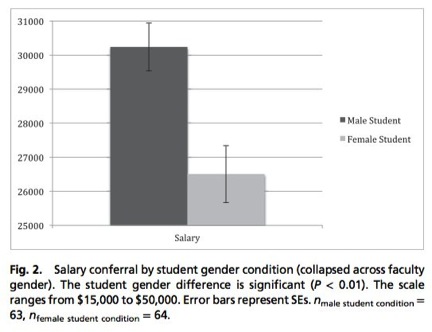
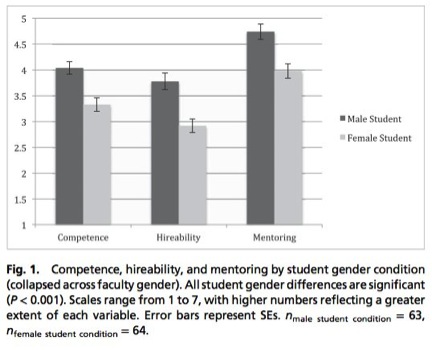
So half of the applications were Johns and half of them Jennifers. What the findings showed were that the faculty members rated John significantly more “competent and hireable” than an identical female applicant named Jen. These participants also selected John to receive a higher starting salary and offered more career mentoring to this male applicant.

And the real kicker? It didn’t matter if the faculty member was male or female. Both were “equally likely to exhibit bias” against Jennifer and viewed her as “less competent.”

A depressing graph:
graph 1 PNAS

How about another?

graph 2 PNASIn her great Scientific American blog post about this study, Ilana Yurkiewicz appropriately writes:

Whenever the subject of women in science comes up, there are people fiercely committed to the idea that sexism does not exist. They will point to everything and anything else to explain differences while becoming angry and condescending if you even suggest that discrimination could be a factor. But these people are wrong. This data shows they are wrong.

The thing that stuck with me about this study, maybe even more so than the disturbing results themselves, is that, as Yurkiewicz points out, the scientists didn’t view gender as a factor in their decision-making. They thought they were using objective data for their assessments – rationally reasoned, non-gendered arguments – to determine the strengths of this particular candidate for this particular job.

I’d bet my house that were I to get into argument with those interviewers of Timon of Athens that the points they would have countered with would been rationally reasoned, non-gendered arguments. And my point is that just because you don’t obviously act like a sexist or consciously espouse anti-female philosophy doesn’t mean it isn’t working on you. And even the benefit of experiencing that disadvantage is no shield from inflicting it on others.

Does anyone want to guess about whether I think this pattern might be found in other contexts?

If it can happen so sneakily in something as cut and dry as the representation of skills on a job application with the exact same credentials but a difference of –en versus -ohn at the end of a J…

If there are forces that bias us against thinking that a woman is as capable and intelligent as a man in doing a job in such a carefully crafted scenario of objectivity

If that can happen in a field whose express purpose is to remove bias from its methodology

How can we possibly imagine that we can create object assessments in all the incredible number of variances and nuances and details about what makes a better work of art?

So of course if you knew for one hundred percent sure that you were absolutely judging the work objectively then yes yes yes yes yes you should absolutely pick the “better” play. But I what I’ve come to finally articulate these seven months later is that I just don’t believe there is anyone in the working world that can honestly say that they can do that.

If you have a slightly better male artist and a slightly worse female one, should you pick the worse one to help achieve better representation of female artists?

The problem isn’t your answer to this question. The problem is that this is how the question seems to always be framed.  And I don’t buy this scenario is really the one that any of us is objectively encountering.

So when I hear “It just turned out that way,” I’m calling bullshit. When I hear, “The season line-up just ended up male heavy,” I’m calling foul. When I see foundations that just “happen” to be given to a majority of male-driven companies, I’m not going to say “Well that must have just been the applicant pool this year.”

We all know the odds are already stacked against women because we see it manifest all around us. And while the scientist in me wants to document and collect all the evidence I can to try and display this finding to the world, the maker in me says I need to find a way do something about it now. I don’t have time to wait for a fix. I don’t have time for more research. I’m making my work right now. And there’s no thinking theater artist I know who would truthfully declare gender wasn’t an issue on the general scale. Where we break down is whether we are willing to acknowledge that it’s happens in our own personal choices.

Intentionally or not, like it or not, we are all making a million tiny anti-women decisions and justifying them with million other reasons.  The troubling implication from that PNAS study is that we not only judge women’s past work less fairly but that the bias impedes the potential for future opportunity. And without opportunity we are less likely to create new examples in which people can start to see anything different. Every performer or writer or director knows without a chance to make anything you can’t get better at making things. Even if you wanted to work way harder to achieve the same perception of success it’s going to be way harder to find the opportunity to do so.

And here’s where I’m going to get honest with you all.

I think a lot about this. I try very very VERY hard to root this shit out at the source. But I know I do it too. I wish I didn’t. But it’s just… in there. And were I able to somehow analyze my seemingly objective rational non-gendered artistic decisions I bet I’d find that I too have subtly undercut women in my process or in the field as a whole. Though I might not see exactly how those predisposed biases slip in, I know am not immune. And neither are you.

And in knowing that, I have felt myself at a cross roads where it seemed like I was asking this question:

If you have a slightly better male artist and a slightly worse female one, should you pick the worse one to help achieve better representation of female artists?

And increasingly, over the last decade of my career I’ve forced myself to do the thing that felt, in some vague and hard to define way, the slightly less artistically “right” choice because I believed it was the better moral one to make.

Just so that I’m totally clear about this:

I’m saying that I have steered projects in artistic directions that I might not have otherwise had I not cared about making a less imbalanced world through my theater. I have often picked the slightly “worse” artists because I believed it was the morally right thing to do.

And I do it constantly. I do it on projects ALL the time. Not just on the ones where it seems obvious. I make myself go against my gut in lots of choices because I think it’s better for theater as a whole.

I don’t often don’t say that out loud.

In fact, I don’t know that I’ve said it to almost anyone before now.

And part of the reason for my artistic public persona – my warrior-queen-who-get-all-the-grants-and-deserves-them-because-I’m-a-badass-take-no-holds-creator stance – is to show that despite doing this you cannot impeach my creative process. I want to demand that people acknowledge my artistic worth. And I do that because I secretly fear that people will see what I’m doing and think less of the work. Because deep down in the muck I fear that most people think women are not as artistically capable or that their stories are not as interesting.

In the past I’d get really hung up about it. I’d worry that I was losing my sense of artistry in order to make a point. And though I still believed it was worth it, I fretted about the cost.

I used to think that I was trading quality for principle when I did that.

Now I’m just going to think, “Jennifer.”

Perusing the outcomes of those choices here’s what I find: way way way more often than not, the person I picked was able to bring something to the table that was tangibly better. For obvious reasons, I am not pointing out specifics here but suffice to say, when I went with that slightly non-gut choice, I was often rewarded back in spades. And even when I wasn’t, if I could remember to view the failure in context of the qualities of the artist’s work and not simply their gender, I almost always saw that the real issue had little to do with them as women.

I’m not saying you have to pick terrible performers. I’m not saying you can never work with who you want. But I am saying that creative worth is totally squishy. I’m saying that we make artistic assessments for all kinds of totally ridiculous reasons. I’m saying that the way it’s usually is done is a massive amount of momentum pushing you towards a choice. I’m saying that we’re probably wrong as often as we are right about how a collaboration or an artistic impulse is going to work out. That failure is built into our creative growth.  I’m saying we might as well start being “wrong” for the right reasons.

I’m saying that if you do this for a living, you have to know that so much of the time the difference between two options in the scope of a whole process doesn’t mean that much in the long run. I’m saying the difference between “really good” and “just a little bit better” is likely negligible. And perhaps not actually there. And even if it might be, at a certain point, the artistic benefit no longer justifies the outcome.

I’m saying if you’re at all considering a chance to give the opportunity to a female voice or person or story you should do it.

I’m saying if you actually care about doing anything about it, you have to do it. Even if something is pulling you away from it. Maybe especially then. Because that thing that’s pulling is ugly and dark and mean. And it hides in reasonable arguments’ clothing, it hides in gut reactions we don’t quite unpack. The only way to exorcise it is push in the opposite direction. Even when it seems strangely hard to do so. Even when it makes you feel a little funny. Activist-y. Moral high-ground-y. Like you’re doing the wrong thing-y.

Trust that you’re an amazing artist. Trust that this small push in the other direction will not harm your work. Know that it is a better thing for the world to have done. And see that your work is no worse off for it.

And then perhaps we can start actually getting this shit fixed.

– A

You can

Is it just me or do people seem tired lately?

I don’t mean standard issue Festival post-partum malaise. I mean an industry-wide heaviness that is seeping into a majority of the conversations I have with people these days. A lot of people seem really weighed down, overwhelmed and ready to cut and run. I’ve been thinking about this weight, the sadness I sense in others and creepingly in myself. I’ve been thinking about how to tackle it and where it comes from.

First, a story, or a confession rather.

About a year ago, I was on the relationship rocks. Not through any kind of infidelity or betrayal. No, there wasn’t anything particularly wrong with my partner and I. That said, through nit-picking and bickering, through the penumbra of apathy and assumption that LTRs can sometimes attain, I’d found myself in a place where nothing felt particularly right either.

I was bored, I felt trapped and I wasn’t sure this was what I wanted my future to look like.

The long and short of all this was that I had to ask myself some hard questions. I had to be honest about whether I was actually living the way I wanted to. I had to really own up to whether the choices I’d made were ones that I really wanted to continue with.

Basically, I had to decide if I wanted to stay or I wanted to leave.

Here’s the thing: as scary as that realization was, it occurred to me for the first time in a long time that I had a choice in the matter. Having to contemplate the very real possibility of not assuming the things I had would always stay that way meant that I really looked at them closely.

And for the first time it occurred to me that some of them were things I really didn’t want to lose. And it also occurred to me that there were things I was doing that were not making that terribly easy. In the midst of this very dark time I had to look at some choices I was making and some habits I was holding onto that were working against some of the things I professed to want. Contemplating whether I really wanted these things kicked me in the ass a bit about getting in gear to go get them.

Another confession, while this was happening in a lot of areas of my life at the time, the LTR I was really most worried about was with my identity as a creator.

Look.

We’ve all found ourselves in the midst of a lot of work that we don’t much care about for, work we don’t really even seem to like. And in those moments it’s easy to say to yourself, as the proverbial Talking Heads saying goes, “How did I get here?”

I, clearly, didn’t throw in the whole towel. But I did throw out a few things and I gave myself some mandates on what had to change. I decided to let go of some things that were making me tired. And I decided that when I get to the end of a project, as I have done just now, I’ll have to think not only about what the outside world tells me in terms of whether the work is good or bad, but whether it’s making me happy, whether I’m really doing what I want.

Another full disclosure: I really liked working on The Ballad of Joe Hill. There were a lot of great things that happened for the show.

But I’m pretty sure the Festival wasn’t the right vehicle for the piece.

That’s hard to write.

It’s hard to write because I spent years courting them and building my reputation as a creator worthy of presentation. It’s hard because there’s a measure of success that comes with being presented by a big name. It’s hard to write because without something like the Festival, I’m on my own to find the people I want to see my shows.

But I still think it’s true.

I’ll give the required caveat: I really appreciate everyone that came out to see Joe Hill. A lot of people really responded to the work. I am thankful to them. I appreciate them. I am happy that they came.

But I still don’t know that they are the people I wanted to reach. And I still don’t know that I totally achieved what I set out to do.

That’s even harder to write.

But I still think it’s true.

What I set out to do what get people that might never see a “play” to come and see this thing that I made. I wanted to find the folks that are a little rowdy and rough around the edges. I wanted to find the people that are into a dare, a risk, a potentially strange, dare I say, unsafe experience.

That’s what I really wanted. Because that was the promise the 2006 version offered to me all those years ago when I first made the show. That was the LTR that I signed up for: an off-road practice of the theatrical experience. A chance to honestly and actually shake up an artistic medium.

What I wanted out of Joe Hill was to get actual NEW theater audiences into the seats. To pave the way for a future definition of theater and theater audiences that are more in line with the ones I want to make.

And I’ll be the first to admit I didn’t get that this time.

Which doesn’t take away the success the show did achieve on other measures of success. It doesn’t take away the pride I have in what I made. But it also doesn’t excuse me from what I really want.

And unless I want to end back up in the heavy place, I need to keep reminding myself of that, and I have to be honest next time I start thinking about where I want my work presented whether it’s going to have a fair shot at getting me where I want to go.

See, there’s nothing wrong with failing. But you have to be honest at the get go about what the goals are and whether you’re really working towards them. And when you aren’t, you have to be ruthless, even when it’s hard, about pointing yourself back towards the where you want to head. This is the divining rod we all carry around in us as artists, that  magnetic pull that tells us whether we are truly inside the truth of our work. And sometimes fear or failure or poverty or allure of praise can push us off that course. Sometimes a compromise isn’t a bad thing. But there are times when it isn’t what we really want and we can feel it, deep down, when when it’s actually at odds with what we really need to be making.

Look, if you’ve already made it as far as a life in the arts, it’s pretty clear that no one is forcing you to live any way but the way you want to. Last I checked, there was no theater artist acting with a gun to their head.  And the bold, startling, scary but ultimately empowering truth is this:

No one in the world will be a stronger advocate for your work than you will be. No one will better articulate and know what you need than you do.

Which means you have no one else to blame if you aren’t doing something you love. Which means that if you feel your work is selling out or getting too middle of the road you are the one that is letting it get that way.

But which also, happily, means that the only thing stopping you from exactly the work you need is yourself.

“But the money Adrienne! The Money!!!” You cry.

“Really?” I reply “Is it really the money? Is the money so good that it’s worth it?”

I just don’t think so.

“But the structure! The company! The audiences! I’ve worked so long and hard to get it to this point. What will I do if I have to leave it all behind.”

Look.

Pew doesn’t know your work. Fringe Arts doesn’t know your work. Independence, William Penn, that big name donor, that huge fancy festival, that amazing company artistic director, that opening night party tray sponsor,  your viewers, even your long term collaborators, not a single one of them know your work better than you do.

Only you know the work you need to make.

They want a lot of things all those people. But for you to want them, you have to, have to, have to also want to be doing the thing that they want or your collaboration with them will always be you wishing you were doing something else. And no matter how happy or supportive or structured or monied these things get you, it still won’t be worth it.

I think this is the fatigue. I really do. I think it’s years and years and years of trying to ignore that the difference between what we have and what we actually want to be doing. You can feel the honest to god joy when you really fucking nailed it on the goddamn head with exactly what you were meant to be doing and who you should be doing it for. And you have to chase that shit like there is no tomorrow.

You do not have to take that role if it’s stupid or offensive.

You do not have to apply for that grant if you hate the terms of agreement.

You do not have to have expensive costumes if the fundraising stresses you out.

You do not have to seek out wealthy audiences if they aren’t the folks you really want there.

You do not have to do any of the things that others tell you. You can do what you want to do.  And only when you do that will you start figuring out if and how that is possible. And it is possible that it isn’t possible. But at least you aren’t pretending that it is and that you’re actually doing it. At least then you can decide if you want to do something else. Or maybe, maybe likely, maybe amazingly, you’ll take that incredible wealth of talent and actually figure out how to do that thing you really wanted to be doing.

Too often I hear my peers talking about work they don’t love with companies that don’t pay enough with people they don’t really want to be around. This is what’s making us tired. And I’m tired of it.

You don’t like the work you’re doing. From now on, it’s on you.

Because you can change that.

Your leverage is your presence in their company.

Your leverage is your work in their festival.

Your leverage is your name on their grant.

Your leverage is your kindness and intelligence and heart in their life and you CAN use it to stem the tide in the opposite direction.

You may say to me, “But my leverage is nothing. They don’t care if I leave, they’ll just find someone else.”

To which I say, then is that really the system that you want in on? A world in which your presence has no value whatsoever? A place in which the uniqueness of what you bring to the table is completely devoid of significance? A system in which your abstention on the grounds of monetary or moral grounds doesn’t mean anything?

Is that worth giving up your happiness for?

No it’s not.

And if they don’t appreciate it, maybe especially if they don’t, if you don’t feel satisfied, if you aren’t getting enough to make the thing worth it, it’s up to you to use that leverage in the other direction. To show the folks what you’re really made of.

You can, nay, you must.

If you don’t, no one else will.

A

Tectonic Shifts

Something tectonic is shifting.

It’s difficult to articulate the magnitude of the slow but massive moving plate of direction and force I feel. It’s something that says it’s time to let go and ask oneself what I actually want, not what I think I can achieve. Of saying aloud what I truly truly can envision.

Let me back up.

So, it’s been a while my dear friends.

I’ve been caught up in the web of work that distracts and delights. My “life” is in at least three kinds of shambles due to lack of attention. But it’s the kind of whirlwind that I adore. How amusing and ironic it is that just as I start to gain some traction in this space, pick up a bit of speed, find a voice through language that seems to start nibbling on the edges of these issues, the work itself intrudes and demands all of my attention. So I’ve had so many feelings and thoughts about making and doing and what matters over these past few weeks. But the energy that I usually reserve for this endeavor, the space and time to think and carve out reason and lessons from impulse and feeling, is currently directed elsewhere most of the time.

So there’s been a lot to ponder, but little time to share it.

Here’s a bite at least.

I’ve written before about the relentless pursuit of the perfect, about my contentious relationship with potentiality. It has been both a motivator and inhibitor. It was, perhaps is still, a trait that I both love and fear in myself.

Loved because I believed that this need to impress, to perfect, to show the world how amazing a thing I can make was/is the reason I make impressive things. I believed that an instinct that runs far back into me, as far back into the conception of myself as I can remember, must be at the core of the work that I do, that it must be at the heart of the thing.

Hated because it was the same voice that said that no amount of doing was enough, kept me awake in the middle of the night believing I would fail this task while simultaneously shouting that it was too small, too pedestrian, too simple to be worth attempting, and that had I bigger vision, I might pursue an artistic feat more real and true.

And too often what ended up happening was this: the beginning of a work is filled with the elated holiness of that first blush, and over time as the thing came into sharper and sharper focus, it seemed to fade from that Aristotle inspired image of a perfection play that lived in the clouds of my imagination. And it’s apparent to me now that near the end of every major process of the last decade or so, I’ve walked away at the moment of the work’s full birth feeling a bit like a fraud, filled with big words and ideas, and scared that someone will expose me and show that none of them have really made it into the thing itself.

But recently, and it’s been building over time, as I’ve found moments to reconnect with old works, think about what truly brought me joy in them, it strikes me that, no, the ideal that I had in my head was not the thing I wanted and loved about being a creator, but a dolly waived in the face vigorously enough that I was distracted into thinking it the goal.

This current piece in particular, this Tempest, shows more than ever how funny that idea was in the first place.

Perhaps this is news to no one but myself, but there is no such thing as THE Tempest. Certainly not with 6 weeks of rehearsal in a park with little money or people. But even with years and infinite funds and whatever space one could imagine, there is no such thing as a definitive. There is just this Tempest, just a Tempest, that I happen to be working on. A particular work made by a particular group of people based on a particular set of factors that govern how the thing is made. Some of these things we can control. Some we cannot. And while I could lament, if I cared to, about how I might better perfect the process, even if I nothing ever went wrong, even if I had more time or money, even if I never lost a performer to circumstances beyond their control, even if the bounds of physics themselves were magically lifted and anything I could see in my mind were possible. Even if all this were true, it wouldn’t change one basic thing:

At the core, the work is you wrestling it out.


With the need to look beautiful.

With the need to be right.

With the need to impress.

With the need to be known.

With the need to reach out to others.

With the need to be larger than you feel yourself to be.

With the need to say something that matters to the world.

With the need to push sadness away.

With the need to feel at home with others.

With a thousand needs that I cannot imagine that are totally unique to you.

With the need to make something perfect and untouchable that no one can ever criticize.

And whatever of those needs drive our feelings and impulses we are often caught figuring out whether to fight or free them as we make our way through the scene (or song, or paragraph, or whatever). Sometimes that fight can feel like endpoint of the work. But I don’t think it is. It’s never the reason we began our art in the first place.

And, for me anyway, I think I’m seeing that beating oneself up about the distance between the ideal of the thing, the perfect version of The Tempest, or LADY M, or The Ballad of Joe Hill is really not about simply getting to the penultimate amazing version of the show. It’s letting the needs dictate the process.

Because perhaps, if I could just get there and prove the worth of the work, the implicit message is that that need with which I am wrestling will magically quiet. Which is why I keep opening the door to another wrestling match even as I grow weary (and older) and feel a little less ready to duke it out inside myself.

But the voice isn’t so strong any more. And I’m a lot less interested in yelling at myself.

Which at first I feared was a mellowing of the artistic impulse.

And perhaps this is what was so disquieting to me several months back when I despaired about the state of my art and myself in it. Perhaps it’s why I felt so far away from the form and unsure if I could continue. Because the thing I identified in myself as the core of my artistic self, this need to work and work and work towards only this “best” version of a piece, wasn’t sitting right anymore. That voice just made me tired a lot of the time.

And in feeling that, I worried that I was losing the central part of myself that made anything worth anything close to worthy. And I worried that I would give in, and make stuff I didn’t care about. That I would give up and stop making at all. That I would have to concede that the making didn’t really matter.

But I think I was missing the point. That I might not make things that appeased the voice. But I also might get to ask myself what I really wanted out of all this. When I am truthful, when I think about the reasons I actually stay, it is no longer to make a perfect piece. It isn’t really to even impress anyone any more. Those used to be bigger driving forces but I don’t know that they are any more.

And somewhere in the midst of this place, one in which there are so many things I can’t control as I usually do, places where there is no way to keep perfection as an attainable outcome, I realize that I have to ask myself what it is that I actually actually want out of being an artist.  And perhaps rather than being dependent on that relentless voice to propel me into success, that perhaps I am actually succeeding in spite of it.

If this work isn’t perfect, but it still feels worth doing, something else must be at play. And I think I’ve honed in on what it might be:

It is the moment when out of nothing, comes something. Whether a room of 4 or 4,000 I am able to witness a birth of sound or movement or word that I didn’t know or only sensed was possible and by helping to direct it, or shape it, or even just witness it I am part of something much greater than the tininess of me. And it can feel perfect in that moment of birth, but the perfection isn’t really the point at all.

It is that in the face of chaos and nothingness and void, there is connection and creation and discovery.

It’s a kind of divinity really.

And I’m learning that it is what in the work actually satiates. Not the most amazing performance, or the most ingenious transition. Because a particular skill or craft does not always equate to genuine creation. Maybe those less practiced in the outcome can actually be a more direct means to find it.

And strangely, in the midst of seeing how joyful I find the moments of that spark in this process in which I am bereft of so many of my usual tricks, I see more clearly the ways in which I am setting myself up to put it lower on the docket of importance.

And so perhaps it’s why I’m coming to this funny cross roads with theater. Because I’m sensing there are ways more efficient to find that spark that ignites through the emptiness. And that the ways that seems most directly plugged into that are more and more looking less and less like a regular process, or theater, or even perhaps “performance” at all.

Like I said, tectonic shifts.

But for now, let’s just enjoy letting the angry perfect voice go in pieces. Let’s enjoy knowing that I cannot give you THE Tempest.

Just this one upcoming, which I think you will enjoy.

A