An Open Letter

In response to a comment from yesterday’s post:

Murph,

A lesson from a teacher who has already taught me a lot: Good intentions don’t matter much if they aren’t borne out in action.

First off, I owe you a public apology. You’re absolutely right. It’s inexcusable that I have checks that have been sitting on my desk since October. We delayed handing them off and  I let it slip under the radar once we got out of show mode. I take full responsibility for that and I have no excuse. It’s behavior that is unprofessional and just plain rude. Despite the impossibility of conveying real emotion online, I want to say to you that I’m really, genuinely, sorry. And I’m doing it in a public place because too often, people do crappy things and no one but the person who the crappy thing was done to ever hears about it.

So I agree that you have every right and reason to doubt the seriousness of my word. I can’t take back that neglect (much as I wish I could). The only thing I can do is say that I feel real remorse at having disrespected someone that has always treated me with care and kindness. I’m clearly still learning how to stay on top of business practices in a responsible way. I should know better and will make sure to DO better in the future.

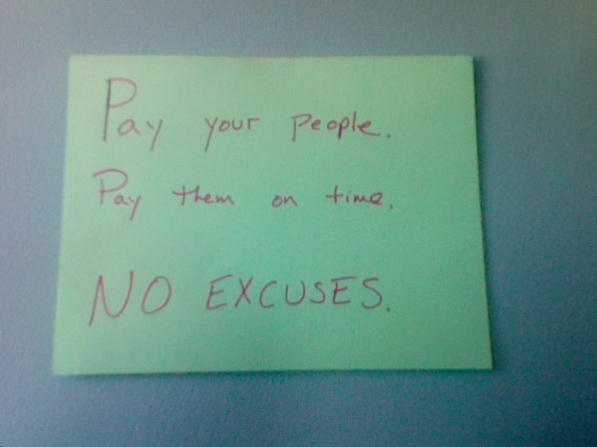
A second lesson from a teacher who has already taught me a lot: When you mess up, the least you can do is admit what you did wrong, do the best you can to fix it and write down your mistake and display it somewhere prominent so that you damn well remember next time not do the same thing again.

A newly hung sign in my work space, tapped to the wall directly in front of my desk:

Photo on 2013-01-19 at 14.52

Suffice to say, you’ll be getting some mail from Swim Pony this week.

And just to quickly touch on the other point you made: I also agree that $1,500 is not a living wage for designers, even if it’s the standard. Designers are, in my experience, some of the most overworked people in the industry (second maybe to production managers). In the interest of disclosure, I will say $1,500 was the level I started out at for the designers on my last show. I picked that number for all the usual reasons (it’s a small operation, don’t have access to a lot of foundation funds without non-profit status, it’s the standard of companies with a lot more capital, etc, etc) but when a designer came to me, I took an honest look at the workload and agreed that we could to do better. We pulled another $1,000 from other places in the budget and the show didn’t suffer a bit.

Of course, $2,500 also isn’t enough to live on either, but it’s a step in the right direction. And more importantly, I hope it shows that when I’m the running an operation, people can tell me when they think something isn’t fair or right. That I’ll try and support them the best I can. That I will apologize, do what I can to make amends, and work to change when I don’t. That I want to know when I’ve hurt someone’s feelings or done something wrong as much as that’s hard to hear. That I’ll make it a core principle of my company to give people what they deserve as much as is possible.

I suppose my hope is that if I keep taking steps in that direction, and encourage those around me to do the same, in 3 or 5 or 10 years I will be offering something that is liveable for myself and the people I work with. But, as is clear today, I’ll have to prove that with actions or my words by themselves won’t mean all that much.  It’s a lesson I’m going to work hard at following in the future.

A

Put the money where the people are

I was working this morning on some research and prep for Swim Pony’s upcoming re-working/re-mount of The Ballad of Joe Hill for the Live Arts this fall and I started thinking a bit about the stage hand strike (IATSE Local 8) that’s currently in progress at Philadelphia Theater Company’s Suzanne Roberts Theatre.

strike

I have read the small bits of info that are out there for the public:

http://www.newsworks.org/index.php/homepage-feature/item/49737-stage-strike?Itemid=1&linktype=hp_impact

http://blogs.phillymag.com/the_philly_post/2013/01/16/stagehands-strike-philadelphia-theatre-company-suzanne-roberts/

but beyond this surface level of information, I can’t say I know a lot personally about this particular situation. I don’t really know the ins and outs of this company (lord knows they are not in any rush to hire directors creating out of the box devised ensemble work) so I don’t really want to speak to the conditions at the place.

I have worked on both sides of the producer/gun-for-hire dividing line. I know the intense weight and pressure that a producer has in keeping the boat afloat. I know the resentment of feeling unfairly compensated for your work. I think both of these emotions are understandable. I also think both sides ought to experience the others’ shoes for a few miles. I bet it would go a long way towards decreasing anger and frustration on both ends.

Unions are imperfect animals. I certainly have steered clear of AEA on many occasions because I find that they often make it impossible for me to create in any way outside of the traditional system. Artists create works in many kinds of ways, but there is incredibly restrictive limits on the kinds of contracts I can engage an actor in. In a devised process the difference between training, research, writing and rehearsing is super muddy. That’s what’s wonderful about it, that the work is so unique to the participants, but it can be near impossible to work that out with a union rep. It’s often exhausting and not possible to create in the standard 40 hour week. 8 hours of generating isn’t doable. It just isn’t. But for AEA, a week is a week. I could cite any number of other irritations and frustrations (don’t get me started on site specific work and the equity cot) but the point is this – in theory a union should allow the workers to lobby for rights that serve them better in the professional world. That world of theater is changing rapidly and the union in some cases can actually hold an out of the box thinker back. This is one example of one union. I’m sure you could cite a multitude of others in the arts with just as anger inducing rules.

That said, in a system in which the employee has little agency – a situation which the traditional regional theater model can often engender – I totally understand the feeling of being an expendable cog in a massive system. The truth of the arts is that the supply versus demand equation is often skewed – there are too few employers and far too many people looking to be employed. Add to that a labor force that generally isn’t in it for the money. It makes sense that as foundation endowments disappear and budgets shrink that a producer might feel that ANY job is a good one when there are scant alternatives. It’s hard to bargain when you have little leverage. A union is a way to gain that amass that leverage.

Everyone knows there’s no money in the arts, right?

Well…

Here’s the thing. I don’t disagree that it’s reasonable not to expect to be making Wall Street money any time soon. But in the past few years I’ve sat on a few grant panels, and I’ve taken up the habit of really digging into the financial records of the companies I’m asked to evaluate. There was a trend that really bothered me, especially with small to mid-sized companies. More times than I’d have liked, I saw a company make a slow steady growth in budget size and increase the external features of the company – the amount of money spent on advertising,  materials for set and design rental, expense of space rental, etc – but keep the actor salaries consistent. I don’t think it’s appropriate to talk too specifically (for a whole host of confidentiality reasons) but I will say you can learn a lot in the 990’s that non-profits make public.

At the NPN conference last month I heard a representative from Doris Duke say that all artists worth their salt will be undercapitalized. If you have imagination you will always dream bigger than your resources. Or as I would put it, the idea expands to money allotted to it. And when we first start leaving that DIY phase we often immediately start dreaming bigger with the little cash we have. It’s so satisfying to put that money towards outcomes we can see and receive praise for – better theaters to rent, cooler lighting effects, fancier set pieces, etc. What’s harder is to do remember that the work someone did for free last time is worth more than free. Ditto for way under paying as well. It’s doubly hard when you are paying something to be objective about what that work is actually worth. I once worked at a company where the base actor salary hadn’t been raised in 10 years.

I get it. We acclimate. It is hard to pay more for something and have the product be the same. Which is why something I almost never saw in those grant panels was the same level of production value and an increase in salaries for the people they were working with.

There’s the old “industry standard” line that I hear floated around. Look, the simple truth is that $250 or $300 a week is not a living wage.  But I hear people actually excited about numbers like this all the time. The truth is we’re often working far more than our income alone would justify. We do it because we love it. We do it because we care about the companies we work for. We do it because we’re asked for favors. We do it because it’s what everyone around us is doing.

But if we institutionalize and capitalize on that, we get artists and crew who always feel like they’re doing too much for too little. And that, in turn, breeds resentment and burnout. It’s the thing that starts making one hold a little part of themselves back from a process because you feel like you’re being taken advantage of. Or get unreasonable about schedule changes or breaks or little things that in most professions wouldn’t be as big a deal. It’s easy to get lazy or pissy when you’re on the defensive and when you feel like you can’t be honest about your needs.

Let me say I am all for entrepreneurship. I understand that a company that has just started will have to go through a “I’m paying you less than you’re worth phase.” It’s like any start up: you begin with blood and sweat and tears. The difference though in the arts, is that we institutionalize that initial phase. We make business  models of over working and over extending. That’s fine when you’re just beginning but when you are hitting year 5, 10, 20, you shouldn’t be hearing the same kinds of complaints. We stay in the “do more with less” model forever. As Andrew Simonet of Artist’s U says, “Let’s start doing less with more.”

We producers need to really take time to think about the reality we’re asking our peers to take part in. Can you really afford that show if doing it means everyone involved needs another job in addition? Is that actually covering your costs? Even if someone will do that much, do you want to be the person that asks them to? We should be asking the people we bring on what it’s like to work for us and then really trying to listen to them.

I think we all need to seriously put our money into the people. Your set design will shrink or expand to the money you allot to it. Clearly, we can adapt, because we all had to do it after the housing collapse. What if you just committed to $50 more a week to the actors in the cast? What if you just promised to pay a TD a little more each time they worked for you? What if you gave a designer enough so that they could really just concentrate on your piece? Each of these shifts might be a couple thousand dollars. In the larger picture, it’s really not that much. I know this is hard. I raise every single dollar that gets paid out by Swim Pony. I stare at budgets all the time. But if you want it to happen, you can do it. That’s why you’re in the arts, you get shit done.

You might say that now is not the time, with the economy the way it is and so many companies reeling from the fallout. I say now is exactly the time when we need to get clear on how we want to operate, now when there are so many forces that might push us in the opposite direction. And while we can’t all jump immediately into the ideal situation, we can make incremental changes Because the truth is, if we endow people and not product now, we pay into a long term stable investment. If we begin from trust and principle, then we have a place to start talking from. If your workers know you have consistently valued them and their work, they’re going to be a lot more flexible when you come to the table with them in the future.

A

UPDATE – Just saw this posted and figured I’d add it to the mix

http://cuetocue.backstagejobs.com/?p=909

Running and Crying

Today is the 30th day. Somehow that seems impossible. The 15,000 challenge has become nearly 33,000 words and it seems like I’ve barely scratched the surface. So when I sat down today, I wanted some kind of summation of what I’ve gained, gleaned, gotten out of taking an hour (or two or three) each day to sit and write about what I do. If the goal was to force myself to think every day about why I make theater and what I want from it, what was the conclusion?

Throughout this month there was a story that kept coming up for me that I never found a way to fit in. I kept sensing that it belonged in the conversation somehow, but could never quite decide exactly what message this part of my history should proffer or in what larger topic or category it should fit. But since today is the last official day of this writing project, and I haven’t found room for it yet, it seems like there’s no choice but just to get it down and see what happens.

So.

When I was 23 I learned to run. Or rather, at 23 I took up running because I didn’t know what else to do with myself.

I had, much to my chagrin, found myself rather suddenly and violently in the deep thickets of a very messy romantic entanglement.

The messy part, at least initially, wasn’t my fault.

I had met someone online and fallen very hard in a very short period of time. It was, in retrospect, a pretty standard infatuation, but it didn’t feel that way. It felt unspeakably new and inevitable all at once. It was like a melody I was humming every moment of every day. Lot of long emails, a date that started as coffee over a couple hours but went on for 12, a person’s new smell and taste. These things reminded me of my capacity to grow bigger and contain them.

I felt like I was really alive at a time in my life when there weren’t many things doing that. I was out of school, working on theater that wasn’t my own, working a job that wasn’t terribly challenging and wondering where all this would head. And then all this feeling just flew into every day. It became a kind of purpose.

This: wanting to cook someone dinner, striving to be the most spectacular version of myself, finding a way to speak about my life and experiences with interest and meaning, it was a palpable sense of physical closeness to someone, but also to the idea of seeing myself as the very best version possible. It felt like I was becoming. And that sense of drive gave me back the part of myself that I had been seeking. The part of me that can feel purpose like a tangible object, soft but strong and pliable, like velvet in your hands.

It was that violently blissful sense of self that shook off the drudge of “just living” and rocketed me back into a sense of possibility and get shit done-ness that I so desperately wanted and needed. And in that phase I started to imagine a life so big that it could contain everything that I wanted and needed and imagined for the future.

So when I found out that this thing that I had not only placed my eggs in but had made my basket had a fiancé in another state I just about lost my mind.

Just like that bliss before it, I was stuck with a new constant sensation: an inversion of that previous emotion that cut into my belly and my chest like a sharp knife.  It was hard to believe that this feeling was so viscerally physical. I thought some days, “This is going to kill me.” I actually felt like I might die it hurt so bad.

One night at 3 am, in the midst of this tumult, I was thrashing around making myself miserable. My bed smelled like him. It was making me nauseous. I wanted to put this thing back together. I needed it to be fixable, not just to hold onto this person, but so that I didn’t need to let go of the version of myself I had found, the better, more infinite, version of me. I couldn’t breathe. And I knew that I literally couldn’t stay in my own skin for another second longer.

I stood up and said, “Stop it. This is all of this you are allowed. You need to go.”

So without knowing exactly what I was doing I put on my gym shoes and a hoodie and a hat and I stretched for a minute and went outside into the winter night and I set off running. I was not a runner. I did not “run” in that easy blithe endorphin-rushed way you think of in Nike commercials. It was awkward and painful and cold. And did I mention the crying? Just running and crying like this big nasty, snotty, wet train barreling down the streets of Philadelphia.

But it was also distracting. So wonderfully distracting that without knowing what path I took or retaining memory of how I did it, I managed to trek from my house at 6th and Washington all the way up to the Art Museum at the end of the Parkway. And I stood on the steps and the feeling started to rise again. I threw up. And then I took off again and ran home.

I ran a lot that year.

Though it was no fault of mine for finding myself in this situation, that I continued to stick around for another year to torture myself most definitely was. But I used the running as a way to distract enough from the present to hold onto that vision of myself as huge and massive and awesome. And I also used it to distract myself from the growing crap pile I was swimming in. Literally and figuratively, I got myself on the move after two years flailing around trying to find myself as an artist. I spun into a productive fervor of need and idea and creativity and hard ass work that launched me into the orbit I’m in today.

Which is why I am deeply conflicted about how to analyze myself in this context.

I read this now and it makes me feel weak and stupid. I hate that this is a part of my history. I wish it wasn’t part of who I am. I feel like I should be better than the person who took off running to try and escape. I wish often that I could have cut that longing off. That it doesn’t still bother me. That I could smooth that experience out enough so that the raw edges don’t still catch at me once in a while.

And there’s another part of me that still wishes that I had been amazing enough to make it turn out different. Because the truth is, I still want to believe that I could be awesome enough to do the impossible, so that I can recapture that feeling of being so incredibly full. There is a part of me that still wants to believe there is enough in me to grasp what I want  and through sheer force of will reclaim it and that feeling of potential in its most potent form. There are times I wish I still had enough raw need and emotion and hurt to need to run and work and create in the blind panic I did then.

I wish both of those things at the same time.

I like to accomplish things. Hard things. I do not like the idea that I cannot achieve what I set my mind to. It is the reason the best of my works are the best of my works. It is the reason I can find myself in a moment in a process saying “I have no idea how to solve this. I have no idea where to find an idea where to solve this.”  And yet each time, somehow, I found a way to do it.

The reason that year-long entanglement went on as long as it did was because I really believed that if I wanted something badly enough and was patient enough to wait it out then what I wanted would become what everyone wanted. But amazingly in that one case, it didn’t happen.

Which is why it still bothers me.

Which is why when I finally got close enough to see the giant STOP sign emerging, when I got so far away from the shoreline from what I wanted to happen that I couldn’t even write a map for how I might get to where I wanted to head, it didn’t get easier. There was not a comfort in finally forcing myself to move past it.

I still want to be awesome enough. For… what? I don’t know. But I still want to believe that there is work for me that is so fulfilling it can make me grow larger every day. That there is a life that vast. It is that need to reach that inspires me to do better. But the despair at the distance between infinity and myself is also the thing that started me writing here to you all in the first place. The thing that made me look around at certain amount of stasis in my career and the field in general and wonder if I can tolerate it when parts of it make me feel so small.

Hmmm. Is that a conclusion?

There’s still one part of the running story I left out:

One the way home from that first run to the Art Museum, I suppose from all the cold air and crying and deep breathing, I got a nosebleed. A gusher. I had assumed that people giving me the terrified wide berth on the streets were doing so because my ugly and obvious feelings were so ugly and obvious that they were scaring pedestrians.

In fact I was just covered in blood. All down my face and all over my hoodie, completely soaked through to my shirt.

And when I finally got home tasted iron on my lips and looked down my very first thought was not the sadness. It was, “Some day I’m going to write a story about this.”

So.

There we are.

The need to achieve the impossible, to get that hit of ecstatic delight, is likely a race one can never win. That feeling is really an idea of perfection that helps us move forward. And it’s up to us to figure out how to negotiate it.

And I guess that’s all we can do.

A

PS – I’ll be back soon.

I have a feeling that I’ll still be writing here with fair regularity, though likely every couple days instead of every single day. (Who wants to read that much anyway?)

I’ll take a day or two and let you know when I get back.
“Play Play”

Can I admit this? 29 days in, I’m finally ready.

I don’t know what to do with plays.

I make most of my living in making theater and I pretty much never deal with them. You’ll notice, if you comb through Swim Pony’s website or press kit that the word “play” never appears. It’s not an accident. It’s always “show” or “performance” or “piece” instead of play. Even “theater” makes me pretty nervous. It’s why I went with “Swim Pony Performing Arts” instead of “Swim Pony Theater Company.”

“Play” and “Theater” conjure up some very specific ideas in my mind. Red curtains. Plush seats. Proscenium stage. Fly system. 3,000 seat houses

Google image search the word “Theater.”

No really. Do it, I’ll wait.

No really. I need to prove this point.

See what I mean?

I know that’s a little reductive, but I think that’s probably what most people think when they think theater. I think it’s probably what most theater audiences think when they think theater.  I almost never work in spaces like that. And the few times I have, I’ve spent all my time wishing I was back in a dirty warehouse or in a de-sanctioned chapel space or outside. These spaces feel so filled with another era’s idea of performance that I spend most of my time trying to get the play to undo everything the space does. So much of what I make is about teaching audiences that the performers are aware, that they aren’t separated by an imaginary wall, that this is about communing with each other and personally, I feel like this:

Theater-Carre

Just gets in the way.

Some may maintain that the concept of theater is bigger than the building that shares its name. Maybe, in theory. But I’d counter that until the specter of that building (and the many nastier, sadder, dirtier, worn out, step down versions of it) gets out of our minds Theater the art form will stay synonymous with Theater the space.

So back to the p-word.

What do you do in a theater? You do Plays with a capital P.

Plays are written by someone who is impervious. They must be, because we are not allowed to change anything they say. Plays can be pulled apart to study their dramatic arc and action. The best Plays’ plots are incredibly clean and wrap up neatly at the end. Big things are revealed in Plays. Plays are about words. They have monologues and juicy scenes where the best actors get to show off their emotions. Plays suggest blocking with stage directions. Plays take four weeks to rehearse.  Brilliant Plays deserve standing ovations. Plays are done in Theaters that look like the one above.

These are my stereotypes about “Plays.” I call them “Play Plays.” Aka – stuff that is exactly what you think of when you think of a play in a theater.

My problem with the traditional system (playwright writes a play, company produces it, director directs it, designers design for it and actors act it) is that at every level it’s so hard to connect the parts of the chain. When your job is super clearly defined, why think about anything else? When the system is too well defined, it gets hard to innovate. If there’s a single way to do things, people whose talents lay outside that box tend to stop participating. Some artists get around this and force their niche into Plays and Theaters.  But many end up feeling alienated from the majority. I know I have.

There are lots of super talented people who do Play Plays in Theaters. Their talents can translate into the larger messier definition of the word. But some of my worst collaborations have been a result of working with people when their idea of theater and mine are different. I know I break a lot of the rules that matter a lot in the Play Play system. I don’t break them to be a jerk. I do it because I think there are lots of things about a “Play” that prize only a few aspects of live performance. I often want to explore the rest. Sometimes to give the other elements the floor you have to change the way you do things. And if a creator is so entrenched in one way of doing things, it gets exhausting to explain or apologize why you want to do things differently over and over and over.

I talked early on in this space that there are things theater is awesome at. I believe that many, dare I say most, scripted shows minimize opportunity for a lot of these things to happen and hold onto a lot of the things that I think keep theater shackled to versions of itself that I want to shed:

That actors perform the script exactly the same every time.

That ideas should developed in the head of the playwright for most of its conception and development with other elements only added on top of this foundation.

That once we hit opening night, the time when the director and actors could in theory learn THE MOST from how the thing works with people, the play has to stop getting changed.

That words are the predominant driving force (and they kind of have to be if they are the thing that you get handed at the start of the process) and sound, movement, visual landscape, are all lower places at the table.

That words on the page are the best way to begin.

That italics between lines are enough to describe what else should be there.

That you can create a set, sound and light design for a finished script.

That actors should have to make sense of and say every word that’s written.

Sure, there are playwrights who think about those things. But they have to think about words more. That’s why they’re playwrights. They think about words more. And while there are some pieces where that makes sense, I think most people don’t realize that’s a choice, that a play could equally start from an impulse of sound or physical space or movement. When was the last time a sound designer’s name was as high up on the playbill as the playwright? We’ve enshrined one way to build a theatrical experience, and we’ve taught our audiences that way is THE way that things are done. And that “Play” way has lead us to one dominant way of thinking about “Theater,” a way that doesn’t often serve other elements taking the lead.

I’ve worked hard to develop a theatrical eye. But that eye happens not to be well served by being handed a script. I need to be able to question the playwright, just like I question all the other elements, and encourage others to question me. I need to see the thing formed in process. I like the option to have a piece start from music, or an actress I love.  I don’t think I’ve directed a fully staged “Play” since college.

As I near the end of this 30-day experiment, I wonder if I’m not sick of theater, just “Theater” and that I do like making plays, just not “Play plays.”

The former, to me, feel like something I can add to. The latter I think will have to change if it wants to survive.

Teaching Voice

I still don’t know how I feel about teaching. I find it very fulfilling and incredibly tiring. I remember and talk about my students  often. I fall in love with my class a little bit every year. I have learned so much more about the subject I teach from working with my students. They are incredible developing people. Every year they surprise me. The ones that I think are going to be the biggest pain in my ass turn out to be the ones that shift my heart and mind in a major way.

The class I teach most consistently is an intro level theater class with the stiflingly boring name “Voice and Articulation.” The participants are almost never theater students any more.  It’s an interesting trend that’s grown stronger each year I’ve taught it. I’m not sure why, perhaps word of mouth?, but each year I find myself in front of more engineering, business, and education majors to the point where this year not a single student identified as a theater student. Strangely, having to think about what it means to teach “Voice” to people that aren’t at all interested in delivering a monologue or projecting in a traditional performance context has really changed the way I think about what voice can mean in that original context. I’ve changed the kinds of things I teach a lot both in class but also in rehearsals. I’ve re-found the necessity  in basic technique and simultaneously discovered how much the person is the same thing as the voice that comes from them, and that voice work is really self work at the core level.

As one student of mine wrote to me last year, “I feel like this class isn’t just about changing my voice. It’s about changing me.”

I don’t ask them to be amazing vocalists on any objective measure. Truthfully, I don’t really know any more what measure that would be. I tell them it is not hard to get a good grade. It’s one of the few places that creatively that I’m just not interested in being a hard ass. It seems beside the point to be a drill sergeant. They might “respect” me, but it won’t get them to the place that they can be vulnerable enough to actually change the sounds they make. I start my classes every year saying this, “You have to physically be present and you have to be willing to try and you have to do your best to be honest.”

I always begin by telling them that it is not a lecture and that they will make sounds out loud by themselves. And by the end of the first day they have all sung in front of each other. I wish I could record this first day and play it back for them at the end the way I require them to write about their voices, what they love and hate about the way they speak on the first day. The “final” is to hand them back this writing and reflect back on whether they still agree with all the things they initially wrote. These papers are always the highlight of the semester because we both get to realize how far they’ve come.

So what’s the problem?

It takes a lot of me to run my class. I finish my three hours on Mondays in the winter exhausted and jacked up on adrenaline. I come out thinking about each person and how they dealt with the week’s exploration and what they will be confronting the next time I see them. I fall in love a little bit with them all. And it takes a ton of energy.

Many of the things that I get out of teaching overlap in a major way with what I get out of being a director. And when I’m doing one, I don’t have room for much else. I’ve luckily never had to do both at the same time, but I think that if I had to, one would suffer for the other.  And as teaching becomes a bigger part of my life and income, I worry that it will become the only thing that I do, the only thing that I am.

I have had a lot of amazing teachers in my life. But the ones that were the best at teaching, were not doing an equivalent amount of art making. I’m not sure how to resolve that. So for now I keep them compartmentalized in my life and hope that the amount of me that is needed for the one will not use up what’s needed for the other.

A

Criticism

Lemming_bw

One of the things that I really love about Philadelphia is the supportive nature of the community. We are, by and large, a city that prizes community over competition. I’ve had people who’ve taught me to write grants, given me tips on where to find cheap equipment, loaned me costumes, offered me innumerable rides, donated space, the list goes on and on and on. Lest we forget, there are a lot of places that aren’t like that. There are a lot of artist communities where the initial instinct is to undercut each other to get oneself ahead.

This is Philly’s superpower.

Sometimes, though, it also feels a bit like our kryptonite.

In our instinct to be kind and supportive, is it possible that we are sometimes TOO nice? Too nice in a way that isn’t actually genuine. If we aren’t willing to receive and encourage useful and productive critique, do we doom ourselves to a community-wide creative dialogue about our work that is surface level only?

There is a right and a wrong way to offer constructive observation. We’ve all had experiences with a peer or critic who speaks or writes about our work in a reductive way that focuses on a tiny issue or comes from a personal perspective that doesn’t take into account the  project’s overall aim or discourse.  We all have been there when a particularly nasty something comes out and seems to be there simply to wound.

On the other hand, I also find an unspoken pressure to always have a cheery, unequivocal rave response to anything I see.  I feel the need to do it. And I feel it from people I see after my shows, this plastic face people put on with a giant smile and that horrid, omnipresent phrase: “Great job! Congratulations!”

When I was in college I took the simplest directing class in the world. We got an assignment and then once each week presented the work we’d been doing to the other classmates, their respective casts and the professor. It became our artist community. We learned how to talk about what the piece was trying to do, how we all felt it was doing on that front, what frustrations and exhilarations the process was offering and any other observations that might be useful.

There were times some pieces got more laughs. There were times some pieces made us cry. There were times when the work seemed super hot and others when it was stuck in the mud. Everyone’s stuff went through highs and lows and over time, you learned that one week’s success was nothing to get too boastful about because a few weeks later you were bound to be feeling lost in the artistic forest. But that openness of dialogue meant that I always felt like I was getting a real beat on what kind of responses my theater was provoking. I loved that chance to really talk and share what I was doing with people that would watch with keen eyes and interested minds.

Even after I finished that track of courses, it felt like those that I’d shared the experience with were still able to hold on to that sense of interest and honesty as we moved into new projects. I liked coming out of a show and having them ask questions about what the piece was trying to tackle and having a genuine conversation about when it was (and wasn’t) doing what I’d set out to do. In many cases, the opinions were wildly different, which was SO incredibly useful. People picked up things that I hadn’t intended or missed giant swaths of stuff that I thought were obvious.

I’ve found myself every once in a while back in a situation like this – in my voice training programme for Roy Hart, in the LAB fellowship, in a small circle of directors that make similar work – but it feels notably absent in the majority of interactions I have with other artists in Philly. More so than in other places I’ve lived and worked in. Am I alone in thinking this? I don’t think so.

Again, I think it comes from being, on the whole, a small supportive community. But like many small supportive communities, we have to be careful about gentleness to a point of over-protectiveness. I think this impulse is worrisome not only because it gives us a false sense of how our work lands with people, but because it encourages us to think about our work as “good” or “bad.” If we make complex work, that has lots of layers, especially from scratch, it’s likely that it will be neither of those things. Or it will be both. It will be “it.”

If I see a raucous comedy show and I come out with my sides in pain from laughing so hard, is that the same “good” as an emotionally turbulent sweeping drama about genocide that leaves me numb and raw at the same time? Of course not. But I do what everyone does when they see people after a show, “You were great, congrats.” Or “Congrats! What a great play.” Or “Great job. Congrats.”

At this point, the congrats/great is so ubiquitous as to be an empty gesture. It had become so devoid of meaning that I used to see any sign of anything other than complete and total positivity to be a mask for hatred or disgust. Which was crazy making. So I’ve pretty much stopped listening to comments post-show. I assume they don’t mean anything and that the comments that people have that will mean something aren’t going to be said to me. Which is too bad. Because I think I could probably use them more than whoever else they’re going to be said to. But it feels like there’s not a lot of space to hear real responses.

Congrats. Great. Congrats. Great. Congrats. Great. Like we’re all some kind of “congrats/great” artist lemmings constantly running up to friends, “congrats/great” hugging them and running away to leave them to receive the next “congrats/great” in a giant “congrats/great” receiving line.

When someone says that to you, does it mean anything? Especially when you know a play isn’t simply “great,” (maybe it’s complicated, in-progress, raw, beautiful, heart rending, personal, silly, unfinished, whatever) when it’s something that is more complex that just “great” does that “congrats” mean anything? Wouldn’t you rather that same person just walked up to you and said “I was here for you” or “I am so happy I got to see what you made.” Because, really isn’t that what you’re trying to say?

Regardless of how “good” or “bad” the thing that the person made was, you’re coming up to them because you’re saying “I support you in this crazy endeavor. I know that you, like me want to make something that moves your fellow human beings in some way. And you did it! You threw your heart and sweat into this thing and now it’s been put out in front of all these people. And I was here! I saw it and now I’m seeing you and more than anything I want you to know that I am proud of you.”

At least that’s me. After a show, when I see my artistic peers, that’s what I want to hear. Not that you loved it or hated it, but that you came and you saw the work that I did and likely you know what it took to do what I just did.

I can understand if you’re in a place where you don’t trust people, where you feel like they might undercut, where their motives aren’t in your best interest, you might not want someone’s advice or response. But this is a town where I feel like respect and trust are pretty flush. And you are a bunch folks whose real opinions I’d want to hear. Because I doubt that what I make is only great or terrible. It’s a lot of things, many of which I probably don’t even know.

I am here to learn.  Most things I make are in progress. And all of them are still conversation as they enter into performance. I wish there was a way to let people know that it was ok to be however they are after seeing the thing I made – happy, sad, confused, alienated, indifferent, or pensive – and that they have permission to express that being in whatever way they can, without worrying about whether it’s great. Without needing to give me congrats. Seeing them is great congratulation enough.

Next time after a show just walk up to me and say, “No lemming?”

And then I’ll say “No lemming.”

And then you can say whatever you want.

A

Catfish

Image

Catfish is a terrible TV show.

I hate that I love to watch bad TV. I regiment the amount I’m allowed so that my brain doesn’t turn into mush, but if I’m home alone eating dinner or doing the dishes there is no easier way to get me out of my over-analytic brain. Trashy shows are like an input of garbage that momentarily stalls the output of to do lists and anxieties that normally flow like a constant stream through my thoughts. I take an especially perverse glee in watching “Intervention” with a nice big glass of wine. So it surprised me when I found myself genuinely empathizing with a person I saw in a new MTV reality program.

It’s clearly crafted for short attention span, shallow adolescent minds that feed on gossip. The show follows people who have met online and “fallen in love” and now, for the first time, are about to meet each other. The show’s host faux befriends them, asks them to recount the turbulent (and usually insane red flag inducing) stories of meeting, researches the people love, inevitably exposes the lies said loves are guilty of perpetrating in their profiles, and then films an eventual meeting/show down.

Like I said, terrible.

The episode I watched begins by meeting a woman named Kya from Missouri. As Wikipedia says:

“When Kya first met “Alyx” online, she used a fake name and fake pictures.”

This is the understatement of the century. The woman in the show was morbidly obese. Very sweet, incredibly vulnerable, and likely upwards of 400 pounds. The pictures she posted on the Vampire Freaks website were of an insanely hot Goth chic with boobs the size of my head.

Kyas-fake-picture

“Alyx” was like-wise an insanely hot Goth guy, well muscled and trendy, despite the brooding smirk and black clothes who lived in Switzerland and was thus completely locationally unavailable.

Alyx-profile-pic

Suffice to say these pictures bear no resemblance to the actual people that posted them.

Kya reveals that several months in to lying she told him the truth and Alyx forgave her. It actually hurt to listen to the honeyed words of praise showered on a person who actually looks beneath the surface because of true love. The host, an impish guy who seems intent on colluding with this poor girl in a clearly delusional scenario, subsequently is SHOCKED and HORRIFIED to find that “Alyx” is also an avatar for the actual person with whom our heroine Kya has been conversing. Suddenly the excuse that Skype doesn’t work on Alyx’s computer seems a bit thin and we are left to worry what deep secrets he too holds. Hypocritical reflections about truth and openness ensue and finally Kya finds out that in fact “Alyx” is Dani, a transgendered person making the transition from female to male.

The reason I bring all this up is that as the cameras followed Kya to Dani’s house there was a point in which I put down the dishes and sat on the couch.

She knocks on the door and waits, uncertain about how she will react when the inner world she has been carrying finally is placed in an actual external context. Dani emerges and shaking says hello. Kya responds in kind. They hug. It is awkward. There is a disappointment mingled with need and anticipation that is intensely palpable on both sides. Kya asks, “So how come you didn’t tell me the truth?”

Amazingly, the two meet and talk, carefully, delicately. Their faces are a funny mix of furrowed brow and pursed lip. This is not what either had imagined and you could see the work it was taking to decide if they could settle for this, if not less, wholly other person from the fabrication they unquestioningly accepted.

The other day I was talking with someone about working in theater and bemoaning, as per usual, the crap that consumes my days. I remarked how a similar thing had happened as I progressed along my chemistry career – how I loved the initial stages and the depth of learning as I delved into more complex concepts, but that I left it because I couldn’t ultimately see myself in research. I didn’t head down that path because the way that one is a chemist didn’t seem to be much in line with what I loved about chemistry – the theory and problem solving. It was workaday, detail driven, minutiae. And I said it scared me that so much of my time these days feels like that.

“So there’s this ‘bullshit,’ for lack of a better word, that goes along with this thing you’re doing now?” they said

“Yeah, and I just miss the time when I was doing the thing and not the bullshit. And I wonder if there’s so much bullshit I ought to do something else.”

And rather than assenting, the person said, “Well. What if there’s just a certain level of bullshit that goes along with anything you’re going to do?”

Ugh.

Why, why, why is this such a bitter pill to swallow? Perhaps because I’ve had a taste of the rush of unfettered work in an educational setting – aka in a totally non “real world” scenario. It really seemed early on in my professional career that the problem was that I was young and there was a magical time when I got older where I’d have less crap to deal with, when I’d just get to be an artist in love with making art and could stop worrying about all the other stuff. I really thought that older, experienced artists lived that way. And I think part of the malaise of the past year or so is me realizing that unstated assumption is just a shiny picture of a hot person that doesn’t exist.

In the LTR I’m having with my art form, am I hitting the moment where you realize there’s NOT a better person in the world for you? That there’s NOT some magic that you can unleash that makes what you’re doing as awesome as you remember if first being, when you KNEW you’d be doing it forever. Where you look at the thing and see there are things that you can change, but that there is no smoking hot perfect person who will love you, of all people, and unflinchingly offer everything you ever imagined or needed.

Oh. So it’s just… this.

Which isn’t “bad,” (question mark)? It is very different than the glimpse of perfection or the ethereal possibility held in potentiality that I fell in love with. The life I have is actually in front of me, far more authentic than the idea I held in my head as a beginner. Which is why I felt so bad for Kya and Dani. Because I’m also biting my lip and looking at the thing I’ve got and deciding if I can deal with losing the fantasy. I have to decide if I want to take what I’ve actually got or keep searching for another shiny thing…

A

So tell me what you want

spice girls

Really, Adrienne? Have you lowered yourself to a reference like this? Is that what you really really want?

Yesterday I wrote a little about some external measures that I think too often become the definitions of success. For me it’s helpful to write those things down and really say to myself “That’s not what you need to worry about.”

But Robert Smythe also pointed out in the comment section that like a previous post, it’s useful to define what you want concretely, rather than just focusing on the things you don’t. If it’s not a fellowship or a grant or a great review that I seek, what is it? So, challenge accepted, here’s my list of personal goals for my theater works, results that actually mean something to me whether or not the projects ever achieve attention or acclaim.

– I want to make theater in which the audience has an experience of intimacy and necessity. I want them to feel as if the piece would not be the same if they had not attended.

– I want to make things in which the line between performer and viewer is not completely obvious.

– I want to make work whose process is hard, work that requires all of my faculties. I want it to be something that fails as much as it succeeds so that I know I am always reaching past my previous successes.

– I want to tackle something every time that I don’t know how to do when I started.

– I want design to be an integral part of my exploration processes and not something tacked on at the end. I want to think of designers as co-creators the same way as my actors and playwrights.

– I want to make ephemeral spectacle.

– I want to make things in which there is a possibility for change in the product every single performance.

– I want to create work that is experienced viscerally, something that makes your body react. I want to affect people on the level of breathing.

– I want to choose collaborators with whom I feel a sense of chemistry. I want to surround myself people who are able to strike the balance between speaking and listening. I want co-creators who are willing to argue with passion when they believe they have to and are able to listen and compromise when it’s necessary.

– I want my rehearsal room to be a place of learning and discovery. I want to be able to go off on theoretical discussion tangents. I like being brainy and feeling like the work is the way to discovering a new concept or pattern. I want to be around people that like to do this too.

– I want a space in which true innovation is possible. In which the outcome is intentionally not pre-defined. I want my theater to be an experiment in the most scientific sense of the word: a question is asked, a hypothesis is offered, the materials are set up and run to their logical course and then the result is evaluated. In that scenario, you genuinely discover.

– I want an art making process in which the participants are able to focus on project at hand, one project at a time.

– I want to find people who have never been to theater and make them love it.

– I want to change the rules so there’s no more sitting in a seat, reading a program and waiting for the lights to turn out.

– I want to create a space filled with theatricality and spectacle from the moment you walk in the door, maybe even before.

A

Means to the end

First off.

I’m pleased to see that my post from yesterday has generated a little bit of heat. I’d love to hear folks’ thoughts about this and would love to keep the conversation going in the comments section.  I’m definitely looking forward to see if there’s a way to capitalize on some of that momentum. I’ve got a few ideas in mind and have been trying to expand some of my thoughts into some more concreteness. It’s gonna take me a few days to get there, but stay tuned because I think I will have some exciting stuff to share.

Anyway, on to today.

Things have been in an “evaluate and change” theme for me the past few days. I started writing here every day in part because I’ve had a general sense of dissatisfaction with my work both on the personal and larger context level. After getting more than three quarters of the way through my self challenge, it seems like what it really boils down to for is this:

–          It’s fine if my work is an irrelevant niche art form that I do because I love doing it so much that I don’t care because I can’t imagine doing anything else.

–          It’s also fine if my mission is to change what theater can mean and be for the world – reaching out to audiences I don’t yet know, tackling content that isn’t represented, and doing it in ways that change what theater means so that I can help-redefine the art form for the future.

One of those things is really personal (artist’s relation to self) and one of those things is about responsibility to a larger whole (artist’s relation to the world). Both of them can be at play in the same person. For me they often are. At their core, neither of these impulses is really about many of the trappings of traditional success: money, acclaim, awards, notoriety. They are goals about either pleasing my own artistic impulses or seeking out and affecting people with the work I make.

What I’m finding problematic is that the people with whom I’m most often negotiating with about how my work gets made are not either of these two categories. They are intermediaries: funders, presenters, artistic directors, renters of space and equipment, critics. These people help work get made, that continue to move the cycle along.  They are usually the people that mete out the things that usually define success. But their job is not to negotiate the relationship of this artist to themselves. Or to negotiate my relationship with my potential audiences of the future.

Their jobs are to give money and present work and program seasons and rent space and critique shows. Their job is to do their jobs. And it’s nice if their jobs align with my goals, but there’s not really any reason for me to believe that working with them will do so unless I am making sure of that.

It occurred to me today there is a world in which I completely drop out of the usual theater success track and do everything I want to. A world in which I never seek out another commission or presentation in a festival. A world in which I don’t write grants or put pieces up for review. There is a world in which all of that could go away and I could still make my work.

I don’t actually need them. It feels like I do. It feels A LOT like I do. It feels like I spend almost all of my energy trying to make sure that they are feeling fulfilled and getting what they need and want from me. And I am not spending nearly the same kind of time making sure I am fulfilling the things I need. I am not spending the time to ensure these partnership are useful to the actual thing I’m trying to achieve.

Which is not a blockbuster sized audience.

Which is not an amazing review.

Which is not an expensive set.

Which is not an award.

Which is not free stuff to use for my productions.

Which is not a giant grant.

Which is not a catered opening night party.

Which is not a huge fellowship.

Which is not an invitation to an international festival.

These things are not ends. They are not the measuring stick. They are only possible means to do something I consider meaningful. They also might not be. I have to know the difference. It is not their job to do it for me.

And it’s my job to make sure I’m gauging by my own actual intentions and not the means by which I am trying to get to them.

A