Cross Pollination

Movement and Time: Nora Gibson and Bradley Litwin

Today you’ll meet the first two of the 30 Cross Pollination finalists. I’ll share a bit about both their initial applications and the conversation I had with them this past Monday.

Nora and Brad Nora Gibson (ballet choreography, video, still image)

Brad Litwin (Kinetic Sculpture, Multimedia Production, Musical Performance)

It was obvious to all of us on the reader panel that this is what both of your artworks have in common: a deep interest and exploration in kinetic exploration and how that functions through time. How interesting might it be then to give two artists who’ve studied these elements via different means a chance to share their research.

Brad: As a multi-discipline artist, I frequently generate inspiration through combining disparate media types, and the juxtaposition of incongruous ideas.
actii.still001

Dancing equations…

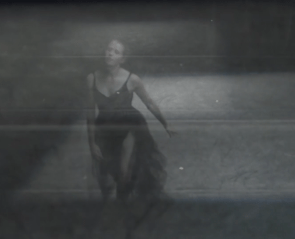
There was a way in which the bodies in the dance samples that Nora presented were abstracted, almost mechanical, as if the human beings had become manifestations of forces. Everything about the presentation of the two dancers in “Divergent Iteration” (a name by the way that could be the title of one of Bradley’s pieces) from the shifting lights to the static and ping of the soundtrack emphasize the way these bodies function like two interconnected vectors pushing and pulling each other in response to constantly shifting stimuli. And in Solo Phase, there was a similar kind of algorithmic exploration of a single dancer layered over top her self in time.

Pick three adjectives that describe the stuff you make

Nora: formal, spatial, beautiful

Brad: compelling, complex, humorous

Brad's piece Tetra-Cycling

Brad’s piece Tetra-Cycling

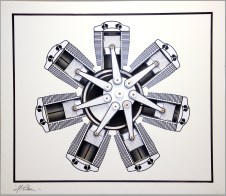
That simplicity, grace and wistfulness of the single dancer split into two, rotating around herself in Nora’s pieces felt like the same kind of engrossing pull we felt look at Bradley’s “Tetra-Cycling” sculpture. And when I first saw Bradley’s sculpture “The Sway of Public Opinion” I couldn’t get over the way this combination of metal pieces added up to something so human, something so familiar. The combination of rotation and undulation of this work felt like dance.

Also, every single one of the readers is crazy about Mechanicards. This one in particular blows my mind.

There was also something exciting about the fact that both of you also have interests and talents in other mediums: Nora’s in video and still image clearly weaving its way into her performance practice and Bradley’s astonishing whole second career in music. Nora’s still images of her dancers with links to these works on video pasted onto walls and newspaper boxes gave a sense that the dance could have an infinite audience. Brad’s exploration into moving theatrical sets similarly changes the kind of audiences that are able to view his works.

Nora: In collaboration, I’ve witnessed my work simultaneously becoming more “itself,” AND becoming radically something else

choreography

A picture from Nora’s application

What’s exciting about this combo is that we have Nora turning humans into stunning mathematical equation machines and Bradley who manages to take inanimate gears and forces and create living balletic motion.

When we met up in person my first impressions were that these were two artists who were open and receptive to a sense of experimentation and play. They WANT what Cross Pollination is about and they are so excited to try something new.

We talked a lot about embracing failure and how risk is a huge aspect of what creates real artistic growth. We talked about where the initial conceptions and research of our artistic products happen – for Nora and I in our rehearsal spaces and for Brad mostly in his head – and how that interplays with execution and precision of outcome. They also both really resonated with the idea that I talked about of looking at the frame around your process – seeing if you can uncover the tacit assumptions in how you make things to really see if you can question everything about how you make.
Artistic engineering

Artistic engineering

I know I really want to see Brad’s making of a sculpture in real time. That he was an engineer and has to have such a precise sense of creation methodology is really interesting. And when Nora talked how she approaches creating choreography as a long series of tiny research projects I felt a real kinship in the sense of building up little pieces one at a time and then assembling them into a cohesive narrative whole.

Cheers Nora and Brad! Thanks for an awesome meeting. – A
Cross Pollination begins…

Hey all,

So it’s been a bit.

And though we haven’t had much time together in this space, I feel like I’ve gotten closer to the Philly arts community in the past few days than I have in the past year. Monday marked the very first of the Cross Pollination “coffee dates” – meetings in which the folks selected and grouped together after the initial application round meet up and see what kinds of chemistry might result. I’ll be doing A LOT of these in the next couple weeks. If they keep going like they have been, the CP team will be in big trouble because we’ve found some really kick ass creators out there in the Philly landscape and choosing half of them to move on is going to be a daunting task.

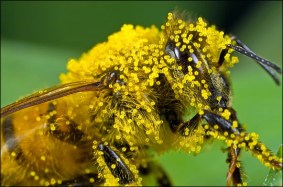
abeepollen1Tomorrow I’ll begin profiling the groups that I’ve met with. I’ll be lucky enough to be an equal participant with all the groups that are brought together as part of this – the third leg of all the trios that move on. And because I don’t want to be the only one to get to see the wealth of awesomeness, one of my big goals for the Cross Pollination project is to share the creative research that happens at every step of the journey. So expect a lot of thoughts about how other genres can teach us about our own work this summer and in the months beyond.
I thought that I’d start at the beginning, with myself, the only common thread through all the projects.

We received 90+ submissions for this project. Only 30 artists/ensembles, 15 pairs, were selected to meet in person with me to see what kind of a trio we might make. Each one of those folks wrote something in their application that sparked myself and the reader panel to know more. And since they did all that work, before we met I too created an “application” that I sent to them. It explained my work and impulses to pollinate using the same questions I’d asked them.

Cross Pollination Application

Name: Adrienne Mackey

Artistic area(s) of practice/expertise: Theater mostly, with a little writing and voice in the mix as well

• A bit of writing

Using 400 – 800 words on this form or another attached sheet write about why you’re interested in Cross Pollination: What makes you want to participate in this project? Do you need to shake up the way you make stuff? What makes you want to work with artists from other disciplines? Is your current process open to change?

I wrote the grant that is funding Cross Pollination on a whim.

I’d received funds from the Knight Foundation previously for another project called “Outside the (Black) Box” in which I staged theatrical works in unusual spaces including a show at Eastern State Penitentiary and another that toured to science lecture halls all over the city. And because this foundation had never done it before, I figured there was no way they fund me a second time.

So I used it as an opportunity to imagine a kind of ideal artistic experience: one that allowed me to meet a huge number of new and diverse creators, one where I got to spend substantive time, was well paid and had access to any resources I might need, and most importantly had the chance to do some research and development without the pressure of any finished product. As a former lab chemist, I approach my creative “experimentation” with a scientist’s sensibility: I ask questions I do not yet know the answer to and then carry out research that delves into the inner workings of my subject of study. And it’s funny that it was while working in a lab that I discovered directing live performance was going to the thing I would commit my life to doing.

I say live performance because when most people think of the word “play” they tend to imagine red curtains and “please unwrap your candy” speeches and sad family members sitting on beige couches talking about their relationship problems. That or Elizabethan doublets and “To be or not to be.” And while I don’t mean to say there isn’t value in those kinds of experiences, the kinds of work I’ve been making for the past decade tends to look and operate differently. I usually ask a bit more of my audiences than sitting back for an hour or two and watching. I want them to sing, I want them to move, and sometimes even choose the way they navigate the experience they take part in.

And yet, while I love creating and directing these kinds of projects, I’ve also always been a bit of an artistic omnivore. I studied classical opera as well as some pretty “out there” experimental approaches to voice. I’ve acted professionally and currently sing back up vocals in a funk band. (I’m the one in the middle with the big hair). In the last few years started writing the words my actors speak and also composed nearly 50,000 words on the state of the arts in Philadelphia and beyond. My directing works have always been an outlet for my interest in other topics – quantum physics, American labor history, science fiction, racial tensions between communities in Philadelphia – and the form these works take are often inspired by other mediums I encounter in researching them.

So in a way, this project is my chance to formalize that process. It’s my attempt to find other people who have developed skills in one area and want to see what they can learn by smashing them up against another’s. It’s a way to remind ourselves that there’s always more to learn, always new directions in which to grow.

• A bit of everything else

1)   Pick three adjectives that describe the stuff you make:  Scientific, Muscular, Surprising

2)   Work samples:

Share a bit about your work. This can links to audio recordings, video clips, a digital portfolio or website, press coverage and/or writing samples – basically, whatever you think best represents what you make. Feel free to also include information on any upcoming show/reading/performance!

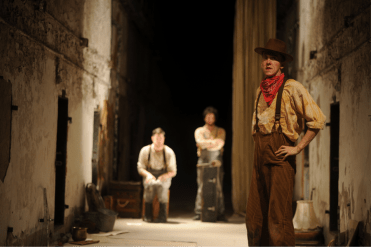
Last fall I created a piece at Eastern State Penitentiary for the FringeArts festival called The Ballad of Joe Hill. I love working in spaces that aren’t theaters. Something about discovering the story of the place and how it’s architecture helps convey the emotion we’re after is really exciting to me. Below are a couple of my favorite photos from the show (all credited to the amazing Kyle Cassidy):

brad trial

hilda suitcase

reporters

hilda hall

For the NPR nerds out there, WHYY also had us on RadioTimes with Marty Moss-Coane to talk about the piece and its historical context.

Here’s a photo for another play I created in 2010 called SURVIVE!

box survive

In this one I really wanted to create a theater experience that communicated the massive, incomprehensible size and complexity of the universe. So we had audience and performers moving through 20,000 sq ft of space in a “choose your own adventure” format. A person saw one of 128 different possible unique viewings of the show’s material, and any one person only able to see about a quarter of the play’s content in a single viewing.

Here’s a video trailer for that. And you can check out more pictures here.

And last I’ll share a little bit of my most recent play Welcome To Campus. I created this show in residence at Drexel University (where I teach) and the piece was a traveling “tour” of the campus performed by student actors. The students brought the audience across 2 miles of the campus giving tours of their own lives in the places these events actually occurred – classrooms, dorms, the gym, etc. We also had a second set of performers out in the landscape that magically manifested whatever the person was talking about. In one scene an actor talks about having to cut a friend out of her life who started drinking and spiraling into a negative lifestyle she was comfortable with and as the tour walks by you see a series of students all having the same phone conversation based on the event the guide is talking about. You can catch another profile on NPR, this time on Newsworks, here.

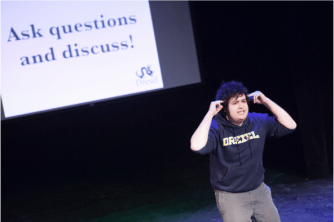
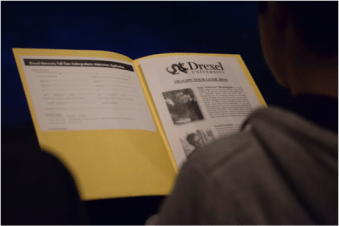
One of the things I really liked about this piece was a collaboration we had with a photographer and graphic artist for objects used in the piece. We weren’t allowed to use official Drexel schwag (our “fake” tour was NOT administration approved) so we created our own folders, maps, tour guide bios, gave audiences a “voucher” for the dining hall (continent on their submission of an application for admission). Kate Raines, a photographer friend, did a brochure style photo shoot of these kids that we used in a power point that started off the show. You can see some of the photos of the students doing their best to look happy and productive.

campus 1

campus 2

campus 3

campus 4

And at the very end of the show the audience is surprised to walk out onto the main stage of the theater building as they hear “pomp and circumstance.” Their names are called as they received “diplomas” (actually the show’s programs) as they “graduated” our play. Crowning achievement of this show was when an actual Drexel applicant and his parents came to the show and said that this was exactly what they wanted to have in a tour when trying to look at colleges.

Thanks for reading. Looking forward to meeting you!

– Adrienne

An interview with Adrienne

Hey all,

FringeArts did a nice little interview with me a while back about my current thoughts on art, projects in the Swim Pony mix and my hopes for sustainability over the long term of a long term career.

If you’re interested in reading (and seeing me sitting backwards in that omnipresent chair) check it out by clicking this picture:

Print

Enjoy,

– A

Cross Pollination Unveiled

spLOGOIs there anything lamer than quoting a David Foster Wallace commencement address to help make a point about artistic awareness?

Probably not.

Which I guess means I’m going to do one super lame thing today. And right after, do something else that’s super not-lame to counterbalance.

Ready for that quote?

“There are these two young fish swimming along, and they happen to meet an older fish swimming the other way, who nods at them and says, ‘Morning, boys, how’s the water?’

And the two young fish swim on for a bit, and then eventually one of them looks over at the other and goes,

‘What the hell is water?!’

The point of the fish story is that the most obvious, important realities are often the ones that are the hardest to see and talk about…

– David Foster Wallace

As artists, working in different genres, sometimes in sub-sets of genres, sub-sets of sub-sets of genres and so on, there are lots of givens about how we work that we take for granted. There are times when the way our work is made seems so self evident that it is almost as natural as breathing the air around us.

Sometimes our working methods can be like the water.

One of the greatest gifts that came from my time a few years back as a Live Arts LAB fellow was to have the chance to talk to my fellow fellows who were dancers. There were more than a couple sessions as a group where it actually blew my mind a little to learn that some of the assumptions I make about creating were totally different than theirs. Things that I take for granted were sometimes just not part of the conversation these other amazing artists were engaging with. Sometimes things were the same but employed in different ways. Sometimes the focus and priority were radically different.

There were times these conversations reinforced my assumptions about art, made me that much more sure in why I did things the way I did. Other times it inspired me to shift my own process and just try what it would mean to create without certain conventions about narrative or structure or audience responsibility. In all cases, these conversations made me more aware of the water around me. Gave me choice about what kind of givens I was swimming in.

I finished that LAB period thinking:

“Wow. If the creative process for two mediums that are almost identical in most aspects can be so different and thought provoking, what would it mean to have this conversation with creators who are even less alike?”

And also:

“Can a visual artist teach a singer something about music? Can a chef give a dancer a chance to unseat their idea of what it means to move? Can a light designer change the way a writer thinks about their words?”

And then finally:

“I really want to find out the answer.”

And luckily, thanks to the Knight Arts Challenge, I found a means to do just that. The result is something I’m calling Cross Pollination. It’s a project that actively seeks a way to dump water all over the floor. It’s a chance to explore without the pressure of a full performance or product. It’s a chance to get paid (and reasonably well, I might add) to open up one’s horizons and cross breed with another artist. It’s a chance to find some crazy mutt hybrid mash up that the world has never seen before. It’s a chance to find out more about the water you’re swimming in.

And I’m so so so excited to begin.

Want more details? Click below. It’s all in there…

Cross Pollination Artist Application

And if you ever need to quickly get to that application without searching the blog just CLICK HERE!

And of course a HUGE thank you to the John S. and James L Knight Foundation for making this amazing project happen.

Enjoy!

– Adrienne