Ken Kalfus is the author of three novels, Equilateral (2013), The Commissariat of Enlightenment (2003) and A Disorder Peculiar to the Country, which was a finalist for the 2006 National Book Award and has appeared in several foreign editions, including French and Italian translations. He has also published two collections of stories, Thirst (1998) and Pu-239 and Other Russian Fantasies (1999), a finalist for the PEN/Faulkner Award. Kalfus has received a Pew Fellowships in the Arts award and a fellowship from the John Simon Guggenheim Memorial Foundation. He’s written for Harper’s, The New York Review of Books, and The New York Times. A film adaptation of his short story, “Pu-239,” aired on HBO in 2007.
Kalfus was born in New York and has lived in Paris, Dublin, Belgrade and Moscow. His new book, Coup de Foudre: A Novella and Stories, will be published in May.
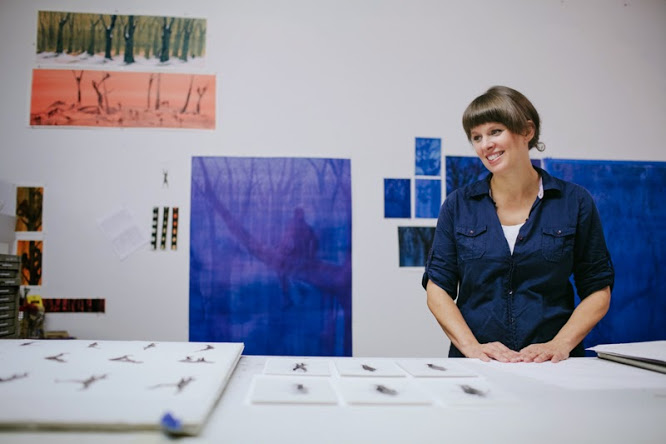
Cindy Stockton Moore is a Philadelphia based artist. Her site-specific installation ‘Other Absences’ is currently on view at Eastern State Penitentiary through 2015. Recent solo projects include ‘Consciousness & Revolt’ at The Galleries at Moore (Philadelphia), ‘Toward Futility’ at Artspace Liberti (Philadelphia), in addition to the two person exhibitions: ‘An Island Now Peopled’ at Chashama Chelsea Project Space (New York) and ‘Water/Line’ at The Center for Contemporary Art (Bedminster, NJ.) She has shown throughout the US and abroad with group exhibitions at venues such as Heskin Contemporary (New York, NY,) PS122 (New York, NY,) Hillyer Art Center (Washington DC,) The Painting Center (New York, NY,) Sandy Carson Gallery (Denver, CO,) Public Fiction (Los Angeles, CA,) and The Boston Center for the Arts (Boston, MA.) Cindy Stockton Moore received her MFA in Painting from Syracuse University. Her writing on art has appeared in ArtNews, NYArts Magazine, The New York Sun, and Title Magazine in addition to university and gallery publications in the US and Canada. She has been a part of the artist-curatorial team that runs Grizzly Grizzly gallery in Philadelphia since 2011.
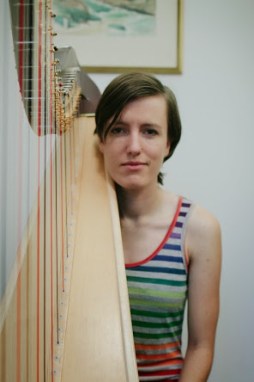
Harpist Elizabeth Huston has dedicated much of her career to furthering audience appreciation of music by living composers through advocacy, education, and performances, and has been credited with helping to “bring the harp into the 21st century” by Harp Columneditor Kimberly Rowe. Her 2014 show 14 Sequenzas was acclaimed as the “Most daring presentation of classical music in 2015” by the Philadelphia Inquirer. Elizabeth received her master’s degree in harp performance from Temple University. Since graduation, she has maintained a rigorous performance schedule, including solo appearances in the Delaware Center for Contemporary Art, the Grand Ballroom of the Philadelphia Conference Center, Dalet Art Gallery, the Maas Center for Performing arts, among others. She has performed harp composition workshops at Temple University and Western Washington University, as well as one-on-one work with composers across the US. Elizabeth is currently serving her first term as the president of the Philadelphia Chapter Harp Society.
Nick Cassway received a BFA in painting from the Tyler School of Art in 1990. He has exhibited his drawings, prints as well as site specific installations both locally and nationally. He is deeply vested in the Philadelphia arts community and was formerly the executive director of NEXUS/foundation for today’s art. Nick currently teaches computer graphics, editorial design and brand identity at Drexel University’s Westphal College of Media Arts and Design and is a current Fellow in CFEVA’s Visual Artist Fellowship program.
The Logic Model
Here. Listen to this while you read. It’ll help you know what to feel.
What do you wanna do?
I dunno.
What do you wanna do?
(first days are funny things)
What do you do to warm up?
What are the mechanics of what you do?
What are the restrictions?
Can I try?
Did you know that the average age of a classical music audience member in 1995 was 55 years old and today it’s 75 years old? The same people have been listening to classical music for the last twenty years.
What’s gonna happen when they die?
Here.
Take this survey.
It’ll tell you what to think.
Don’t worry it opens in a new tab so you don’t lose us.
Also keep the music playing while you do it
And don’t worry. I logged on with Facebook too.
It’s secure.
Y’know what, I lied. I didn’t actually log on with Facebook. I created a password and used my e-mail.
But I’m sure it’s still secure.
Did you feel like the survey answer was true to your personality type?
….did you even take the survey?
Maybe it would be better if I drew a picture to show you what the week was like…
Here.
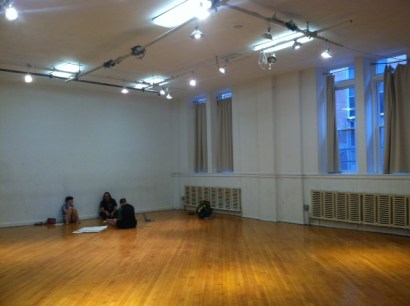
A. The beginning, and questions about beginnings. An empty room promising [perhaps overwhelming] possibility. Three people sitting on the wooden studio floor, knees up, notebooks open. What if…?
B.
C.
D. Laughing and weaving lies. Stealing from artist statements, personality quizzes, and the Chinese zodiac. What if we winked at the ways we try to tell each other what to think and how to feel? What if we gave the audiences a survey and then assigned them a “personality type” at random?
Raph is a breakdancer, Adrienne is a director and vocalist, and Manu is a director and clown. Before the residency week started, the three started discussing an interest in masks via email. From what I gathered, they were curious about masks in both a theatrical and an emotional sense. Which are the masks we wear that allow us to pretend to be something we’re not on stage, and which are the masks we hide behind offstage, in real life? Thematically, the week revolved around the act of unmasking, and I’ll go through the exercises that brought this about.
On the first day of the residency, the group decided to take turns leading each other in exercises. Adrienne would lead a vocal exercise, Manu a clowning one, and Raph a dancing one. Of course, Raph said he couldn’t sing, Adrienne complained that she wasn’t funny, and Manu insisted she was a terrible dancer. In the spirit of overcoming fears, they determined that Raph had to sing, Manu had to breakdance, and Adrienne had to be funny. The focus shifted quickly from the artists leading exercises in the things they are good at to the other artists doing things they wouldn’t otherwise do.
Eager to try breakdancing, Adrienne and Manu tried one of Raph’s dancing exercises. Laying on their backs, knees bent, they were directed to “find the hole,” with no further direction. At first, Raph looked on while Adrienne did somersaults, and Manu comically pantomimed falling through the hole. Raph joined them on the floor and turned gracefully over his shoulders a few times, showing us that you “find the hole” by finding the space between your body and the floor and threading yourself through that space. Though the “point” of the exercise was to introduce us to Raph’s style of dance, the exercise encouraged a sense of playful experimentation along with some laughter and flailing.
Next, Manu introduced an exercise I’ll call “Being in Front of an Audience.” The instructions were short; one by one, each person would get up in front of the rest of us and “be.” This meant no thinking ahead, no joke-telling, no forced movement. The exercise focuses on letting no, not forcing a performance in to being, and just allowing yourself to “be.”
I know this exercise sounds like it should have been really easy for Raph, Manu, and Adrienne, but it wasn’t. In fact, I think it’s a very difficult exercise for most trained performers. Performers spend years learning how to perform in front of and audience. Performers are required to bring about a series of premeditated actions when they get on stage, and spend years learning acting techniques that obfuscate this fact. Traditionally, performers are conditioned to perform on stage, rather than enter a state of “being,” the performance flowing organically from that state.
To get at the heart this concept, and to understand exactly what these performers were asking of each other this week, I want to take a quick detour and talk a little more about what it means to perform. If I go to see my friend, Jill, as Juliet in Romeo and Juliet. I know that Jill’s actions on stage are not representative or indicative of who Jill is when she’s not on stage. In this example, Jill is performing actions she’s practiced and is repeated. She is “forcing” the performance of Juliet into being. She is not just “being.” This also applies to performers that perform on stage. Take the case of singer-songwriter, Joni Mitchell. When Joni is performing on stage, who is she? She is not performing a character like our friend Jill was performing Juliet. Yet, I suspect that when Joni is performing on stage, she’s not just Joni Mitchell. She’s Joni Mitchell performing the very practiced, premeditated role of Joni Mitchell. No matter how confessional, convincing, or personal the performance might be, I think Joni Mitchell on stage is not representative of who Joni Mitchell is when she’s not on stage. From this it follows that traditional modes of performance are almost the opposite of “being” as Manu describes it.
So, what fascinates me about Manu’s exercise? It’s a performance that runs contrary to a lot of what we understand to be performance. “Being in front of an audience” is so different from performing, even if it might not look like it. “Being” is not Jill performing the role of Juliet, and it’s not Joni performing Joni. It’s a little more transcendent.
So, back to the room, in which Adrienne, Manu, and Raph are all about to try this exercise. It was Adrienne who said she could feel her heart beating in her ears when she stood in front of us – not on stage, just in the middle of a big room in front of friendly faces. She stood and Manu guided her through the exercise, offering suggestions like “breathe,” and “try adding in a little movement.” Adrienne stood for a good few minutes, punctuated by deep breathing and a few sighs of nervous laughter. And then, out of the silence, something happened. Or maybe it was that something stopped happening. Adrienne was “being.” Manu invited her to follow her impulses, and invited Adrienne to start swearing as a way in to the exercise. Adrienne dropped into a new body. This body was playful, mischievous, and definitely rude. This body had a silly voice, pointy and piercing. This body yelled a terrible and ridiculous word (that Adrienne would never say) over and over again, each time funnier than the last.
Manu was the last to get up and do the exercise. She had led everyone else through it, and now we all had to lead her in her own exercise. At first she stood in front of us and stood still, looking out. She started shaking subtly, tears welling up in her eyes. “This always happens to me,” she said. She took a few deep breaths and, regaining composure, stood in front of us. Watching her “be” was difficult at first. It’s easy to watch a performance, but this was observing humanity. It was active. It was empathetic. It was hard.
The next day Raph, Manu, and Adrienne started talking more explicitly about the masks they wear. Honest conversations, like the very candid one we had about masks, were brainstorming sessions as much as they were therapy. This particular conversation yielded the idea to use a technique, seen in Nature Theater of Oklahoma’s show, Romeo and Juliet, that would help them “be” on stage. Nature Theater’s Romeo and Juliet consists of two actors reciting recordings of people attempting to recount, from memory, the plot of Shakespeare’s Romeo and Juliet. Underneath the actors’ faux-Elizabethan garb and hokey trans-continental accents, the actors are wearing headphones, listening to recordings of real people and repeating those stories, verbatim, to the audience. Intrigued by the kind of fidelity this technique offered, they began recording stories about the masks they have adopted in their lives.
Raph went first. He recorded a story about prejudice he faced in grade school as a suburban black boy and how that moment transformed the way he sees himself to this day. You can hear the original recording below:
Manu listened to Raph’s recording through headphones and repeated his words in front of Adrienne, Raph, and I. Suddenly, the story Raph had recorded just moments before was Manu’s. The story was no longer about a black boy dealing with racial prejudice; it was about an immigrant girl in a suburban school facing a different racial prejudice. The words, pacing, and pauses were all Raph’s, but the same words in a different mouth told an entirely different, yet equally convincing, story.
Manu described performing as “being overwhelmed” by Raph’s recording. Left with little time for judgment or interpretation, she was left to recite his words without thinking. This state was similar to “being.” Watching her, I felt uncomfortable. Even though I knew it was Raph’s story, the disjunction between Raph’s words and Manu’s extreme honesty on stage was troubling. Imagining I didn’t know Manu, I started asking myself questions – “Why would a white girl be grouped with the bussed in black city kids?” Then, doubling back on myself, “Am I that sure of her racial identification?” and “Why do I assume she’s female?” Raph’s story directly contradicted the assumptions I had made about Manu, and Manu’s honest delivery made me evaluate what felt true in the story against the assumptions I made about Manu based on her physical appearance.
They continued to experiment with different people reading different stories, and came away with two observations about this technique. Firstly, it works best when the person reading the story has never heard it before and cannot predict where it is going. By the time Adrienne recited Raph’s story, we’d heard it a few times. While it remained difficult to stay with the recording, as an audience member I could tell when she was remembering part of the story versus saying it blind. Those moments stood out because the remembering took her out of the moment of “being.” Secondly, they found that things were actually more interesting when the performer and the narrator were noticeably or physically different. For example, a man telling a story written by a woman, or a person with an accent reading a story recorded by someone who has a different accent. While they were initially concerned that these differences might confuse people, they decided that they were also more thought provoking and challenged people’s assumptions and prejudices in a more profound way.
At the end of the week, sitting in a coffee shop, we all got really excited about the ways this storytelling technique might bring people together. We imagined the power of hearing one person’s recording of their side of a fight, and hearing the other person they’re fighting with tell their story. The other person would have to say the other person’s side of the argument and that could be a really powerful experience. Can you imagine your significant other telling you the story of how you first met them? Can you imagine what it would feel like to hear someone decades older tell your story? How about your boss?
If the beginning of the residency was about these artists unmasking each other by the end they’d found a way to unmask their audiences too. While this was a very process-oriented week (compared to Ken and Cindy’s very product-oriented residency), they walked away with a new way to “be” onstage. While this residency week started in a nebulous place, it ended with a tool that help’s people feel empathy. It encourages people to change, or at least reexamine, their beliefs because it forces them to see and hear their exact words in another person’s mouth. They might be surprised to find them equally true, equally relatable, and equally human.
Arianna Gass is a recent graduate of Vassar College. In addition to documenting Cross Pollination, she is the Program Manager for Drexel University’s Entrepreneurial Game Studio. Her own art practice is located at the intersection of digital and embodied play, and her scholarship focuses on feminism, performance studies, and game studies. You can find more of her writing and work at www.ariannagass.com.
The second collaboration in the Cross-Pollination series was between Ken Kalfus, a novelist, Cindy Stockton Moore, a visual artist, and Adrienne (aka Swim Pony). This group was very project oriented; the majority of tour time was spent telling story we devised together. Consequently, I chose to focus on the process that lead us to that story and the story itself.
Here. Listen to this while you read. It’ll help you know what to feel.
What do you wanna do?
I dunno.
What do you wanna do?
(first days are funny things)
What do you do to warm up?
What are the mechanics of what you do?
What are the restrictions?
Can I try?
Did you know that the average age of a classical music audience member in 1995 was 55 years old and today it’s 75 years old? The same people have been listening to classical music for the last twenty years.
What’s gonna happen when they die?
Here.
Take this survey.
It’ll tell you what to think.
Don’t worry it opens in a new tab so you don’t lose us.
Also keep the music playing while you do it
And don’t worry. I logged on with Facebook too.
It’s secure.
Y’know what, I lied. I didn’t actually log on with Facebook. I created a password and used my e-mail.
But I’m sure it’s still secure.
Did you feel like the survey answer was true to your personality type?
….did you even take the survey?
Maybe it would be better if I drew a picture to show you what the week was like…
Here.
A. The beginning, and questions about beginnings. An empty room promising [perhaps overwhelming] possibility. Three people sitting on the wooden studio floor, knees up, notebooks open. What if…?
B.
C.
D. Laughing and weaving lies. Stealing from artist statements, personality quizzes, and the Chinese zodiac. What if we winked at the ways we try to tell each other what to think and how to feel? What if we gave the audiences a survey and then assigned them a “personality type” at random?
This is the feeling I had this morning. This is the premise of this project: Starting from a totally blank canvas.
Not even a canvas. The idea that something has to be painted on. The idea of paint. The idea of having an idea to paint something at all.
Because really, where do a visual artist, a theater maker and writer and harpist logically begin if they want to try and make something together?
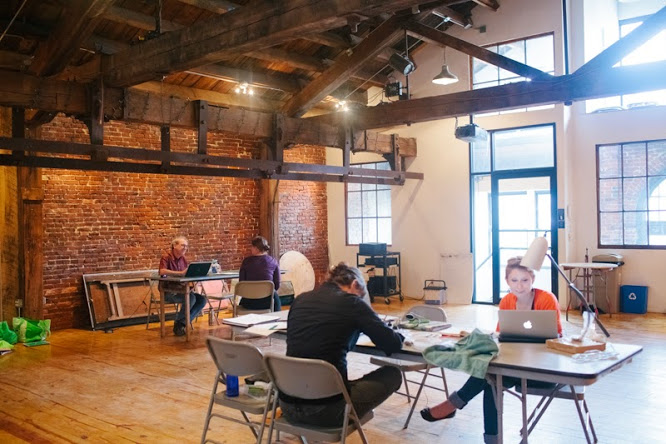
This morning I walked into a room with two creators I’d met only once before. I had butterflies in my stomach, big fat ones, like first day of school jitters. We started, carefully, delicately, hesitantly to… What? Carefully try to suss out exactly who the other is and what exactly we might find in this insane thing we’ll be doing.
I thought, “What have I gotten myself into?”
I thought, “I have literally no idea what is going to happen.”
I thought, “Do your best not to fall into things you already know how to do because they are easy, or familiar, or you know how to make them work.”
I thought, “This is terrifying.”
I thought, “It is really tough to know where to begin.”
I thought, “Listen.”
I thought, “Try and stay open to something you’ve never imagined before.”
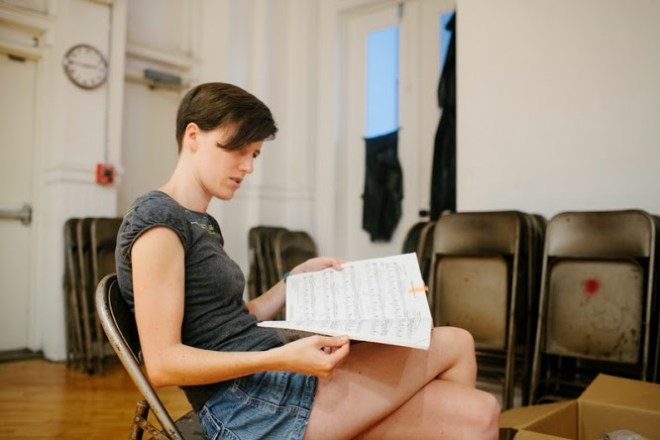
It is a pace I am so thoroughly uneasy with because it is so thoroughly rare in my regular artistic life. So rare that I allow myself permission not to be in charge, not to have the active working idea, not to try and keep the energy of the room moving forward and productive. As a director, I feel myself wanting to know the answer, wanting to show people their faith in me as leader is secure, wanting to get us on track already towards where we are going.
But all this well-intentioned Midwestern productive attitude-ery also means that you can slip into taking yourself where it’s easiest to lead, rather than really waiting until the very new, very strange, very uncertain thing emerges.
And despite my fear, despite my worry that it feels like nothing is happening, after 8 hours I can see there are some things emerging.
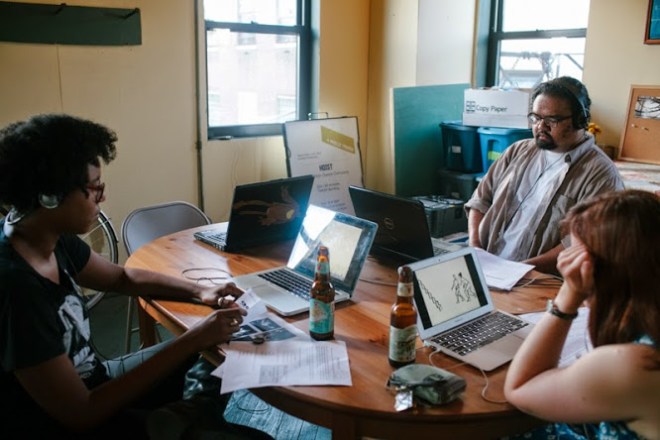
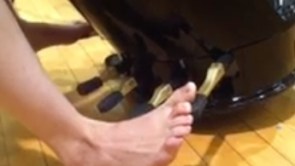
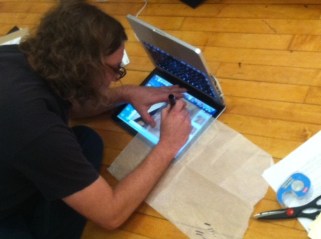
I have put my hands on an instrument I have never touched before. I have watched an artist demonstrate his iterative process – one that normally takes acetate and photoshop and a vinyl cutting machine – on a sideways laptop screen with a piece of tracing paper, some scissors and tape. I’ve enjoyed seeing an actor confront a harpist on stage and I’ve seen that interaction photographed and then turned into a looping gif on a computer screen with a different selection of the musician’s playing as it repeats again and again and again and again and again. I’ve talked about why a video on Vine might be a meditative experience and what it would mean to create audience customize-able art.
I’ve shared a vision for a super strange, exciting and foreign line of inquiry. And despite my fears, I think it’s pretty interesting. Even if I have no idea of how to evaluate it yet. Maybe especially because of that.
I think I also had a moment where I realized that contrary to how I feel on almost every other artistic project I work on, in trying strange, potentially crazy ideas with these two I have nothing to lose and everything to gain.
I also ate a lunch of donuts and fried chicken. That was pretty good too.
At the end of the day I am tired. It is work, searching so hard across the ocean of discipline to find some common ground. But tired in a good way. In a way that makes me excited to get up tomorrow and try again.
Thanks Nick and Liz. I’m excited about more to come…
Last night I finished recording backing vocals for a second album with Johnny Showcase.
It is a funny thing, this.
Funny to think that there might be people in the world who pick up this object or pull its digital instance out of the interwebs, and might see my name and think, “Oh she’s a professional singer.”
This strikes me as so impossibly strange.
How can I explain why?
Well…
It is funny to me because this thing has always been something of a joke on the audience. I’ve always done it in a kind of air quotes way, as if to say, “If I were a singer, and I knew how to sing, and I were someone who did this, this is what I’d do.” When I sing I play act at a character who is a singer who thinks they are amazing. I pretend as if I am someone who is fierce and believes fully in her own ability. I play someone who is almost bored with this endeavor and wears the virtuosity of performance with an almost disdainful air.
I can sing in this way because it is so pointedly not me. So not me that I delight in showing it, like a magic trick, to those who have seen the “real” me and watching them meld these two disparate pieces into a messy collage. They know me as an intellectual, a thinker, a director, a serious type. The sequins, the makeup, the eyelashes, the hair, these are costumes yes, but they are also talismans of transformation. They are portals that allow me to transcend the self that I tend to walk around in and become free. And their power feels tied to the audience. Without a power that summons them forth, they have no meaning and they are not able to be filled.
In the spaces before the transformation, in rehearsals and the studio, I am a hybrid half formation. I am not onstage, I am without my armor and I am so much more clearly myself. It is here that I can grow nervous and tense. It is here that I have to take responsibility head on. It is here that I am simply a singer trying to sing a song. And it is here that I feel like a fraud and a fake who has been getting away with this for a long time. It is here, every time that I hope that I will not expose myself too much as a counterfeit.
Something that I have learned: every other person in the room knows more about this than I do.
This is not false modesty. It is simple objective truth.
If you ask me what things I can claim some level of expertise at I will say that at one point in time I knew a lot about a particular bit of chemistry. I currently know a lot about a particular brand of theater making. And as with anything, the more one learns, the more one realizes that there is so much more to know. But in theater the confrontation of the unknown has become itself something familiar. I know that I can walk into a room and run a rehearsal. I know better how to take comfort in the early stages of a process. I don’t fear my capacity to produce a show.
On some deep level, somewhere along the way, I gave myself permission with theater. As a director, I can say that I really do believe that my “right” is just as right as another’s. And so my work flows from a place where I see that the formal structures I began with are scaffolding that eventually can fall away if I need to build in a new way.
Not so with singing.
I have pursued music with a kind of “Really? Ok… If you think I ought to” attitude from the beginning. I sang mostly because people said I had a nice voice. I sang because I was rewarded for doing so. But I don’t think I can say that I sang because I loved my voice. I didn’t sing because I needed to, I sang because it seemed like something I could use as a way to be special or impressive. All my singing was for other people’s ears.
And so my measure of musical success was also in the ears of others. My sound was “right” only in as much as it was valued externally.
My formal study of voice was plagued by constant uncertainty. I did not have a terribly developed ear, pitch matching and recall were middling at best. I had little aptitude for music theory and too little time or space to really devote to its study. What I did have was a decently developed instrument for my age and a keen facility to hide faults in my sound. So when I sang in groups, rather than really learning to read music, I often relied overly heavily on mimicry of those next to me in choir and eventually recordings of other singers for solo works. I did whatever I could to sneak by without being noticed as out of tune or worse missing the melody entirely.
What this did was develop a tendency in me to pull back when uncertain. To really sing out only when I could be totally sure of success. It meant that I never asked for help or gave myself permission to be a learner. Instead I would get quiet or drop out and then go home and furiously try to fix the problem alone where no one could see my mistakes. But there are times when this is not the most efficient way to solve problems, and it often means that the underlying ear training isn’t addressed. It meant that I could not be in my body and sound around others, it meant that I incrementally pulled my identity as a singer inside of myself. It meant that I only wanted to sing when I could be perfect and therefore meant that I never allowed myself space to learn.
What makes me a good director, I think, is not that I come into the room with all the best ideas ready and laid out. It is that I am able to watch and listen and respond and try things that fail and discuss and then try again and fail again and try some more. I think my directing skill is tied to an ability to risk and reap such risk’s rewards. I do not take negative response as a referendum on me but as useful information to help the thing I’m trying to do get closer to what I think it’s capable of.
So when I look back at that fledgling singer who was so afraid of disappointing it seems clear that her need to do it right got in the way of her ability to genuinely grow. When a flaw was exposed it was like a raw nerve. It was the part of me that I had worked so very hard to keep secret. And so it meant that such vulnerability was often debilitating to the point of paralysis. I cried in solo lessons, the one place that I truly couldn’t hide, almost as a matter of course. I learned bad habits of tensing my body, my jaw, my mind, in an effort to force out the right thing. My senses were focused only on the listener, gauging their interest and assessment rather than actually figuring out how I felt when I made these sounds. I did not trust myself, ever.
But I comforted myself by saying this was not something I “really” did. Singing was a hobby, a side project, one that I loved but knew that I didn’t work hard enough at. I wasn’t a “real” singer but I took solace that if I ever actually had the time I could have tried “for real.” If I’d actually buckled down and focused on it, I would have done better. I would have done it right.
I made my way through music in this fashion though middle and high school, through auditions and jazz choirs, through madrigal ensembles and state competitions, through musicals and recitals, through college scholarships and choral solos, through diction coaching and operatic arias, through Brahms and Mozart and Puccini and Stravinsky and Wagner and Bach.
The first three things that occur to me when I think about my four years studying voice in college are this:
Not being allowed into the chamber choir because my vibrato was too big
Being called a “wall of sound” in a vocal jury
Not having enough time to learn the Russian for the Rachmaninov set in my senior recital
So it seems the height of irony, if to no one else than myself, that I am known in my community as an expert in voice. That I have carved out a tiny niche of experience in a technique whose central tenet is exploring the edges of vocal sound, the pieces that we normally exclude and cover up and refine out. That I have the excuse that it’s supposed to sound ‘bad’ has been the out that I have given myself.
I remember when I first learned that Roy Hart’s early work was driven by a deep desire to be a classical musician, that he had a facility in this regard, that so much of his exploration was in part motivated by a wish to be validated by the classical community. I remember hearing this and thinking, “Ah. Yes. We are the same in this regard.” And it is such a funny thing that I spend so much time as a teacher trying to instill the very thing I still struggle to find for myself. A belief that one’s voice is worth hearing. A trust that the sounds that come naturally are not broken. That the failure is the most useful part of the journey because it begins a conversation about where we can grow.
I have this exercise I often do with students where I ask them to take everything we’ve done and forget it. I ask them to improvise song or speech or sound with no other goal than to simply voice something that pleases them. It is often the most difficult thing. It is this exercise that most often makes people cry or laugh or shake without knowing why. This is the most radical thing it seems – to express a sound for no one but ourselves.
So much of my experience with classical training is one of need and fear. A desire to do right, to be right, to sound right, to know the right notes and almost mechanically find myself able to become a vehicle for them. What is the sense to make of all that formal training? Is it just necessity that we fight and fight and fight with ourselves to internalize these rules only to find ourselves desperately needing to throw them away later?
I think of the experience of what it feels like to have to drill as scale again and again and again. To run the same sequence in a recitatif ad nauseum in a lesson until it becomes unconscious, until it is in me and of my body. Until it is simply a pattern than has become carved deep into my being. I can see that in the best moments, in the ones when I could just give myself permission to be deeply “wrong,” I could finally open enough to try until I finally got to something new and that felt like an opening. That felt like deepening. And it was these kind of times when I felt like maybe I wasn’t such a fake, that I was just a learner trying to master something currently bigger than myself.
The sections of those long ago songs that came easy, the bits that I could get on the first or second try, these musical sequences have faded in the ten years since I stopped singing classically. But those asshole passages with tiny twists and bits that ensnared me so deeply and so thoroughly, the ones that made me cry, these are the same ones that I can remember perfectly now. These are the ones I will know in my bones until I am nothing but.
Last night I found myself at the end of the evening having to make up a harmony with no prep time, on the spot, with people much more skilled at this than I. It was clear that it was harder for me to find my spot that the others. And normally this is a very hard place for me. I often lock up and resign myself to taking the work home and trying to drill it in alone with no one to hear. In the first album’s recording session I stayed in a state of abject terror over whether I was the problematic sound. But over these past few days, I have told myself to just try, earnestly without judgment, as best as I am able.
With the laser specificity that is a recording session I have come to see that I am not the only one who sometimes strays out of tune or misses a note when really trying to get it perfect. I have realized that in the years at this I am actually getting better. I am not perfect, but I am also not the total fraud I fear.
I am exactly where I am, with some degree of facility and a lifetime of learning more in front of me.
And this is sort of what I wanted to explain, I think. That we must give ourselves the gift of failure. That we must come to believe we need it or the need to deny it will take us over completely.
The process of change is so slow we barely see it.
This is how it is possible that I am sitting with a dear friend and fellow creator on Friday and realize in the midst of our conversation that I am… happy. That I am open and new. That in front of me lays fields of possibility. That the anger and confusion and pain that I felt not so long ago is actually melted and revealed something quite unexpected and different.
Do you ever wish you could sit down and check in with a version of yourself from the past?
“I need to know it’s worth doing thisart, in thisway, at thistime,” says Adrienne in December of 2012.
The truth of the matter is that the works I’ve made are things I’m proud of.
The truth of the matter is that I increasingly lost an internal sense of why I needed to make them.
The truth of the matter is that I don’t really care what anyone else thinks “theater” is or if I’m “good” at it.
The truth of the matter is that my “theater” is simply a means to a deeper question about connection and understanding and thoughtfulness and desire and finding a way to make sense of what I’m doing here.
The truth is that for a while I got a fair bit better at making “theater” as other people define it and a bit worse and making sure it was still answering the deeper questions I wanted to be asking.
The last year and a half has been a concerted and nearly constant effort to realize this and get myself in a place where that was no longer the case.
It has been hard.
I have felt like a failure often.
Most of the time progress was slow to the point of imperceptibility.
But today, for whatever reason, it has hit me: the work I’m in the midst of making now is worth doing. This work. In this way. At this time. And for the first time in a long time, I feel really really free.
Today it seems I’ve gotten far enough from there to really see the distance.
Random snapshots from recent life:
Friday: I am randomly invited to a conference on game design in Boston the next day. I drive 6 hours the same day to get there. The next day I have conversations about ethics and narrative structure and audience agency. I feel like I am talking about my theater.
Two weeks ago: I hand in the first draft of a study plan that predicts the next two and a half years of reading and artistic practice which will make up my self-directed graduate degree in interdisciplinary arts. I know almost nothing about anything on my reading list. I am ecstatic. I wish there was more time I could add to the universe because the list is already too large for the time I have to tackle it.
One month ago: I decide that I need to do something creative that requires my hands. I decide I need to learn to play the piano. I start downloading beginner’s sheet music. I spend 30, 40, sometimes 60 minutes a day with Für Elise and simple chord progressions. I love being a beginner.
This week: I chat back and forth with a painter and novelist about the possibilities of a week’s worth of collaboration and experimentation for Cross Pollination. There is a little trepidation about what exactly we will do. I do not know. I do not care that I do not know. I do not, as I normally would, make a bunch of plans of things I do know how to do so that the trepidation subsides. I decide to wait until I genuinely think of something I want to do.
Today: I watch a video by game designer Brenda Romero about her “The Mechanic is the Message” series. I hear her talk about her love/hate relationship with her ascension into the ranks of “professional” creator. I hear her speak about a nascent need to remove herself from the industry of her craft, to make things by hand. I hear her explain how she took time, extensive time, away from digital design to play board games. I hear how she begins to make games about things she never imagined possible, games explore deep and vast tragedies. Games that challenge the player to examine their own agency and choice in participating. Her elements are handmade, deeply personal, unreproduce-able. This is the point, it seems to me. It also seems to me that in the end, the rewards her games reap are equally unique, meaningful and rich. They fill the creator’s soul rather than the professional’s resume.
Thursday: I have two conversations in the same day about ideas for new projects. One is a piece for only two people at a time and the other for a potential 2,000. One takes place almost entirely inside the mind of the viewer, the other could cover most of the city of Philadelphia. They feel like the same kind of inquiry. I feel like I can start working on both of them tomorrow, by myself, if I wanted to. Not researching, not imaging, literally, making stuff that will go in them. I like not having to wait to get started.
Six months ago: I decide I want to write. I decide I want to write fiction. I decide I want to write a novel. Every few weeks I pull up the document and write furiously for a few days. At last count I am up to 170 pages and 39,949 words. I also decide I can show it to people someday or not. Either way it won’t matter. I just need to write it.
And so it is that I find myself at this moment feeling the most vibrant and true expression of my theater-related creative impulses into forms that look almost nothing like what “Theater” would typically be defined as.
And so it is that I find myself confronting new projects that are amazing and daunting and unknown in almost every way.
And so it is that I have met more people and had more new conversations about creativity in the last few weeks than in the last few years.
And so it is that I have stopped feeling so crushed and frustrated.
And so it is that I don’t worry about whether what I’m doing is right.
And so it is that I know the only thing that matters is if it’s what I feel myself needing to be doing.
And so it is that finally finally finally… it seems I’ve found what that is.
And so it is that I stand in the shower today thinking about my conversation on Friday and realize that it feels like something I have to share and so I write this, hastily, before I run out the door because it is also clear that it has to be done today, right now, before I lose understanding of it in just this particular shower-inspired way.













 It is a pace I am so thoroughly uneasy with because it is so thoroughly rare in my regular artistic life. So rare that I allow myself permission not to be in charge, not to have the active working idea, not to try and keep the energy of the room moving forward and productive. As a director, I feel myself wanting to know the answer, wanting to show people their faith in me as leader is secure, wanting to get us on track already towards where we are going.
 Last night I finished recording backing vocals for a second album with Johnny Showcase.
 The process of change is so slow we barely see it.
 swimpony.org