arts

Ownership is not the same as owning shit

What does it mean to own our creative work?

Is there anyone out there who hasn’t had a moment of green rising proprietary “back off what’s mine” sensation when seeing another artist doing something just a bit too similar to something they have already done?

I have. “That was my idea.” I’ve said that a lot. In the last month. More than once. So trust me, I get it.

Our creative work feels like it is of us. It feels like a piece of us. And when someone seems to takes that piece, even if they change it up a lot, even if they interpret it differently, we start to feel a little nervous.

Why?

Is it because that new version reflects back on us in ways that we don’t want? Is it because we fear that they might do it as well (better?!) as we did? Are we scared that people will see this new version of our thing and forget that we got there first?

A bit of all of the above, most likely.

Most of my artistic career I have spent copying other people. Often wantonly and shamelessly. Ariane Mnouchkine, Julie Taymor, Joseph Chaikin, Dan Rothenberg, Whit McLaughlin, Jon Stancato my college boyfriend, Robert Johnson my high school director, Tracey Servé (née Deerfield) my best friend at 16. All of these other people’s styles and humor and tricks were things I vacuumed up and spun around inside of me and spat back out into new forms.

Early on I loved Mozart’s Magic Flute and Greek mythology. In retrospect I see this isn’t simply because I had a natural born affinity for the finer classical things in life but because I happen to get to see my voice teacher in the chorus at the Lyric Opera and because my 6th grade teacher had a bangin’ unit on the Greeks in which I happened to seriously dig on Hera. These are influences that planted in my forming brain and stuck there. So when I happened to get around to making some shit myself, it’s not surprising they dislodged and informed the things that started coming out.

At the time I had no sense of how the work came out of me, it just came. And as I started adding layers of influence, the studies in college, my own research, the new people I met and the things they had to say, it felt like my work kept getting richer and richer. All through school this trend continued and it felt like everything I saw could become part of the work: every word, every line of music, every movie, every image. These all had the potential to change how I thought about the things I was making.

And then a few years into working professionally, I made a show that I was really proud of and that show got a review and that review had a sentence or two that mentioned a couple songs I’d used and it was clear that they felt like I had no right to take this music and use it for my own purposes.

It sounds pretty naïve now, but it was the first time it ever occurred to me that I had to be careful with using other people’s material.

This is a tricky thing. There are times when we take the work of another and we do something to it that the original author might feel perverts the original message. That’s a tough thing. It’s tougher when we are farther and farther from the sources we appropriate. There’s a kind of cultural colonialism that can leave a bad taste in the mouth. This is something I think each artist needs to wrestle with. What is the story I am telling and why am I using this source? Only you can decide if you feel like you are doing so responsibly. Only you can decide if you are qualified to own that shit.

In this way, I’m glad to have become aware. I think it’s good to think, so long as it does not paralyze. It’s important to imagine how your interpretation of another’s creative output will affect you and them. Owning your inheritance is part of growing up as an artist.

But in another way, one that I think is quite separate from this first way of seeing ownership, I think we start to see our work as a commodity that we control.

The funny thing about the devising process, for me at least, is that it is a medium of association and collage. And the more I know, the more I start to see that every idea at some level comes from somewhere else. And the more I start to try and limit myself to the things that I can conceive of without “stealing” from another artist or person, the more I start to despair that any new work is possible.

I think that maybe there is no such thing as new ideas.

Lady M is Roy Hart voice on Shakespeare’s text and a lot of choral movement work I see in other directors

SURVIVE! is Radiolab mixed with a video game with Pay Up with Neal deGrasse Tyson.

Joe Hill is Hill’s folk music and Eastern State and historical re-enactment

The Giant Squid is “What if I mixed H.P. Lovecraft with Steve Zizou and site specific staging?”

These works feel the most unique to myself and my company. And they are all nothing more than a mash up of other people’s stuff. Everything I’ve ever made is just a mix of elements from other places that happens to come out in the particular measurements that are unique to me. And really, how else could it be? Is it really possible for anyone to have a totally unfettered and brand new idea? Really?

And if the idea of ownership and copyright were to continue to its logical end wouldn’t every combination of words or notes or movements at some point in the future become property of someone else? Creativity is a process of impulse and intuition. It is a process of meaning making in which we create image, story and metaphor by combining things in new and unique ways. That’s why we see other people’s theater, that’s why we study the masters as students. Because we want to learn and pick up things from those that have gone before us. We are supposed to be inspired by other people’s work. But I guess not too much, or too obviously.

Not enough so that you can see the raw materials we’re drawing from.

But isn’t that just the difference between an awesome piece of art and a mediocre one? Is the awesome piece of art really missing the same set of inputs that come from outside of themselves? Or is it just transforming them in a way that makes us astonished and awed and not really care where it came from, because of its so obvious newness in its combination?

There’s an article out there that I read once about how inventions arrive when the culture as a whole is ready to receive them.  I’m too lazy to look up the exact link right now so you’ll have to take my word for it. But this makes sense, no? No one is going to create a light bulb until electricity has been invented. And similarly, a specific series of notes might not be possible until the culture of jazz or blues or funk or whatever has arrived to usher our ears into wanting to hear it.

It starts to feel a little arbitrary saying “This is mine” or “That is his” when really, we might both have never arrived there without the discoveries and forward motion of a million tiny pushes before us. People talk a lot about the kind of omnivorous consumption of influences in Shakespeare’s text. I wonder if such a writer could exist today…

This is why I think that taking ownership is different than owning our work the way we own a car or a book our house. Our work is a living, changing, shifting thing. It has meaning only in so much as we share it with others. And in sharing it, we need to know, need to hope!, that it’s going to matter enough to someone else that it’s going to stick in their brains and reappear and come out when they too start making shit.

I know it twists a little something inside when you see a character that looks just like the one you made. I know it hurts a bit to hear a melody that sounds too much like yours. These words and sounds feel like ours. But they aren’t. Not really. They came to us by virtue of the artists before us. If we’re truthful, if we really take a hard look, nothing we create is truly and totally our own. I don’t believe it can be possible.

And if we can give ourselves up to that, I think what we do is put the value on the expression of the idea, the form and context of the words, and the performance of the sound, rather than the thing itself. In doing that, we put the value not on the art but on the artist, on the producer and not the product.

Anyone can come up with a good idea. The trick is to execute them with brilliance. That’s where the real craft comes in. And ultimately that’s the value I want to create in the world: my worth as a maker, one who takes ownership over the influences I include and the messages I create of them, one who then freely gives that to anyone who’s aching to take it up so that they too might do with it whatever they will.

A

Project: Write your own eulogy!

You know what sometimes makes me a little sad?

If you ride SEPTA you know the strangely accented woman who voices the stops on the Broad Street line. A couple years ago I became hyper aware of the particular announcement she gives just before the metal entryway slides shut and the car starts to pull ahead:

“Doors closing.”

Think vaguely Indian mixed with British, every time just as you are about to move on:

“Doors closing.”

I don’t know why, but I always have this tiny existential sadness slip into my heart when I hear that.

“Doors closing.”

Now when I make a big choice, one that feels like it’s going to determine the course of life for the next month, year or beyond, I think of that announcement. When I hit a major milestone I hear it too. Sometimes, I’m just sitting there thinking and I realize that at one point I thought I wanted to be a doctor and now I teach actors to fake illness for them instead. I think about whether I could, if I had the inclination, turn it all around and still go after that medical degree. And I think, maybe I could, but I probably won’t.

“Doors closing”

That announcement rings in my ears often, reminding me that I’m about to do (or already have done) something that will dedicate myself to one path instead of another. It’s a wistful thing, but not an outright depressing one. This is the price we pay for depth of experience, this loss of the breadth, yes? But it’s still a pinprick of wondering what might have been, if I’ve made those other choices.

Too often, I think we see ourselves in this direction, from beginning to end, thinking only of change as a series of losses we incur. Too little are we able to imagine ourselves in reverse, looking back at the slow gathering and gaining of life.  Would we do things differently if we knew better which path we want to be on, which doors we should be perfectly happy to let swing shut as we speed on by to our goals? This is for our careers, our artistic lives, but of course our artistic lives are inextricably entwined with our larger selves as well. They don’t all move ahead in step but shift forward and back in tandem creating the momentum for the overall direction we take.

“Doors closing” is sad because it reminds me I don’t have forever and I’m the one to make the best of the time I still have left.

Here’s a project for today: write your own eulogy. Take 20 minutes to imagine the kinds things people will say about you when you’re gone.

And don’t just write what you think might be possible based on where you are now. Write the fantastical “you” that you want to wish into being. Write about the art you want people to say you made. Write about the family you want to have been surrounded with. Write about the places you know you want to have seen, the people you want to have met. Write about your work in a way that makes you think proudly, feel flamboyant and believe in a future unchained by any expectations other than your own.

And then when you’re done, type it out and save it somewhere safe.

This is your map.

Let it rest for a few days or a week or even a month and when you’re ready take it out. And start to think about the distance between here and there. Plot your course. Do it concretely. Give yourself an estimate of time and fuel and direction and cost. Think about which doors you need to walk through and which ones you might even need to pry back open. Think about detours and tolls along the way that might pull you from the straightest path.

Know that you can always still get there, you just might have to be craftier.

Then think about all the routes you’re wasting energy on holding onto.

And if you don’t need them, let those doors close.

A

PS – Full disclosure: I’m stealing this from Creative Capital’s wonderful strategic planning workbook. But I think they won’t mind. And I hope you’ll enjoy.

It’s never what you think it is

Sticking with it: it’s where we separate real artists from the people who used to make art.

Because real art making is not about your amazing idea. It’s about not stopping. Real art making is about learning that ideas are only worth their executional salt. If you only dream it, if you never do it, you haven’t actually made anything.

And that’s as it should be, no? A cook who dares not near a stove can’t really claim his title. A swimmer who never hits the water doesn’t have much credibility. And plumbers are only made so by, well, plumbing things.

Do you feel despair, my dears, as I do between those long stretches of making anything? It’s because until you create again, you are just another person who used to make art. It’s because you can feel that impulse, that inertial force, that ease in which you just might stop and give up. Unless you’re making some art, you aren’t actually an artist.

And isn’t it just the bitterest of pills to swallow?

I look at the people younger than me and I want to ask them: How many of your fellow artistically minded graduates really hunkered down and decided to make a life in the arts? How many incredible creative compatriots decided to do something else? How sure are you that you’ll never give up?

I look at the people in my own age bracket and I want to yell: Think of all the people you’ve made work with in the last decade? How many of those people are still doing it? Isn’t that scary?! Aren’t you tired like me? Do you worry that you will keep going?

I look at the people a generation ahead of me that are still doing it and I want to inquire: How? How are you still here? Can you promise me it gets better? How did you make it work? Do you still worry about giving up?

In those times between being someone who used to make art and being an artist, how do you keep summoning up the energy and effort and love and vulnerability?

I don’t mean to say that if you aren’t cast in a show you don’t count. Art work is not limited to the opportunities that others afford us. Our work is so much more than the moment of performance in front of an audience. Our work is reading about the subject we want to create from. Our work is learning a new monologue or asking a friend to come and read our freshly written scene. Our work is discussing an idea and creating a plan of action. It’s searching out objects and finding inspirational images or writing 500 words a day to figure out what kind of stuff we actually want to make.

Our art is so much more than just an outcome. But it also must be more than just an idea.

The art in our mind – the play imagined, the painting visualized, the text  to be written – is always perfect. And the actual work we make is always something short of that ideal. Ideas are not art. Art is when the wheel hits pavement and starts to generate friction. It’s when reality begins to pierce the perfection.

Want an ever bitterer pill?

Your good ideas and intentions simply won’t matter if they never get implemented.

Your beautiful dreams are of no substance if you do not hang out long enough to get them done.

There is a new push in teaching and child development to stop telling kids how smart they are and to instead praise how hard they work. Turns out that when someone is praised for being good at something, they are incentivized to keep this image of themselves intact. If you think you are smart, if you want to keep this idea of yourself intact, doesn’t it make sense that you won’t want to put yourself in a situation that would prove otherwise? And it turns out that when you tell children they are “smart” they are a lot less likely to try something beyond their current capacity to succeed. When you are afraid of failure, you play it safe.

What to do? Tell them they are good at working really hard. Teach them that they will get a lot from trying really hard. Tell them the amount of effort and work they put into something will reap an equivalent reward. The difference between being smart and working hard is that one is a state to maintain and the other is an action to perform. Which one do you think is more productive?

You young ‘ens, with your amazing and fancy new ideas! Oh! How can I express how much I know where you are? Your artistry is like clay in your hands. You feel its heft and weight and shape. You know you are capable of making it into whatever you need it to be. You are strong. You are artistic potential incarnate, if only you could just get started. You know you can make awesome things. You just don’t have the right tools yet to shape this beautiful raw material. You just haven’t been given the opportunity to present what you can do.

Forget that opportunity. It’s never coming. Just throw that clay on the floor and start making whatever you can in the best way you know how.

I spent a year out of school waiting for the moment to become the artist I knew myself to be. I worked for others and held my own ideas tight inside myself. I waited and waited for the right place to display myself, to unveil what I knew I had to say. In that waiting I kept thinking “Oh how surprised all of you will be when you see what I really am!” In that year that I waited and dreamed and hid myself I wasn’t just less than the artists I wanted to be, I just wasn’t an artist. And it took me realizing that I’d spent a year working in a coffee shop and a cheese store (and that this was NOT going to be the sum of my very expensive education) to realize I needed to stop waiting and start doing.

That play you’ve been half working on for the last six months? You know, the one that you’re already not that excited about?  You know that essay you have been meaning to write but just can’t get into? That painting that’s already a little underwhelming?

All those works of art, the ones that feel like they are already imperfect and kind of one dimensional and boring and maybe I hate them and this isn’t the art I was really meant to make…

Go finish it.

Not because it’s going to be good. (It probably won’t be.) Go finish it because it teaches you how not to give up. Go finish it because it teaches you to soldier on in the face of your own limitations. Go finish it because it teaches you the value of “working hard” and not “being smart.” Go finish it because this kind of work is the lesson that will teach you the most about what it really means to succeed, which is not leaving the work undone and unfinished.

I defy you to show me any company that you love, any artist you admire, whose cannon does not include some seriously stupid and poorly executed crap. I look back at the things I’ve done and I cannot help but wince at over-long and flowery writing, at “dramatic” directing choices that now simply read as amateurish and scene work that I intended as intense but simply came off as inane. There are essays I have written in the course of this writing project that I seriously hate, but I published them anyway. And truth be told, the ones that I deemed most perfect are not the ones that have flown into people’s hearts. They are often the ones I might have sat on if I hadn’t forced myself to put it out there.

Folks a bit further on in your careers, correct me if I’m wrong here, but as far as I can tell, the need to succeed only gets worse. As you develop better taste, you’re that much more aware of the gulf between what you want and what you actually are.

But isn’t that better? Would you actually want to know that there is some pinnacle of artistic prowess and you’ve achieved it? That what there is to learn is something you’ve already gleaned?

Artists that survive are not the most brilliant or the most talented or the smartest. They are the ones who don’t let the idea of their work get in the way of the work they’re actually doing. They are the ones that do not look at failure as referendum on their worth. They look at process and see if they did they best that they could do. Artists who are successful are the ones that keep making art.

Here’s a hint: some of your work will suck. No matter what you do, some of those babies you bring into the world are big fat ugly stinkers. And even if they aren’t, even if they’re great, even when they’re earth-shatteringly groundbreaking, they’re likely never as good as they were in your head.

Let me repeat that for emphasis:

It’s never going to be as good as it was in your head.

We all might as well get used to it now.

(I’m looking at you.)

Stop making excuses. Stop waiting for the impulse to appear. Stop waiting until you are as capable of execution as your idea is worth.

Stop waiting. Start making.

A

PS: You folks who’ve been around the artistic block a few times, help some of us feel better. What’s the worst thing you ever made?

Efficiency

Quick note : for those interested in the women in theater conversation there’s more coming your way. I am trying to get some more data together and want to also include some thoughts about the data that I’ve already put out there, so stay tuned later this week for that.

But for today: Something I’ve been thinking about lately is efficiency.

On some levels one could say that theater isn’t efficient at all. There’s nothing easy about creating work, in fact the easier the work is to create, the more rote or robotic, the less I personally tend to be interested in it. This is efficiency for efficiency sake alone.

This is not what I mean when I ask, “Can we be more efficient?” No, I am asking if we can be more streamlined in the path to the goal we strive towards.  In other words, how can we be most efficient at the need we are sating?

And to do that let us first ask: why do we do it, what is the base need to create artwork? I think it’s something to do with our own necessity to express and the need of others to listen. We are telling stories, making music, and moving bodies and in experiencing those things our audiences uncover something about themselves. It’s like a communion of infinite variety – magically shifting the experience of one into the bodies of many.

On one level, the standard four week process is rather efficient, isn’t it? We all know what to expect, when things will arrive, how the art will progress from start to finish. There are, of course, deviations but there is a kind of simplicity in knowing how the process is supposed to work. But is it efficient at delivering this communion? Does this process get us closer quicker to the ability to give a piece of ourselves with those that might take it in?

I don’t know.

Increasingly, in this time when many theaters are losing funding and audience base, I hear stories of shows with rehearsal process that are condensed to three (two?!) weeks of rehearsal. There is this way that we say, there’s simply less room, less resource, less money, so we have to be more efficient with our time. But. But. But… Is it? Is it more efficient? We have shortened the time we take, we have lessened the money that costs, but have we made ourselves more efficient at the ultimate goal?  Many days I look at that model and wonder if there’s actually a palpable difference in the outcome. Or is this simply a more efficient means to create something?

I don’t think so.

I think we can feel the difference. I think the audience can too. Even if they can’t articulate why, I think they just know when someone has just started working out a first good idea instead of the third, forth, eight, tenth, deeper and more realized choice. I think this kind of efficiency gets the “job” done, but to what end? I think it prizes the output over the process. I think it makes the external trappings of the product the parts that we place the most value on.

Naïve. Simple. Dreamer. Call me what you want. You can tell me that I don’t know what it’s like to work in the “real” world.

But I wonder if we all have to define “real” art in the same way. I wonder if we haven’t all deluded ourselves into accepting a much narrower definition of our form than is necessary.

When you started creating theater, what was the context?

Was it in a flashy space? Was it with hugely expensive surroundings? I doubt it.

If you’re like me it was in a class in a basement without any stuff. You fell in love with that first moment you saw an actor really transform into a character. You swooned a bit when a designer took a single light and flashed it across a wall in a way you’d never seen before. You adored the director that first changed how you thought about a scene. One found grandeur in such tiny things, and that somehow in all this nothing, something was able to emerge. It is in the midst of this dingy room with its banged up chairs that we find our capacity to create.

And that, I think, is the real efficiency. It’s that with nothing that is tangibly expensive or valuable we create beauty or pain, feelings that are deep and real and genuinely meaningful. We make something so real out of things that are so obviously made up.

The traditional stage with set and lights and sound and costumes and velvet curtain and seats and air conditioning, and lobby and box office – is it efficient?

I don’t think so.

What is theater? Ask yourself. Is it a script?  Is it character? Is it telling a story? Is it moving people through space? Is it visual splendor? Is it interplay of light, sound or object over time? Is it some combination of all of these things?

If you know what theater is to you, then ask yourself if you are getting there most efficiently?

Is that other stuff getting in the way of actually getting to the real thing?

Is that push towards “professionalism” actually pulling you from making the thing you desire?

Is it possible that theater is at its core something more basic, more internal, more directly accessed than we’ve made it out to be? If so, can we be brave enough to do it more efficiently?  Can we shed some of these trappings for efficiency’s sake and preserve what is most needed?

The past few months, I keep thinking about this question, about whether I could take all that money I spend on building things that I will tear down in a few weeks, and instead create something in a space that already exists. I wonder if I need to budget for all that stuff. I wonder if anyone would even miss it if the work was good enough. It seems so much more efficient. What if I could create a theatrical experience in which the audience interacted directly with the performance? What if I didn’t even need “actors?” What if I could put a “play” into a box and hand it to someone? Is that possible?

I don’t know.

But I feel like I need to ask the question. I feel like I need to find out.

A

Are you climbing up the mountain?

There’s this thing that my friends and I used to do in college while we were eating.

“Oh my God, I am so fucked right now. I have a biochem lab write up and a Theatre History paper AND I need to read three chapters for sociology.”

“Well let me tell you that I am so f-ed right now because I have to do the Theatre History paper, memorize two scenes, complete three comp sci projects that are all past due and I have an a capella rehearsal until 10.”

“And can I just say how totally and completely screwed I am because I have a poly sci exam tomorrow that I haven’t even started studying for, a 10 pager for linguistics, the Theatre History paper, the scene memorization, two rehearsals and I said I’d tutor my roommate in French for an hour.”

This can go on ad infinitum.

There was a perverse glee with which we detailed and enshrined our over committed-ness. It was pandemic across the student body. It was our mascot, this looming specter of the impossible tasked to us. We wore it with pride the way we might have worn out maroon and white had we been a school with more traditional means of displaying pride. (Perhaps it’s why something as lame as “The Garnet Tide” was allowed to continue into perpetuity. Really? The Garnet Tide? Though, for such an extremely liberal school, a vaguely menstrual symbol of our collegial devotion is also sort of fitting. But that’s a side note.)

Anyway, in thinking a little deeper about the writing that I did last time I was in this space, I was trying to suss out the exact difference for myself between useful frustration at one’s limitations – the kind that leads to progress and growth – and shame and anger that pulls one back and gets in the way. I started thinking about that habit, one that I took to so easily along the route of higher education. And I started to realize how this parasite of “I am so fucked” has found itself quite a number of comfortable hosts here in the artistic community.

How many times when you talk to people about their work do you hear them bemoan their over-full schedule with stuff it sounds like they aren’t really excited about? When was the last time you asked someone the dreaded “What are you working on?” and received a calm and happy, “Just this one amazing project that I love”? I notice in myself a weird feeling of not enough if I answer that I am simply doing one show for months (years!), rather than rehearsing one, finishing off the run of another, while prepping three for the next coming months in the span of a few weeks.

Why is that?

To be sure, there are financial pressures that force us to do more than we ought. But if it were money alone, why are there are an awful lot of projects that I see people take on for next to no pay or exposure? Projects they don’t even like. Projects that they seem to refer to with disdain.

“If you hate the work and you aren’t really getting any money, why are you doing this?” I often want to ask.

But I don’t. It doesn’t feel like my place to tell someone that they seem to be making some pretty artistically self-destructive choices. And who am I, with my measly one or two projects a year, to say anything at all?

What if we all took a step back? What if we all tried to cull the herd and take on things that really serve at least two of three purposes – artistic growth, making money, or real  enjoyment.

I used to have a day job that was just a money job. I hated it and it felt like it was actually making me stupider. It was also really easy. And over time, I realized that even if this job paid me double, triple, ten times what I was making, I would still resent being there. And that’s when I quit.

I’ve also had artistic projects that felt like they were so fulfilling and so happiness inducing that I would find a way to make time to make them happen even if I had no cash. So I kept doing them, because they feed enough of the other parts of me at that moment to make the little money worth it.

Sometimes we start things because we love them and they make us happy, and we forget to check back in and see if that’s still happening. Like any relationship, the way that you are when you first start seeing someone/something has to change over time. A job that at one point in life was a real step forward, ten years later might feel like a step back. That only makes sense. But it’s tough in the moment to remember that, that sometimes we outgrow the things we once wanted.

Here’s the image that I have in my head. (PS credit where it’s due – I first started picturing this image for myself after hearing an amazing speech by Neil Gaiman from a commencement at UArts). Imagine the artist you want to be, the life you want to lead.  That life is the top of a mountain. With each step you take, are you going up the mountain or down? Are you getting closer to the top, or walking away? Even if the thing you’re considering seems like a good idea, is it still getting you closer to the peak?

If it’s not, why are you doing it?

Coming back to the original thing for a moment: Taking on too much can be a way to distract ourselves.

If we are so busy that we don’t have time to stop and think, when we are so busy looking at the road just in front of us and hacking through the brush just to move ahead, it’s actually easier in some ways. We don’t have to evaluate choices. The work to get ahead is so strenuous, so effortful, that the prize is simply moving forward, having done it at all.

That forward motion may be exactly what you need. Or not.  You have to look at the mountain to know.

When I was in school, I had a moment where I realized that by committing myself to a Chemistry thesis, a devised acting piece, an original directing work, a voice recital in four languages, not to mention the choice to shed dorm life and learn to pay bills and cook my own food all at once, I was giving myself an out.

The out was this: If I do all of these things, no one of them has to count.

If my concert was under prepared, that was only understandable, as clearly I had no time to rehearse. If my thesis was a little sloppily slapped together, well that’s alright, because I was balancing so much else. If I wasn’t the actor I imagined, that was because I was too busy not because I didn’t really belong on stage. If I paid my bills late, who could blame me, no one else in my peer group was acting like such an adult.

All these things together meant that no one of them really reflected back on me. Their shortcomings were the limitations of my time. Their successes were the “real” me.

As a life long perfectionist, this has always been a struggle – finding ways to keep hold of this “real” me fantasy. But these days, when I have actually set up my life in such a way as to actually have that stuff, the time and money, I find myself strangely more bottled up than ever. As I found ways to have more control over my life, it was more difficult to keep pretending that given infinite time and resource I would someday make those amazing things that I kept promising myself about.

I think it’s because there’s finally no excuse. There’s not much left between “real” me and myself. And it’s hard look at the things you’ve done and say, “That is the best I could do.”  Not because I was busy, not because I was under funded, because it was actually just the extent to which I was capable. This is why we (definitely me!) procrastinate. Not because we are bad. Because we are scared that we might be less capable than we wish we were. So we over book and over commit so we never get the chance to measure the “real” thing, and so we can keep the fantasy.

The times when I have most found myself climbing down the mountain are the times when I was afraid to come up short. They were the times when I let myself be measured by other people’s expectations (and hated them for it!) because I feared myself incapable of succeeding by my own. The times when I have most despised theater and myself in it are the very times when I’m carrying all this crap I didn’t want, when it feels like it’s holding me back, like some kind of gravitational inevitability. That time and energy were conspiring to keep me from my best self.

There is a real sadness in giving up the idea of the “real” self, and as Americans I think it’s especially difficult. We live in a culture that teaches one to dream, dream, dream. BE YOUR BEST SELF, we are admonished. And while I am all for dreaming, the flip side of that tendency is get so comfortable with the imagining of one’s best self, that we never actually bother to get it. You have to give up the ideal to make something real.

I think more likely, more often, the thing holding me back is me. Me struggling to be ok with being less than perfection.

Middle of the Road

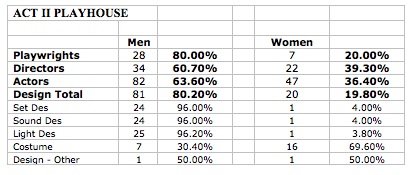
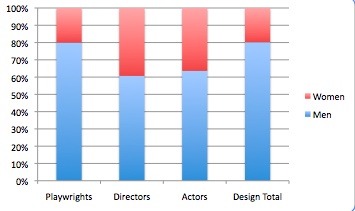
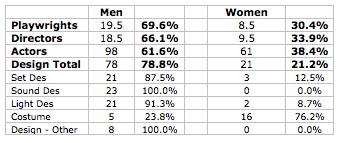
Yesterday we looked at the folks on the upper end. Now let’s look at some people in the middle.  Here are data sets for four mid sized companies: The Lantern, Interact, Theatre Exile, and Act II Playhouse.

Using this website I found the “revenue” listed for each of these companies to be in the mid to high hundred thousands. I’m assuming that’s for the most recent tax filing. For comparison yesterday’s figures for the Arden, People’s Light, PTC, and Wilma had revenues listed at 5.29 million, 4.11 million, 3.95 million, and 3.64 million respectively.  So on the whole we’re looking roughly at an order of magnitude smaller.

This is useful to note for two semi-self evident reasons:

1) Larger companies tend to employ more people and therefore a difference in representation in these companies has a higher impact on the community as a whole.

2) We can make a reasonable assumption that jobs at better funded theaters will tend to pay at a higher pay grade.

This is obviously not always true in every instance, but gives a useful bit of context when comparing numbers across company sizes. Still, unfair representation is, obviously, unfair at any scale.

lantern stats

Lantern graph

interact stats Interact graph
 theatre exile stats

theatre exile graph

act ii stats act ii graph

A

PS –

1) Act II’s data on designers was particularly tough to find (especially for seasons 08/09 and 09/10). This is why the total numbers of designers is lower than the expected based on corresponding number of productions. This data is less complete than the other theaters’ info. If you’d like the raw data feel free to ask.

2) Again, if you want to know how I calculated these numbers you can check back on the PS from yesterday’s post.

True Story

If you give me an ear, I will give you eyes with which to see.
– Kahlil Gibran

True story.

Two years ago, I took a shower. I had just purchased a house in south Philly, most of which needed some major rehab. As such I, and all of the stuff that went along with me (including my fiancée) was confined to one large front room in the house on the second floor. I slept there, ate there, did all my work there.  It was, in essence, a studio apartment in the middle of a three-story row home.

I say all of this to so that you can understand that though technically this space is now my living room, I was very comfortable there.  Unlike most living rooms, I did my most intimate things there. In other words, I was actually living in there.

Which is why I was walking around in it naked. That and it was summer and hot and I was still adjusting to a living space without air conditioning.

It was a Friday morning and as such, was trash day on our block. And I realized this with sudden vehemence as I, naked and sauntering through my living space, walked near to the windows to grab something and made direct eye (among other things) contact with a garbage man outside.

He smiled, nodded and gave me a thumbs up.

It took me a second. Probably a couple. I was a half second away from giving a thumbs up back. Like I said, I was comfortable and in my domestic space, I wasn’t thinking about myself in the subtly different way I do when I imagine myself being seen by others. So it took me that long to realize what had happened. And as best as I can construct the thought process went something like this:

“That guy can see me.”

“I’m naked.”

“I’m a girl.”

“There’s a guy outside looking at my boobs because I’m a girl.”

“I should back away from the window.”

“We really need to get some blinds in this room.”

The truth is, I don’t really care that the garbage man saw me naked. I mean, I guess in a world where I could go back and redo anything that ever bothered me, I might, at some point, go back and erase that event. But on the list of things that I regret or would change about my existence, this is on the very very low end of the list. It’s one that probably wouldn’t be worth the energy to undo.

I don’t usually think about this moment and when I do, I don’t reflect on it with a whole lot of shame or embarrassment. I’ve categorized it in my mind as a silly thing that happened a couple of years ago. But when I was trying to think of a way to introduce the second half of the post for today, it kept creeping back into my mind. Not because of how I see it now after processing it, but for the way I felt the very moment after it happened.

I kept remembering how in that moment before this guy looked at me and I looked back at him I was just “Adrienne”, wandering around my apartment thinking about the day and the stuff I had to do. And then in the moment right afterwards, I was not just Adrienne but “naked female Adrienne” who had been seen (ogled? admired? violated? made to feel beautiful?) by some sanitation worker because I got too close to the window. I kept thinking how aware I became of this one particular aspect of myself. And in thinking about it now, I remember how vividly in that moment I became so aware of the two sets of eyes through which I could view this event.

There was one part of me that looked at this situation in that moment right afterwards and saw no big deal: just a naked person walking past a window that someone sees and makes light of. And there was another part of me that felt different, uncertain, and weird and saw this as a potentially troubling incident: a woman alone in a house who is stared at and then evaluated (thumbs up!) and potentially left feeling sexualized in a way she didn’t agree to.

At moments like these I have a tough time knowing which set of eyes to use. And I’m using this moment as an illustrative point because it helps me try and quantify something that is really difficult to say with clarity or the depth with which I feel it:

It takes work to view the world with dual vision all the time. It is hard to know how and when to apply that second sight.

If somehow I could run this experiment again as a guy standing naked at the window would I think about the fact I was a naked dude or just that I was naked and too close to the window?  Would I interpret the thumbs up as a “hah hah, caught you naked, oh the things you see as a city employee” droll little interlude or would I get a creepy “I’m staring at you and personally up-voting your sexy nakedness” vibe?  Would it have gone down the same way or been different?  And above all – even if I could know that his reaction was in response in some amount to my gender – do I have to care?

Is this something that should bother me?

Sometimes it takes a new vision or angle on something very familiar to know that it is something that should bother people. Sometimes we normalize things we shouldn’t and it takes some one who takes a step back to say “Uh, what the hell? Why aren’t we all seeing this?” It’s awesome when those people do that for us who have the luxury not to notice.  But it’s a lot to ask of those second visioned people to do all that work alone.

Are there situations where people are legitimately undermining or diminishing someone based on their being a woman?  Yes.

Are there times when someone is undervaluing female perspective or representation without realizing it? Of course.

Are there times when choices are made that coincidentally result in unfair gender balance that have nothing to do with gender at all? Absolutely.

I can’t remove the lens that constantly evaluates the world this way. So when I, or anyone with an outsider lens that they view the world with, witnesses something that is potentially disturbing, it it is real mental work to try and suss out which of these scenarios is at its core. Sometimes you’re not sure which is happening. You don’t want alienate people that you care about. You want to believe they aren’t doing things that hurt you on purpose.  But you also don’t believe you can let them continue to make this mistake.

It’s a super tricky dance, deciding how to proceed. That takes effort.

And I’ve mentioned before that sometimes it’s tiring to try and figure it out alone. Sometimes, you just wish you could hand that lens off for a little, try and put it into a forum for debate, and try to ask the people that don’t usually bother to shoulder that task to take up the burden for a little bit.

This is an attempt to do that. It’s an attempt to make the problem of gender imbalance that I see in theater not just a “female” problem but a communal one.

You didn’t give me your ears, but I’m grabbing them anyway. It’s not meant to be an attack, but it is meant to try and give some people that may or may not being making choices intentionally the eyes with which I’m seeing things. And I’m doing it with numbers and graphs because it feels like it’s a little easier to get you to look with my eyes that way.

Over the next few weeks, I’m going to roll out data on gender breakdowns over 6 seasons (12/13 through 07/08) of playwrights, directors, actors and designers in Philly theater productions. I think the numbers speak for themselves in many ways, but at some point, I think I will also add some thoughts about how we might interpret such data and what could be a productive set of actions that might result from it.

So here goes

I thought it might be illustrative to start with four of the largest and most visible non-profits. Below is the raw data with percentages and a graphical breakdown for The Arden, People’s Light, PTC and The Wilma. In all cases the graphs are totals of all 6 seasons of productions and blue in the pie chart indicates men and red indicates women.

ARDEN THEATRE CO.

arden stats

arden pie combined

people's light stats

people's light pie combined

Philadelphia Theatre Company

PTC stats

PTC pie combined

The Wilma

wilma stats

wilma pie combined

There’s an awful lot more blue.

A

PS – Some notes on methodology:

1) These numbers are based, when available, on information provided by companies on their websites.

2) For any info not listed online by the company itself I have searched online reviews to confirm missing information, ideally from more than one source when possible.

3) Many seasons (most especially the current one) have incomplete listings and are indicated as such in the raw season by season data (which anyone is welcome to request).

4) The raw numbers indicate a slot in which a male or female is chosen to fill a position and not total number of different individuals hired. In many cases the same person directs, acts, designs, etc multiple times at a venue.

5) In the case of adaptors, translators, and multiple authors I have evenly split writing credit across all names listed. While I recognize this may overvalue on creator’s input from the reality of a particular project, I believe that will balance out over the entire data set and removes me from making personal judgment calls. For example, in a translation of a classic work by a male author with a female translator I would give .5 playwright credits to each gender. For musicals I have similarly split credit among composers and lyricists.

6) For ensemble-generated works I have excluded playwright credits unless specifically listed.

7) Shows calculated are those that are listed as part of their regular season. Benefits, special events, and fundraisers are not included.

8) I have listed designers as a combined figure but also shown breakdowns by category which differ vastly in some cases.

In defense of messy, ill-conceived nonsense

When I was in high school I used to have this recurring dream.

(Is there anything less interesting than other people’s dreams? Alas, we soldier on…)

In my dream I am always sitting in the backseat of a car, something halfway between a cab and a limo. I am sitting faced forward and looking at the rear head rest of the driver’s side seat.

It is quiet. The car is humming along. There is a small rocking back and forth. It is night and very dark and headlights bob ahead in the distance.

I am sleepy. Heavy. And this is the moment I notice the person to my right.

We are close and it is warm and cocoon-like in our nearness. The backs of our hands are close enough to feel the hairs brush past each other.

And then with suspension and a breath catching softness, that person and I decide to hold hands – my right in their left. Soft and warm and simple. We do not look. We simply touch and ride and shake in the gentle back and forth of the darkness.

And that’s when I wake up.

When I usually tell this story, I put a postscript on it. I say the person was different every time. I say that there was nothing overtly sexual in what was happening. I say I can feel the feeling of holding their hand like I can hold an object right this moment. I know it with a palpable familiarity.

These are true things.

There were a startlingly various number of people that held my hand in the back of that car. Alan Lewis who played Jesus in Godspell my freshman year. Octavio Lara who had a thin mustache and worked at a Starbucks near to me. Isabel Lazo who’s family owned an awesome Mexican restaurant in downtown Chicago.  Sara Swain, my 8th grade best friend. Tom whose last name I don’t remember who played Smee in my community theater’s production of Peter Pan and called me “Wendy, Dahhlling.”

I also used to say that the person sitting next to me was always someone I was in conflict with. I always explained this dream as a subconscious effort to resolve some sort of internal dispute. It was my way of working out something that was bugging me about that person. It was my lizard brain’s way of getting over a grudge.

That’s the part that’s not totally the truth.

I think that I add this last bit when explaining the dream because of this: it felt so real. It was so intensely emotional an experience. It seemed like there had to be some higher reason for it. What happened after I held hands with someone in that car at night was that I felt like I was in love with them.

I don’t mean in a 16 year old crush-y kind of way. I mean this intense red enveloping ensnaring feeling of love for another human being. And though there were people like Alan that I was definitely feeling sexual about (oh beautiful Jesus/Alan and his curly curly hair) this feeling was something a bit unlike anything I had words for. I would wake up and feel this sensation from the tips of my toes right through those fingers that had falsely felt that other person.

It seemed that I had become one with this random set of semi-strangers. I loved them. I felt like I knew them. It seemed as if we had shared something deep and tender.

But of course, “we” had shared nothing.  I had felt moved by this wave of emotion, but that wave only existed in me. It was intense and consuming, but it wasn’t something that the person and I had in common.  So it was a little awkward to meet up with these folks in real life, feeling so intensely about them and wanting to re-connect to that magical feeling of one-ness. Almost a little like the feeling of getting a bit drunk with a friend and proclaiming an eternal bond and love. In the moment it’s so palpable and that next day it’s all a bit of a fog. A cheap trick of the wine.

I think I put that PS on the dream because the feeling was so real and meant so much to me, that I needed to explain it somehow.

We do this with our works, don’t we? We do this when we see things that move us. They make us feel so much that we believe we must make sense of them. We must understand what in them is doing that. We have to make sense of why we’ve made them and how they work on us. We must explain to others what we’ve done.

I want to make a case for removing that PS in our art practice.  I want to make a case for just enjoying the hand holding, regardless of what it might mean.

I could invent a reason that I’d have to resolve something with Tom or Sara, but that was put on after, it wasn’t really part of the dream. The real message wasn’t some deeper intellectual machination. It was the beautiful and encompassing feeling. It was the fact that I, as this young person, for the first time felt opened up to being filled so full.  The feeling was the point. It was the totality of what was happening. And by pretending that it was about something else – a hidden desire to resolve interpersonal conflict that doesn’t really exist – it makes the thing that it really is a bit less mysterious and lovely.

Sometimes our work is just that, two people holding hands in the back of a car in your dreams. It’s not there to explain or “do” anything else. It is meaningful because it allows us the opportunity to open up to feelings we’ve never known in our actual lives. Perhaps they’re feelings we couldn’t know outside of this place. And I think there’s a pressure often to want the work to be more than that. I think that especially as Americans we want to know that we’ve gotten to the bottom of the thing, achieved whatever goal is there to retrieve. And feeling for the sake of itself is a tough sell.

Sometimes a color or a sound or a movement doesn’t have to be unpacked. It is simply something that springs from us. And when it springs, let us be brave enough to simply share it, to let another inhabit it so that they might know it too. Let us dare not to explain or dissect. It may be messy. It may make no sense. But it is of us, and from us, and to try and fit it into a box may squeeze out of it what was wonderful.

The problem with my PS to that story is that it leaves no room for you.

Without the add on there is a chance that I could tell this story and through its sheer force you too might imagine yourself in that car with a person you barely know and for a moment imagine that liquidy, heated, big fat and filled up feeling coursing through you.

But the PS pulls it away. It puts it behind glass and makes it a specimen of my brain that is a product of interpersonal influences A, B and C.

It means that the feeling I had has to have a reason. It means that when I tell it, there’s no chance for you to fill in the how and whys of that feeling in yourself. There’s no space to be in that car and see what that feeling might be in your own body.

As if that isn’t enough.

As if the ability of a creator to give another person the chance to sink into a love or a sadness or a change in breath isn’t a tiny miracle in itself.

– Adrienne

Criticism

Lemming_bw

One of the things that I really love about Philadelphia is the supportive nature of the community. We are, by and large, a city that prizes community over competition. I’ve had people who’ve taught me to write grants, given me tips on where to find cheap equipment, loaned me costumes, offered me innumerable rides, donated space, the list goes on and on and on. Lest we forget, there are a lot of places that aren’t like that. There are a lot of artist communities where the initial instinct is to undercut each other to get oneself ahead.

This is Philly’s superpower.

Sometimes, though, it also feels a bit like our kryptonite.

In our instinct to be kind and supportive, is it possible that we are sometimes TOO nice? Too nice in a way that isn’t actually genuine. If we aren’t willing to receive and encourage useful and productive critique, do we doom ourselves to a community-wide creative dialogue about our work that is surface level only?

There is a right and a wrong way to offer constructive observation. We’ve all had experiences with a peer or critic who speaks or writes about our work in a reductive way that focuses on a tiny issue or comes from a personal perspective that doesn’t take into account the  project’s overall aim or discourse.  We all have been there when a particularly nasty something comes out and seems to be there simply to wound.

On the other hand, I also find an unspoken pressure to always have a cheery, unequivocal rave response to anything I see.  I feel the need to do it. And I feel it from people I see after my shows, this plastic face people put on with a giant smile and that horrid, omnipresent phrase: “Great job! Congratulations!”

When I was in college I took the simplest directing class in the world. We got an assignment and then once each week presented the work we’d been doing to the other classmates, their respective casts and the professor. It became our artist community. We learned how to talk about what the piece was trying to do, how we all felt it was doing on that front, what frustrations and exhilarations the process was offering and any other observations that might be useful.

There were times some pieces got more laughs. There were times some pieces made us cry. There were times when the work seemed super hot and others when it was stuck in the mud. Everyone’s stuff went through highs and lows and over time, you learned that one week’s success was nothing to get too boastful about because a few weeks later you were bound to be feeling lost in the artistic forest. But that openness of dialogue meant that I always felt like I was getting a real beat on what kind of responses my theater was provoking. I loved that chance to really talk and share what I was doing with people that would watch with keen eyes and interested minds.

Even after I finished that track of courses, it felt like those that I’d shared the experience with were still able to hold on to that sense of interest and honesty as we moved into new projects. I liked coming out of a show and having them ask questions about what the piece was trying to tackle and having a genuine conversation about when it was (and wasn’t) doing what I’d set out to do. In many cases, the opinions were wildly different, which was SO incredibly useful. People picked up things that I hadn’t intended or missed giant swaths of stuff that I thought were obvious.

I’ve found myself every once in a while back in a situation like this – in my voice training programme for Roy Hart, in the LAB fellowship, in a small circle of directors that make similar work – but it feels notably absent in the majority of interactions I have with other artists in Philly. More so than in other places I’ve lived and worked in. Am I alone in thinking this? I don’t think so.

Again, I think it comes from being, on the whole, a small supportive community. But like many small supportive communities, we have to be careful about gentleness to a point of over-protectiveness. I think this impulse is worrisome not only because it gives us a false sense of how our work lands with people, but because it encourages us to think about our work as “good” or “bad.” If we make complex work, that has lots of layers, especially from scratch, it’s likely that it will be neither of those things. Or it will be both. It will be “it.”

If I see a raucous comedy show and I come out with my sides in pain from laughing so hard, is that the same “good” as an emotionally turbulent sweeping drama about genocide that leaves me numb and raw at the same time? Of course not. But I do what everyone does when they see people after a show, “You were great, congrats.” Or “Congrats! What a great play.” Or “Great job. Congrats.”

At this point, the congrats/great is so ubiquitous as to be an empty gesture. It had become so devoid of meaning that I used to see any sign of anything other than complete and total positivity to be a mask for hatred or disgust. Which was crazy making. So I’ve pretty much stopped listening to comments post-show. I assume they don’t mean anything and that the comments that people have that will mean something aren’t going to be said to me. Which is too bad. Because I think I could probably use them more than whoever else they’re going to be said to. But it feels like there’s not a lot of space to hear real responses.

Congrats. Great. Congrats. Great. Congrats. Great. Like we’re all some kind of “congrats/great” artist lemmings constantly running up to friends, “congrats/great” hugging them and running away to leave them to receive the next “congrats/great” in a giant “congrats/great” receiving line.

When someone says that to you, does it mean anything? Especially when you know a play isn’t simply “great,” (maybe it’s complicated, in-progress, raw, beautiful, heart rending, personal, silly, unfinished, whatever) when it’s something that is more complex that just “great” does that “congrats” mean anything? Wouldn’t you rather that same person just walked up to you and said “I was here for you” or “I am so happy I got to see what you made.” Because, really isn’t that what you’re trying to say?

Regardless of how “good” or “bad” the thing that the person made was, you’re coming up to them because you’re saying “I support you in this crazy endeavor. I know that you, like me want to make something that moves your fellow human beings in some way. And you did it! You threw your heart and sweat into this thing and now it’s been put out in front of all these people. And I was here! I saw it and now I’m seeing you and more than anything I want you to know that I am proud of you.”

At least that’s me. After a show, when I see my artistic peers, that’s what I want to hear. Not that you loved it or hated it, but that you came and you saw the work that I did and likely you know what it took to do what I just did.

I can understand if you’re in a place where you don’t trust people, where you feel like they might undercut, where their motives aren’t in your best interest, you might not want someone’s advice or response. But this is a town where I feel like respect and trust are pretty flush. And you are a bunch folks whose real opinions I’d want to hear. Because I doubt that what I make is only great or terrible. It’s a lot of things, many of which I probably don’t even know.

I am here to learn.  Most things I make are in progress. And all of them are still conversation as they enter into performance. I wish there was a way to let people know that it was ok to be however they are after seeing the thing I made – happy, sad, confused, alienated, indifferent, or pensive – and that they have permission to express that being in whatever way they can, without worrying about whether it’s great. Without needing to give me congrats. Seeing them is great congratulation enough.

Next time after a show just walk up to me and say, “No lemming?”

And then I’ll say “No lemming.”

And then you can say whatever you want.

A