gender

Heavy

35.9% of Americans in 2009-2010 were considered “obese” by the CDC. An additional 33.3% were categorized as “overweight.” That means at that moment, 69.2% of the country is heavier than “normal.”

When we go to the theater what are we looking to see ourselves reflected in the stories portrayed on stage?

If so, why don’t two thirds of them look like two thirds of the country? If not, are they the images we wish ourselves to be? Or are they simply supposed to be the strongest creator available for the role, and if that’s the case, why are so many more of them than us so much thinner?

Do you notice how carefully I’m wording things here? I do. Have you noticed that I haven’t used the “F” word yet? I do. It’s hard to write objectively about this. This is such a tricky subject. It is so sensitive. But it dominates so thoroughly the vision of our stages that I’m going to stop dancing around and just say it:

It is hard to be a fat actor.

It is hard if you are not fat, but a little heavy. It is hard if you aren’t fat but could be and fear becoming so. It is especially hard if you are a woman.

There might be a few reasons that don’t point toward malicious bias. Heavily dance or physicality based works are going to require a higher level of physical strength and endurance and result in a larger expenditure of energy.  While that does not exclude a heavier performer, I think it makes some logical sense that you’ll get a higher proportion of people who are thinner, which is probably somewhat correlated to long days of exercise and physical activity.

Being fat might make it harder to do your job… maybe. But it might not. And I think it’s rarely the full reason that certain kinds of roles are off limits to certain BMI’s.

Because that argument just doesn’t fly when it comes to a lot of theater. It is possible to be in tune with one’s body even with “extra” weight. And if the performer doesn’t limit themselves, why do we limit the roles that are open to them? Why are we instinctively so nervous about seeing certain shapes do certain things onstage? Are we grossed out, worried, upset? What is it? Forget the gender gap, the racial paucity; I defy you to find me a show full of “fat” actors in Philly. You will not be able to.

If you are doing Grapes of Wrath and everyone is starving, fine, I understand. But show me where it says that Emily Webb from Our Town has to be skinny. Yet I’d stake my savings that 9 times (or more) out of 10 the thin girl gets the role.

Look, I don’t pretend to be objective here.

I have a long and complicated history with weight, one that has spanned both ends of the size spectrum.  At 13, I probably weighed somewhere in the neighborhood of 180 or 190. I don’t really know, because I didn’t go near a scale if I could help it. My grandmother used to chide me with reminders like, “Fat girls don’t get married.” An aunt once remarked, “Adrienne eats like it’s war.”

By my own admission, I was not happy with my body. I hated it. And to compensate I retreated into my brain. I was at war with the free and uninhibited person I felt like on the inside and the tight, closed off and frustratingly clunky form I had on the outside. Which was why late in my 14th year my mom intervened, told me that she loved me no matter what but that if I wanted, she would help me develop a healthier set of eating habits.

Which I did. Sort of.

That summer I started paying attention to the things I put in my body. I stopped housing bags of Doritos absent mindedly. I started exercising on a consistent basis for the first time ever. I learned to really enjoy cardiovascular work outs. I realized that it helped allay my natural tendency toward anxiety. I felt better. I liked how I looked. I was proud of myself for doing it.

Then I went back to high school. I felt so much better, I was so much more excited to be seen. I got the only female lead, as a sophomore, in the first play of the year. I was bumped into a higher level choir and auditioned and was selected for the state competition. I got a boyfriend, which I’d never had. People suddenly paid attention to me. I got friends in the older kid crowd. I felt on top of the world. The change was so sudden and so total and so completely timed with the shift in outward form that it seemed impossible to extricate the experiences of that year from the process of losing all that weight.

The truth is of course not so simple. Yes my outer self had changed, and because of that I allowed more of the person I really felt myself to be to shine through. All the confidence and brazenness and smartness and silliness I always had suddenly seemed like it had a venue to be shown. I had just finally given myself permission.

But of course at the time I associated my new-found creative and personal successes with being beautiful. And I associated that beauty with being thin. And so when I had to wear a bathing suit onstage, I lost another 15 pounds. And when I played Wendy in Peter Pan and was told to try and look younger, I lost another 10. It became a game, the weight loss. One that I assumed would just continue to result in rewards, in a better and better version of myself.

I would go out with friends and eat watermelon for dinner to save on calories.  I worked out a couple hours after donating blood in 90 degree heat. (PS, I didn’t eat the cookies). I was obsessed with food and thought about it ALL THE TIME.  I fixated on my “big hips” which I couldn’t do a damn thing about because I had whittled them down to jutting bones. I want to look back at 18 year old Adrienne and say, “You actually can’t workout your way to a smaller pants size if you have a wide skeletal pelvis. Maybe put some of that energy into learning your lines.”

At my thinnest, I was somewhere around 104 or 105 depending on how much water I’d had that day.

I’m 5’6” by the way.

And that was the point at which my mom said I was done losing weight. If you consider the standard BMI measurement useful (which is super questionable) I started just on the cusp of officially “Obese” and plummeted down well below “Underweight.”

I got over it. College food helped. Learning to love weight lifting helped. I work hard to focus on feeling strong, quick and agile rather than simply thin.

This blog isn’t an autobiography. And I don’t bring up this story for sympathy, though I bet many people reading this who can sympathize. But my story is not the same as many others. There are people who are beautifully in tune with their bodies regardless of their body fat index. Who are graceful and flexible and could be called fat. In fact just this afternoon I was talking to a friend who said that gaining a bunch of weight after having a kid helped her to realize that her creative talent wasn’t dependent on her staying small.

The point is that I felt able to embrace and believe in a fuller vision of myself as a creative person when I thinned up. Until that point, I’d always loved theater. I participated in middle school and my first year of high school. I’d had lovely, nearly transcendent, experiences. But I didn’t believe that I was eventually going to be one of those seniors that got out front and center. Based on the things I’d been cast as before – Mrs. Hannigan, the mom in Music Man, Golem in the Hobbit, ensemble member in Godspell – I figured I’d find a niche in the strong character roles that I’d seen other heavy girls play.

When I came back that summer lighter, I was so upset that they’d switched the fall play from Arsenic and Old Lace to a Neil Simon romantic comedy. I knew I could kill at those funny old ladies I’d been practicing all summer. But it didn’t occur to me that my lovely voice, passion for acting and intelligent incisive attack of text could put me front and center.

I couldn’t be a leading lady. Not if I was fat. And in my head I still was.

I auditioned for that show’s sole female part – an ingénue role – with little expectation. But during the audition process, I began to realize that people saw me differently now. And no doubt, the confidence that blossomed that show, that year, had to do with the fact that for the first time, I believed myself capable of ANY kind of role, ANY kind of creation. I could make people laugh or cry or sigh. I felt like I had control over my creative destiny. And I assumed all of that had to do with the new exterior through which those things were expressed.

I believe with every fiber of my being that there is no way I would have gotten that part if I hadn’t been thinner than the year before. And some days I really wonder if I hadn’t lost all that weight if I would have believed in myself with the same vehemence and confidence. And without that, I wonder if I’d have bothered continuing with acting, found directing and do what I’m doing today.

Two thirds of people in this country are “heavier” than “normal.” How many of those people do we see on the stage? How many stories do we tell that can include that perspective? And more importantly, how many kinds of characters do we unconsciously limit the size of, regardless of the actor’s ability to embody the role.

When was the last time you saw a heavy Juliet or a pudgy Romeo?

I’m left with lots of questions and not a lot of answers. Is this inevitable? Who’s driving it? Why does it happen?

And if it bothers us, what can we do about it?

A

Middle of the Road

Yesterday we looked at the folks on the upper end. Now let’s look at some people in the middle.  Here are data sets for four mid sized companies: The Lantern, Interact, Theatre Exile, and Act II Playhouse.

Using this website I found the “revenue” listed for each of these companies to be in the mid to high hundred thousands. I’m assuming that’s for the most recent tax filing. For comparison yesterday’s figures for the Arden, People’s Light, PTC, and Wilma had revenues listed at 5.29 million, 4.11 million, 3.95 million, and 3.64 million respectively.  So on the whole we’re looking roughly at an order of magnitude smaller.

This is useful to note for two semi-self evident reasons:

1) Larger companies tend to employ more people and therefore a difference in representation in these companies has a higher impact on the community as a whole.

2) We can make a reasonable assumption that jobs at better funded theaters will tend to pay at a higher pay grade.

This is obviously not always true in every instance, but gives a useful bit of context when comparing numbers across company sizes. Still, unfair representation is, obviously, unfair at any scale.

lantern stats

Lantern graph

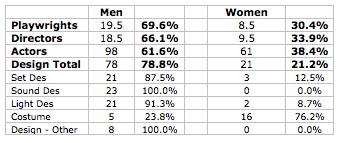
interact stats Interact graph
 theatre exile stats

theatre exile graph

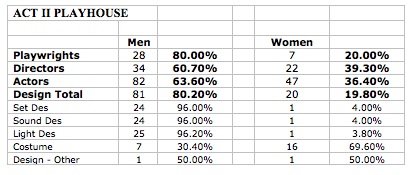
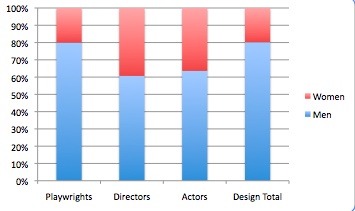
act ii stats act ii graph

A

PS –

1) Act II’s data on designers was particularly tough to find (especially for seasons 08/09 and 09/10). This is why the total numbers of designers is lower than the expected based on corresponding number of productions. This data is less complete than the other theaters’ info. If you’d like the raw data feel free to ask.

2) Again, if you want to know how I calculated these numbers you can check back on the PS from yesterday’s post.

True Story

If you give me an ear, I will give you eyes with which to see.
– Kahlil Gibran

True story.

Two years ago, I took a shower. I had just purchased a house in south Philly, most of which needed some major rehab. As such I, and all of the stuff that went along with me (including my fiancée) was confined to one large front room in the house on the second floor. I slept there, ate there, did all my work there.  It was, in essence, a studio apartment in the middle of a three-story row home.

I say all of this to so that you can understand that though technically this space is now my living room, I was very comfortable there.  Unlike most living rooms, I did my most intimate things there. In other words, I was actually living in there.

Which is why I was walking around in it naked. That and it was summer and hot and I was still adjusting to a living space without air conditioning.

It was a Friday morning and as such, was trash day on our block. And I realized this with sudden vehemence as I, naked and sauntering through my living space, walked near to the windows to grab something and made direct eye (among other things) contact with a garbage man outside.

He smiled, nodded and gave me a thumbs up.

It took me a second. Probably a couple. I was a half second away from giving a thumbs up back. Like I said, I was comfortable and in my domestic space, I wasn’t thinking about myself in the subtly different way I do when I imagine myself being seen by others. So it took me that long to realize what had happened. And as best as I can construct the thought process went something like this:

“That guy can see me.”

“I’m naked.”

“I’m a girl.”

“There’s a guy outside looking at my boobs because I’m a girl.”

“I should back away from the window.”

“We really need to get some blinds in this room.”

The truth is, I don’t really care that the garbage man saw me naked. I mean, I guess in a world where I could go back and redo anything that ever bothered me, I might, at some point, go back and erase that event. But on the list of things that I regret or would change about my existence, this is on the very very low end of the list. It’s one that probably wouldn’t be worth the energy to undo.

I don’t usually think about this moment and when I do, I don’t reflect on it with a whole lot of shame or embarrassment. I’ve categorized it in my mind as a silly thing that happened a couple of years ago. But when I was trying to think of a way to introduce the second half of the post for today, it kept creeping back into my mind. Not because of how I see it now after processing it, but for the way I felt the very moment after it happened.

I kept remembering how in that moment before this guy looked at me and I looked back at him I was just “Adrienne”, wandering around my apartment thinking about the day and the stuff I had to do. And then in the moment right afterwards, I was not just Adrienne but “naked female Adrienne” who had been seen (ogled? admired? violated? made to feel beautiful?) by some sanitation worker because I got too close to the window. I kept thinking how aware I became of this one particular aspect of myself. And in thinking about it now, I remember how vividly in that moment I became so aware of the two sets of eyes through which I could view this event.

There was one part of me that looked at this situation in that moment right afterwards and saw no big deal: just a naked person walking past a window that someone sees and makes light of. And there was another part of me that felt different, uncertain, and weird and saw this as a potentially troubling incident: a woman alone in a house who is stared at and then evaluated (thumbs up!) and potentially left feeling sexualized in a way she didn’t agree to.

At moments like these I have a tough time knowing which set of eyes to use. And I’m using this moment as an illustrative point because it helps me try and quantify something that is really difficult to say with clarity or the depth with which I feel it:

It takes work to view the world with dual vision all the time. It is hard to know how and when to apply that second sight.

If somehow I could run this experiment again as a guy standing naked at the window would I think about the fact I was a naked dude or just that I was naked and too close to the window?  Would I interpret the thumbs up as a “hah hah, caught you naked, oh the things you see as a city employee” droll little interlude or would I get a creepy “I’m staring at you and personally up-voting your sexy nakedness” vibe?  Would it have gone down the same way or been different?  And above all – even if I could know that his reaction was in response in some amount to my gender – do I have to care?

Is this something that should bother me?

Sometimes it takes a new vision or angle on something very familiar to know that it is something that should bother people. Sometimes we normalize things we shouldn’t and it takes some one who takes a step back to say “Uh, what the hell? Why aren’t we all seeing this?” It’s awesome when those people do that for us who have the luxury not to notice.  But it’s a lot to ask of those second visioned people to do all that work alone.

Are there situations where people are legitimately undermining or diminishing someone based on their being a woman?  Yes.

Are there times when someone is undervaluing female perspective or representation without realizing it? Of course.

Are there times when choices are made that coincidentally result in unfair gender balance that have nothing to do with gender at all? Absolutely.

I can’t remove the lens that constantly evaluates the world this way. So when I, or anyone with an outsider lens that they view the world with, witnesses something that is potentially disturbing, it it is real mental work to try and suss out which of these scenarios is at its core. Sometimes you’re not sure which is happening. You don’t want alienate people that you care about. You want to believe they aren’t doing things that hurt you on purpose.  But you also don’t believe you can let them continue to make this mistake.

It’s a super tricky dance, deciding how to proceed. That takes effort.

And I’ve mentioned before that sometimes it’s tiring to try and figure it out alone. Sometimes, you just wish you could hand that lens off for a little, try and put it into a forum for debate, and try to ask the people that don’t usually bother to shoulder that task to take up the burden for a little bit.

This is an attempt to do that. It’s an attempt to make the problem of gender imbalance that I see in theater not just a “female” problem but a communal one.

You didn’t give me your ears, but I’m grabbing them anyway. It’s not meant to be an attack, but it is meant to try and give some people that may or may not being making choices intentionally the eyes with which I’m seeing things. And I’m doing it with numbers and graphs because it feels like it’s a little easier to get you to look with my eyes that way.

Over the next few weeks, I’m going to roll out data on gender breakdowns over 6 seasons (12/13 through 07/08) of playwrights, directors, actors and designers in Philly theater productions. I think the numbers speak for themselves in many ways, but at some point, I think I will also add some thoughts about how we might interpret such data and what could be a productive set of actions that might result from it.

So here goes

I thought it might be illustrative to start with four of the largest and most visible non-profits. Below is the raw data with percentages and a graphical breakdown for The Arden, People’s Light, PTC and The Wilma. In all cases the graphs are totals of all 6 seasons of productions and blue in the pie chart indicates men and red indicates women.

ARDEN THEATRE CO.

arden stats

arden pie combined

people's light stats

people's light pie combined

Philadelphia Theatre Company

PTC stats

PTC pie combined

The Wilma

wilma stats

wilma pie combined

There’s an awful lot more blue.

A

PS – Some notes on methodology:

1) These numbers are based, when available, on information provided by companies on their websites.

2) For any info not listed online by the company itself I have searched online reviews to confirm missing information, ideally from more than one source when possible.

3) Many seasons (most especially the current one) have incomplete listings and are indicated as such in the raw season by season data (which anyone is welcome to request).

4) The raw numbers indicate a slot in which a male or female is chosen to fill a position and not total number of different individuals hired. In many cases the same person directs, acts, designs, etc multiple times at a venue.

5) In the case of adaptors, translators, and multiple authors I have evenly split writing credit across all names listed. While I recognize this may overvalue on creator’s input from the reality of a particular project, I believe that will balance out over the entire data set and removes me from making personal judgment calls. For example, in a translation of a classic work by a male author with a female translator I would give .5 playwright credits to each gender. For musicals I have similarly split credit among composers and lyricists.

6) For ensemble-generated works I have excluded playwright credits unless specifically listed.

7) Shows calculated are those that are listed as part of their regular season. Benefits, special events, and fundraisers are not included.

8) I have listed designers as a combined figure but also shown breakdowns by category which differ vastly in some cases.