theater

Sell Out

I wrote a bit last week about the difference that can occur between the way an artist lives their life and the way almost everyone else does. I’ve been thinking a bit more about that difference and what’s been hitting me especially hard is the strange and terrible relationship most artists have to money. I think this issue in particular – how we think about money, what it means in relation to our work, and how we decide to navigate that relationship – has a lot to do with why so many of us feel like no one understands how we live.

While it’s obviously simplistic to reduce an entire nation into one value system, in my own experience I can say that I often find myself a little at odds with the American context in which I exist. Ours is, and of course I’m generalizing, a culture that places a high value on earning as a measure of success. And because of that, it’s one that makes justifying the life of an artist particularly tough, tougher perhaps than countries whose wealth it exceeds.

I would wager that on the whole, the impulse to make and share our work is anti-monetary. Artist are in a rush to give away their product, especially when they first start making it. I would also wager that the impulse to “own” ones work like a product or thing is a learned skill. It’s something we find ourselves having to do, not something that is inherent to the thing itself. Of course this is not always true, and not always true of everyone, but for the purposes of this article, I’m again going to generalize and say that on the whole the artistic process is one that is at its core financially altruistic, and therefore at odds often with commodification. (Read Lewis Hyde’s wonderful book The Gift for more on this.) We do it because it’s what we really want to do. And for whatever reason, we’ve managed to value doing that higher than we value making it value driven.

Think about how radical a notion that is. Seriously.

For most, the conversation about how to navigate career is so thoroughly dominated by money that it’s almost hard to imagine how deeply strange it is to most people. No one is surprised that a doctor might choose a specialty that pays more, but we often feel guilt about picking a role or working with a company for the same reason. We make our work and then we are dying to give it away. We are inclined (and often do) so whether or not other people want to pay us. We don’t want to choose jobs on solely on income potential but equally (if not more) on artistic merit. The fact that you feel that at all means you have decided to step outside a value system that many people accept as a large guiding path in their entire lives.

And weirdly, because art does live outside of this metric in some ways, I think the oddity of such a thing, the mystery of how art can “charm” people out of this traditional way of thinking, becomes romanticized in its own right. We think about “poor” art as something that must be so enrapturing and enthralling that one would give up money to do it. Even I still bring forth the specter of the young impassioned creator in a terribly tiny apartment and having no money but loving your art so so so much that it’s worth it. This is in the cultural subconscious and it’s something we have to contend with.

But we’re not oblivious. There are tangible ways that money matters: it influences who has power and status, it can give us access to security and education, it feeds and houses us, and can give us cool stuff. Wealth can determine an artist’s path – to pursue art in the best way that the work demands or to make difficult choices about the kinds of personal investment they can leverage or the resources and programs they have access to. Frustratingly, training in the arts is almost always expensive. Compensation in the career is generally not. As creators we don’t want to care about it, but as citizens in this country we see we need it. We don’t want to make our work about the money, but we also don’t want the people we work (or ourselves) with to live in an unhealthful and unsustainable way.

This must be why some parents bitterly resist their children embracing a life in the arts. If you don’t have the experience of the intensity and depth of the artistic practice and experience, of course doing such a thing looks like a waste – like deciding to work at the GAP when you could be saving lives in the medical professional or running a business. Not all artists are poor. But in general, a great painter or theater actor or dancer is not making the same income as a doctor or lawyer. We are indoctrinated early that we do our work for love and not money. We are told ad nauseam by our society that “starving” and “artist” are nearly synonymous.

So as artists, we live daily with some pretty insanely contradictory attitudes and behaviors in relation to money. There are a lot of voices saying that we should want to make a lot of money if we’re good at what we do and there are a lot of voices also saying at the same time that if we are doing this art thing then it must be fulfilling enough to do for it’s own sake.

Take for example the phrase: “Sell out.” What’s your gut reaction to it? Is it good or bad? Well, it all depends on what context you’re looking at.

When you are mounting a new work there is this thing that happens when a show starts to “sell out.” This is true even outside of the self-producer realm, where you actually are counting the dollars that those ticket sales are bringing in. Yes, I’d say even in a straight up “actor for hire setting,” if you’re a “sell out” show there is a sense of accomplishment, of pride, of elevation in your work having reached a certain kind of level. That it’s something people connect to. Even if you receive not a single extra cent for the sold out-ness, it makes you feel better, doesn’t it?

What does that phrase even mean? Literally, that all the seats were bought. But it’s come to roughly equate with artistic quality. If all the seats are bought it must be valuable. And if it’s valuable it must be good or why would so many people pay for it? Conversely, there’s an unspoken pressure that says if a beautiful and amazing production has few buyers that something is wrong it. It’s a value system that isn’t concerned whether a piece happens to have picked a bad time of the year to perform. Or that the subject matter happens to have a smaller audience base but for that base the work is HIGHLY impactful. Or that your 3/4 full houses absolutely LOVE your show compared to the full houses for the work down the street that is merely entertaining enough to spend 20 bucks on. It’s a message that uncomplicatedly says more money equals better art.

Even if you know it’s not true, it’s still working on you somewhere in the back of your mind. So it’s worth sometimes saying out loud, even when it seems obvious, that small houses don’t mean you’re a bad artist. You might be, but the two aren’t necessarily related.

And weirdly, while on the one side we’re putting pressure on ourselves to be financially successful, we also have another voice inside telling us that making art for money is a cop out, a cheapening, a bastardization of the “true” impulse for creation. “Sell out” also has the connotation of the artist that is corrupted by money, who makes their work for financial gain alone and has lost touch with a “real” creative spirit. We tend to romanticize the bohemian life, both from within and outside the profession. It’s also a fallacy, this idea that our work without the pressure of money is “purer,” but it’s equally as potent.

It is strange, no, that the exact same phrase is both an indicator of our highest measure of success as well as a total debasement of the form. It is a frustrating dissonance that an art maker is trying to navigate all the time. And if we aren’t vigilant about what the goal is at a given moment we can end up in a kind of schizophrenic negativity where no matter what we do we’re coming up short.

Look, if we only made the work that made the most money, we’d probably cut out the most ambitious, and personally fulfilling projects. And yet, it’s also true that there are limitations on what’s possible with our work and those limitations are often determined by a project’s bottom line.

There are times I’ve looked back at works I made with a thousand dollars and felt wistful about the “purity” of my choices. I look at that work and think about how I did it just because I loved the art, that it was uncomplicated and “true” (or whatever). But, really, when I’m honest, that’s pretty BS right? The impulse for the work wasn’t actually less complicated by money, I was just making the same kinds of choices about how and where to allocate cash but on a much tinier scale.

I think that as we become more successful, we more obviously have to confront these questions – how does money work in out work, what do I spend it on, what kind of aesthetic am I after and how does cost play into that – but I don’t actually think they are new.  People who want to always spend all the cash on fancy stuff do it when they have a little. They do it when they have a lot. We just notice it more.

And troublingly, I have no good answers here. Just an observation that we, like everyone, have to figure out what standard of living we want and what we are and aren’t willing to do to achieve it. What we can do is not abdicate the decision to others but continue to make it for ourselves. You can argue whether you agree with the way that America equates wealth with success and decide how much you’re willing to let it influence your goals in life. You can create a work environment you believe in and pay people whatever you decide you want to and allow them to make the choice if the monetary recompense is equal to the task. Your project can lose money or knock it out of the cashola park. It can be the best thing your ever made or a total hack job. With every choice there are two assessment tools we need to use – one financial and the other artistic. And it’s up to you to decide which one needs to take precedence at this particular moment.

We don’t want to make money the value on which we measure our creations, so we should be wary of allowing it become an indicator of our success. On the same token, our ability to make work is predicated on the rest of our life being functional enough to keep the artistic part going. Money plays a part in that.

I don’t want money to drive my art making process.

I want to make enough money as an artist to live sustainably.

Two statements.

Two totally different standards of measurement.

So the trick is to remember that they have to be either/or and they don’t have to be correlated directly. They both are like spinning plates that I need to pay attention to in order to keep them in balance. Which might mean a little nudge on one for a while and then run back and push on the other a little.

And my guess is that I’ll always have to keep an eye on that balancing act.

– A

How the other half lives

Right after I finished college, during my “anthropology experiment” phase of online dating I went out with this guy who was going to Wharton.
 
I was worked at a coffee house off Rittenhouse square near his apartment which was about the extent of what we had in common. So usually, I’d finish work, we’d go to some bar nearby and sit there staring at each other a bit bemusedly and ask each other questions. Usually our conversations went something like this:
Guy: So ok, let me get this straight: You got this incredibly expensive education and a degree in chemistry. You could be going to med school or grad school.
 
Me: Yeah. But I realized that I wanted to do something else that meant more to me.
 
Guy: So instead you’re working as a barista?
 
Me: Well, for now. I’m making money so that save enough to take time off and pay for stuff to do what I really want to.
 
Guy: Which is?
 
Me: Make plays.
 
Guy: So you’re working a crappy job that doesn’t pay you much so that you can take time off and work more on something that doesn’t pay you at all?
 
Me: I guess. I don’t really see it that way. And eventually I’ll be making some money doing theater, not a lot, but enough to live.
 
Guy: Weird.
 
Or if I was asking the questions, it would go something like this:
Me: So ok, let me get this straight: You don’t really like finance. But you’re going to this school for business. And the plan is that someday you’ll move to New York and get this job that works a million hours a week.
 
Guy: Yeah but it pays a TON of money.
 
Me: Will it be interesting? Will you like the work or find it rewarding?
 
Guy: No. But I can retire really early and do whatever I want.
 
Me: And what do you want to do?
 
Guy: Astronomy. I really love that. It was what I majored in when I was in college.
 
Me: But you could just DO that! That’s a job.
 
Guy: Yeah but I’d have no money.
 
Me: Weird.
On and on like this.
 
Perhaps the two of us were a bit more forthright than most – I about the grim specifics of a life in theater and he in turn about working on Wall Street – but I would wager that this dicotemy is one that a lot of people have to choose between. And when you land on one side of the line, sometimes it’s tough to imagine being on the other. This guy and I dated each other for a while. Longer than you’d think given how little we had to talk about, how much we thought the other person was sort of bizarre and had their priorities mis-aligned and especially how much my sister really hated him. (Dale, you’re right, he was kind of douchy). I think it was really just the fascination with how the other half lives, how people make choices totally different from your own and seem to carry on totally confident in them. At least that was true for me. 
 
I’m not trying to be glib about this. It was genuinely strange to think back on this time when I was bumping up this very specific and particular way that I live my life against another person my own age. I’d go to social functions with him and people would flock around me. I am not a social butterfly, I don’t do small talk well. But I think the fact of me in the midst of these people was an anomoly. I was a weirdo doing weirdo things. And those weirdo things were different enough to make a lot of people ask me questions about what I did every day – working at a cheese shop, the piece I was planning on, etc – the things that to me seemed awfully banal. 
 
At this point, it’s been a long time since I had a significant person – friend or significant other – that wasn’t involved in the arts. The only ones left are my family and the few folks in my non-theater jobs that aren’t performers. These folks are mostly acclimated to what the artist’s life is like but there are still times when I feel a little alien trying to explain what I do and why I do it to them. I think it’s important for us artsy types to remember that there’s a difference. Not to alienate ourselves or imagine that no one understands us, but to remind ourselves that it’s likely not intuitive to the average person what the particular concerns of an art maker will be. Remind ourselves of all the choices we take for granted. Remind ourselves the things we gain for all the losses we sometimes perceive ourselves needing to adopt. It’s not an excuse for the arts to be impoverished, but it’s an important reminder why anyone would persist in them when such a lack of recompense is potentially part of the deal.
 
Think about the fact that artists, as general rule, are always looking for more work. This instinct is so ingrained that often we need to remind ourselves not to take jobs that don’t pay or don’t pay nearly enough. How many janitors do you see considering coming in on off days just to get some exposure to the craft? Beyond simple economics, I think that artists take on lots of work because they love the work they do. And indeed they are often evaluating that work not simply on metrics of money but on the level to which the work challenges, engages, and uplifts them. This force likely plays a role every time we decide to start a new project and it means that we have to evaluate and make meaning of our income source ALL THE TIME. This is rare in the outside world. Don’t underestimate that power.
 
Artists make their own schedule. Ok, not all. But many. As generative creators this is sometimes a strange paradox: no one stops you from doing whatever you feel like. (No one forces you to do anything either). Even when you are a gun for hire, we still get to decide if we take a job. And though we often view that instability with fear, it is a real power to say yes or no to work, to determine whether you deem an institution worthy of you. And at the end of the day, you can always go entrepeneur. Nothing stops you from making something yourself.
 
You get to work with so many people and form deep deep bonds with them in short periods of time. I worked in an office for a summer. It was boring and I barely talked to anyone. One of the things I love about rehearsals is that suddenly I feel like I’ve rediscovered a whole new group of friends. In fact often, I like to work with the same folks simply for the pleasure of their company. Making a play is like going to war without the war – all the comradery, none of the bloodshed. And when you really hate your boss or your co-worker, you know that you only have to deal with them for a few weeks or months. If you hate your boss, you can even quit and know that it only affects the next few weeks of your salary versus the rest of your life. While temporary-ness can be tough in some ways, you also know that you can take risks and try things others might not be able to if it meant a commitment of forever.
 
You get to make things that matter to you. Not always, not perfectly, but in general if you’re in the arts you aren’t there to please others. The world of theater especially is just too punishing. If you didn’t find something meaningful in the words you write or say, the movement you create, the songs you sing, the stories you are telling, you’d leave. If you make your own work this is doubly true. And this is why we are willing to put up with jobs we really don’t care about, because the thing we really do is what we really want to be expressing about ourselves.
 
And finally, Artists like what they do. Let me repeat that. We like what we do. This one still flabergasts me. That there are so many people in the world that literally hate the thing they spend most of their waking hours doing. That they are biding their time and counting down the hours until they are free.
 
You are already free. I know sometimes it doesn’t feel that way. But you really are.
 
And that is a serious luxury.
 
A

Redefining, renegotiating

I went to a tiny college. My senior year, single and fancy free, I was on the hunt for a low key dating thing. I was on the prowl, not setting too terribly high a standard and yet there was not a single person I could find on campus that I remotely wanted to get involved with.
The problem was this: In such an insular community, I already knew everyone. And anyone I might have been interested in, I already had some fore-knowledge of. I likely knew all the people they’d dated, knew things about them, and had an opinion of who they are and what they were about. And ditto in the reverse for them knowing the same info about me. And having just gone through a two year LTR followed by a series of emotionally involved if less physically proximate entanglements, I was interested in meeting who didn’t already have an idea of who I was. And in return, I wanted to meet someone that was a surprise, that wouldn’t know me in the context of the other folks I’d been involved with or the specifics of my extra curriculars and major.  In short, I wanted a bit of a fresh start.
Recently, after a week of incredibly and exciting productive work on a new project in its infancy, a collaborator of mine and I were reflecting and he said, “You don’t know me very well.”
My first impulse was to argue, to say, “That’s not true at all. I’ve seen a lot of you in rehearsals, learned the ways you think, what excites you and the kinds of things you want to say in your work.” And then I thought about that feeling I had in college. Why despite my desire to get involved, I simply didn’t want that to be with the folks I saw around me. Why I was had this negative sense of knowing everything about everyone’s business.
After a moment of thought I said to this person, “That’s true. I don’t know you very well.” Because I think the truth is that I don’t. And in some ways, it’s easier that way.
Growing up in an artistic community can be a tricky business.
I think about mistakes I’ve made in the past with more than a little bit of cringe-i-tude. I think about stuff I’ve said, challenges I’ve backed down from, people I’ve pissed off, and the painful artistic flubs I’ve brought on the world. Some of them I really wish I could change. Not all, surely, but in anything, in life, we’re bound to mess up a bit, and I am certainly no exception. And it’s a tough thing as we grow to try and negotiate that evolving self, the person you feel you are versus who others have defined you to be.
Growing up, my sister and I had very different personalities. We categorized ourselves (and were categorized) in pretty different boxes. Dale – the outgoing, far more socially fluent of the Mackeys – was known for her sensitivity, her ebulient wit and charm and her facility with language and words. I on the other hand – a bit more inwardly focused, a bit more guarded, focused and intense – was the science-minded Mackey. I associated myself with drive and passion but quietness and a tougher time communicating with those around me.
Dale was the socialite poet, I the mastermind thinker.  And these labels felt awfully firm in their attachment.
So it’s funny to me now when I say to people that I’m a little socially awkward and they say, “Really? I don’t see that.” And it’s taken me a lot of those to realize that I’m still affixing a badge from an Adrienne that may not really exist any more. My sister and I realize now in our adulthood while we do have some differences, in the new contexts we’ve placed ourselves into we are far more similar than either of us realized. Indeed, part of the reason I started posting so often in this space is that I realized just how much I liked expressing myself through writing and just how long I’d been hesitant to do so because we already had a writer in the family. It was only just occurring to me that perhaps that was no longer true.
The creative identities and patterns we forge as young people in an artistic community can be hard to outgrow. Beyond type casting, the habits we entrench in our early workings can stick to us, and they can be difficult to shake. I have felt this keenly as I start to take collaborations with folks that scrappily began as friends just getting together and have to shift them into the “real deal” in terms of scope, money and professionalism. There have been times when I have found frustration that those people with whom I have only begun working seem to negotioate the personal/professional line easier than those that knew me at 23.
There are creators in this city who were once my teachers. There are people who have worked with me before I knew how to pay. There are folks that have seen me break down, lose steam and hope. But most of those things aren’t true anymore. And I don’t want those patterns that I don’t think are applicable to define who I am today. So rather than getting frustrated, I’m trying to see this as a kind of opportunity. A chance to learn a lesson in how to define oneself to others at every stage of one’s career. We do this a lot when we’re young. But maybe it’s still helpful at the midway point or even near the finishing line.
Almost every theater company I know in Philadelphia was founded in my lifetime. And that means that relatively recently almost every one of those institutions has been where I am now. That’s a comforting thought, no? To think even the monoliths were slogging to figure it out, just as much as we are now. To think that the largest and most impervious “institutions” were not gifted status and knowledge by the gods. That they built it over time (and not even that long a time). That they likely made mistakes (may still be making them), but above all, did so by changing and updating themselves as they grew.
Which means you don’t have to do everything right, right now. Which means that you can try and fail and figure out how to do better.
 Which also means that your faults are yours to own and change. That no one is making you who you will become. You  are. That it’s up to you to see your actions and look at how they are perceived and received and decide if it’s what you want.  And if it isn’t, to change.
We must not be afraid of doing it.
You are never trapped by history. If you are in a pattern, be that in the way you make work, the area or title under which you do that, or the people with whom it happens, you can change it if you’re willing to put in a little elbow grease or speak up when speaking up is needed. And rather than seeing that as a burden, think of it as a chance to re-affirm, to re-assess and re-negotiate your sense of self and art in the world. Don’t assume that the people around you have grown alongside you. Rather take the time to re-state your hopes and desires and goals, even if you think that they must be obvious. You might find that a perfect fit from the past is chafing needs a little tending. Or you might just find that everyone else has also been hoping to shed the old habits as well and is happy to jump on your boat and float that way with you.
So be bold and brave enough to keep asking for the things you want and need.
The only thing you have to lose is the stuff you don’t want anyway.
A

Philly reviewers, it is Tim-on to get your shit together

Excuse the bad joke. I can’t help it. I pun when I’m pissed.

Ooo-hoo. Adrienne is angry.  (Can you hear it in the typing? CLACK! CLACK CLACK CLACK!)  I would write in all caps (LIKE THIS!) because that is how I feel, but you would probably stop reading, and I do NOT want you to stop reading.

If you frequent this blog you likely have a sense of what I think about the role of women in the contemporary theater scene.

(In the off chance you are new here, feel free to go back and read this, or this, or this, or this…)

So when I heard that the Philadelphia Artists’ Collective (or PAC) was doing a production of a Shakespeare play – Timon of Athens – that included a bunch of cross gender casting I was interested. Interested because I will be doing a similar (even more substantial) gender re-assigning in Clark Park’s Tempest this summer. Interested to see how they handled this gender switcheroo in context of the classical cannon. But most of all interested to see how people reacted to what they were doing.

And, like one sometimes does when one is intrigued by a colleague’s choices for a production, I read a few reviews about the show to see how it was received.

And now, as previously mentioned, I’m really really angry.

First off: my job here is not to defend this particular production. In fact, I have not yet seen this play. I will, next week. But I write this now, not yet having seen this play, quite intentionally.

There are statements in the reviews of Timon assessing creative choices that I cannot substantiate or discredit.  I do not know if the actors in the various roles are interesting to watch. I do not know if the opulence and greed of the play is borne out in the staging. I do not know if some of the problems that reviewers cite around this particular staging are true. Indeed, given that some of them appear in multiple assessments, perhaps some of the points they mention are quite valid.

But then again, I don’t know, I haven’t seen it yet. And my problem is not with the specifics of one stylistic choice or another.

Indeed, my problem here is quite the opposite.

I will say upfront that there are several actresses in this production I admire and respect, whose work I tend to like very much. And I am making such a long and belabored point of not knowing anything about the show’s specifics because I know that once I have seen the performance I may well be inclined to defend these performers’ specific choices. And I really don’t want that to get all muddled up with what’s really problematic here: the thing that’s really sticky and challenging.

I want to be absolutely and unwaveringly clear that my issue has nothing to do with giving specific critique to these particular people – be positive or negative – and everything to do with the blithe and blanket notions undercutting the women in this production that I see made under the banner of “criticism.”

“Them’s is fightin’ words.” You might be thinking.

You betcha.

Let’s start with Philly.com.  You can read the whole thing if you want to, but I’ll skip to this sentence starting off the final paragraph:

As director, Dan Hodge makes a tactical error in casting women in many of the male roles; it knocks the play off balance (tiny women playing cutthroats and shrill senators), and confuses the issues that have nothing to do with gender.

Ok. (deep breath)

Let’s play a little mad libs game. Pretend this statement isn’t about a play but a business. Everywhere there’s a statement about theater, I’ll replace it with a corresponding business word. Let’s see what we get:

As CEO, Dan Hodge makes a tactical error in hiring women in many of the male jobs; it knocks the company off balance (tiny women working as cutthroats and shrill managers), and confuses the business plans that have nothing to do with gender.

You wanna publish that in a newspaper and see what kind of letters you get?

I didn’t think so.

Having no women in a play doesn’t mean the play has nothing to do with gender in the same way that having a play with only white people has nothing to do with race. It has everything to do with gender: about our conception of what greed is, what it looks like, who is allowed to display it, and the gender with which we associate that quality.

If the play’s issues – greed, ruthlessness, heroism unrewarded – are indeed not about gender, than it really shouldn’t matter if a man or a woman displays those things. The point of the review should be whether the specific actor embodying that role is successful in doing so.

That you make a point to say that “tiny women” should not be onstage displaying those things says to me that you have now made this a play about gender in a way that Shakespeare did not. It says to me that you don’t think tiny women, in general, as a whole, are not suited to being greedy or ruthless. That you can look at a tiny women and know by virtue of her tiny woman-ness that she is neither of those things.

You dislike this particular actress? Fine. Cite the specifics of their performance. But to lump women as a category under the “not viable to play this role” category is demeaning and ignorant.

And don’t get me started on the misogyny inherent in the word “shrill.”

The lesson here is that men playing aggressive roles have the potential to be booming and commanding while aggressive woman onstage are annoying and screechy.  Ladies interested in Shakespeare’s works, please stick to Desdemona or Ophelia or Juliet or Cordelia or Lavinia and go die because you love a dude who is kind of an emotional asshole to you.

Or go be Lady Macbeth and kill yourself.

Or go be Cleopatra and die (again) because you’re an oversexed “gipsy.”

Or be really excited to get married.

Or a witch.

Who wouldn’t be totally satisfied with that?

Moving on.

Here is what Citypaper has to say. Again, feel free to read the whole thing but I’m skipping here to the summation at the end:

And while I understand the need for good women’s roles in an ensemble company like this one, it’s still a mistake to have Apemantus and several other key male characters played by women — Timon’s wretched world of greed and infighting is, in every sense, man-made.

Is it possible that this is worse? I think it is. Worse because of the infantilizing and diminishing way that it’s phrased.  It is the casualness of these words that more than anything makes me want to punch the paper upon which the words are written:

Dan, Dan, Dan… Silly man.

Oops! I think you made a “mistake”.

FYI, this play is male-driven. You might not remember because you’ve been around so many ladies (I mean 50/50 in the cast, but come on, that’s an awful lot for a Shakespeare play).

You forgot it’s about BIG things like “greed and infighting”. It’s not that this particular female performer is not powerful commanding. It’s not that this particular actress you’ve chosen is not ferocious or greedy or money hungry. It’s not that many of the women in your show are young apprentices and might be worth evaluating based on experience or talent instead of gender.

No, no. You didn’t realize that women are not capable of such things.

This story is “man-made.”

Oh, Dan. I hope you don’t make that mistake again…

Because “while I see the need for good women’s roles,” while I see that the two female co-founders of your company are excluded from this very large and powerful portion of the theatrical cannon, while I see the incredibly limited scope of what a woman is traditionally defined as in some of these plays, while I see the subtle and casual limitations that I am placing on them, while I see the constant barrage of definition that many works put on women, a definition they constantly have to battle against, while I see that the logical extension of my argument is that because I don’t usually see women play these roles and it feels weird to me I want you to stop doing it thus ensuring that women are never cast in these roles and making sure that I, nor any audience really, will ever ever acclimate to seeing such a thing –

While I see all of these things, I’d really rather not have to deal with that.

So could you just, you know, not make me think about it?

Punch. The. Paper.

I’m out.

– A

PS –  I sincerely hope that some of these reviews are a product of bad editing. If there is a fuller version, one that addresses some of my problems with generalizing here, I’d love to read them.

And, I would like to point out and credit reviewers like Howard Shapiro who manage to give their opinion about this piece without invoking a lady’s inherent inability to be greedy.

The Revolution will be Fiscally Sponsored

Sometimes you don’t notice massive tectonic shifts around you. Sometimes they’re so slow and gradual it’s only in retrospect you see that neon and slap bracelets for example are no longer the height of fashion.

Other times, you can. You can feel the slow but steady momentum of a major change happening and once you become aware of it, it’s hard not to notice how it is all around you. Once you begin to see it, it’s hard to do things that feel like they’re working against the advancing tide.

Ten years ago, if you were an artist arriving on the Philadelphia scene and you wanted to create structure to make your work, you formed a non-profit.

My guess is that ten years from now, no one under the age of 40 will imagine taking that step.

This is the wave that I see rolling over the artistic landscape. Across the country young and emerging artists look at the standard non-profit with dread. We see dwindling funds going to a fewer and fewer number of large entities. We see our own artistic mentors unhappy at having to spend so much of their time running an organization that doesn’t allow them time to make their own work. We see ourselves needing to learn bookkeeping, taxes, scheduling, payroll, and marketing if we are to follow the traditional “in house” model.

We see massive non-profits that get a massive portion of the funding out there and see them as the place that many in cultural landscape look to. We see mid level ones that receive a middling portion of the pie and demanding a mid-sized level of attention. And we see small non-profits that get small chunks of change and equivalently modest voices in the larger picture.

And then we think, “There just isn’t room here for any more organizations.”  In cities like Philly, ones that have had a resurgence of art and culture in the decades just before you arrived on the scene, there is an especially conflicting feeling – one in which you love the arts scene for the people that have come before you, nay may even be in the city because of those fore-runners, but are simultaneously fearful that you will ever find foothold exactly because of the people that have had success before you got there.

Is the answer to simply find the next city on it’s way up? Duke it out as a non-profit somewhere that hasn’t yet peaked? (Baltimore, I’m looking at you…)

I don’t think so.

A few months ago I read an article:  THIS ONE

The message in it struck a chord with me. For years I’ve been toying with whether or not to take my work from a solo produced project to project endeavor to a non-profit. A lot of people encouraged me to just find the board, get the paperwork filed and take the plunge. For years I kept saying “At some point. But not now.”

Why?

For a long time, I couldn’t really articulate the fear. And in practice, I saw a few friends take the plunge and really have little change in “business as usual.” And yet, I just couldn’t see where Swim Pony would fit as another non-profit in 10 or 20 years. As much as I admire companies like Exile or the Lantern, I didn’t see space in which my version of a non-profit could grow. Plus, I didn’t want my own office with my own copier, my own space, a full four-show season every year. At the end of the day I went into the arts to be in rehearsals not to worry about filling the toner cartridge.  And I was even more nervous about the idea of handing control to a board of directors. And I worried that a non-profit would put pressure for every show to be a success, or the same style, etc etc etc.  And as I started talking about this to others, it seemed like a LOT of people were in the same boat.

I think there was a time when the regional theater model was a necessary step in the expanding of the arts across the country.

And I think that time is over.

I think the creators that will survive the next few decades are the ones that have already start to accept that the model that they studied and saw as they grew into their artistic homes is one that will not work for them. Just as the idea of what a “job” is has changed radically, so much new artists rethink structuring the administrative side of their art practices.

This is the new revolution of artist as entrepreneur. And that revolution is going to be fiscally sponsored.

Fiscal sponsorship refers to the practice of non-profit organizations offering their legal and tax-exempt status to groups engaged in activities related to the organization’s missions. It typically involves a fee-based contractual arrangement between a project and an established non-profit.

If you don’t know about it now, you will soon. And I think the reason for this is that fiscal sponsorship is the first swing of the pendulum back towards allowing artists to hand off the administrative work they haven’t trained for to those that did and do want to do. Fiscal sponsorship is about streamlining. It’s not about building up, it’s about connecting out: finding ways to think of oneself not as an island needing to generate all of its resources but as a chain of interconnected aspects of a larger whole.

There was a time when most people thought of fiscal sponsorship as a temporary state that a new organization entered into on its way to “full” non-profit status. But as a 5 year fiscal sponsee myself, I can tell you, I think that for many, this will become a permanent way of life, a way to still take part in funding structures that haven’t yet caught up to the new way that art is being made, while refusing to join a practice that undercuts our ability to make it.

Because in reality, why would an artist run a theater space or marketing firm in house? The maintenance of a building or running of a PR campaign is actually a rather different thing entirely than structuring one’s next creative project. And simpler still: do I need a copy machine all to myself when I could split the cost across three or four other companies without any inconvenience?  We can mourn the loss of sheer number of dollars in this brave new world of post housing bubble collapse. We might at first glance blame it for the fact that we don’t get to each build our own tiny kingdoms since there’s just not enough money to go around. But I think that what’s happening now was always inevitable. I think the shortage of money has forced into sharp contrast a tidal wave that had been steadily approaching for a while.

Some days I thank the great beyond for my chemistry degree. I thank for it because it reminds me that I’m smart, and on some nasty unconscious level, I think a lot of artists really believe they are incapable and unintelligent. That they can’t do the books and the taxes and the admin AND the art because they’re stupid.

First of all, no one can do all those things. Especially not without the training. Go ask your accountant to choreograph a dance and see how well he or she does.

Second, just because I can do those things, doesn’t mean I should or that I want to.

And I don’t. I went into the arts to direct and to create plays. And there are plenty of sacrifices – a certain level of money and status, to name two – that I’m ok to offer up because I love what I do. But not doing the art is not one of them.  We need to learn to share our audiences, spaces, and stuff so we can be smarter about producing: by pooling resources and delegating the jobs that we don’t need to do.

And then maybe we can actually get back to making a greater portion of our time go to making our art.

So as one of those “emerging” artists on the horizon, I’d like to help foster the conversation about how we creators can be as innovative in the structures that support our work as we are in the work itself.

This is the first thought in what will likely be a series of many.

– A

PS – A quick shout out to the Wyncote Foundation, who I was able to receive funding from for this research thanks to fiscal sponsorship

Also so first resources for folks new to the topic:

1) A link to a talk I gave with another small company called “Don’t Start A Non-profit.” This is part 1 and you can find the second and third parts (which are mostly discussion with the large group) on Swim Pony’s Youtube channel.

2) Here’s a link to the power point from that talk:  http://www.slideshare.net/SwimPonyPA/dont-start-a-nonprofit

3) A couple of “Fiscal Sponsors” (non-profit umbrellas) we talked about that I recommend:
http://www.fracturedatlas.org/ (I currently use these guys)
http://www.nyfa.org/ (Check out their website for lots of cool info like grant databases, etc)
http://www.thefield.org/ (Know less about them but have heard good things)

Not Funny

Comic. Droll. Wacky, kooky, silly and slapstick. Side-splittingly hilarious. Amusingly madcap.

If you’re an artist, do you want these words applied to you?

And if they are, are you afraid they negate your sense of craft?

Let me say up front, the funny is not exactly my personal forte. It’s a genre into which I dabble, a mode that I sometimes employ. But it’s not really my mainstay, and I don’t think many would classify the majority of my work as comedic. When people see my stuff, though there are often things that make people laugh, I think they likely put it under the heading of the frowny face dramatic mask and not under the upturned smile.

In many ways, I’m pretty lucky because of that. Lucky not to have to wrestle with the label of “funny” or “humor.” It’s something of a relief to be “serious” because I don’t personally have to deal with a stereotype and unfair bias that my fellow creators who do live squarely in the humor category do.

Comedy: No one takes it seriously, am I right?

And before you go telling me it’s not true, go look at the big awards in any category of art making and then count the number of “dramatic” works compared with “comedic” ones. I don’t even need to do a survey, I know that the things that people deem worthy of accolades are the heavy stuff. I unconsciously do it myself. I think we all do. When I pitch works to presenters, I down play the comedic, and emphasize the avant-garde and heady. When I want people to think I’m smart, I don’t go for the funny. I remember in college reading biographies of Moliere – one of the greatest comedy writers ever to exist – and being struck with how much he wanted to be a tragedian. That he tried to be a “serious” actor and wanted so deeply to write “serious” plays and failed over and over. He was cursed with too great a sense of humor.

Even if we don’t think that we think that way, we can’t help but admiring someone for delving into something “hard.” We revere those that make us cry and don’t see effort in the same light when it’s directed at making us laugh. Is it something hardwired that makes people equate humor with lightness? Something unconscious that makes us assume levity equals lack of depth? Why is that? What is it about “heavy” subject matter that somehow makes things more worthy of debate or academic discussion?

I think this bias runs very deep in the structures we have created to support artists, in the non-profit world most especially. Arts are a deeply imperfect fit for this model. And while again, no one would say it, I think deep down we all think of non-profitship as “doing good” in a very particular way. It is selfless and egoless and totally “good” and “serious.” And I bet its why foundations get a little squicky about giving their very important and tax deductible money to people for “just” being funny.

Feeding hungry children in Africa. Raising awareness for disability. Offering Shakespeare’s tragedies to the Philadephia area.

They all have that humorless ring to them, don’t they? They are all good for you rather than feeling good to you. They all smack a bit of responsibility and social progress and of eating one’s vegetables.  Starving babies aren’t funny and if I have to compete with them for funding I guess my artwork should be just as serious.

Artists end up in this strange contortion in which we must prove that people do come to our works (and valuing theater based solely on the number of butts in seats is a whole other problem) and that they enjoy them (whatever that means) enough to value our art in society, and yet we must also prove that our work isn’t just amusement or leisure. That we deserve support, unlike a movie that people might just go and buy because they already want to, in a way that is different that these commercial outlets.

Look, entertainment is different than artwork. They are totally different metrics. Like a Venn diagram you can have one or the other or both depending on where you’re placing yourself, and they can overlap in strange and sometimes frustrating ways. But at the core they are two different circles. And the trickiest thing about those two circles is that we only associate one of them with being commercially marketable. We only equate one of them with capitalistic success.

I think laughter is tangible a sign of entertainment. And so laughter becomes a symbol of commercial success and selling out and all the things we think that a good artist in the non-profit would should ward against.  Because if something has commercial value it can’t be taken serious in the “art” world or what does the art world have left to defend itself with? I think it’s a posture that is ultimately a defensive one. And it’s why entertainment and the “Arts” remain such strange and uncomfortable bedfellows. They are not the same, but they are confusingly similar. And in an effort for artists to distinguish their art from entertainment, I think too often we run to the side of the Venn diagram in which the two circles stop overlapping.

The problem with arts under the moniker of a “social service” runs deeper than just the topic of comedy, but I think it applies most especially. If at your core you want to make artwork, however you define it, and you happen to express it through humor, you have to deal with this battle going on in the minds of those around you.

Some artists are funny. Some make us cry. Both can be beautiful or transgressive or enlightening. People talk about great works of art  “elevating the human spirit.” What’s more elevating than laughter?

Here is the truth:

There are comedies that are not art, work that are uncrafted and uncomplicated, even if they entertain. There are comedies that are art, complex and intelligent and change our ability to see things in a new way.

The same is true about dramatic works, we just seem to have a bit more objectivity with them.

A

A fruitful metaphor

Something a little new for today. A sharing of work in progress.

Soon, I’ll be embarking on a week of exploration about choice, fate and living life. I’m interested in creating metaphor for things that we feel and experience every day as a way to look at them a little differently. And, partly in response to one of my challenges posted here, I’m interested in writing more.

So here’s a bit of… something. Something in the midst of becoming… something. Think of it as a step down the road. I’ll keep you posted on where it ends up.

——-

A SHORT SOMETHING ABOUT LIFE AND FRUIT


(You sit down at a table)

(You notice a bowl fill with fruit)

(Inside your head you hear a voice that is not your own. It’s a comforting voice, likely female. It is not too loud and not too soft. It is not to cocky and not too uncertain. It is simply the truth. This is what the voice says:)

On the table in front of you sit a pear, an apple, a papaya, a bunch of grapes and a plum.

(There is exactly this on the table)

They are in a bowl.plum

(They are)

You are closest to the plum.

(You are, literally)

You are closest to the plum.

(You are, non-literally as well)

Sometimes the plum is small and sometimes the plum is scared. Other times the plum feels the opposite. This is because it knows there is something that makes the plum very different.

On the outside it’s much the same as the rest: shiny skin, plump, waiting for what it was meant for to finally happen. It, like all fruits, wants communion, consumption, to be made meaningful. And perhaps, hopefully, yes most surely, some day it will take its secret (guarded) wish and send it on to the future. The plum wants more than just to sit and wait and rot. Inside it has something to share, something that will grow.

The plum is the only single pitted fruit of the bunch. This is the secret it carries, it’s single inner promise, one that is big and solid and palpable.

And as the plum waits, it shrinks back into itself, desiccating infinitesimally every moment, and feels this rock of expectation within: immobile, immutable, and taking up an ever larger proportion of itself.

(Silence for a moment)

The plum feels cramped. It is being pushed upon. Who can see it with so many others in the way?

(It is in fact being touched by the other fruits. Perhaps it is near the bottom of the bowl. Another fruit is picked up and eaten.)

The plum thinks, “Why must I be buried under these indecisive many seeded monsters? Why do I have to spend so much time pondering this single thing inside me? Why does it take up so much of myself?”

The plum wonders what would happen if things were different. Wonders if the grapes wouldn’t spill over so much if they too had to commit themselves to one single investment, one sturdy wish to the future.

(Another person turns the bowl and you now see a papaya, blocking the plum from vision.)

The plum is sure the papaya is the worst of all fruits.

Why must they carry with them an excess of chances showering the ground beyond their fair share? For the plum it is an excess. A greedy hunger. The plum sees this as an attack – a wish to remove the opportunity from those that would happily share the soil if only each could keep to his own fair share of land.

It’s why the papaya must be so large. It can’t help itself, holding all those seeds.

The plum imagines a life in which it too were able to spread itself thinner and across a greater number of chances.

But wish or no, the plum still feels that singular purpose, and it’s sharpness is a reminder.

– A

What would you do with ten million dollars?

In 2011 PIFA spent $10 million dollars on their first festival.

Think about the impact of $10 million dollars on an arts community. What can (or should) that look like? If that number just seems beyond imagining, take these few stats in to help give it some perspective:

$10,000,000 is 25% more than all of the Pew Charitable Trusts annual budget for a year. It’s roughly all the assets of The Arden. It’s about 100 years of Swim Pony work if I continued at last year’s pace.

And as this article says that’s also

  • The total combined cost of the four years of the Live Arts Festival and Philly Fringe leading up to PIFA.
  • The combined grants that will be given out this year by the state’s Pennsylvania Council on the Arts ($8.1 million) AND the city’s Philadelphia Cultural Fund ($1.6 million)

Chances are you aren’t a millionaire. Which means that unlike the folks over at the Kimmel, you don’t get to decide where that money goes.

You can argue how PIFA is spending its money (and from the looks of Facebook a whole bunch of people are) but imagine instead what it might be like you didn’t have to. For a moment, imagine that you had to give away that 10 million dollars tomorrow to theater artists or companies. What kind of work would you want to support and why? Would be to companies with an established track records or would it be to scrappy folks making stuff that a little less predictable? Who are the people who you know are awesome that just can’t seem to get the dough?

The question is at its core: where do you think the money belongs and what kind of work do you want to see in the future?

The Wall Street Journal did just this thought experiment in NYC with some interesting results.

I think that chances are the money in the real world is not allocated the way that artists might decide if they had the control. And while on the one hand, we could look at the difference between where the money does go and where we think it should be going and despair, I think that there’s another take away here. Artists are often out front of what’s coming down the artistic pipeline. How could they not be? They are witnessing the development of the future leaders and successes before they get there. And I think because of that, we should concentrate on doing a better job telling the outside world not only about our own awesome work, but about the awesome works of the fellow artists that we admire and respect. The folks that we know you need to know.

There’s a trend among smaller companies these days to have a section of their website that lists of other people that they think are great with links to their info.

I think this small gesture might be the first signs of something bigger.

I think it’s a signal that the monolith arts organization is ending. I think it’s a sign that in the face of a crowded ecosystem, rather than trying to fight the largest predators on the landscape, new makers will give up on the traditional company and instead seek out loosely affiliated groups of creators, folks who respect and admire and promote each other rather than trying to take on all of the resource and producing themselves. I think it’s a sign of a larger, and perhaps more diverse ecosystem of artistry in the future.

At least, that’s what I hope. Because it’s the future that I see people like myself surviving in. I dream of a future with more opportunities for cross-pollination between individual artists or collectives and institutional organizations. I wish for a Philadelphia in which the possibility for getting one’s work to an audience doesn’t depend so heavily on one’s institutional building capacity. And In my mind that means more money directly to artists AND presenters/curators that are not their own primary generative source.

In addition to this, I think there are organizations in town that do a huge service to the landscape with little to no monetary or accolade recognition. They diversify our audiences, educate us as artists or create unimagined resources that help us immeasurably more than their budgets would belie.

So with that context, here’s what I would do if I had PIFA’s cool 10 mil to divvy up to Philly theater and affect change the way I want to. I’ve listed the company or person, divided roughly into categories of how they’d serve the city’s future arts interests and why I want them to have that moolah.

–       Hidden City: $2,000,000

–       Fringe Arts: $1,500,000 earmarked for local artists only

These are the folks that have the possibility to take on a bulk of administration for artists so that they can really focus on the art. HERE Arts, PS 122, The Kitchen, La MaMa. NYC is lousy with places you can apply to without a 501 (c) 3 to help get your work out there. We need more places like this.

–       Team Sunshine Performance Corporation – $500,000

–       Applied Mechanics – $700,000

–       The Berserker Residents – $500,000

–       The Bearded Ladies – $300,000

I love these four companies. They are doing the new exciting work and they are each doing it in a totally different way. If you don’t know these people, go look ‘em up right now. Bigger bucks to the Mechs in part because their stuff is super tough to explain and raise money for. Little less to the Beards because they’ve done pretty well on the institutional support and grant front.

–       The Mantua Project – $500,000

–       PlayPenn – $500,000 – earmarked for a spot every season to a local playwright

–       Shakespeare in Clark Park – $1,000,000

Talk about people who do an awful lot with very little. Chances are you don’t know Mantua, which is too bad because it is one of the most exuberant, genuinely empowering and artistically excellent youth theater programs in Philly. You probably know Play Penn. And as much as I personally tend not to spend as much time in the traditional script world, I think it’s great that they’re making this town a place that people think of when it comes to developing them. And lastly, chances are you do know Clark Park. Now take a second to think about what their presence means to this city. It is hard to deny when you look at a photo like this:

clark park

Remember that what they do is 100% free. I defy you to argue how much that matters for theater’s future in this city.

–       Artists U – $1,000,000

–       Culture Works – $600,000 – earmarked for offering free membership to mid to small size organizations for a year or more

–       White Pine Productions – $300,000

If I could endow AU forever, I would. I think there’s probably no better program for artists out there. I am sure that there’s nothing making a deeper more sustainable impact on creators in this city. Culture Works I know less from the inside, but they are asking some big questions and thinking hard about what arts will look like in the future. White Pines is in an even younger state of development, but anyone that is trying to transform an empty Gilded-Age mansion into an artist haven and offers its incredible beauty to selected resident companies free of charge is bueno in my book.

–       $75,000 unrestricted fellowships to Charlotte Ford, Sarah Sanford, Lee Etzold, Manu Delpech, Leah Walton, Jess Conda, Gwen Rooker, and Jenna Horton

Think about the possibilities that open up when a year or more of your living expenses are subsidized. There are more women than men out there and they are fighting for fewer total jobs. No offense to the talented guys on the theater scene, but can we get a little cash to these ladies, already? By the way, Pew whose fellowship program actually does do this for real people has awarded 16 men and only 4 women Fellowships in theater based on the listings back to 1993 on their website (with 47 men to 26 women granted across all disciplines from 2007 to this year). So you know, the ladies actually need it.

And finally shout outs to Headlong, Amanda Damron, Scott McPheeters, Green Chair, Johnny Showcase, Les Rivera (aka el Malito), Megan Mazarick, Mike Kiley, and Nicole Canuso who I love but didn’t include for the purposes of this because they aren’t officially theater.

I think about how different that list is from the amounts of money that is actually dispersed. I think about the real impact such a gift would make. And I think it’s important for us to do imagine and articulate a vision of the world where the money does go where we’d want it to. So that when we’re asked to be a part of that conversation, we’ve thought as long and hard as the people that generally get to decide.

I’d be interested to hear, where would you put all that money?

A

What’s old is new again (?)

The 2006 Philadelphia Live Arts Festival and Philly Fringe

Coming home…

Sometimes a piece of art in early stages is filled with a certain kind of special newness.

It’s a fluttering, butterfly feeling, a buoyancy that fills me with brilliance and space. It feels like being full of something delightfully lemony and bright. It feels like opening a door a crack and peaking into a possible future full of light.

It can be with a person – an actor or co-creator. But it just as easily could be a bit of writing, a song, an inspiration, the kind of process you’ve just discovered.

It’s a creative crush, this affinity and affection. I think of this thing, the who or what I’m falling for, and it starts to feel like a piece of me. Or rather, it feels like I am beginning to know it, and I like it, and I want to be even more a part of it. It feels like it could become a piece of me, lifting me up and making me better. I want to mesh these two separate things – the work and myself – into a single whole.

In the wanting to be filled up with this deliciousness I treat my memories of this bit of text written or character choice. I do it over and over. I listen to the same snippet of music or replay in my mind this or that scenic choice. I take it out when I’m blocked like a secret piece of candy, mining this tiny taste of sweet for sustenance. And through this replaying of little moments, obsessing and relishing in the details like a gushy teenager, I think of where this thing might go in the future. I think about our potential happily ever after.

It’s sort of like falling in love. Falling in love the way one would with a potential lover, but instead with my work, with my own capacity for creation.

And while it does feel that way, like love, I think that love is not exactly the right way to describe this feeling. I think it’s closer to desire, infatuation. Closer because the feeling gives a glimpse at something perfect and mysterious without letting one in on all the arduousness of specificity, of actually having to do the work of completing the promised outcome.

Perhaps in art as in life, infatuation and love feel confusingly similar, but are not quite the same.

Desire, need, infatuation are emotions based in hunger and lack. They are shadows, mere glimpses at potential. And I think it is only possible in absence of the whole where one can maintain an imagined perfection.

As I once heard someone say, there are two kinds of art works – perfect ones and finished ones.

Love is something different. It grows out of actually weathering through the test of stress and time. It is a gathering. Of knowledge. Of familiarity. Of fault. Of history. It is precise in a way that infatuation cannot be, because it is built on actual details and shared experience.

I think that our artistic work is like a romantic partner. It is a relationship we have to manage over time. And I think that in our art, as in our personal lives, we need to define what kind of partnership we believe in having with our companion. Do we seek a turbulent but intense bond that is unknowable and always elusive? Or do we work our way to a cozy if duller comfort?

Perhaps this is where the myth of the wild art of youth comes from. The work of our 20’s is like the kind of boyfriends one had right out of college. They are a bit messy and dangerous. They hurt you and teach you where you need to keep yourself protected. But they mean so very very much. They have moments that seems so impossibly intense and lovely that even if they turn out terribly, you love them for their failures.

Are these early plays the ones we settle down with? Or do we instead slowly grow into our art? As we grow we begin to revisit things we initially passed over because they weren’t shiny enough. We tackle subjects and modes of working that we couldn’t quite grasp the depth of in the first go round. And we stop trying so hard to impress and begin to steep ourselves in tenderness and support, in a making that is deeper and perhaps more lasting…

Is one better? I don’t know. But I’ve been thinking about this a lot lately.

The first full piece I premiered in Philadelphia was a show I created called The Ballad of Joe Hill. I made that work in 2006. And this fall I will be presenting it again after seven years.

This seems a little impossible – seven years for a work to come to fruition. That a thing I started during a time in my life that was intensely uncertain will find a new form when so much of who I am and what I do is now known. This piece, which is one that examines what a life is worth and how we make it so, is one that began a relationship with so many of the people I now think of as home. And it is one that I have often looked back fondly on for the sheer creative ineptitude and blind luck and intuitive spirit that guided its creation. It was a piece born out of those infatuated seeds. It was a piece I wept and worried and laughed over at every step of its creation. And in watching it again, in thinking about what was there that first go round, I see so many things that still lift me up with light. And I wonder what it will mean to go back there.

Can I find love within this thing borne of infatuation?

Or perhaps I’m simply framing this all wrong.

If desire is steeped in anonymity and vulnerability and love in recognition and protection, perhaps my question ought not to be whether one is better than the other. Perhaps I do not need to assume that the thing must be one or the other.

Maybe my question should be whether they must be mutually exclusive.

A

Cat Doctor


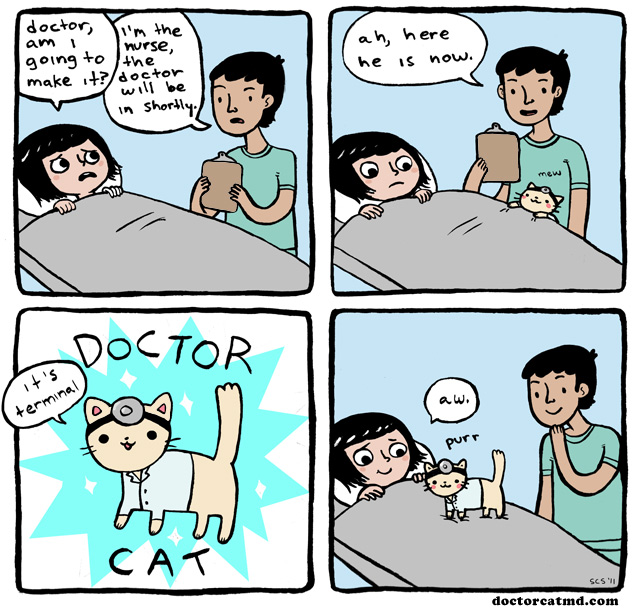
2011-01-10-doctor-cat

In order to pay my mortgage I currently still have to have jobs outside the creative sector. And the one that I work most often is for U Penn School Medicine’s Standardized Patient Program.

A standardized patient or SP is a person who portrays an illness or medical situation in order to allow medical students to practice their skills. So that for example, the first time someone has to give a life threatening diagnosis, it can be to an actor and not a real person. And the mega bonus of this system is that the “patient” can then come out of character and have a substantive discussion about how what just happened affected them. So that the medical professional to be can get some insight into the patient perspective. And in doing this they can start to see cause and effect – when you do this particular behavior it makes me feel a certain way, has this particular result.

It’s kind of satisfyingly scientific actually. It removes the judgment and anger from critiquing interpersonal skills and reduces it down to inputs and outcomes. Try this particular tactic to gaining my trust? I can tell you what the emotional output is in this scenario.

I like this job in part because it has taught me to listen. It has taught me the value of the subjective experience. It has taught me that intention is often not a useful tool towards substantive change. I can want to make you feel better but if my choice of words in expressing that is offensive or off-putting then my intention is a moot point.

When I train the performers I use metaphors of theater a lot. And when I get back into the rehearsal room, I have started using the tools of this SP trade in return. The language of linking action and behavior to some relatively objective measure of emotional outcome is really really useful.

Lately though, I’ve been noticing this trend in my day job that is puzzling. And it’s one that I’ve been subsequently trying to untangle in my theatrical work.

I’ll call this thing “Cat Doctor.”

Fact: I love cats. Love them. Seriously, if that toxoplasmosis parasite that makes you love cats is real, I have it. If there is a cat in a window, I will stop and talk to it. I literally want to smash the small furry bodies into my face.

And that’s weird. And very unique to me.

So if were in a doctor’s office and a cat in a little white coat and stethoscope walked into the room I would be overjoyed. I would be so pleased to be treated by cat doctor that I’d be a little beside myself.

But that doesn’t mean that cat doctor is a good doctor.

And so when I train my SPs I tell them that they have to watch out for the cat doctors – the students that they love for reasons that aren’t really anything to do with their medical skills. This can be because it reminds them of their best friend in 8th grade, or because the person is really attractive or has large ears and that’s just funny. Whatever the reason, when cat doctor syndrome occurs, I tell my SPs to be on double watch for their scores, because they need extra vigilance to make sure they can back up with substance why they are rating this person high.

I’ve been throwing this term around a lot in auditions lately. And I think about it in relation to collaborators.

Does the same cat doctor rule apply to the arts? If I see an actor who’s a bit of a mess, who’s a little bit off, but for whatever reason tickles my fancy, am I a fool to just trust that gut instinct? Should I resist casting the catactor?

If I love to watch them, can I trust that others will as well?

Every director I know has an actor that they love to work with that I just don’t see the charm of. Someone they just want in the room. Maybe they’re just blinded by some intuitive thing… Or maybe the particulars of an artistic process aren’t supposed to reduce down to objective quanta in the same way as a med school exam. And perhaps whether or not the audience can see exactly why, that cat doctor has a magic or influence that matters. They treat the problem with a strange and unconventional approach that just happens to work, even if it looks crazy.

Or maybe I’m just too distracted with the cuteness.

A