theatre

Owning It

There’s a great quote that starts one of my favorite books about the artistic process – Art and Fear by David Bayles and Ted Orland – that goes like this:

Writing is easy: all you do is sit staring at a blank sheet of paper until the drops of blood form on your forehead.

– Gene Fowler

The book is a pretty straightforward and unsentimental view about art making. It talks about how much of your output will be ignored (“Virtually all artists spend some of their time – and some artists spend virtually all their time – producing work that no one much cares about”) and the various ways we set ourselves up for self-sabotage. What this book also says is that the only way to get better at making work is to make a lot of work. As they say, much of your output is there simply to “teach you how to make the small fraction of your artwork that soars.”

I like the idea that when I make crap, it’s not just crap, but crap that builds a bridge towards something else that is not crap. Then at least the crap is useful. And I need that crap to feel useful. Why?

Because I live, work and create in a shame-based economy.

It might not seem like it from the outside, but if I’m really being truthful, most of what I do is to avoid the pain of looking like an idiot. That awesome rehearsal plan didn’t just spring happily from my mind. It took the spectral terror of being left with nothing substantive to say in front of the room to make it come into focus.

People have asked me why this writing project was something I wanted to make public. I might, if I’m being cagey, tell you that I sensed a lot of people were feeling the same way I was.

True. But not actually the truth.

I do appreciate the people who’ve responded to what I’ve written. And I love hearing from you all that these struggles are shared. But the real reason I am writing publically is to shame myself into getting my ass in gear to put words on (virtual) paper on a regular basis.

I do things like this when I know I need a kick in the ass. When I decided I had to leave my day job at NBOME, I wrote a post-it that I affixed to my computer with the date. I gave myself one year from that post it to get out of that job. And then I told everyone I knew about it.

Why? Because, like I said, I live work and create in a shame-based economy.  I knew if I kept telling people about the post-it, people would remember to ask me about it. And when those people asked me about, that feeling that I might not get it together to find some other, more sanity inducing, way to make money would surface. I did get nervous that I would disappoint, and I figured out a way to make life happen without the work that was making me miserable.  And 4 months before the post-it deadline I left.

If I know that someone will think less of me, if I think that someone will perceive me as failing, I work harder. It’s why I love structure and clear evaluative systems. It’s easy to know if you’re staying ahead of the curve if it’s clear what wrong looks like. I spent a lot of my education in high shame-potential situations. I committed to more than seemed possible. I tried things that I saw other people do a lot better than I did and then held myself to their standards. Once in a while I felt a little insane. I beat myself up about stuff a lot. I was also really productive and found myself doing things I never knew I was capable of.

You might say that this is unhealthy. You might be right. Heck for a really long time I felt a lot of shame about feeling so much shame.  That’s how deep it goes.

So for a period of time after school I worked really hard to remove all the shame inducing motivators and gave myself huge swaths of freedom for my art to wander through. I stopped comparing myself to people who had more advantage or resource. I kept things a little closer to the chest so that stuff couldn’t be critiqued until I decided it was ready. I wanted to give my art room to blossom on it’s own, without that fear of failure looming over me.

And while I was in the middle of doing that I noticed something:

I wasn’t making or doing anything I cared about.

I had tried to force myself into a place where I acted as if I didn’t need to care or listen to that niggling feeling in the pit of my stomach when I didn’t do anything creative for a few days. I had convinced myself that the ambition and failure terror weren’t linked. And I was semi-successful for a little while. Until I looked at what a life without one of my biggest motivators actually left me. And that was something I wasn’t really all that excited about.

And then I started to feel bad about that.

Oh, old friends embarrassment and remorse, you’re back! How I missed you so.

I’ve come to terms with regret and shame as ways that I learn from my past mistakes. Just as the impulse to jump too deep into the pleasure pool can get one’s life off track, so similarly can overwhelming feelings of mortification cause one to block their creative selves. But no one sane advocates for the removal of all of life’s pleasures. So maybe we can leave a little room for the negative emotions, so long as they help us get where we’re going.

Thinking about this I recall a thing that I always tell my students when they first start working on their voice. I say that there is no such thing as a “bad” voice, only voices that do what you need them to, and voices that don’t. The voices they have were developed from a style and set of communication patterns that helped them, at some point, achieve something.

High pitched and squeaky? Maybe it helps you to sound small and cute.

Low and monotone? Perhaps you need to show the people around you that you have emotional control.

The point, as I tell them, is that these patterns emerge when doing these things a lot offers some kind of reward. It’s efficient. And there’s nothing wrong with a sound if it’s doing what you need it to. The pattern only becomes a problem, only gets called a bad habit, when you decide you want something and the voice you have gets in the way of doing that.  When the natural voice you have developed is something you can no longer control the way you want to.  Flexibility is the key.

Whether it works for you is what actually matters.

“Ugly” voices aren’t bad if they’re useful. I think “ugly” feelings can be viewed the same way. Some of my best work has come to me when I have felt my worst. Which is different than saying that I need to feel at my worst to get anything done. For as long as I can remember, shame has been a strong motivator. Sometimes towards good things and sometimes not.

So the question isn’t, “Can I remove shame from my life entirely?” because from what I’ve lived so far, the answer will be no. Instead:

How do I use and shape the natural impulses I can’t always control towards a healthy and productive life?

There’s another saying in the Art and Fear book that I really love:

Artists don’t get down to work until the pain of working is exceeded by the pain of not working.

– Stephen DeStaebler

I write this blog knowing that other eyes will see it.

Because I want to be culpable.

Because I want to be exposed.

Because I want to increase the pain of not working.

It’s already worked, clearly, because I’m still here.

A

Middle of the Road

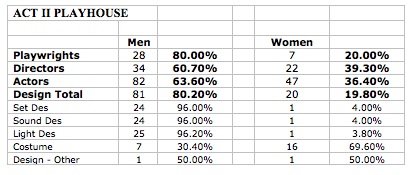
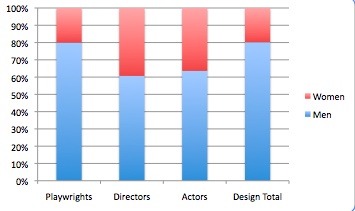
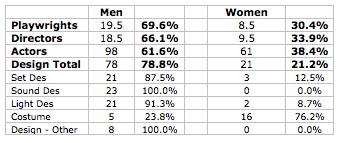
Yesterday we looked at the folks on the upper end. Now let’s look at some people in the middle.  Here are data sets for four mid sized companies: The Lantern, Interact, Theatre Exile, and Act II Playhouse.

Using this website I found the “revenue” listed for each of these companies to be in the mid to high hundred thousands. I’m assuming that’s for the most recent tax filing. For comparison yesterday’s figures for the Arden, People’s Light, PTC, and Wilma had revenues listed at 5.29 million, 4.11 million, 3.95 million, and 3.64 million respectively.  So on the whole we’re looking roughly at an order of magnitude smaller.

This is useful to note for two semi-self evident reasons:

1) Larger companies tend to employ more people and therefore a difference in representation in these companies has a higher impact on the community as a whole.

2) We can make a reasonable assumption that jobs at better funded theaters will tend to pay at a higher pay grade.

This is obviously not always true in every instance, but gives a useful bit of context when comparing numbers across company sizes. Still, unfair representation is, obviously, unfair at any scale.

lantern stats

Lantern graph

interact stats Interact graph
 theatre exile stats

theatre exile graph

act ii stats act ii graph

A

PS –

1) Act II’s data on designers was particularly tough to find (especially for seasons 08/09 and 09/10). This is why the total numbers of designers is lower than the expected based on corresponding number of productions. This data is less complete than the other theaters’ info. If you’d like the raw data feel free to ask.

2) Again, if you want to know how I calculated these numbers you can check back on the PS from yesterday’s post.

True Story

If you give me an ear, I will give you eyes with which to see.
– Kahlil Gibran

True story.

Two years ago, I took a shower. I had just purchased a house in south Philly, most of which needed some major rehab. As such I, and all of the stuff that went along with me (including my fiancée) was confined to one large front room in the house on the second floor. I slept there, ate there, did all my work there.  It was, in essence, a studio apartment in the middle of a three-story row home.

I say all of this to so that you can understand that though technically this space is now my living room, I was very comfortable there.  Unlike most living rooms, I did my most intimate things there. In other words, I was actually living in there.

Which is why I was walking around in it naked. That and it was summer and hot and I was still adjusting to a living space without air conditioning.

It was a Friday morning and as such, was trash day on our block. And I realized this with sudden vehemence as I, naked and sauntering through my living space, walked near to the windows to grab something and made direct eye (among other things) contact with a garbage man outside.

He smiled, nodded and gave me a thumbs up.

It took me a second. Probably a couple. I was a half second away from giving a thumbs up back. Like I said, I was comfortable and in my domestic space, I wasn’t thinking about myself in the subtly different way I do when I imagine myself being seen by others. So it took me that long to realize what had happened. And as best as I can construct the thought process went something like this:

“That guy can see me.”

“I’m naked.”

“I’m a girl.”

“There’s a guy outside looking at my boobs because I’m a girl.”

“I should back away from the window.”

“We really need to get some blinds in this room.”

The truth is, I don’t really care that the garbage man saw me naked. I mean, I guess in a world where I could go back and redo anything that ever bothered me, I might, at some point, go back and erase that event. But on the list of things that I regret or would change about my existence, this is on the very very low end of the list. It’s one that probably wouldn’t be worth the energy to undo.

I don’t usually think about this moment and when I do, I don’t reflect on it with a whole lot of shame or embarrassment. I’ve categorized it in my mind as a silly thing that happened a couple of years ago. But when I was trying to think of a way to introduce the second half of the post for today, it kept creeping back into my mind. Not because of how I see it now after processing it, but for the way I felt the very moment after it happened.

I kept remembering how in that moment before this guy looked at me and I looked back at him I was just “Adrienne”, wandering around my apartment thinking about the day and the stuff I had to do. And then in the moment right afterwards, I was not just Adrienne but “naked female Adrienne” who had been seen (ogled? admired? violated? made to feel beautiful?) by some sanitation worker because I got too close to the window. I kept thinking how aware I became of this one particular aspect of myself. And in thinking about it now, I remember how vividly in that moment I became so aware of the two sets of eyes through which I could view this event.

There was one part of me that looked at this situation in that moment right afterwards and saw no big deal: just a naked person walking past a window that someone sees and makes light of. And there was another part of me that felt different, uncertain, and weird and saw this as a potentially troubling incident: a woman alone in a house who is stared at and then evaluated (thumbs up!) and potentially left feeling sexualized in a way she didn’t agree to.

At moments like these I have a tough time knowing which set of eyes to use. And I’m using this moment as an illustrative point because it helps me try and quantify something that is really difficult to say with clarity or the depth with which I feel it:

It takes work to view the world with dual vision all the time. It is hard to know how and when to apply that second sight.

If somehow I could run this experiment again as a guy standing naked at the window would I think about the fact I was a naked dude or just that I was naked and too close to the window?  Would I interpret the thumbs up as a “hah hah, caught you naked, oh the things you see as a city employee” droll little interlude or would I get a creepy “I’m staring at you and personally up-voting your sexy nakedness” vibe?  Would it have gone down the same way or been different?  And above all – even if I could know that his reaction was in response in some amount to my gender – do I have to care?

Is this something that should bother me?

Sometimes it takes a new vision or angle on something very familiar to know that it is something that should bother people. Sometimes we normalize things we shouldn’t and it takes some one who takes a step back to say “Uh, what the hell? Why aren’t we all seeing this?” It’s awesome when those people do that for us who have the luxury not to notice.  But it’s a lot to ask of those second visioned people to do all that work alone.

Are there situations where people are legitimately undermining or diminishing someone based on their being a woman?  Yes.

Are there times when someone is undervaluing female perspective or representation without realizing it? Of course.

Are there times when choices are made that coincidentally result in unfair gender balance that have nothing to do with gender at all? Absolutely.

I can’t remove the lens that constantly evaluates the world this way. So when I, or anyone with an outsider lens that they view the world with, witnesses something that is potentially disturbing, it it is real mental work to try and suss out which of these scenarios is at its core. Sometimes you’re not sure which is happening. You don’t want alienate people that you care about. You want to believe they aren’t doing things that hurt you on purpose.  But you also don’t believe you can let them continue to make this mistake.

It’s a super tricky dance, deciding how to proceed. That takes effort.

And I’ve mentioned before that sometimes it’s tiring to try and figure it out alone. Sometimes, you just wish you could hand that lens off for a little, try and put it into a forum for debate, and try to ask the people that don’t usually bother to shoulder that task to take up the burden for a little bit.

This is an attempt to do that. It’s an attempt to make the problem of gender imbalance that I see in theater not just a “female” problem but a communal one.

You didn’t give me your ears, but I’m grabbing them anyway. It’s not meant to be an attack, but it is meant to try and give some people that may or may not being making choices intentionally the eyes with which I’m seeing things. And I’m doing it with numbers and graphs because it feels like it’s a little easier to get you to look with my eyes that way.

Over the next few weeks, I’m going to roll out data on gender breakdowns over 6 seasons (12/13 through 07/08) of playwrights, directors, actors and designers in Philly theater productions. I think the numbers speak for themselves in many ways, but at some point, I think I will also add some thoughts about how we might interpret such data and what could be a productive set of actions that might result from it.

So here goes

I thought it might be illustrative to start with four of the largest and most visible non-profits. Below is the raw data with percentages and a graphical breakdown for The Arden, People’s Light, PTC and The Wilma. In all cases the graphs are totals of all 6 seasons of productions and blue in the pie chart indicates men and red indicates women.

ARDEN THEATRE CO.

arden stats

arden pie combined

people's light stats

people's light pie combined

Philadelphia Theatre Company

PTC stats

PTC pie combined

The Wilma

wilma stats

wilma pie combined

There’s an awful lot more blue.

A

PS – Some notes on methodology:

1) These numbers are based, when available, on information provided by companies on their websites.

2) For any info not listed online by the company itself I have searched online reviews to confirm missing information, ideally from more than one source when possible.

3) Many seasons (most especially the current one) have incomplete listings and are indicated as such in the raw season by season data (which anyone is welcome to request).

4) The raw numbers indicate a slot in which a male or female is chosen to fill a position and not total number of different individuals hired. In many cases the same person directs, acts, designs, etc multiple times at a venue.

5) In the case of adaptors, translators, and multiple authors I have evenly split writing credit across all names listed. While I recognize this may overvalue on creator’s input from the reality of a particular project, I believe that will balance out over the entire data set and removes me from making personal judgment calls. For example, in a translation of a classic work by a male author with a female translator I would give .5 playwright credits to each gender. For musicals I have similarly split credit among composers and lyricists.

6) For ensemble-generated works I have excluded playwright credits unless specifically listed.

7) Shows calculated are those that are listed as part of their regular season. Benefits, special events, and fundraisers are not included.

8) I have listed designers as a combined figure but also shown breakdowns by category which differ vastly in some cases.

In defense of messy, ill-conceived nonsense

When I was in high school I used to have this recurring dream.

(Is there anything less interesting than other people’s dreams? Alas, we soldier on…)

In my dream I am always sitting in the backseat of a car, something halfway between a cab and a limo. I am sitting faced forward and looking at the rear head rest of the driver’s side seat.

It is quiet. The car is humming along. There is a small rocking back and forth. It is night and very dark and headlights bob ahead in the distance.

I am sleepy. Heavy. And this is the moment I notice the person to my right.

We are close and it is warm and cocoon-like in our nearness. The backs of our hands are close enough to feel the hairs brush past each other.

And then with suspension and a breath catching softness, that person and I decide to hold hands – my right in their left. Soft and warm and simple. We do not look. We simply touch and ride and shake in the gentle back and forth of the darkness.

And that’s when I wake up.

When I usually tell this story, I put a postscript on it. I say the person was different every time. I say that there was nothing overtly sexual in what was happening. I say I can feel the feeling of holding their hand like I can hold an object right this moment. I know it with a palpable familiarity.

These are true things.

There were a startlingly various number of people that held my hand in the back of that car. Alan Lewis who played Jesus in Godspell my freshman year. Octavio Lara who had a thin mustache and worked at a Starbucks near to me. Isabel Lazo who’s family owned an awesome Mexican restaurant in downtown Chicago.  Sara Swain, my 8th grade best friend. Tom whose last name I don’t remember who played Smee in my community theater’s production of Peter Pan and called me “Wendy, Dahhlling.”

I also used to say that the person sitting next to me was always someone I was in conflict with. I always explained this dream as a subconscious effort to resolve some sort of internal dispute. It was my way of working out something that was bugging me about that person. It was my lizard brain’s way of getting over a grudge.

That’s the part that’s not totally the truth.

I think that I add this last bit when explaining the dream because of this: it felt so real. It was so intensely emotional an experience. It seemed like there had to be some higher reason for it. What happened after I held hands with someone in that car at night was that I felt like I was in love with them.

I don’t mean in a 16 year old crush-y kind of way. I mean this intense red enveloping ensnaring feeling of love for another human being. And though there were people like Alan that I was definitely feeling sexual about (oh beautiful Jesus/Alan and his curly curly hair) this feeling was something a bit unlike anything I had words for. I would wake up and feel this sensation from the tips of my toes right through those fingers that had falsely felt that other person.

It seemed that I had become one with this random set of semi-strangers. I loved them. I felt like I knew them. It seemed as if we had shared something deep and tender.

But of course, “we” had shared nothing.  I had felt moved by this wave of emotion, but that wave only existed in me. It was intense and consuming, but it wasn’t something that the person and I had in common.  So it was a little awkward to meet up with these folks in real life, feeling so intensely about them and wanting to re-connect to that magical feeling of one-ness. Almost a little like the feeling of getting a bit drunk with a friend and proclaiming an eternal bond and love. In the moment it’s so palpable and that next day it’s all a bit of a fog. A cheap trick of the wine.

I think I put that PS on the dream because the feeling was so real and meant so much to me, that I needed to explain it somehow.

We do this with our works, don’t we? We do this when we see things that move us. They make us feel so much that we believe we must make sense of them. We must understand what in them is doing that. We have to make sense of why we’ve made them and how they work on us. We must explain to others what we’ve done.

I want to make a case for removing that PS in our art practice.  I want to make a case for just enjoying the hand holding, regardless of what it might mean.

I could invent a reason that I’d have to resolve something with Tom or Sara, but that was put on after, it wasn’t really part of the dream. The real message wasn’t some deeper intellectual machination. It was the beautiful and encompassing feeling. It was the fact that I, as this young person, for the first time felt opened up to being filled so full.  The feeling was the point. It was the totality of what was happening. And by pretending that it was about something else – a hidden desire to resolve interpersonal conflict that doesn’t really exist – it makes the thing that it really is a bit less mysterious and lovely.

Sometimes our work is just that, two people holding hands in the back of a car in your dreams. It’s not there to explain or “do” anything else. It is meaningful because it allows us the opportunity to open up to feelings we’ve never known in our actual lives. Perhaps they’re feelings we couldn’t know outside of this place. And I think there’s a pressure often to want the work to be more than that. I think that especially as Americans we want to know that we’ve gotten to the bottom of the thing, achieved whatever goal is there to retrieve. And feeling for the sake of itself is a tough sell.

Sometimes a color or a sound or a movement doesn’t have to be unpacked. It is simply something that springs from us. And when it springs, let us be brave enough to simply share it, to let another inhabit it so that they might know it too. Let us dare not to explain or dissect. It may be messy. It may make no sense. But it is of us, and from us, and to try and fit it into a box may squeeze out of it what was wonderful.

The problem with my PS to that story is that it leaves no room for you.

Without the add on there is a chance that I could tell this story and through its sheer force you too might imagine yourself in that car with a person you barely know and for a moment imagine that liquidy, heated, big fat and filled up feeling coursing through you.

But the PS pulls it away. It puts it behind glass and makes it a specimen of my brain that is a product of interpersonal influences A, B and C.

It means that the feeling I had has to have a reason. It means that when I tell it, there’s no chance for you to fill in the how and whys of that feeling in yourself. There’s no space to be in that car and see what that feeling might be in your own body.

As if that isn’t enough.

As if the ability of a creator to give another person the chance to sink into a love or a sadness or a change in breath isn’t a tiny miracle in itself.

– Adrienne

Criticism

Lemming_bw

One of the things that I really love about Philadelphia is the supportive nature of the community. We are, by and large, a city that prizes community over competition. I’ve had people who’ve taught me to write grants, given me tips on where to find cheap equipment, loaned me costumes, offered me innumerable rides, donated space, the list goes on and on and on. Lest we forget, there are a lot of places that aren’t like that. There are a lot of artist communities where the initial instinct is to undercut each other to get oneself ahead.

This is Philly’s superpower.

Sometimes, though, it also feels a bit like our kryptonite.

In our instinct to be kind and supportive, is it possible that we are sometimes TOO nice? Too nice in a way that isn’t actually genuine. If we aren’t willing to receive and encourage useful and productive critique, do we doom ourselves to a community-wide creative dialogue about our work that is surface level only?

There is a right and a wrong way to offer constructive observation. We’ve all had experiences with a peer or critic who speaks or writes about our work in a reductive way that focuses on a tiny issue or comes from a personal perspective that doesn’t take into account the  project’s overall aim or discourse.  We all have been there when a particularly nasty something comes out and seems to be there simply to wound.

On the other hand, I also find an unspoken pressure to always have a cheery, unequivocal rave response to anything I see.  I feel the need to do it. And I feel it from people I see after my shows, this plastic face people put on with a giant smile and that horrid, omnipresent phrase: “Great job! Congratulations!”

When I was in college I took the simplest directing class in the world. We got an assignment and then once each week presented the work we’d been doing to the other classmates, their respective casts and the professor. It became our artist community. We learned how to talk about what the piece was trying to do, how we all felt it was doing on that front, what frustrations and exhilarations the process was offering and any other observations that might be useful.

There were times some pieces got more laughs. There were times some pieces made us cry. There were times when the work seemed super hot and others when it was stuck in the mud. Everyone’s stuff went through highs and lows and over time, you learned that one week’s success was nothing to get too boastful about because a few weeks later you were bound to be feeling lost in the artistic forest. But that openness of dialogue meant that I always felt like I was getting a real beat on what kind of responses my theater was provoking. I loved that chance to really talk and share what I was doing with people that would watch with keen eyes and interested minds.

Even after I finished that track of courses, it felt like those that I’d shared the experience with were still able to hold on to that sense of interest and honesty as we moved into new projects. I liked coming out of a show and having them ask questions about what the piece was trying to tackle and having a genuine conversation about when it was (and wasn’t) doing what I’d set out to do. In many cases, the opinions were wildly different, which was SO incredibly useful. People picked up things that I hadn’t intended or missed giant swaths of stuff that I thought were obvious.

I’ve found myself every once in a while back in a situation like this – in my voice training programme for Roy Hart, in the LAB fellowship, in a small circle of directors that make similar work – but it feels notably absent in the majority of interactions I have with other artists in Philly. More so than in other places I’ve lived and worked in. Am I alone in thinking this? I don’t think so.

Again, I think it comes from being, on the whole, a small supportive community. But like many small supportive communities, we have to be careful about gentleness to a point of over-protectiveness. I think this impulse is worrisome not only because it gives us a false sense of how our work lands with people, but because it encourages us to think about our work as “good” or “bad.” If we make complex work, that has lots of layers, especially from scratch, it’s likely that it will be neither of those things. Or it will be both. It will be “it.”

If I see a raucous comedy show and I come out with my sides in pain from laughing so hard, is that the same “good” as an emotionally turbulent sweeping drama about genocide that leaves me numb and raw at the same time? Of course not. But I do what everyone does when they see people after a show, “You were great, congrats.” Or “Congrats! What a great play.” Or “Great job. Congrats.”

At this point, the congrats/great is so ubiquitous as to be an empty gesture. It had become so devoid of meaning that I used to see any sign of anything other than complete and total positivity to be a mask for hatred or disgust. Which was crazy making. So I’ve pretty much stopped listening to comments post-show. I assume they don’t mean anything and that the comments that people have that will mean something aren’t going to be said to me. Which is too bad. Because I think I could probably use them more than whoever else they’re going to be said to. But it feels like there’s not a lot of space to hear real responses.

Congrats. Great. Congrats. Great. Congrats. Great. Like we’re all some kind of “congrats/great” artist lemmings constantly running up to friends, “congrats/great” hugging them and running away to leave them to receive the next “congrats/great” in a giant “congrats/great” receiving line.

When someone says that to you, does it mean anything? Especially when you know a play isn’t simply “great,” (maybe it’s complicated, in-progress, raw, beautiful, heart rending, personal, silly, unfinished, whatever) when it’s something that is more complex that just “great” does that “congrats” mean anything? Wouldn’t you rather that same person just walked up to you and said “I was here for you” or “I am so happy I got to see what you made.” Because, really isn’t that what you’re trying to say?

Regardless of how “good” or “bad” the thing that the person made was, you’re coming up to them because you’re saying “I support you in this crazy endeavor. I know that you, like me want to make something that moves your fellow human beings in some way. And you did it! You threw your heart and sweat into this thing and now it’s been put out in front of all these people. And I was here! I saw it and now I’m seeing you and more than anything I want you to know that I am proud of you.”

At least that’s me. After a show, when I see my artistic peers, that’s what I want to hear. Not that you loved it or hated it, but that you came and you saw the work that I did and likely you know what it took to do what I just did.

I can understand if you’re in a place where you don’t trust people, where you feel like they might undercut, where their motives aren’t in your best interest, you might not want someone’s advice or response. But this is a town where I feel like respect and trust are pretty flush. And you are a bunch folks whose real opinions I’d want to hear. Because I doubt that what I make is only great or terrible. It’s a lot of things, many of which I probably don’t even know.

I am here to learn.  Most things I make are in progress. And all of them are still conversation as they enter into performance. I wish there was a way to let people know that it was ok to be however they are after seeing the thing I made – happy, sad, confused, alienated, indifferent, or pensive – and that they have permission to express that being in whatever way they can, without worrying about whether it’s great. Without needing to give me congrats. Seeing them is great congratulation enough.

Next time after a show just walk up to me and say, “No lemming?”

And then I’ll say “No lemming.”

And then you can say whatever you want.

A