Context for Creation

Where we go from here

Hey all. It’s March 31st and the official end of my month of blogging here on the topic of gender parity in theater. I recapped the other day some of the projects that this month has inspired and begun, but I also wanted to say a couple things not only about those specific projects but about a few bigger picture things that have slowly amassed over the course of this month on a larger, perhaps more philosophical level.

One of the lessons I feel like I’ve taken away from this month of work is the sense that it’s important to keep perspective on two scales – the very small and personal and the very large and grand.

I find for myself that when I get too stuck in the minutiae of my own little world and my own little perspective on that little world, I can miss solutions or a sense of possibility. It’s easy when we are used to seeing something all the time to assume that it will always have to be that way. There are trends of inequity that have persisted for so long they have become banal and commonplace. And so in listening to other creators, in gathering voices of women artmakers en masse, by looking at my field as a whole and branching into other mediums as well, by looking at this problem not just as a personal one but a community-wide issue, I feel like I’ve gained a feeling of possibility, of mobility that I haven’t had in a while. Stepping back and looking at the larger picture has made me say more forcefully there are things I see in my community that are not acceptable even if they are common.

Simultaneously, I have also gotten better at tasking myself with small concrete things that I can do in and hour or two with a few people. I have become more able to say, “What can I do right now to make a step towards a larger goal?” rather than getting frustrated at an inability to fix everything in its entirety. I have felt easier in making a step forward, even if it is imperfect or not totally complete and saying that something good and finished NOW is better than something immaculate that takes months to perfect.

Another lesson learned is the power of a system that can handle multiple points of entry. One of the most awesome things about the Awesome Lady Squad is the fact that there are projects starting to gain momentum that I am not the sole driver of. Projects that I am appreciative of but may not have the expertise or immediate interest in prioritizing. If the Squad is to succeed I think our responsibility must be shouldered by many. Because the truth is some day I’m going to get busy with a project or a life event. Or there will be (maybe already is) more to do that I have time to oversee. And one of my core beliefs is that we will do so much more if we all trust each other to take your idea and run further with it than you knew was possible.

And last, I’ve realized that there is nothing more powerful that one human looking another human in the eye and doing your best to speak honestly and listen to each other.

That sounds mushy.

It is.

But man, is it also effective.

I’ve written thousands of words about these issues, spent hours trying to articulate exactly how I’m feeling and what I want to communicate. And yet, one of the most impactful moments I’ve had was when I sat down talked with some other creators about how their choices affected me and listened honestly and openly to their response.

If there is anything that I take from a month of work trying to advocate for female artists it is this: we have to be brave enough to start saying what we actually think and feel. To do so assumes that real and substantive change is possible. It assumes that our views are valuable enough to be heard and flexible enough to absorb response.

It is hard to tell someone, especially someone you admire and care about, that their actions might have consequences they do not intend. It also feels like the closest I’ve come to actually shifting the way someone will think and act in relation to this topic in the future.

And in this way, let me share where I go from here:

I will continue to work with The Awesome Lady Squad in the coming months. I’ll keep you abreast of those changes.

I will return to many of the questions about sustainability and how to engage in a long and happy life as an artist.

I will send some focus to other special interest groups and work towards a community that is aware and equitable in all aspects.

I want to encourage us, Philadelphia, to start engaging in these harder conversations. The ones that scare us. The ones that are uncomfortable. The ones that might mean we really have to rethink some of the ways we do things. These are the ones that will make us the city that others look to. These are the things that will create a more sustainable and strong community in the future.

Feeling the renewing possibilities of the imminent spring,

A

Cross Pollination Unveiled

spLOGOIs there anything lamer than quoting a David Foster Wallace commencement address to help make a point about artistic awareness?

Probably not.

Which I guess means I’m going to do one super lame thing today. And right after, do something else that’s super not-lame to counterbalance.

Ready for that quote?

“There are these two young fish swimming along, and they happen to meet an older fish swimming the other way, who nods at them and says, ‘Morning, boys, how’s the water?’

And the two young fish swim on for a bit, and then eventually one of them looks over at the other and goes,

‘What the hell is water?!’

The point of the fish story is that the most obvious, important realities are often the ones that are the hardest to see and talk about…

– David Foster Wallace

As artists, working in different genres, sometimes in sub-sets of genres, sub-sets of sub-sets of genres and so on, there are lots of givens about how we work that we take for granted. There are times when the way our work is made seems so self evident that it is almost as natural as breathing the air around us.

Sometimes our working methods can be like the water.

One of the greatest gifts that came from my time a few years back as a Live Arts LAB fellow was to have the chance to talk to my fellow fellows who were dancers. There were more than a couple sessions as a group where it actually blew my mind a little to learn that some of the assumptions I make about creating were totally different than theirs. Things that I take for granted were sometimes just not part of the conversation these other amazing artists were engaging with. Sometimes things were the same but employed in different ways. Sometimes the focus and priority were radically different.

There were times these conversations reinforced my assumptions about art, made me that much more sure in why I did things the way I did. Other times it inspired me to shift my own process and just try what it would mean to create without certain conventions about narrative or structure or audience responsibility. In all cases, these conversations made me more aware of the water around me. Gave me choice about what kind of givens I was swimming in.

I finished that LAB period thinking:

“Wow. If the creative process for two mediums that are almost identical in most aspects can be so different and thought provoking, what would it mean to have this conversation with creators who are even less alike?”

And also:

“Can a visual artist teach a singer something about music? Can a chef give a dancer a chance to unseat their idea of what it means to move? Can a light designer change the way a writer thinks about their words?”

And then finally:

“I really want to find out the answer.”

And luckily, thanks to the Knight Arts Challenge, I found a means to do just that. The result is something I’m calling Cross Pollination. It’s a project that actively seeks a way to dump water all over the floor. It’s a chance to explore without the pressure of a full performance or product. It’s a chance to get paid (and reasonably well, I might add) to open up one’s horizons and cross breed with another artist. It’s a chance to find some crazy mutt hybrid mash up that the world has never seen before. It’s a chance to find out more about the water you’re swimming in.

And I’m so so so excited to begin.

Want more details? Click below. It’s all in there…

Cross Pollination Artist Application

And if you ever need to quickly get to that application without searching the blog just CLICK HERE!

And of course a HUGE thank you to the John S. and James L Knight Foundation for making this amazing project happen.

Enjoy!

– Adrienne

Applied Mechanics gets an Awesome Lady Squad Commendation!

Hey friends,

Many, many things a brewin’ here at Swim Pony HQ.

I know I promised you Cross Pollination would unveil here today but this weekend was just too terribly full of fantastic awesomeness and I need just a couple more days. So Wednesday it will be! (This time I promise, for real…)

Awesome Lady Squad is in high-level action mode! We had the first meeting to for the Awesome Lady Lady-festo last night and I am humbled and awed at the fantastic minds of Philadelphia creators. Look for updates on that soon!

Today, however, I thought I’d share something new. While much of our attention in this space has been on shedding light on things I’d like to change, I think it’s also worth pointing out the amazing artists who are already modeling the kind of work that ALREADY gives voice and space to women creators (and gaining a stellar artistic rep at the same time). So every once in a while I’ll be asking some questions of folks doing just that so they can share how they are successfully getting their work into the world in a way that the Awesome Lady Squad commends.

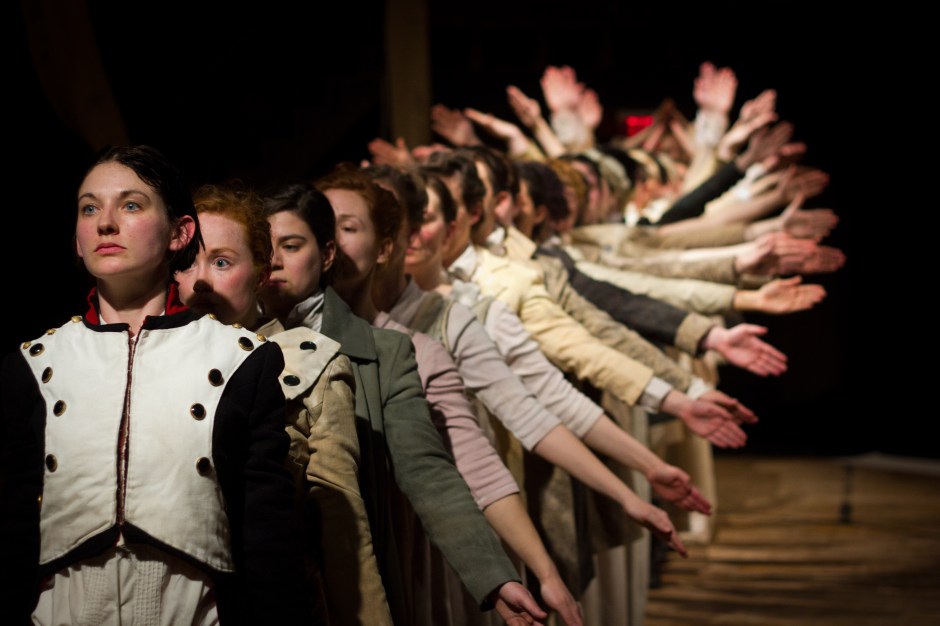
Today, get a bit inside the mind of Applied Mechanics. I chatted a bit with Becky Wright (a good friend) to find out more. But first! A pretty picture of their work to entice you:
IMG_2378b

1)   How does gender parity and awareness of women in theater play a role in selecting your material?

We are a very collaborative company, founded by women, with majority female members and an alternative-model labor-sharing administrative structure.  Every piece we’ve ever made has come from an idea or a spark of inspiration from a company member, so in a sense the work is always reflective of the concerns of the group.  I think it’s safe to say that most of us identify as feminists and that our artistic motors have been shaped by our experiences as women in the world, as female artists—and, for our one male company member, his experiences as a gay male artist.  Collaborative art-making involves such intense processes of interrogation, exploration and reflection—so I’d say, overall, gender and female-artist awareness play a major role in everything we do.

To speak more specifically, we’re currently working on a piece inspired by [Russian feminist art/punk activist group] Pussy Riot.  This idea came from two company members who were following their story particularly closely at the time of their arrest.  We all intuitively leaped on this seed of an idea; as we began research and exploration (the early stages of our development process) we quickly discovered that a big reason why Pussy Riot’s story and the questions it brings up resonated with us so deeply is specifically because they are female artists.  Their story is our story.  And they have done these powerful, dangerous, earth-rocking things with their position as female artists, claiming that position as one of profound subversive power and gigantic imaginative and radical influence.  Our piece has expanded to encompass questions about contemporary feminism, its oppositional relationship to global capitalism, protest art, 21st century resistance, and the socio-historical qualities of a moment when artists’ voices are politically important. These questions are close to our hearts and central to our ongoing artistic project.

One thing that’s been really nice about working on this piece, the first of ours that takes on explicitly political content, is that it’s made us realize that we’ve actually been dealing with these questions all along: all of our past pieces in some way engage questions of power and control, allocation of resources, society’s power to shape identity, and the possibility of communities to affect change.  These questions are central to feminism.

Again, some brief specifics: in our recent piece Vainglorious, a large-scale historical fantasia about Napoleonic Europe, we had a woman playing Napoleon and a man playing Josephine (and lots of other cross-gendered casting, mostly in the form of women playing men, throughout the world of the piece.)  While we made this choice based purely on company members desires and personal qualities, we had to recognize after the fact that the choice “says something” about gender.  Embracing this allowed us a deeper exploration of the power plays and politics of that piece.  We’ve also made pieces with trans characters (Portmanteau), de-gendered characters (Some Other Mettle), and always always make pieces with strong, unusual female characters.  It’s worth mentioning, too, that our performers create the characters they play—so the women of Applied Mechanics, through engaging in our group authorship process, have a huge amount of agency in their theatrical and artistic output.

In all these ways, I’d say gender parity and women in theater are at the heart of our material.

A tiny post-script: I think there was a while in there where some of us in the group would worry about not having “enough male energy” in the company.  And then at a certain point we were like, “why are we worried about this?”  It’s amazing how pervasive the norms of the dominant culture can be.

2)   Does this inform your working and administrative structures in any way?

It does, actually.  We have worked really, really hard to cultivate an egalitarian working model that embraces all participants, distributes company labor, and values communication and consensus over hierarchy.  For me, this is a self-consciously anti-patriarchal model.   It looks at the ways most theaters run, the received narratives created in overwhelmingly large part by straight white men (and thus designed to reward male-socialized habits and aesthetics) and says: we reject that, and reject the goal of gaining access to it, and we claim the space to work in another way.  This is often difficult, and certainly does require a great deal of energy, presence, and mindfulness from all company members, but the result is that we have this thing, this company, that allows us a sense of shared ownership while granting us all agency and a supportive artistic home.

3)   Do you know your statistics (number of actors, directors, designers, etc) in terms of representation? Can you share them?

For several years, the company consisted of five women and two men.  It has now shifted to consist of six women and one man.

Of the 32 “outside” actors we’ve hired in our history, 21 have been women and 11 have been men.

Of the 4 guest designers we’ve hired (to work with company designer Maria Shaplin) three have been women and one has been a man.

Of the 5 stage management/production assistants we’ve hired, four have been women and one has been a man.

There are also an assorted bunch of folks we’ve hired for one-off work/labor calls; this is an estimate, but I think on those we’ve been about half and half women and men.

4)   What would you say to a female artist feeling discouraged about her place in the arts community?

It can take a while to find your people.  Don’t worry: you’ll find them.  All of my collaborators I met through working other gigs, going to see stuff, or coincidences born of just doing my thing.  It makes a huge difference to have people you love to work with.  It makes it easier to feel like, at least in some respects, you have your own place and your own community.

Keep your eyes open for folks you admire and are interested in working with or for.  It’s not that hard to track people down in this town, and it never hurts to ask for a coffee—or an assistantship.

And I know this will sound a bit “follow your bliss,” but—follow your bliss!  Don’t wait for permission to make the art you want to make.  Do what you think is cool.  Claim the space to do it.

Art life is a weird life without a clear path.  There is so much bushwhacking to do, and so much stumbling.   I think men and women tend to be socialized differently, and it can often be harder for women to access the kind of assertiveness and entitlement that’s so useful sometimes in getting gigs and attention and carving out a niche.  But I also absolutely think that self-doubt and failure and periods of frustration are natural parts of the artists’ life.  Finding a way to accept those stages of the cycle without being too self-punishing can make it way easier to fight the necessary battles—whether that’s about accessing particular kinds of assertiveness or asserting other ways of working.

5)   Anything else you’d like to add?

When Maria Shaplin and I started this company, it was because there was art that we wanted to exist that didn’t exist yet.  We realized we could make it exist by making it ourselves, and we realized no one was going to give us permission to do it.  So we had to just do it.  So we did it.  And we were incredibly fortunate (still are) to have access to a community of brilliant collaborative artists who were down to do it with us.  The company, which grew out of that initial project, consists of the people who stuck around and were excited about working on the artistic and organizational experiments that Applied Mechanics has come to pursue.  I don’t think that the experience of wanting to make art and having to give ourselves permission to do it happened because we’re women (it happened because we’re artists) but I think the lesson of claiming space and asserting new working models is vital to the feminist project.  I’m not saying it isn’t a worthy battle to fight for access to existing systems, but I also say it is a necessary battle to fight for new systems.  For me, this goes for both artistic concerns (structural, as well as aesthetic) and organizational models.

Thanks Becky!

You can check out Applied Mechanics bio below or their website for more info: http://www.appliedmechanics.us/

Applied Mechanics is director Rebecca Wright, designer Maria Shaplin, and performers Jessica Hurley, Thomas Choinacky, Kristen Bailey, and Mary Tuomanen, and stage manager Bayla Rubin.  This ensemble of artists collaborates to make work that challenges conventional ideas of theatrical space, narrative, and performer-audience relationship: they create visual landscapes for the audience to wander through, and multiple intersecting storylines for them to choose how to watch.  Their plays are immersive, multi-sensory, and choose-your-own adventure.  Their process is collaborative, democratic, and based on a commitment to organizational and artistic innovation.

Applied Mechanics’ pieces include the apartment plays Selkie and Ses Voyages Sauvages; It’s Hard Times at the Camera Blanca (Fringe 2009) which took over a Fishtown Bar; the invasion play Portmanteau (Fringe 2010) which, following its Philadelphia premiere, toured from Texas to Louisville to Maine; the dystopic environmental piece Overseers (Fringe 2011); and the large scale historical fantasia Vainglorious: Epic Feats of Notable Persons in Europe After the Revolution, which involved a cast of 26 Philadelphia actors and which  remounted to great critical acclaim in the Philadelphia International Festival of Art (PIFA) in April 2013.

Reframing

Sometimes when I spend a long time talking about myself as occupying a disadvantaged position it makes me a little depressed.

In writing about women in the arts I’ve found myself sometimes feeling frustrated this past month. And I think it’s because when you define yourself in this way – as a person who is being to subjected and trying to navigate a system that is not always set up to your advantage – you can start to see the problem in everything.

In the general sense, I do think women get less of a fair shake. On average, I believe it is true that we’re under-represented in almost all aspects of the field.

But I think we can probably all agree that thinking that way is no way to live. It’s just too tough constantly imagining oneself as a victim of an intractable problem. It feels too large, it feels to impossible, it seems pointless to even try, if you spend too much time in that mindset.

At least it does for me.

This, I think, is why some pretend it’s not a problem. They have to shut out any disadvantage and just keep plugging away as if things were totally equal because it would just be too depressing otherwise. I’m not chiding these folks too much, because I understand the impulse. No one wants to feel powerless. But I also don’t think that I can join them, because at a certain point I think most female artists just see too clearly the power difference.

A few years ago I listened to an interview with the famed brain scientist Oliver Sacks. I was surprised as he spoke to learn that he in fact suffers from a variety of neurological issues himself. I was even more interested in a statement he made that was something along the lines of this: I don’t know that I’d have been able to discover all the amazing things I had if I hadn’t had an abnormal brain myself. That interview made me think back to reading Jill Bolte Taylor’s book about how a stroke’s paralysis of certain kinds of “left-brain” style thinking gave her an appreciation for “right-brain” thought processes and a new outlook on life.  It made remember a friend of mine from college who was in a serious car accident and who said that she could feel the palpable difference between the kind of person who was “normal” and the way that her mind was now different, how she’d developed a sense of both the neurologically-dominant perspective and her new one as a recovering patient.

That interview planted a seed in me that’s grown into a guiding principle: I just have to believe that all the things that I believe are my weaknesses – my introversion, my status as a female artist, my lack of trust fund, my sometimes weird aesthetic impulses, my thorough dis-interest in classical works of the theatrical canon – all these things that sometimes make me feel like an outsider, are actually my secret superpower. These things that separate me from the dominant viewpoint are the things I can uniquely wield as weapons that those supposedly more in power can never hope to employ. These are the ways that I will be able to innovate. These are the things that will make my art works full of a fuller perspective. They are the things that will give me an angle in that others just can’t see.

This is nothing new, this idea. Lots of people know this. But it’s the thing that really helps on the days when the problems feel so big. When all I can see is how much harder the obvious road will be for me than for some dude with the same skill set.

Those are the times when I say to myself, “You just have to believe that in the long run this makes you stronger. You just have to believe in the long run you will be better for seeing differently.”

It’s the moments when I look at the obvious path and realize if I just cut through the bushes I might get to the top in a totally new way. It’s the moment I realize I have a machete in my hand and can start hacking at something new.

It is a problem in one lens, and I can jump into that perspective when needed to make progress on an issue I see.  But it’s something I can also reframe in my own mind to give me a sense of strength and destiny.  And while it might seem as if all this is a bunch of self-delusion, it’s those moments where I’ve really embraced the outsider in me, rather than just feeling frustration with it, that wonderful things emerge.

Things like a squad of awesome ladies, many of whom I’ve never met who suddenly are some of my most ardent supporters.

Things like creators in different cities who I am suddenly planning to meet because of our shared interest.

Things like an interview for a national theater organization because of my vocal views on an “outsider” subject.

Things like a renewed vigor for a writing forum that I’d let slide more than I wish in the past few months.

This onslaught of new and positive activity all came from just deciding to sit down and reframe an issue as one I can use as a leverage point rather than just being something that pisses me off. It’s become a power I can wield. And I like that.

Yes, it’s still a problem. Yes it’s one I’m solving all the time, and mostly likely will be the rest of my life. But it is also in my capacity to use it to my advantage.

Even on the days it doesn’t feel that way.

Especially on the days it doesn’t feel that way.

I see this as my chance to have choice.

– A

Crowd source the grant of the future!

Hey friends!

First! I wanted to tell you that there’s big news coming your way from Swim Pony. This coming Monday we’ll be unveiling our next project: Cross Pollination. Cross Poll will be an awesome exploration of artistic mash ups. If you’ve ever wanted to see what happens when comic artist meets a dance company, this project will be right up your alley. So stay tuned for the info on all the details and the artist application to get involved.

And a huge thank you to the John S. and James L. Knight Foundation

knight-logo-300

for supporting the Knight Arts Challenge Philadelphia. Trust me, you’ll be thanking them to when you see what we’re rolling out on Monday….

Second! I wanted to follow up and say that one of the most popular posts this month on the blog – the one in which I laid out a proposal for a results-oriented grant for gender parity – is gathering some steam. This is a project I am really hoping to make happen for realz in the relatively near future.

Most grants when being developed go through an extensive panel process. They have a lot of people reading and writing and then re-reading and re-writing the application guidelines. They examine the goals and expected outcomes. They look at the metrics that will be used to assess the project. And they think about who will enact these suggestions.

I want to create a grant that has just as much of a review process. And yet, I am just one human with my singular human brain. But what started happening informally after I posted about this the first time was that people started emailing me their suggestions. They asked questions about how things might work. They proposed ideas to make it stronger. And while I know that I wouldn’t implement all aspects of every suggestion, I also know that each one gave me a new perspective on how to think about shaping the thing. They were all super helpful in getting me to think like someone on a review panel.

It makes me wonder if this might be something worth asking for more of.

So here goes. I’ve re-listed the original guidelines proposed below and if you have thoughts about them, let me know!

What are the questions you’d have if you were to apply? Tell me the things that might seem difficult to interpret. Give me suggestions for things to expand that you’d want to know more about. Think about your work and how it might be assessed for this thing and let me know if you see a potential change to make it clearer or easier to take part in.

Think of this as your chance to crowd source the creation of a grant for the artistic world we want to see.

AWESOME LADIES GETTIN’ WHAT’S DUE (ALGWD for short)

Proposed guidelines:

1)   The ALGWD team announces to the Philadelphia-area theater community that starting next season any company, of any size, with access to their own non-profit status or a fiscal sponsor is eligible for an award at the end of a three year period.

2)   The funding awards will be made in two categories:

  • $25,000 will be awarded to 5 companies with the highest percentage of women artists represented across three artistic categories (see below).
  • Any company that achieves 45% female representation across all three categories is eligible to receive $10,000.
  • PS – You have to hit the minimum in all three. No exceptions.

3)   Female artists represented will be calculated based on a statistics over three categories:

  • Number of women playwrights
  • Number of women directors
  • Number of women actors

4)   Other rules and guidelines:

  • Companies will submit their statistics and then have them validated by the grant committee in order to be eligible.
  • The statistics must include all artistic output by a company.
  • Artistic outputs included must be open to the public.
  • A company must meet a minimum of three public works to be eligible for consideration.
  • Funds are string-free. You can use them for whatever you want.

5)   And maybe we could also add this as a bonus:

  • A $1,000 in additional funds are available for any company that can also show an equal parity across all categories of theatrical design regardless of whether they reach the above minimums.

Throw your comments in below. Or send them to swimponypa@gmail.com

You might just get what you asked for…

– A

PS – A big thanks to all those already super engaged in responses to the original post. I’ve definitely been keeping them in the mix!

The Problem Still Exists

Hey All,

I recently wrote a little something for TCG’s blog on gender parity in the arts. Obvs, I figured I’d share it here as well.

If you prefer to read it on an orange background with a silly picture of me sitting backwards in a chair you can click here. Otherwise, the full text is below:

———–

The Problem Still Exists

 (This post is a part of the Diversity & Inclusion blog salon led by Online Curator Jacqueline E. Lawton. Check out further Diversity & Inclusion interviews on Jacqueline’s blog. If you are interested in participating in this or any other Circle blog salon, email Gus Schulenburg.)

Diversity & Inclusion blog salon: Gender Parity in the American Theatre

JACQUELINE LAWTON: Year after year, research shows that approximately 17% of all plays produced in the United States and the United Kingdom are written by women. We’re stuck at this number and it’s hard to comprehend. Last year, Forum Theatre convened a symposium to investigate the gender imbalance in theatre and posed this question: Is there a female dramaturgy (ie. a specific point of view that female writers bring to theatre)? If so, what does it look, sound and feel like?  Who holds the agency for it?

ADRIENNE MACKEY: I think that any artist can’t help but create out of the materials of their own experience. Being a woman in the world means dealing with assumptions about how women are and can be.

I work in the devising community so my plays don’t come fully formed and ready for rehearsal. The space between the story/material at the work’s center and those tasked with representing it is a much smaller one and therefore less tricky to navigate. What is the makeup – it’s look, sound and feel – of the female dramaturgy in these works? Its the mixture of the women taking part in the process. And the agency for it is held by the particular women creating that particular piece at that particular moment.

JL: Where do you live? How do you feel your community has addressed the issues of gender parity? How has this particular issue impacted you and your ability to practice your craft?

AM:I live in Philadelphia where it feels the artistic community exists in two spheres – the half that works in the traditional regional theater mode of season programing and the half that works in a generative and original collaboration style without a set amount of content to be produced. Though the two halves are very fluid (many performers traverse between these two worlds often) I make this distinction because I see gender parity playing out very differently depending on which of these two worlds you’re operating in. Most of the women here in Philly, myself included, who feel a high degree of ownership over their artistic output and less at the mercy of others’ biases towards women artists are making their own stuff. They are self-generators and self-producers and they aren’t stuck waiting for roles or slots in a company’s season.

Last year on my blog I surveyed 12 different season-based theaters over the past six years in Philly for numbers on women directors, playwrights, performers and designers.  (https://swimponypa.wordpress.com/2013/02/07/true-story/) The results were mostly skewed towards men in all categories (generally with 2 men for every woman) and were most pronounced in this regard the larger the budget size of the company. I see how the weight of that imbalance can simply corrode a person’s soul after a while.  So I feel lucky that I am mostly in control of the work I make and my ability to create and program plays that are representative of a world where female narratives are an important part of the conversation. The only real barrier to feeling total equal is my sense that funding organizations may also be mirroring the trends we see in the theaters. My next project probably ought to be the number breakdown on funding sources and whether their support is equally gendered across their grantees…

JL: Do we need gender based theaters? What is gained by having stories of a certain community told by artists of that community? What is lost?

AM: I don’t know if I think we need gender based theaters per se. I think it’s an impulse to equalize the numbers and while I have nothing against it, it doesn’t help integrate the female perspective into the spaces that need it most. We need women in all theaters so that the next time a work has potentially misogynistic imagery or themes, there are women interested in talking through and discussing them. I personally want to give our male allies the eyes with which we see these works rather than simply secreting away.  I believe this will pave the way to true equity faster.

Better, I’d propose, to create financial incentives for companies that consistently display a parity of representation in its performers, writers and directors. Reward the outcomes not just the intentions. Try and tell me that a $25,000 grant at the end of three seasons of equitable gender distribution wouldn’t motivate AD’s to find themselves plays with more women writing, directing or performing in them.

JL: What practical action steps would you recommend to local, regional and national theatre companies to address issues of gender parity?

AM: Assume the best intentions of all creators, that no one wants inequity. So when you have these conversations, work hard on both sides to remember not to pull into defensive postures or aggression towards the folks that might want to change but just don’t know how yet.

Find measures that are quantifiable that you want to meet and share them with others.

And while I don’t necessarily advocate for only doing all-women works, I do most definitely advocate for creating an all-female spaces to discuss and strategize how to tackle these issues. It is nothing against one’s male colleagues to say there are certain struggles they just can’t really understand. There are times you need to talk to people who have dealt with the same issues and one of the unfortunate outcomes of an unequal field is that if you don’t seek it out, it’s rare to find that many female creators gathered in one space.

Most recently in Philadelphia, my company Swim Pony launched the Awesome Lady Squad – a forum to meet and use the collective brain power of women to systematically tackle the inequities we see here in our community.  In two short meetings I created a longer list of actionable steps to start working on this issue than I have felt able to do on my own in the past several years.  (https://swimponypa.wordpress.com/2014/02/14/dispatches-from-the-awesome-lady-squad-4-on-the-topic-what-wed-like-to-see-instead/)

JL: Why is it important that we continue to have these conversations to address issues of gender in theatre?

AM: Because the problem still exists.

When it’s done – when I see an equal distribution of female artists across the theaters of Philadelphia – I’ll stop talking about it.


Adrienne Mackey is the founder of Swim Pony, dedicated to works that are loud, strange and never seen before on earth! She has directed SURVIVE! – a 22,000 square ft installation exploring the universe and LADY M – an all-female take on Macbeth. Most recently, Adrienne directed THE BALLAD OF JOE HILL at Eastern State Penitentiary boasting a completely sold out run and a profile on NPR’s Radio Times. She has received two Knight Arts Challenges, an Independence Fellowship, a Live Arts LAB fellowship and New Edge Residency. Adrienne also sings backup vocals as “The Truth” for Johnny Showcase and the Mystic Ticket.


Jacqueline E. Lawton received her MFA in Playwriting from the University of Texas at Austin, where she was a James A. Michener fellow. Her plays include Anna K; Blood-bound and Tongue-tied; Deep Belly Beautiful; The Devil’s Sweet Water; The Hampton Years; Ira Aldridge: Love Brothers Serenade, Mad Breed and Our Man Beverly Snow. She has received commissions from Active Cultures Theater, Discovery Theater, National Portrait Gallery, National Museum of American History, Round House Theatre and Theater J. A 2012 TCG Young Leaders of Color, she has been nominated for the Wendy Wasserstein Prize and a PONY Fellowship from the Lark New Play Development Center. She resides in Washington DC and is a member of Arena Stage’s Playwrights’ Arena. jacquelinelawton.com

3 years and $300,000 and I’ll fix it, for realz…

Alright, enough moping.

So remember how I said that the tough thing about talking about the issue of gender parity, the problem, wasn’t intentions, but a lack of culpability for outcomes.

In other words, how do you get people to not just think about doing the right thing but actually motivate them to do it?

Guess what?

Yesterday, I figured it out.

You just need some money.

You need a funding program that has nothing to do with intentions, because we all have the best intentions. What you need is a reward system that is entirely based on outcomes.

So.

Without further ado, I give you:

SWIM PONY MASSIVELY OVERHAULS THE STATE OF WOMEN ARTISTS IN THREE YEARS AND WHO KNEW IT WOULD BE THIS FLIPPIN EASY GRANT PROGRAM

Also known as:

AWESOME LADIES GETTIN’ WHAT’S DUE (ALGWD for short)

(With support from Pew Charitable Trusts

Or maybe William Penn

Or maybe The Wyncote Foundation

Or The Knight Foundation

Really who cares, someone has to fund this, right?)

Here are my proposed guidelines:

1)   The ALGWD team announces to the Philadelphia-area theater community that starting next season any company, of any size, with access to their own non-profit status or a fiscal sponsor is eligible for an award at the end of a three year period.

2)   The funding awards will be made in two categories:

  • $25,000 will be awarded to 5 companies with the highest percentage of women artists represented across three artistic categories (see below).
  • Any company that achieves 45% female representation across all three categories is eligible to receive $10,000.
  • PS – You have to hit the minimum in all three. No exceptions.

3)   Female artists represented will be calculated based on a statistics over three categories:

  • Number of women playwrights
  • Number of women directors
  • Number of women actors

4)   Other rules and guidelines:

  • Companies will submit their statistics and then have them validated by the grant committee in order to be eligible.
  • The statistics must include all artistic output by a company.
  • Artistic outputs included must be open to the public.
  • A company must meet a minimum of three public works to be eligible for consideration.
  • Funds are string-free. You can use them for whatever you want.

5)   And maybe we could also add this as a bonus:

  • A $1,000 in additional funds are available for any company that can also show an equal parity across all categories of theatrical design regardless of whether they reach the above minimums.

This means for three years there’s a looming pile of cash incentivizing the choice to bring women artists in. It’s not the only consideration, but it’s enough to help counteract a tiny bit of that un-intentional push away from a female artists in the other direction.

And happily, unlike calling someone out or making a stink, this grant doesn’t hurt anyone who decides they can’t or won’t be able to meet the gender equality minimum. You can do all the dude heavy, dude written, dude directed plays you want. It just means you’re missing out on the free money party.

Of the 12 companies I surveyed numbers on last year, a few were pretty darn close – Flashpoint, Simpatico and Azuka – but not one would have hit this minimum requirement across all three categories. But if there were $10,000 at stake, how much do you want to bet they’d tweak their selections just a tiny bit to nudge them over the line? If the next time the AD’s of these companies looked at their numbers and knew that hiring one more female director got them $10,000 do you think they’d think as hard about whether or not to do it? Do you think that the choice between a female playwright and a male one would be quite so agonizing if one picking the former meant they might be one of those companies competing for the top 5 slot?

For most companies, $25,000 or $10,000 in funds that aren’t project ear-marked would make a huge difference. That’s an entire person’s salary in some cases. That’s the budget for an entire show for the really small ones. And even if you’re a bigger dog, one where the scale you’re operating on won’t be totally transformed by this kind of cash, think about how hard you chase donors on this scale. You could just do the work you’re already doing AND save women artists from inequity while getting money handed to you.

The way I see it there are something on the order of 30 – 40 companies in Philly and the surrounding areas who’d be eligible. If I had to guess, right now, there are probably only a handful – 5 maybe – that potentially meet those guidelines already.  From rough estimation it seems like about half those companies could probably hit those numbers with just a bit of effort to add a few female directors or playwrights or plays with more female roles. If I were a betting woman, I’d guess the same half of those 30 – 40 would come out the other side of three years with hands outstretched for their $10,000.

Think about the impact that would make in this community:

  • 5 companies at the top x $25,000 = $125,000
  • ~16 more companies at the minimum x $10,000 = $160,000
  •  ~15 that also hit the design minimum x $1,000 = $15,000

That’s $300,000.

This is really not that much money.

Think about that Philly funders…  For a single upper limit Pew organizational project grant:

  • You could have an incredibly concrete means to measure the impact of your efforts by surveying the stats on gender before the award period and after.
  • You could incentivize not promises or discussions but measurable, quantifiable outcomes.
  • You could reward those companies already employing positive gender parity practices.
  • You could send a message that your organization cares deeply about the status of women artists and is able to take steps to do something about it.
  • You could create an art-making environment in Philadelphia that can be nationally recognized as the most female friendly in the country.
  • You could massively shift everything about the way this city works for women artists.

No hemming or hawing. No yelling or fighting. No pipelining. No apologies for what we intended to do but couldn’t quite make happen.  Just three years to make it happen or not.

Some folks will ask you for a whole new system and ten years or more to implement it.

I’m just asking for three years and $300,000.

Let’s do it now Philly before some other city snatches up our good idea.

– Adrienne

PS – Shout out to Brad Wrenn who dreamed this up in the car with me when I was having a shitty morning yesterday.

Tired

How best do you root this shit out?

I have been seriously trying to think on this one in the past couple days.

I keep thinking about #thesummit and I’m still not sure how best to proceed, both when it comes to talking with folks who are semi-anonymous AD’s I don’t personally know and with my close friends and peers. There are a couple of recent specific incidents that have sparked this post’s train of thought, but it’s also an issue that I’ve struggled with for a while, and, based on convos from the Awesome Lady Squad, a phenomenon that I think is much much bigger than just me.

It’s easy to make a list of female directors. I’m glad I did it. But it’s harder, by a lot, to actually get people who are making artistic choices, to take that list and hire them. I really believe that almost everyone, in theory, supports that list. Is there anyone in this community who would admit they don’t want women to hold an equal place? But somehow, seasons get chosen, shows are cast, and it continues to happen. If we all agree it’s bad, how and why do such inequities persist?

The problem, I think, isn’t that any one choice is particular misogynistic or horrifying. I think that’s actually pretty rare in this community. What’s more likely and perhaps far tougher to solve, far more problematic, are singular well-reasoned, well-intentioned choices across many many companies that still add up to a gender inequity in the community as a whole.

The problem, I think, isn’t intentions, but a lack of culpability for outcomes.

Which is why trying to tackle such a thing is so tricky. You don’t want to feel like you’re attacking any particular person or company, any particular choice, because of course those people have well reasoned and thought out plans for why they’ve chosen the way they have. It feels mean. It feels punitive. But then what exactly are you supposed to do about the fact that women are still vastly under-represented on and off the stage in almost every theater in this city? How in particular does one try and make a dent in this?

I’m trying. I’m trying to throw darts at what I think might be the board. I’m trying to initiate conversations with a fair number of different people on both the very tiny and very large scale of company sizes to see if I can get them to engage. I’ve been having this conversation everywhere, from theater lobbies to parties and even in my own home with my own fiancée who has his own company.

But I’ll be honest, right now, I think I’m failing. Right now, this morning, it’s feeling like a real uphill battle. And at this moment, it’s feeling a little defeating. Because despite trying to be intensely careful about my wording, despite continuing to reiterate my respect and admiration for folks, it still feels a little like I’m the one who has to constantly justify what I’m seeing. That if I perceive an imbalance that I want to unpack or converse about, I have to ensure that I’m completely grounded in my observations before we can engage. That it is my job to make sure I don’t put people on the defensive, even if my aim is to provoke and question an aspect of their work. That I better walk in knowing an awful lot about the person or company and their reasons for doing what they’re doing or I’m doing something wrong. It feels like I’m the one with the onus to prove there’s a bias.

And that’s hard to do. And it feels a bit like an impossible task at this moment. It’s hard to know everything about why someone selects a season, why someone has picked a particular play. It’s hard to be sure that under intentions, there are less obvious things that still might be worth addressing.It’s hard to know exactly how the issue is feeding into the situation, especially the closer in you zoom.

What I do know is that as I’ve looked at a few companies, I still see that fewer actresses will get cast and fewer female playwrights will be produced next year. That’s what I wish I could fix.

When I talked about this conversation with my fiancée he said this:

“The thing is, I just think it would be sad if people felt inhibited to talk about things. Or if their imaginations were squashed because they were trying so hard to be careful.”

I thought,  “I feel that way so much of the time.”

I feel that way whenever I try and bring this up. That if I’m not so terribly careful, I’ll make people feel unfairly labeled and then I’m the bad guy. That I’m not giving them a chance to show their side of things. Sometimes I so get tired of always having to hear the other side of things first. Because my aim is never to put people on the defensive but it feels like regardless of my tactic this is always the result.  And many times, the risk of alienating someone doesn’t feel worth it in a given moment and not bringing it up is the only way I can ensure someone won’t get their hackles raised.

So sometimes I don’t.

And sometimes when I do, the result doesn’t always feel that I’ve been able to communicate what I’d hoped. More times than I wish, I’ve walk away feeling further from the person I wanted to engage than when I started. And this in particular makes it harder to do the next time.

This must be part of why these things persist, no?

I don’t want to squash the imagination of others. But it sometimes feels to me, and I hear from other women that they feel this too, that this problem squashes us all the time. And it’s hard to know what to do when I don’t think people aren’t trying to do it. It’s hard because it feels like for me to ask for what I think is fair, I’m also punishing or taking something away from someone else.

We’ll have to think on this one a bit more…

– A

The Means To Manifesto

cooltext1368115366Hey all,

After a couple of mammoth posts past, and a few I’m working on to come, I’m keeping things short and sweet today, if still terribly important.

Instead of sending tons of my thoughts out to you all, I’d like you to send me your thoughts so that I can compile them in time to undertake a task for the next Awesome Lady Squad meeting.

Here’s our first official creation mission: A re-framing of how we look at each other as female artists. Replacing the model of scarcity and competition to a model of abundance.

In other words? An Awesome Lady Lady-festo.

I want to create a code of ethics for how the Awesome Lady Squad will function.  This document should contain clear and simple guidelines that underpin the way Awesome Lady Squad members promise to work with each other and the world around them. It is an agreement that details the ways we can model the behavior we want to see around us.

So you tell me: what does it mean to be an Awesome Lady creator? How do we define what kinds of working models we want to hold up?

Think specific, think concrete, and ideally concise.

Throw thoughts in the comments or on facebook or by email (swimponypa@gmail.com). I’ll be compiling and setting up a committee for this soon.

– A

PS – for some initial inspiration look to the Core Principles of Artist U

The more (of us) you know…

When you really start looking for something you start see it everywhere.

This is how I’ve been feeling the past few days as I draw my attention fully focused onto the topic of gender parity in the arts.

When you really start looking for something you start seeing it everywhere.

I’ve had more substantive conversations and been struck by more observations about this in the last 48 hours than I probably have in the last 48 days. And that’s really saying something, because I think about this a lot. But what’s most interesting and exciting? I’ve also felt freer and more invested in really trying to articulate the difficult honest version of my thoughts. I haven’t dumbed it down. I haven’t tempered my real feelings for the sake of the easier chit-chat. I’ve really tried to say what I believe and then listen back in a way that is open, non-presumptive and curious.

I want to try and capture some of those observations and conversations. I feel like talking in generalities gets us only so far. I really want to share and discuss real world examples here in Philly and figure out how we as a community feel about particular choices. I think this is the best way to really get into the meat of the matter. But I am also cognizant that part of creating safe space is making sure people don’t feel like they might say something to me and then see it online without having been consulted or that I’m putting really specific thoughts about their company in the public eye without being invited to the table.

So I’m gonna work a bit on those writings and I’m going to send them to the people they are in reference to, and my hope is that those folks will not only consent for me to share my thoughts, but possibly get in on the action.

So for today, instead, I’m going to start with what I know: female directors.

One of the things I catalogued last year was the number of women directing for companies in Philly. Female actresses and playwrights didn’t have it easy, but female directors (most especially at larger sized companies) had a rough go of it, especially if you factor out directors who occupy multiple directing slots in a season.

Part of the problem, I think, is a chicken and egg syndrome. More guys are directing which reinforces the idea of the pool of directors being more guy heavy generally and so when AD’s think about bringing in outside directors their first instinct is likely one of the people already visibly working.

Elissa Goethschius started an awesome thing on her website in which she literally just catalogs names of female directors. There is no plug or assessment of each particular person, just a list that shows the sheer size of the population that a person in a position of choice might choose from.

So in that vein I’d like to put out into the Philly arts ether a list, as comprehensive as I can muster of female directors/lead artist types (cause sometimes that distinction is fuzzy) who are working in theater (though again that line gets blurry) that I know of who you might consider to direct the next time you’re considering…

  • Abigail Adams
  • Krista Apple
  • Gedney Barclay
  • Samantha Bellomo
  • Suzana Berger
  • Deb Block
  • Cara Blouin
  • Carly Bodnar
  • Tina Brock
  • Karen DiLossi
  • Anne Marie Cammarato
  • Liz Carlson
  • Jen Childs
  • Candace Cihocki
  • Jess Conda
  • Ginger Dayle
  • Emmanuel Delpech
  • Amber Emory
  • Lisa Jo Epstein
  • Lee Etzold
  • Rebecca May Flowers
  • Charlotte Ford
  • Kate Galvin
  • Allison Garrett
  • Tamanya Garza
  • Arianna Gass
  • Brenna Geffers
  • Anisa George
  • Karen Getz
  • Amanda Grove
  • Jill Harrison
  • Allison Heishman
  • Jenna Horton
  • Candra Kennedy
  • Maura Krause
  • Kathyrn MacMillan
  • Manon Manavit
  • Deb Marcucci
  • Sarah Mitteldorf
  • Maria Möller
  • Sebastienne Mundheim
  • Gigi Naglak
  • Charlotte Northeast
  • Megan O’Brien
  • Erlina Ortiz
  • Malika Oyetimein
  • Michelle Pauls
  • Lizzy Pecora
  • Martina Plag
  • Harriet Power
  • Nora Quinn
  • Erin Reilly
  • Gwen Rooker
  • Jen Rose
  • Sarah Sanford
  • Chelsea Sanz
  • Rebecca Schaffer
  • Jessica Schwartz
  • Joanna Settle
  • Micki Sharpe
  • Catharine Slusar
  • Amy Smith
  • Eva Steinmetz
  • Elizabeth Stevens
  • Sam Tower
  • Meg Trelease
  • Mary Tuomanen
  • Daniella Vinitski
  • Meghann Willians
  • Becky Wright
  • Blanka Zizka

And of course me, Adrienne Mackey.

That’s it for today.

A

PS – I know there are more. Let me know and I’ll update. Also, I’ve only included in town folks for now, though I know there are many who work in Philly but may not permanently reside here.
