Process

I do not want to get angry

I do not want to get angry.

I’ve seen it happen before to those that work in this field. I watch the mentors of my early 20’s and notice that while they execute their work with skill and depth they increasingly carry around this place of anger.

Some days, when I feel tired and when it seems like it is such an absurd thing I am doing I start to get angry too. I can feel it rising from below and make its way up and through me. The anger comes in tiny commented sarcasms or critiques of the work of others. It is a critical voice, one that knows so much and in all that knowledge requires ever increasingly exacting standards. It looks at the works of my past, works that I loved when I made them, and only sees the flaws.

I wonder some days if this is inevitable, if the skill we possess is always just a bit behind what we are able to critique and examine. I think about how hard, how very hard, it is to make something and how easy, how incredibly easy, it is to dismiss or undercut or find fault. I think about the work it takes to shield ourselves from all those critical voices in our professional field. I wonder about the use of such voices in the pursuit of making something new.

My own mind counters with a thought: But without those critical voices how do we get better? If no one tells us what we’re doing wrong how do we refine and strive for more?

I think about this thought that my mind has offered me. I look at it like an object on a shelf and in response I think, “But who decides what’s ‘wrong?’ And what exactly is it I’m getting better at?”

I put this second thought on the shelf next to the first and stare at them side by side.

My earliest theatrical experiences were in “community” theater. As a shy teenager plays gave me a structured system to experience lives beyond my own and to examine a theme or idea not just by thinking about it but by physically embodying it day after day. Theater was the way I practiced a kind of empathic weightlifting. The stretch of pretending to be other people made me learn more about myself. I know it made me a braver and more compassionate person.

My friends and I did want to make something “good.” There was a sense of striving in these projects. We hoped our work would be seen as “well done.” But I can look back at those plays and see, of course, that in almost any objective sense of professional theater excellence they  were silly and small. Back then there was so much farther to go.

This is not to say that I want to make sloppy things. I like rigor. But I wonder if hard work is different than polished work. For though I know I will not likely find again the love I once had for Godspell or The Music Man, I do think it is useful to remember what is beautiful about such “community” theater. It allows us a system to join. It brings us together in shared purpose. It is a vehicle for vulnerability in our early learning before we have mastered something.

Most of the theater makers I know did not begin by aiming for “professional.” They began from community. They found love in a space of sharing.

So I wonder about a collective industry adoption of virtuosity and excellence as a sign of our professional status. I wonder if excellence, while understandably desirable, may lead us away from the thing that actually feeds us in being artists. I wonder if virtuosity of craft might slowly build up armor around our bodies and keep us impervious to the vulnerability that keeps us growing and open.

I wonder about other yardsticks with which to measure success:

Happiness?

Connection?

Authenticity?

I know some part of me fears that these seem too genuine, too fuzzy, too amateur. I worry that without Excellence I will be laughed at or pitied.

But I also wonder if maybe this is the feeling of that vulnerability I seem to have lost. And I know for sure that the pursuit of Excellence seems to keep making me angry. So perhaps it’s time to try something new.

 – A

Sharing the Process

Adrienne and I just opened The Children’s Hour with EgoPo Classic Theater, with her as guest director and me as stage manager/dramaturg. It’s an intense, dramatic play that takes the audience through a roller coaster of emotions as the lives of the characters fall apart.

But despite the emotional investment the performances demand, as I sit behind the semi-transparent black curtain that separates my tech booth from the performance space, I can’t help feeling like the audience is missing half the experience, if not more. Our rehearsals included hours of conversation and exploration, of developing backstory and relationships and searching for answers to difficult questions. We fought tooth and nail – sometimes even against what was written on the page – to build the characters into real people instead of archetypes, with sympathetic motives for the choices they made, good or bad. Once in an early rehearsal, I came out of the studio to the lounge to gather actors for the next scene, and when I apologized for being behind schedule, they responded unanimously that they were not upset at all, that they’d loved having the time to sit and talk about the play.

The audience doesn’t generally get to see this part. Of course, the purpose and goal of all the exercises and conversations is to create layers that will exist in performance even without explicit knowledge of where they came from. And doing the work definitely makes a better end product. But even so, when a friend asked me how the play was going, I told him it was great, but that I felt like I’d gotten a lot more out of the rehearsal process than I do now being in performance.

Here’s the thing. A big part of why I wanted to pursue theatre as a career is because of how much I love the process. I love learning new things about empathy and humanity from how different people interpret words or ideas. I love asking questions and the eureka moments when something finally clicks into place. And it’s great that theater-makers get to experience this. But for theater to continue serving a purpose in the contemporary world, we can’t be doing it just for the joy we get out of it. We have to make and share theater in such a way that the impact it has on audiences is as powerful as the impact it has on the artists creating it.

And if the most impacting part of the work is often the process rather than the product, and we want the audience to have as effecting an experience as possible, then syllogism tells us that we should bring the audience more into the process. Like the special features that are probably one of the only reasons people still buy hard copies of some films, or backstage passes that let people see behind the scenes of rock concerts, or the Pottermore website JK Rowling created to share more of the secrets of the Harry Potter world that have been only in her head for so long. All these things open a window into process, into how a product reached its end-state. And people love it.

Process-orientation has been part of the Swim Pony mission for a long time, both in the kind of work we do and in how we share and develop it with our community. But we’re excited to do even more. We’re excited to further develop an artistic community that’s about dialogue and openness from the beginning, rather than one that presents a streamlined finished product that only scratches the surface of what went before. I hope you’re as excited about it as we are.

-Sam

Re-conceptualizing Gameplay as Play Play

Sam here. As Swim Pony’s new Artistic Associate, I’ll be taking on some of the company blogging alongside Adrienne.

I grew up playing video games. Since my brother is only seventeen months older than me, we spent most of our time together as kids, and in addition to building LEGO cities and biking around the rotary at the end of our street for hours, that meant a lot of video games. First, it was Cruisin’ USA on the Nintendo 64, Super Smash Brothers Melee on Game Cube, and every generation of Pokemon. Later, we were more into epic role playing games like Fire Emblem and the Tales series, as well as real-life simulations such as Animal Crossing and Harvest Moon… and the occasional round of Mario Kart.

At a certain point, I developed more of my own interests and gradually played fewer and fewer video games. Ironically, I think my falling out with the hobby coincided pretty directly with diving into theatre full-throttle in middle school. For a while now, I’ve thought of gaming somewhat nostalgically, as something I really enjoyed and wish I could have time for again.

So starting work for a company interested in the hybridization of gaming and theatre feels more than a little bit like coming full-circle. Over the past few weeks, we’ve started Play Play meetings, where a group of theatre artists gather and share ideas/games/research links that explore the whole game/theatre mash-up concept – and it’s more prevalent than I thought. Key players in both industries are becoming more and more interested in immersive experiences that welcome participants into the world of the game or the performance, and therefore it’s clear to see how the two can meet in the middle.

Our conversations so far have focused largely on games with hyper-realistic role playing and thus real world believability. We talked about Sunset and Gone Home, two short computer games that place you in a hyper-realistic world where you role play as a character and have to explore your environment to solve a mystery. They’re what are called “real-time art” or “story exploration games.” By default, you’re forced to interact with your environment as you would if it were real: open drawers, turn on lights, read notes. The ability to interact with the world in a real way is as important as the plot in creating a sense of immersion, if not more so.

But digital games aren’t the only form of “gaming” out there. Another popular genre is LARPs (live action role plays). When this topic came up, I realized that I have a huge amount of misconceptions about what LARPing is today – partially due to ignorance, and partially because I’ve just never really thought about it. I considered LARPing as sort of a physical take on fanfiction: players dress as their favorite character(s) from existing games or stories and act out alternate universe/continuation plotlines.  In some cases, this is accurate; LARPing can be as simple as a group of friends getting together and fighting with foam swords, inspired by characters or scenes from fantasy worlds.

But I have recently learned that LARPing is a lot more than that. Adrienne shared a clip from a Nordic LARP called Delirium, in which 36 players portrayed couples in a mental institution for fifty hours. The environment was designed so that it was impossible to escape from your character; if players tried to rebel against non-player authority figures or the set expectations for a situation, the scene would reset and they’d have to start over. The experience was much more intensive and immersive than my preconceived notions of LARPs.

Though this is considered a game, since people choose to play and to take on roles, it feels very theatrical; there is a set, costumes, lighting, rehearsed actors (playing doctors and other authority figures), and so on. It seems a bit like a sneaky way to get shy audience members to become participants in a large-scale immersive play, by tricking them into thinking they’re playing a game rather than seeing theatre.

One of our Play Play conversations brought up something else that is, technically, a LARP. Several members of the group talked about times when they were assigned to play out societal roles in middle school as a practical lesson. One “game” involved first, second, and third world layers; the small first world group had a Nintendo, Doritos, and air conditioning, while the third world classroom was jam-packed with no entertainment, money, or hope for escape. Another school had “Immigration Day,” where they spent the whole day standing in line, and were more successful at getting through quickly based on the characters they’d been assigned and how they dressed and acted correspondingly. These cases were very successful at getting participants to engage and play their roles because the setting was created with real in-game rewards and punishments for role playing appropriately.

My question after hearing about these scenarios was whether the participants, as middle schoolers, were aware of the lessons they were supposed to be learning or if they just felt like they were playing a fun game. This led to agreement that debriefing about the lessons learned was an essential part of the experience. But in thinking about actually devising a theatre/game hybrid, is there a way to ensure participants are aware of the plot being created around or by them while they’re actively within it? For that matter, is it more effective/useful to aim for an immersive and complex world or to prioritize the plot you want the participants to experience?  How many branching storylines are you able to realistically incorporate into live theatre, when each change affects the real world and the variables are harder to control? How can the digital element of video gaming be incorporated into live performance? Is that a necessary part of game/theatre hybridization?

This is just the tip of the iceberg of our conversations and the questions they brought up for me. I’m excited to see where we go from here, both at Play Play and Swim Pony at large.

And I think my brother – who never stopped playing games — will be proud to hear I’ve started again, and that I even get to consider it part of my job.

-Sam

In the interest of honesty, or, Can we all just agree to stop beating ourselves up?

It’s always this time of year, as the early cold and un-springlike “spring” gives way to the actual warmth and sunshine of early summer that I think back to my days at the end of college. I often think about this time with a rose-colored view of myself – highly engaged, copiously productive, and focused in a way that I often long for in the present tense.

I think back on the way I think I was back then and I get jealous. Of myself.

There are days now where I wonder what I exactly I’m doing with my time. There are days that I think about other artists and I am certain that they are getting so very much more done than I am. There are lots of days where I think that I am wasting the precious little life I have available to me by not doing more and getting more and being more than I currently am.

Are you an artist who thinks this? Probably.

Because chances are if you are a creator there are a million more idea seeds then there will ever be emotional, physical, mental resources to carry out those initial impulses to conclusion.

This, despite all emotional evidence to the contrary, is as it should be.

I was watching some show the other day on successful show runners for TV and listening to people talk about the insanity of that process. In one case a showrunner described the schedule for the creative product he worked on and then concluded by saying that humans have the capacity to do 90% of what he just explained. The last 10% were fumes and exhaustion.

You know what my first thought was after watching that?

“God you’re lazy.”

You know what my second thought was?

“You’ve only taught a class, written an essay, and spent 45 minutes on a creative project today. This is like a vacation day. Tomorrow you’ll do a real amount of work.”

Can I just say, what the fuck is that?

Because the other part of the show, the one that I think is the most perverse kind of pride, is the strange way that these creators talk about being miserable. They talk about loving the show so much that they sacrifice their lives, their loves, their actual in the moment living for it. What exactly is all of it for then? What kind of art will you make when you have no life other than art to draw from?

This is possible in short term bursts, perhaps. Maybe sometimes even preferable. But this is not a plan of artistic longevity. I don’t just mean that you’ll be tired and exhausted. I mean you literally will have no time to fill your creative research stores to make anything else worthwhile.

I don’t know about you but I want to be creating in 10, 20, 40 years. I don’t want to burn out at 35. To do that I’m going to need some opinions and stories beyond the ones I have now. If I miss all of my life and use up all the creative stores of inspiration in a mass and panicked frenzy of making, what will be left?

There is a complex, I think built in some part by our own internalized sense of worthlessness mixed with a Hollywood idea of fame and success, that tells us that the only version of productive creativity is one that exhausts the creator. We aim for the stay of constant producing, of being pushed to the very limit of what is possible, of working and working in a fevered dream state until we are used up and left empty husk shells at the side of our works.

This is the idea of creativity as inspired and frenzied genius – that it is something that possesses us, that we are nothing without it, that it is only through work that we can prove our value and work.

I know exactly zero people who actually work this way all the time.

I know about a million who work really really hard, then fart around watching bad television and doing nothing of “substance” for big stretches in between.

Of those million I’d say, oh, ALL percent of them feel shitty about the downtime.

Even writing these words, right now, I am thinking about the myriad of actual things I could be doing. I could be writing something that will go towards a brilliant novel. I could be practicing my piano and vocal improvisation skills. I could read one of the giant pile of books on game theory that I’ve amassed on my shelf. I could grade the mountain theater journals sitting next to me.

I could theoretically do all these things and if I try to weigh what I am doing in this moment against all the potential things and their potential values and usefulness, I will always always always come away thinking I haven’t done enough in enough time for enough people.

Does this sound familiar?

As you read this are you simultaneously saying, “Yeah, sure but she can say that because she’s actually doing a lot and I’m actually lazy” because my guess is you are.

I have been busier this semester than I have been in almost any time in the past 10 years that I can remember but I still watched a lot of bad TV. I still found time to fart around on the internet. I still found time to play video games.

And I think that part of the reason I was able to do so much wasn’t in spite of the down time but because of it.

We need to give ourselves a break once in a while.

It’s actually necessary for the work.

Seriously.

I look back at that person I was in college and if I am honest with myself I realize a few things. The first that I never worked as hard as I want to remember. There were long days of producing nothing, of taking time and cooking meals or searching match.com. I also know that I worked hard, but often far less smart. I spent hours and hours on things I can knock out in 20 minutes now. This is what comes with experience, the ability to get down to the heart of something and really do it and be done.

So in the interest of honesty, I’m going to stop pretending like it’s possible to work all the time. I’m going to stop pretending like a 30-minute lunch break is for quitters. I’m going to stop acting as if I don’t have phases where I just need to mess around on the internet. This is actually part of the way that the creative work gets made. The farting around is part of the work.

If I step back and really look at my body of work, I can see that boredom is a necessary part of the process. It creates room for new ideas to form. It allows space for us to consider something we don’t already know.

If you’re perfectly productive, you’ll never get bored.

So next time you think you should be making or doing something but instead you take a walk or a Netflix, don’t get so mad at yourself. I won’t.

Because if there’s one thing I really shouldn’t make time for in my schedule it’s the constant self-flagellation.

– A

Week 1: The Logic Model

Here. Listen to this while you read. It’ll help you know what to feel.


What do you wanna do?


I dunno.


What do you wanna do?


(first days are funny things)


What do you do to warm up?


What are the mechanics of what you do?


What are the restrictions?


Can I try?


Did you know that the average age of a classical music audience member in 1995 was 55 years old and today it’s 75 years old? The same people have been listening to classical music for the last twenty years.


What’s gonna happen when they die?


Here.
Take this survey.
It’ll tell you what to think.


Don’t worry it opens in a new tab so you don’t lose us.

Also keep the music playing while you do it


And don’t worry. I logged on with Facebook too.

It’s secure.


Y’know what, I lied. I didn’t actually log on with Facebook. I created a password and used my e-mail.


But I’m sure it’s still secure.


Did you feel like the survey answer was true to your personality type?


….did you even take the survey?


Maybe it would be better if I drew a picture to show you what the week was like…

Here.
photo-10


A. The beginning, and questions about beginnings. An empty room promising [perhaps overwhelming] possibility. Three people sitting on the wooden studio floor, knees up, notebooks open. What if…?


B. 


C. 


D. Laughing and weaving lies. Stealing from artist statements, personality quizzes, and the Chinese zodiac. What if we winked at the ways we try to tell each other what to think and how to feel? What if we gave the audiences a survey and then assigned them a “personality type” at random?


What’s next for you?

Singing

Close truthLast night I finished recording backing vocals for a second album with Johnny Showcase.

It is a funny thing, this.

Funny to think that there might be people in the world who pick up this object or pull its digital instance out of the interwebs, and might see my name and think, “Oh she’s a professional singer.”

This strikes me as so impossibly strange.

How can I explain why?

Well…

It is funny to me because this thing has always been something of a joke on the audience. I’ve always done it in a kind of air quotes way, as if to say, “If I were a singer, and I knew how to sing, and I were someone who did this, this is what I’d do.” When I sing I play act at a character who is a singer who thinks they are amazing. I pretend as if I am someone who is fierce and believes fully in her own ability. I play someone who is almost bored with this endeavor and wears the virtuosity of performance with an almost disdainful air.

I can sing in this way because it is so pointedly not me. So not me that I delight in showing it, like a magic trick, to those who have seen the “real” me and watching them meld these two disparate pieces into a messy collage. They know me as an intellectual, a thinker, a director, a serious type. The sequins, the makeup, the eyelashes, the hair, these are costumes yes, but they are also talismans of transformation. They are portals that allow me to transcend the self that I tend to walk around in and become free. And their power feels tied to the audience. Without a power that summons them forth, they have no meaning and they are not able to be filled.

In the spaces before the transformation, in rehearsals and the studio, I am a hybrid half formation. I am not onstage, I am without my armor and I am so much more clearly myself. It is here that I can grow nervous and tense. It is here that I have to take responsibility head on. It is here that I am simply a singer trying to sing a song. And it is here that I feel like a fraud and a fake who has been getting away with this for a long time. It is here, every time that I hope that I will not expose myself too much as a counterfeit.

Something that I have learned: every other person in the room knows more about this than I do.

This is not false modesty. It is simple objective truth.

If you ask me what things I can claim some level of expertise at I will say that at one point in time I knew a lot about a particular bit of chemistry. I currently know a lot about a particular brand of theater making. And as with anything, the more one learns, the more one realizes that there is so much more to know. But in theater the confrontation of the unknown has become itself something familiar. I know that I can walk into a room and run a rehearsal. I know better how to take comfort in the early stages of a process. I don’t fear my capacity to produce a show.

On some deep level, somewhere along the way, I gave myself permission with theater. As a director, I can say that I really do believe that my “right” is just as right as another’s. And so my work flows from a place where I see that the formal structures I began with are scaffolding that eventually can fall away if I need to build in a new way.

Not so with singing.

I have pursued music with a kind of “Really? Ok… If you think I ought to” attitude from the beginning. I sang mostly because people said I had a nice voice. I sang because I was rewarded for doing so. But I don’t think I can say that I sang because I loved my voice. I didn’t sing because I needed to, I sang because it seemed like something I could use as a way to be special or impressive. All my singing was for other people’s ears.

And so my measure of musical success was also in the ears of others. My sound was “right” only in as much as it was valued externally.

My formal study of voice was plagued by constant uncertainty. I did not have a terribly developed ear, pitch matching and recall were middling at best. I had little aptitude for music theory and too little time or space to really devote to its study. What I did have was a decently developed instrument for my age and a keen facility to hide faults in my sound. So when I sang in groups, rather than really learning to read music, I often relied overly heavily on mimicry of those next to me in choir and eventually recordings of other singers for solo works. I did whatever I could to sneak by without being noticed as out of tune or worse missing the melody entirely.

What this did was develop a tendency in me to pull back when uncertain. To really sing out only when I could be totally sure of success. It meant that I never asked for help or gave myself permission to be a learner. Instead I would get quiet or drop out and then go home and furiously try to fix the problem alone where no one could see my mistakes. But there are times when this is not the most efficient way to solve problems, and it often means that the underlying ear training isn’t addressed. It meant that I could not be in my body and sound around others, it meant that I incrementally pulled my identity as a singer inside of myself. It meant that I only wanted to sing when I could be perfect and therefore meant that I never allowed myself space to learn.

What makes me a good director, I think, is not that I come into the room with all the best ideas ready and laid out. It is that I am able to watch and listen and respond and try things that fail and discuss and then try again and fail again and try some more. I think my directing skill is tied to an ability to risk and reap such risk’s rewards. I do not take negative response as a referendum on me but as useful information to help the thing I’m trying to do get closer to what I think it’s capable of.

So when I look back at that fledgling singer who was so afraid of disappointing it seems clear that her need to do it right got in the way of her ability to genuinely grow. When a flaw was exposed it was like a raw nerve. It was the part of me that I had worked so very hard to keep secret. And so it meant that such vulnerability was often debilitating to the point of paralysis. I cried in solo lessons, the one place that I truly couldn’t hide, almost as a matter of course. I learned bad habits of tensing my body, my jaw, my mind, in an effort to force out the right thing. My senses were focused only on the listener, gauging their interest and assessment rather than actually figuring out how I felt when I made these sounds. I did not trust myself, ever.

But I comforted myself by saying this was not something I “really” did. Singing was a hobby, a side project, one that I loved but knew that I didn’t work hard enough at. I wasn’t a “real” singer but I took solace that if I ever actually had the time I could have tried “for real.” If I’d actually buckled down and focused on it, I would have done better. I would have done it right.

I made my way through music in this fashion though middle and high school, through auditions and jazz choirs, through madrigal ensembles and state competitions, through musicals and recitals, through college scholarships and choral solos, through diction coaching and operatic arias, through Brahms and Mozart and Puccini and Stravinsky and Wagner and Bach.

The first three things that occur to me when I think about my four years studying voice in college are this:

  • Not being allowed into the chamber choir because my vibrato was too big
  • Being called a “wall of sound” in a vocal jury
  • Not having enough time to learn the Russian for the Rachmaninov set in my senior recital

So it seems the height of irony, if to no one else than myself, that I am known in my community as an expert in voice. That I have carved out a tiny niche of experience in a technique whose central tenet is exploring the edges of vocal sound, the pieces that we normally exclude and cover up and refine out. That I have the excuse that it’s supposed to sound ‘bad’ has been the out that I have given myself.

I remember when I first learned that Roy Hart’s early work was driven by a deep desire to be a classical musician, that he had a facility in this regard, that so much of his exploration was in part motivated by a wish to be validated by the classical community. I remember hearing this and thinking, “Ah. Yes. We are the same in this regard.” And it is such a funny thing that I spend so much time as a teacher trying to instill the very thing I still struggle to find for myself. A belief that one’s voice is worth hearing. A trust that the sounds that come naturally are not broken. That the failure is the most useful part of the journey because it begins a conversation about where we can grow.

I have this exercise I often do with students where I ask them to take everything we’ve done and forget it. I ask them to improvise song or speech or sound with no other goal than to simply voice something that pleases them. It is often the most difficult thing. It is this exercise that most often makes people cry or laugh or shake without knowing why. This is the most radical thing it seems – to express a sound for no one but ourselves.

So much of my experience with classical training is one of need and fear. A desire to do right, to be right, to sound right, to know the right notes and almost mechanically find myself able to become a vehicle for them. What is the sense to make of all that formal training? Is it just necessity that we fight and fight and fight with ourselves to internalize these rules only to find ourselves desperately needing to throw them away later?

I think of the experience of what it feels like to have to drill as scale again and again and again. To run the same sequence in a recitatif ad nauseum in a lesson until it becomes unconscious, until it is in me and of my body. Until it is simply a pattern than has become carved deep into my being. I can see that in the best moments, in the ones when I could just give myself permission to be deeply “wrong,” I could finally open enough to try until I finally got to something new and that felt like an opening. That felt like deepening. And it was these kind of times when I felt like maybe I wasn’t such a fake, that I was just a learner trying to master something currently bigger than myself.

The sections of those long ago songs that came easy, the bits that I could get on the first or second try, these musical sequences have faded in the ten years since I stopped singing classically. But those asshole passages with tiny twists and bits that ensnared me so deeply and so thoroughly, the ones that made me cry, these are the same ones that I can remember perfectly now. These are the ones I will know in my bones until I am nothing but.

Last night I found myself at the end of the evening having to make up a harmony with no prep time, on the spot, with people much more skilled at this than I. It was clear that it was harder for me to find my spot that the others. And normally this is a very hard place for me. I often lock up and resign myself to taking the work home and trying to drill it in alone with no one to hear. In the first album’s recording session I stayed in a state of abject terror over whether I was the problematic sound. But over these past few days, I have told myself to just try, earnestly without judgment, as best as I am able.

With the laser specificity that is a recording session I have come to see that I am not the only one who sometimes strays out of tune or misses a note when really trying to get it perfect. I have realized that in the years at this I am actually getting better. I am not perfect, but I am also not the total fraud I fear.

I am exactly where I am, with some degree of facility and a lifetime of learning more in front of me.

And this is sort of what I wanted to explain, I think. That we must give ourselves the gift of failure. That we must come to believe we need it or the need to deny it will take us over completely.

– A

Everything old is new again

everything_old_is_new_again_by_ekzotik-d4cdlz3The process of change is so slow we barely see it.
This is how it is possible that I am sitting with a dear friend and fellow creator on Friday and realize in the midst of our conversation that I am… happy. That I am open and new. That in front of me lays fields of possibility. That the anger and confusion and pain that I felt not so long ago is actually melted and revealed something quite unexpected and different.

Do you ever wish you could sit down and check in with a version of yourself from the past?

I can.

“I need to know it’s worth doing this art, in this way, at this time,” says Adrienne in December of 2012.

The truth of the matter is that the works I’ve made are things I’m proud of.

The truth of the matter is that I increasingly lost an internal sense of why I needed to make them.

The truth of the matter is that I don’t really care what anyone else thinks “theater” is or if I’m “good” at it.

The truth of the matter is that my “theater” is simply a means to a deeper question about connection and understanding and thoughtfulness and desire and finding a way to make sense of what I’m doing here.

The truth is that for a while I got a fair bit better at making “theater” as other people define it and a bit worse and making sure it was still answering the deeper questions I wanted to be asking.

The last year and a half has been a concerted and nearly constant effort to realize this and get myself in a place where that was no longer the case.

It has been hard.

I have felt like a failure often.

Most of the time progress was slow to the point of imperceptibility.

But today, for whatever reason, it has hit me: the work I’m in the midst of making now is worth doing. This work. In this way. At this time. And for the first time in a long time, I feel really really free.

Today it seems I’ve gotten far enough from there to really see the distance.

Random snapshots from recent life:

Friday: I am randomly invited to a conference on game design in Boston the next day. I drive 6 hours the same day to get there. The next day I have conversations about ethics and narrative structure and audience agency. I feel like I am talking about my theater.

Two weeks ago: I hand in the first draft of a study plan that predicts the next two and a half years of reading and artistic practice which will make up my self-directed graduate degree in interdisciplinary arts. I know almost nothing about anything on my reading list. I am ecstatic. I wish there was more time I could add to the universe because the list is already too large for the time I have to tackle it.

One month ago: I decide that I need to do something creative that requires my hands. I decide I need to learn to play the piano. I start downloading beginner’s sheet music. I spend 30, 40, sometimes 60 minutes a day with Für Elise and simple chord progressions. I love being a beginner.

This week: I chat back and forth with a painter and novelist about the possibilities of a week’s worth of collaboration and experimentation for Cross Pollination. There is a little trepidation about what exactly we will do. I do not know. I do not care that I do not know. I do not, as I normally would, make a bunch of plans of things I do know how to do so that the trepidation subsides. I decide to wait until I genuinely think of something I want to do.

Today: I watch a video by game designer Brenda Romero about her “The Mechanic is the Message” series. I hear her talk about her love/hate relationship with her ascension into the ranks of “professional” creator. I hear her speak about a nascent need to remove herself from the industry of her craft, to make things by hand. I hear her explain how she took time, extensive time, away from digital design to play board games. I hear how she begins to make games about things she never imagined possible, games explore deep and vast tragedies. Games that challenge the player to examine their own agency and choice in participating. Her elements are handmade, deeply personal, unreproduce-able. This is the point, it seems to me. It also seems to me that in the end, the rewards her games reap are equally unique, meaningful and rich. They fill the creator’s soul rather than the professional’s resume.

Thursday: I have two conversations in the same day about ideas for new projects. One is a piece for only two people at a time and the other for a potential 2,000. One takes place almost entirely inside the mind of the viewer, the other could cover most of the city of Philadelphia. They feel like the same kind of inquiry. I feel like I can start working on both of them tomorrow, by myself, if I wanted to. Not researching, not imaging, literally, making stuff that will go in them. I like not having to wait to get started.

Six months ago: I decide I want to write. I decide I want to write fiction. I decide I want to write a novel. Every few weeks I pull up the document and write furiously for a few days. At last count I am up to 170 pages and 39,949 words. I also decide I can show it to people someday or not. Either way it won’t matter. I just need to write it.

And so it is that I find myself at this moment feeling the most vibrant and true expression of my theater-related creative impulses into forms that look almost nothing like what “Theater” would typically be defined as.

And so it is that I find myself confronting new projects that are amazing and daunting and unknown in almost every way.

And so it is that I have met more people and had more new conversations about creativity in the last few weeks than in the last few years.

And so it is that I have stopped feeling so crushed and frustrated.

And so it is that I don’t worry about whether what I’m doing is right.

And so it is that I know the only thing that matters is if it’s what I feel myself needing to be doing.

And so it is that finally finally finally… it seems I’ve found what that is.

And so it is that I stand in the shower today thinking about my conversation on Friday and realize that it feels like something I have to share and so I write this, hastily, before I run out the door because it is also clear that it has to be done today, right now, before I lose understanding of it in just this particular shower-inspired way.

And so it is I share it with you.

And run.

To be late.

To the next amazing thing.

– A

Writers of Stage and Page: Erlina Ortiz and Kirsten Kaschock

erlina and kirsten

Two more “coffee date” creators! Today we have:

Erlina Ortiz (directing, playwrighting)

Kirsten Kaschock (writing, choreography)

This particular brand of cross-pollination feels unique.

Unlike almost all of the other pairings we did in this round, these two are creators (at least partially) in the same medium. And yet in most every other way – cultural influence, stage of career, form in which your words are expressed – their works differ. Couple this with me and my own burgeoning sense of language and you have three pretty different wordsmiths. The panel and I really liked the idea of a conversation between writers at different ages, of different races and cultural backgrounds, using different kinds of means to communicate language. And yet, despite those differences we do have a common a background in some kind of live performance form either theater (for Erlina and I) and dance (for Kirsten).

Erlina, third from the left

Erlina, third from the left

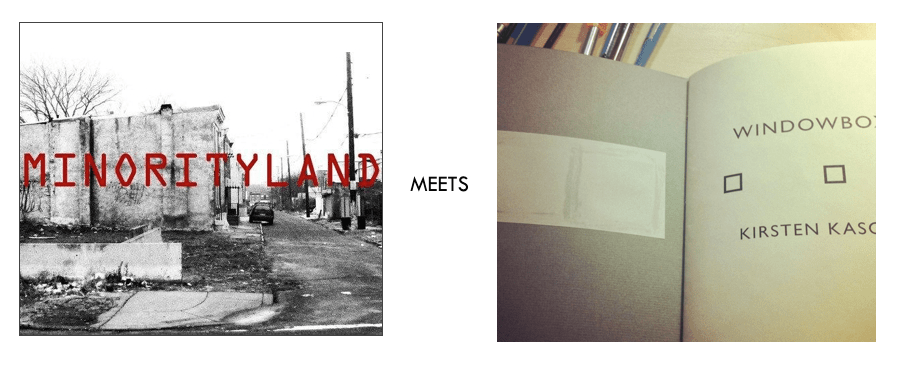
What struck us most in Erlina’s application was the review by Citypaper for her piece Minorityland. That the reviewer admits to all her preconceived notions about what Erlina’s work would be and how she would assess it, that she admits to not wanting to participate in the issue that the work is addressing and that she then flat out says that she was totally and completely wrong on every count… What a powerful testament to a young creator’s ability to transcend the powerful stereotypes that others will put on her as a young woman of color. What great evidence that her writing is something we should be paying attention to.

For Kirsten it was clear that she’s hungry to take your writing in new places. And how exciting to find a writer in this place after a Sleight-356x535successful career with a large body of output, how amazing to be on a precipice of something wholly new. I loved the bit from her novel Sleight, loved the slow burning build of tension that the back and forth between the interviewer and subject creates. It’s a lovely and quiet power. One that made me guess at answers in advance, trying to anticipate the person I felt myself in conversation with.

I think… well, I think I sleight because I always have. My mother sent my sister Lark and me I guess for poise and I was good. And when you are good and a girl at something you stay with it—maybe for all the goodgirl words that come. Goodgirl words like do more, keep on, further—instead of the other goodgirl words—the if-you-are-you-will words—be nice and softer and you don’t like fire do you? – From Sleight

It was this sentence from Kirsten’s application:

“So far, what I have not been able to achieve as a writer is a creative (rather than scholarly or documentarian) relationship with the performing arts. Because I have a background in dance, I often wonder if I have shied away from more text-based theatre because I felt more qualified and educated in movement techniques.”

that made me think of this pairing. Because it would be so exciting for Kirsten to offer Erlina the gift of decades of experience and vice versa for Erlina to offer the memory of the gusto and daring of first setting her words free on a stage. It would an erlinainteresting mash up to see how these two writers might write together. How their differing experiences and approaches could inform each other. How their experience with their respective strengths might shift each other’s sensibilities.

Erlina’s application describes her creation process in a sample convo with her collaborator:

“Wait! Omg.. what if she was her daughter!?”

“Oooo that’s good.. omg I can’t wait to write that.”

A typical conversation for us.

Needless to say, we are very open to change.

"thread" right over the heart

“thread” right over the heart

In person, it was clear Erlina is excited, articulate and energized. She’s a young director/creator/writer I met last year and one who I think Philly ought to be watching. We should all be psyched about where her work will go. And Kirsten is a language island of sorts – the writer in a dancing family. Her seamless transition back and forth and back and forth between language and movement (having worked and studied as both a writer and choreographer) are like a ballet in themselves, one that weaves and binds these two disparate elements together. Can it come as a surprise that she has the word “thread” quite literally written on her chest?

Pick three adjectives that describe what you make:

Erlina: Entertaining, Scary, Real

Kirsten: Visceral. Unnatural. Haunting.

What was exciting about this conversation was the fact that we span such a range of experience levels. Erlina is literally just embracing that role of playwright with her second piece for the Fringe this year. Similarly, she talked about how it was leaving home that really inspired her to embrace her Dominican heritage and begin to use it as the fodder for her artistic expression. I am a director who came to writing semi-unwillingly, creating scenes for language initially out of necessity and then discovering non-fiction writing as a means to express in the in the long in-betweens between shows. And Kirsten is both a poet and novelist – one who talked about needing the distance that fiction provides, that getting too close to reality weights and drowns the work. She often employs the metaphors of science fiction to create an othered world that can allow us to examine our own.

From Erlina’s play Minorityland:

Deb: (sighing) You know… I don’t think bees were every meant to sting humans.

Otis …what?

Deb: I think one day some stupid bee went astray and stung some human and now, that’s all anyone thinks bees are good for. And everyone started running away from all the other bees and the bees said well fuck it. I may as well sting humans too…You make your own enemies by assuming the worst out of everyone.

We also discussed the intersections of language and performance, about authenticity and the difference between movement and story. I think that there could be lots to do in this group, plenty of interesting experiments to try. There was also a lot of talk about convention – for example the choice made from necessity for Erlina’s company to cross gender cast or cast young actors in roles that are older – and how it changes the performance, whether the “real” thing is actually better.

Thanks to you both for meeting with me!

A

An interplay between effort and ease: Lauren Rile Smith and Francois Zayas

Lauren and Francois

The latest “blind date” from Cross Pollination! Today we meet:

Lauren Rile Smith (trapeze, circus arts)

Francois Zayas (music, composition, percussion)

Muscularity mixed with grace. This was a theme that emerged in both their applications.

lauren door 1Whether expressed through a virtuosic solo on maracas or the twisting expertness of a trapeze act, this pairing grew partly from a sense that both acrobatics and jazz are art forms that require intense training, years of study in almost formulaic muscle memory, in order to achieve a sense of freedom and flight in the moment of performance. They are also both mediums that depend on deep trust – of the instruments/objects used to perform, of the people who join us in that performance – in order not to falter and fall.

Francois: “Through all the years of my career I have experienced the benefit of collaboration with other artists many times. This is something that I seek out in francois maracasmy everyday life and constitutes an essential part of my creative process.”

Lauren has mentioned to me in the past that she is often seen as unique in her work for being a woman who acts as an acrobatic “base” or support (a position usually occupied by male performers). It strikes me that perhaps (though I will admit to having had only the first tastes of the banquet that is jazz music) it is also unique to have a percussionist as the leader of a jazz ensemble. In this way both of these creators strike me as participating in tradition while simultaneously innovating within it. It also seems as if your part in your artworks creates a kind of foundation, a ground floor on which everything else can be built.lauren trapeze

Lauren: “I see a powerfully interdisciplinary potential in circus, as an art form that straddles genre, from dance theater to variety-hall burlesque.”

And there’s a parallel too in the way that their works re also a vehicle to express personal identity: be it in the way we are allowed to see a female body moving through the air or in the awareness of how one’s Caribbean roots can be expressed through pulsating waves of rhythm.

Pick three adjectives that describe the stuff you make:

Lauren: feminist, muscular, inventive

Francois: Unique, thoughtful, Cuban

francois drums close

Credit: Alan Jackman

This was a conversation that wove its way through all these things and more: Lauren talking about the way that the aesthetics of ballet are sometimes necessary in trapeze but sometimes not, Francois talking about how standard jazz improvisation has become a default that people expect but might not really strengthen the composition of the music.

Thanks to both of you!

– A

What exactly is “devising” anyway?

Hey folks, something a little different for today.

This past Sunday I gave a presentation on “devised” theater for Directors Gathering. As I sat down to prep for the evening, I realized that for so much of my career I’ve defined my work (or had it defined for me) as a series of oppositions. My work tends not to exist in a traditional space. It tends not to take a linear form. It tends not to let the audience sit back and passively observe.

As I started trying to describe this “style” of work I kept asking myself, rather than thinking about what it isn’t can I articulate was it is?

The short answer is yes, I can.

And because I was so pleased with the reply that I found in answer to that question, I thought it would be worth sharing with you.

So here it is…

A