Random

Coming Soon: The Summer of Play Play!

There’s this term I use for plays that I think epitomize the passive theater experience: Play Plays.

In the past, when I’ve used the “play play” term I‘m generally making fun of a kind of play that exists in a very narrowly defined idea of theater one that, in my opinion, doesn’t makes the full use of the superpowers of a live medium. I’ve been thinking a lot about the word “play” in the last couple years and in particular about the ways our “plays” contain very little “play” for the people we invite in to experience them. I’ve been looking to games as inspiration for how theater might learn to do things a little differently. Lately, I’ve realized I need to do more than just read about these ideas, I want to put them into action.

So! This summer Swim Pony is going to re-define it’s own snarky definition.

We’re launching “Play Play”: an exploration of theater and games in collaboration to find whatever engaged and play-full experiences might be possible. We’re inviting anyone interested in the intersection of games and theater as an avenue for play (play) to join in on an open-source six week research and exploration project. What exactly does that entail?

Throughout June, July and August the Play Play team will meet up six times for 2.5 hours, the first half for research and discussion and the second for on the ground trial and error in the real world. This is pure research, no final products in mind here. We’re just interested in learning more about what’s out there, and conducting some simple experiments in real time. Swim Pony will offer up a meeting space, some snacks and a little cash if an idea simply needs some resources to come to completion. Meetings will be lead collectively and topics of interest decided together.

So if you’re already looking into game and theater hybridization or if you’re just intrigued by the idea look at the dates below and email swimponypa@gmail.com with your name, preferred email and a few sentences about why you’re interested.

Participation is free and selection will be first come, first serve-ish. (What does that mean? Mostly, if you email first you’re in! That said, we want to create a balanced group, ideally with a variety of perspectives and experiences so we’re just being upfront that we reserve the right, if we have to cap, to pull from responses with an eye for group diversity.)

Can’t take part! Have no fear. We’ll chronicle the work and share a post on each week’s discoveries on the blog.

THE NITTY GRITTY DETAILS

DATES: Mondays June 22nd & 29th, July 13th & 20th, August 3rd & 10th. All from 10am – 12:30pm. YOU MUST AGREE TO COME TO AT LEAST 5. Everyone gets one off but the idea of this is to get a running convo, which isn’t possible if it’s too hodge-podge attendance-wise. If you need to miss one please indicate the date in your email.

LOCATION: TBD depending on size. We’ll let you know.

Best!

A

8 Steps To Actual Actual Innovation in Arts Funding

A few years after I first started working in theater I ADed under a director who used this phrase that I love. When he was trying to uncover something about a moment, get at what the character was doing, he would say something like, “So what’s actually actually happening is…”

I love this turn of phrase, actually actually, because I think it speaks to the layers of honesty with which we communicate. There’s a way in which we might say we’re doing something but actually actually we’re kind of doing something else. Like when I say that I’m working all day on a grant but actually actually I’m equal parts answering grant questions and distracting myself with games on my phone or reading emails that I don’t really need to look at. It’s not malicious, this uncovering of my real activities but it does show the ways in which we label our actions in ways that aren’t always inclusive of all the forces working on us. I’m not on the internet because I don’t want to write the grant, I do, I just also am tired and really enjoying unlocking the secrets of Dwarf Complete.

Actually actually is a manifestation of our actions in the most literal and concrete sense of themselves. It strips them of their highfalutin’ intentions and gets down to the nitty gritty of their real intents and their actual (actual) effects. It shows that our motives are often more complex and human than their purest descriptions.

Sometimes I wish I could ask arts funders to tell me what they actually actually want.

In my anecdotal experience, when people give away large amounts of money there’s what they say they want in their beautifully crafted guidelines and then there are the means by which these funds are dispersed. And a lot of the time, the stated want isn’t actually actually best engendered by the means in which things are executed.

I don’t, truly, honestly, think this is malice. I know as artists there are times it can actually feel that way. But I really don’t think it is. That said, I think it’s useful for us to remind ourselves of the difference between what is said and what we feel like we actually actually see. It keeps you sane. It keeps things in perspective. It allows you not to get caught up in rage when you feel like you are held to a standard or desire that’s not always what is shown on the surface.

This isn’t true across all my experience, and it certainly exists at a lot of levels of divergence from that first actually to the second. The one that most gets me though, the one I find the most often frustrating, is the call for “innovative” art. Innovation is a tricky work. It is grounded deeply in risk. It requires, by definition, newness and the encountering of the unknown. It is something encountered for the first time. All of which is very hard to explain in a clear and delineated narrative six months, a year, two years before the innovative thing is going to take place, before its component pieces are thoroughly explore and identified, before its map has been charted, before experiments have been conducted to test hypotheses. By the time these kinds of things are known, the actual innovation is already over.

You can court the unknown, or you can have a steadfast plan carried out without alteration. You can scientifically journey into unfamiliar experimentation or you can seek the rigorous and practiced craftsman to execute his skill. These are both interesting and potentially worthy things. But in actual actuality they are a non-overlapping Venn diagram.

I understand the desire to know things, I do. But you can’t have it both way my darlings. Or rather, you can, in a way, if you pretend it’s possible and leave it to those actually executing the thing to try their damnedest to pull those two circles toward a tiny space of intersection. It’s a lot of work, that pulling, work that I’d say is better served elsewhere, like actually actually implementing some innovation.

My guess is things won’t change soon. But if someone else’s giant pile of money were up to me, here’s how I’d actually actually propose to get there:

 ADRIENNE’S LIST OF FUNDING PROCESSES FOR ACTUAL ACTUAL INNOVATION IN THE ARTS

1.   WHAT: Give $5,000 to the first 25 people under the age of 30 that ask for it. No questions asked.

WHY: First off, in the grand scheme of things, this is nothing. This is one not that large Pew grant. For reference, my very first show, THE BALLAD OF JOE HILL, was made with $1,500 and it launched my career into an entirely new orbit. Think about what 25 upstart artists could do with 5K. Plus, if they ask first they’re likely the most shit-together folks of this age set.

2.    WHAT: Rent a rehearsal studio space for a year and give away 20 hours worth of time to anyone that asks for it.

WHY: Space is one of the first thing that starts costing you money fast and it’s especially hard when you are at that stage where you’re in total blank canvas mode. It feels decadent and wasteful to sit in a room you paid for without a plan so often this time, which is actually the most important, happens in the cracks and spaces between “real” rehearsal.

3.    WHAT: You want fancy video work samples for grants? Hire a staff videographer and pay for them to shoot and edit the work of people in the Philly arts community.

WHY: The cost of a staff person like this is likely akin to one big grant to a large organization. Pay for this instead and you will get better work samples. You won’t have to keep telling artists we’re not spending enough on videographers. You won’t have us waste our time developing the skill set of videography and editing when we could be making stuff.

4.    WHAT: Democratize the grant writing process. Hire a staff that crafts the language submitted to the panel or board for every applicant. If you need to offset this cost have them work on a commission basis commensurate with budget size.

WHY: It is true that an individual artist might have a project as worthy of funding as a huge non-profit. But the chances that a solo creator has a whole paid staff of grantwriters is nil. So in essence, a huge part of what you’re actually measuring in the grant process is the monetary reach of the applicant and not the actual artistic ability. This is campaign finance reform 101. If everyone has the same writer, then the projects will actually be presented in a fair and equal way.

5.   WHAT: Fund an entirely “research” based phase with no require showings or products other than to document what happened and share that with the artistic community.

WHY: This is the thing that the academic weight of science has over the arts. People believe that research for research sake is valuable WHETHER OR NOT IT BECOMES A VIABLE PRODUCT. Scientists know this. They know negative results aren’t failures. I think artists know this but they get so beaten down about it that they forget. What if we got to go and sit in on rehearsals for each other or read papers about the questions other companies are asking and the methods they use to do so? What if we had a peer to peer exchange system the way that the scientific world does? I bet we’d all be a lot artistically richer for it.

6.   WHAT: No project grants. For 5 years. Only operating support.

WHY: Seriously. You all know. I don’t even need to explain this one.

And while I’m at it:

7.     WHAT: Stop dictating how to spend the money. No required areas. No explaining if you have to shift money from one place to another.

WHY: Do you know about these folks: https://www.givedirectly.org/operating-model.html? Their aim was to benefit the extremely poor across the globe. There are lots of charities that decide how exactly poor people across the globe ought to make their lives better and allow people to give them a cow or build a school, or whatever. In most cases the funder is telling the person who could use the funds what method would be best for the person to improve the person’s life. Sound familiar? These folks thought to themselves, “Hey. Who knows better than the actual person how they could best make their life better.” In other words, they assumed that person was as intelligent and capable as they were, just in need of the funding. I think we need to start imagining a world where artists just get to use money for their art in the way that they see most efficient towards making their art. Because if we believe they are smart and capable creators, why would we assume they don’t know where the resources toward their work ought to be best used?

And lastly:

8.    WHAT: One year, forget about trying to define “excellence” and just give all the money out by random lottery.

WHY: It was a real lesson in what a little but of status can do when my recent War of the Worlds collaboration was picked up as the mayor’s selection into the Bloomberg Public Art Challenge. Comparing the way people talked about the project with my collaborators and I before and after someone decided it might be worth a million dollars showed that so much of the perception of “value” and “quality” is intensely subjective. If we could just try democratizing this for a year, we might end up with people that would never ever seem like they would deserve that money, but absolutely blow us away with what they are capable of.

I’d even propose that if we took one major funder’s pool and did this instead of what they currently do, we wouldn’t even need more money. But I bet we’d have a whole lot more actual innovation

That’s all for now…

A

A totally blank canvas

blank

White. Open. Unknown.

This is the feeling I had this morning. This is the premise of this project: Starting from a totally blank canvas.

Not even a canvas. The idea that something has to be painted on. The idea of paint. The idea of having an idea to paint something at all.

Because really, where do a visual artist, a theater maker and writer and harpist logically begin if they want to try and make something together?

foot

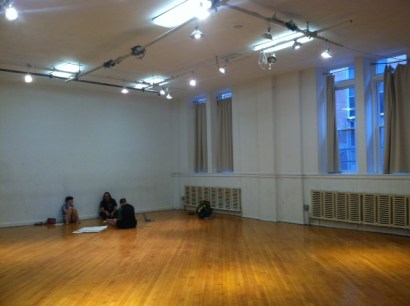
This morning I walked into a room with two creators I’d met only once before. I had butterflies in my stomach, big fat ones, like first day of school jitters. We started, carefully, delicately, hesitantly to… What? Carefully try to suss out exactly who the other is and what exactly we might find in this insane thing we’ll be doing.

I thought, “What have I gotten myself into?”

I thought, “I have literally no idea what is going to happen.”

I thought, “Do your best not to fall into things you already know how to do because they are easy, or familiar, or you know how to make them work.”

I thought, “This is terrifying.”

I thought, “It is really tough to know where to begin.”

I thought, “Listen.”

I thought, “Try and stay open to something you’ve never imagined before.”

NickIt is a pace I am so thoroughly uneasy with because it is so thoroughly rare in my regular artistic life. So rare that I allow myself permission not to be in charge, not to have the active working idea, not to try and keep the energy of the room moving forward and productive. As a director, I feel myself wanting to know the answer, wanting to show people their faith in me as leader is secure, wanting to get us on track already towards where we are going.
But all this well-intentioned Midwestern productive attitude-ery also means that you can slip into taking yourself where it’s easiest to lead, rather than really waiting until the very new, very strange, very uncertain thing emerges.

And despite my fear, despite my worry that it feels like nothing is happening, after 8 hours I can see there are some things emerging.

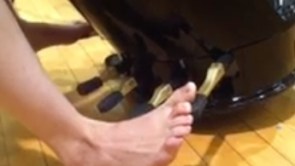
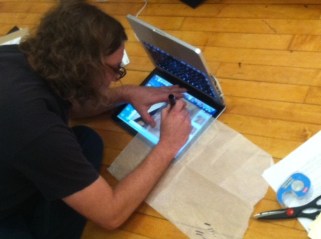
I have put my hands on an instrument I have never touched before. I have watched an artist demonstrate his iterative process – one that normally takes acetate and photoshop and a vinyl cutting machine – on a sideways laptop screen with a piece of tracing paper, some scissors and tape. I’ve enjoyed seeing an actor confront a harpist on stage and I’ve seen that interaction photographed and then turned into a looping gif on a computer screen with a different selection of the musician’s playing as it repeats again and again and again and again and again. I’ve talked about why a video on Vine might be a meditative experience and what it would mean to create audience customize-able art.

I’ve shared a vision for a super strange, exciting and foreign line of inquiry. And despite my fears, I think it’s pretty interesting. Even if I have no idea of how to evaluate it yet. Maybe especially because of that.

I think I also had a moment where I realized that contrary to how I feel on almost every other artistic project I work on, in trying strange, potentially crazy ideas with these two I have nothing to lose and everything to gain.

I also ate a lunch of donuts and fried chicken. That was pretty good too.

At the end of the day I am tired. It is work, searching so hard across the ocean of discipline to find some common ground. But tired in a good way. In a way that makes me excited to get up tomorrow and try again.

Thanks Nick and Liz. I’m excited about more to come…

A

It will be hard, but not in the way you think

Hey all,

Know it’s been a bit. Some (VERY EXCITING) new things on the horizon that have to do with the recent hiatus. That said, I thought I’d re-post an oldie that I was reading over again recently.

We’ll be talking soon…
A

Swim Pony's avatar

hard

There’s this cliché that people always throw out to young artists, “It’s such a hard life. You shouldn’t go into the arts unless you have to. Unless you can’t do anything else.”

I hated that.

As a young person, telling me something was hard was just about the fastest way to get me to want to do it. Telling me something was potentially crushing and impossible was even more enticing.

I loved the idea of hard work – rehearsals for hours, going home and reading and writing about theater, studying and researching. This kind of all or nothing attitude towards tackling something was exactly what I wanted. I sought out to fill every corner of my life with my work in theater because I thought that this is what “professional” looked like.

After a bit more than a decade of an actual life as an artist I’ve slowly morphed into…

View original post 885 more words

Interlude

federal copy

This is where you start

The life of a creator can be tough between projects. It can be especially frustrating if you feel like the work you make is dependent on others being around to help you do it. Some days it feels awfully tough to “direct” all alone in my apartment. And on days like this it can feel like my work is dependent on so many factors out of my control to come into being.

I recently had a convo with a friend who was in a slump, feeling down about the announced seasons of most of the local theaters (the perennial “No parts for me” frustration), wishing that could she saw a creative outlet on her horizon. Like I said, I know the feeling. But I also wonder sometimes if we don’t unconsciously do ourselves a disservice thinking this way –  giving ourselves an out from really going after what we want. If it’s up to others to determine our creative fate, it’s not our fault if we don’t feel ourselves moving ahead.

This blog is the product of one of those long stretches between rehearsal processes. It was a way for me to put all that energy I had into something even if it wasn’t a show. This space, this writing, has been a reminder that there is a way to keep a practice active and moving even when you can’t work it in exactly the way we might wish. Like taking up rowing after getting a bad sprained ankle. Doing something similar but a little different might mean, as I’ve found, a challenge is also an opportunity to find that one’s output doesn’t have to be so narrowly defined.

Anyway.

In this spirit, I’ll try to share ways that I find to keep the research and performance work alive in these interludes between the work. And to start I’ll share a small theatrical experiment.

This is a walking sound journey. It’s rough, a very first draft, but a style I’ve been really interested in playing with recently. This piece came out of a two day exploration at Headlong’s Dance Theater Camp with Amy Smith on “Experiential Journeys.” The goal was to research how to create experiences that bring people into their environment in new and different ways. I wanted to try a solo experience that integrated the real world with an invented narrative. The way that I feel when I’m walking down the street and the music I’m listening to suddenly, serendipitously, syncs with what I’m seeing around me.

So here’s what you do:

1) Download the two files at this link and put them onto your phone. (Or if you get decent service you can play them online.) Grab some headphones.

https://soundcloud.com/swimpony/sets/federal-walk

2) Go to the northeast corner of Broad and Federal. Stand next to the mailbox.

3) Before you move, orient yourself. For this experiment you will walk east on Federal, take a left on 13th, another left on Elsworth and then a final left onto Broad as you pass the diner. You’ll essentially make a loop around the block and end up back where you started.

3) Start playing the first track. Then go for a walk.

4) When you finish track 1 go back to the mailbox. Start playing the second track and wait until it tells you to “Start walking” and repeat the same path.

That’s it. You’ve just participated in a little work in progress.

Feel free to let me know what you think.

A

Jealousy

Hey folks,

Since there are so many newbies to the Swim Pony blog joining us for our month of lady artist awesomeness, I figured I’d re-share a post from last year that garnered a lot of attention.

It’s not specifically related to being a female artists, but I’m sharing it because I think it’s going to be one of the major principles laid out in the Awesome Lady Squad’s manifesto (coming this weekend!). One of the ways I think we all get cheated out of the arts community we really want is by being sold on the idea that there isn’t enough to go around. And if there isn’t enough for all of us, we end up feeling like we have to fight each other to get any.

Let’s decide this isn’t the case.

Let’s assume there’s enough Awesome for everyone at the table.

Hope to see you next Sunday and Monday.

– A

Swim Pony's avatar

mon Some people have all the luck

I will admit it. It’s really hard sometimes to be happy for your artistic peers. There are times when someone you know well gets a job, or some big funding, a fellowship and you just think to yourself, “Damnit. I am just as good as them. This is not fucking fair.”

There are times when I hear about people’s successes and my first instinct is to figure out how I could get a hold of the same opportunity. There are also times I despair at the seeming lack of luck, a random set of factors that make their stuff trendy and my stuff totally prohibited from some desirable professional stepping stone:  I don’t do straight plays, I don’t have an MFA, I’m not great with Shakespeare, I don’t act, I’m not part of an ensemble, whatever. It’s harder, not easier, the closer the people…

View original post 813 more words

Choice

So I’ve been reading the many articles that have been appearing on HowlRound recently about women directors

First this one

Then this one

And finally this one

All of these to some degree are about the language we use as female directors in our rehearsal rooms.  I’ve been thinking, brewing, about this for a few days now. Thinking about my own rehearsals as a female director. Of my responses to the article and responses to the responses, and then if humanly possible my response to the response’s response.  I’ve been formulating my own opinions about how I feel in response to these articles. And it occurs to me this afternoon that to explain my feelings about how to talk about language, I need to first talk not about words but about voice.

This semester I have a student named Maranda who has the most amazing voice.

Her sound is generally placed pretty low in her chest. It’s not raspy or throaty but it’s lower and further back than the typical standard of placement for most American speakers. I should probably mention she is Jamaican and sports a relatively thick Patois accent, too.

She is usually one of the first to arrive so on the days I teach at her school, I watch students walk into the black box for voice class and greet her sitting in the second row of the seating area.

“Hello, Ma-RAAAN-dah,” most of them say.

“Hello,” she says back and smiles. 

So far this semester I’ve led Maranda and her classmates in exercises on playing resonance in different parts of the body, in articulation exercises, and projection. I’ve tried to give them skills to open up access to all the sounds their voices are capable of.

One of the first realizations to come in my class is there is no such thing as a person’s “voice” in the singular sense. Around week 3 my students always begin to write about their voices in plural. They talk about how their sounds change over a range of different contexts and in relation to different people. The voice they use for a boss or teacher is quite different than the one they might employ for their friends, entirely different from the one they use with their parents, and different still than one for performance. These voices, they are begin to realize, are not the same. Consciously or not they are employing different sounds to try and achieve a different relationship with the listener.

And it is around this time that they read an article about vocal habits and explain what the author Patsy Rodenberg means when she says that habits are only a problem when they are no longer a choice. It is also around this time that I begin to hammer home a point that I will make through the rest of the course, a moral that underpins everything about the way I approach voice work: there is no such thing as a voice that is “better” than another voice. Ethically, morally, aesthetically, there are no “bad” voices.

There are simply voices that are useful in communicating and achieving what you want, and voices that aren’t.

Which means a high-pitched tiny “girly” voice can be fantastically useful in some contexts just as much as a low basso commanding one. A quiet sound just as powerful as a loud one depending on what you’re using it to do. It just depends on what you’re after.

Most of the students, to some degree, read the article and understand that the point I’m after is that your voice, your tendencies, your style is just as “good,” as long as it’s serving you to get what you want and as long as it is your choice. So when they start making sounds that at first feel funny in their bodies and mouths I say that I don’t care if they talk that way, but I do care that they have the option. When I make them stand in front of each other and speak I ask them constantly what they are trying to make the audience think and feel. The class and I collectively listen to each person and think and talk about ways we can use the voice to get us to the goal the speaker is aiming for.

Each vocal quality is a different choice that will provoke a different effect. That effect is their choice to make. I’m simply trying to give them tools to have as many ways to do that as possible.

This is what I think about when I think about the conversation regarding language and female directors. Each kind of language is a choice. Each one will elicit a different response. Each one is useful in some ways and not in others. It just depends on the tactic the particular directing is using to get to the end goal.

Can assertive language be effective? Sometimes. It can also be aggressive and off-putting.

Can accommodating language be perceived as weak? Sometimes. It can also be welcoming of a variety of perspectives and lead to an open and collaborative environment.

There are processes where I mostly ask questions. There are others where I mostly tell everyone what to do. And I don’t think the answer is picking an answer as to which is “right.” Because inevitably that “right” won’t be right for some people and some works of art. What troubles me in the task of trying to define the best type of female directing language is that it actually removes the choices that we so desperately seek to empower these female artists with. Better, I’d say, to ask whether the kind of language you use is getting you what you want. Better, perhaps, to ask if the language you use is one that you feel you own and have agency over. Better, I’d propose, to ask if your language is a habit over which you have choice.

Most recently, my voice class has been focused on an assignment where students bring in pieces of text that they have to present in front of each other. The text cannot be their own writing and this means that each of them must think about how to shift their voices to best communicate the language they have chosen to share with their audience. Last week, when Maranda went up she looked just a tiny bit nervous.

“Can I ask something first?”

“Sure.”

“The character in my book… Do you care if I talk like a white girl?”

Everyone giggles for a second.

“You can present the text however you want to.”

And Maranda’s voice, with its resonant and lilting Jamaican accent that has charmed the class for weeks, transforms into a nasal flat Midwesterner. Close your eyes and you literally wouldn’t believe it was the same person.

Our mouths collectively hit the floor.

The next class I watch again as the students enter.

“Hello, Ma-RAAAN-dah,” they say as always. And she laughs as I tell her it’s obvious they are jealous of her sound.

And she smiles because she I can see she knows it is true. And I’d guess it’s not only because of the beautiful voice that comes naturally but also because she has the power to shape the way they hear her. She could sound a different way if she wanted to. She can be those other kinds of voices when she chooses. She can go to all the places my exercises ask her to. But when she finishes, she doesn’t stay in those other sounds.

She goes back to the accent.

Because she has the choice.

– A

One small thing (that’s also huge) that you can literally do RIGHT now

I’ve spent a lot of time the past couple weeks writing about my feelings. I’ve spent a lot of time talking about the things that I’m trying to do to make Philadelphia a more equal place for artists who are women.

Today, instead, I’m asking you to do something.

Take a look at the websites of your favorite performance companies. See what seasons they have lined up. Or see if they haven’t announced them yet.

And for ones that are still undecided, and ESPECIALLY for ones that have announced seasons with imbalance toward men, send a quick email to the Artistic Director, Managing Director, and head of their board.

Tell them you are their audience base.

Tell them you want to see women employed by their company.

Tell them it matters to you that this happens.

You can do this today. It might take you 15 minutes It could change an entire year of programming.  That’s how powerful your voice could be.

And if you aren’t feeling creative, I’ll even give something badass and awesome to cut and paste into an email:

“Dear _______ Theater Co/Ensemble/Theatre/Whatever,

I love your work.

I also love female art makers.

And I’d really love to love both of those things at the same time.

I want you to know, because of how much I care about your company, that I’m concerned about the inequity of representation for women artists in next year’s theater season. As a member of your audience base, I’m letting you know that one of the ways I will make choices about what I will or won’t see will be based on whether I see women getting the space on stages they deserve.

I care about seeing female characters. I care about hearing female voices. I want to see women in directing and design positions.  And because I want to believe you want this to, I’m reaching out.

I’m asking you, as an audience member, as a fan, and as part of the community your mission seeks to serve, to please look long and hard about the work you’re bringing me next year and make sure that gender parity – for playwrights, for designers, for directors and actors – is a priority in the work you present.

Because I know it is for me.

And I hope you make me proud.”

Steal, change it, do whatever you want, just DO it. Right now, this very moment, you could make a difference.

– A

Lady-Festo!

cooltext1368115366What time is it? LADY-FESTO Time!

Mark your calendars friends. It’s official.

From 7 – 9:30pm on March 23rd and 24th at Headlong Studios (formerly the Arts Parlor) The Awesome Lady Squad will write it’s Lady-Festo.

“What, pray tell is a Lady-Festo?” You might be asking yourself.

A Lady-Festo is the document that will lay out the ways our Squad will carry out it’s awesome missions and how we promise to treat each other as Awesome Lady Squad members.

I’ve also recently contacted the Squad with some updates about our goings on and you can read all the details here. The long and the short is, we want your ideas. So come one night or both. And if you can RSVP to swimponypa@gmail.com so we get a sense of the group size.

If you want to join the Squad email list, have no fear, you can do that RIGHT NOW.

And later this month hammer out a document that will change the face of ladies in the arts for eternity!

Stay awesome.

– A

Dispatches from The Awesome Lady Squad #3: In which the vision grows and begins to come into focus

cooltext1368115366

Did you feel it?

On January 26th at 9pm did you sense the pulling undertow of a wave the coming change? Or perhaps it was subtler, more like an aftershock. A tiny rumble under the feet that you almost could have missed.

Did you sit back and say, “Hey… Did Philadelphia just get a little more… Awesome?”

Well whether you noticed or not the unequivocal answer to that question is a big fat defiant “Oh, HELL Yes.” Because on January 26th the Awesome Lady Squad gathered again for the second time. We chatted some more, shared topics and questions with those who couldn’t make it to the last meeting and even more excitingly began to come up with ideas for how we begin to spread.

Today’s mission on the blog: a recap of the last meeting.

Tomorrow’s: a roll out of some potential projects for the future.

So let’s get to it!

Below is a summary of the three main questions we talked about in the general order we tackled them:

i) What is your work? Does being female affect you as an artist/creator? Does it change the kind of work you make or the way in which you make it? If applicable, has that shifted in any way over time?

ii) How do you get it made? How does your female identity intersect with the ways you get your work into being? Do you think being a female artist differs from being a male one? If applicable, has that changed in any way since you started your career?

iii) What should the future look like? If money, time and other people’s attitudes were no barrier and the world could be exactly as you wish, what would be the working theater community look like? Try and answer as often as possible with “It would have –“ or “It would be – “ versus “It wouldn’t – “

And, as with the notes from the last one, these are some of the things we expressed, written down to the best of my note taking ability and grouped together by my own intuitive categories.

Making Your Own Work

–       I’m curious to know how many people didn’t want to make their own work but started to because of lack of opportunity? (About half the room raises their hands.)

–       My dance company really values showing the opposite of the expected, of the equality inherent in our values. The women also lift the guys because we want to show that women are equally capable.

–       One of the reasons we started making our own work was to look at our perspective as women, especially as sexual people. Turns out that’s very hard and very complicated. I’m 36 now versus 26 when I started. Now I feel a stronger commitment to these issues now than when I was younger. Now I’m seeing more people, especially women creating their own work

–       Does being female affect the work I make? The way I make it? Has it changed over time? Yes. Yes. and Yes. The reason I founded a company was to create opportunities that were lacking in my life.  I wanted to get away from a spirit of competition that was not welcome to me. Philly has always been different than so many other places that I’d done theater. I picked here because that kind of competition wasn’t here when I started.

–       I run a summer theater camp, about 2 years ago I started writing a children’s musical, the lead character was a guy, the best friend was a guy. I realized, I don’t think I’m telling a story that I as a little girl could identify with. So last summer I made sure that the two leads were both female.

The Need to Impress

–       I recently had two young interns, one male and one female. And of course this is anecdotal, but I was so struck how the young woman spent almost all her time trying to impress me and figuring out how to help me do things and the young man spent all this time asking questions about things he wanted to know.

–       It’s the audition paradigm. I feel pressure in this inherent idea that you have to impress. That even when you’re doing the work, good work people like, you’re still auditioning every day. That paradox, that are in tension with each other plague me wherever I go.

–       My personal experience is that you’re applying for a job or going after a role and you’ve got 80% of the stuff they want, a man will apply. But women will say that I don’t know 20% of the job and not apply. That instinct to focus on the 20% unknown versus the 80% we do is part of the issue. In particular as a younger woman I get nervous about speaking something that is truthful for fear of offending. I wonder if maybe the outcome is not as bad as we fear.

–       I was at an audition sitting with 4 or 5 actresses and we’d all done the work of reading the show before showing up. As we were talking we realized that we didn’t love the play. In fact, it was pretty bad and the female roles in particular were really bad. And as we’re talking about it, an actor that works all the time comes in. I asked if he’d read the play (no) and later found out he booked it that day and we didn’t. The point isn’t that I didn’t get cast. It’s like, why did I do all this work on something I didn’t care about? Why show up and get judged for something I don’t know that I even want to do. Young women want to impress. You’re constantly trying to insert “I am smart and just as good” into the conversation but you have to think about who you’re having the conversation with in the first place.

–       Often I’m auditioning for a piece I didn’t conceive, for fewer female parts and parts I don’t really like. So now if I read it and I can’t sit in a comfortable place with it, I remember I don’t have to submit for it. If I’m not enthusiastic about it then why am I doing it? I would rather have les work that I’m more passionate about.

Being on the Management/Administrative Side

–       I feel like I come from a different place because I’m a managing director, my experience has been that I came in and there were too many men. I’m really glad I’m here because there are now women. It’s a constant conversation in the office. The way that plays and playwrights are talked about. There’s something really strong advantages to “oh you’re here and at the table.”

–       In the dance world there are a million female dancers, and so many times I see people get to a point where you have a company and working with all women, and then feel like they have to bring in a male dancer to legitimatize dance or funding or get audience

–       I come from a different context, a new discipline, and when I decided I wanted to make performance, I was the only person doing that in Philadelphia at the time. There was no place that could support my work because I need aerial rigging. So we had to make every opportunity for ourselves, had to educate all our reviewers and audiences, and because all our work is inherently about women’s bodies and shapes, I don’t feel conflicted about that at all. I do feel disconnected sometimes but I’m free not to have to have someone else’s conversation.

–       WHY do grants for women always seem to have to have a social change aspect??

Being A Spokeswoman

–       In my company I became the self-appointed gender watchdog. I always made sure that there were equal female playwrights and directors and designers and roles. Sometimes I could feel eyes rolling.

–       As a brand new company doing classical work, I want to help this company and tell these stories equally. But it’s really hard. What I need help with is figuring out how do you talk about it. What to do when I feel the eye roll. What to say when just a little attempt is not enough. How do I be assertive and say this is important? To get out of the place where I feel like I need to apologize.

–       I am trained as performers and show my feelings. And that ends up hurting me sometimes. This matters to me and I hate feeling myself getting red and blushy and upset.

–       I want to find ways to have open and non-defensive discussions about this. Getting men to understand that they don’t understand means more advocates on our side. It’s not a fight against, it’s fighting to bring them with.

–       Being young, I’ve been in a position of having to learn a lot. If I get a gig I take it, if I take it then it seems like I have to deal with anything that happens. I’ve been doing a lot of backstage work – set design and carpentry. There are physical and weight carrying aspects that I see people not letting me take part in. I want to find a way to voice that I’ve not been treated like the others, that people won’t let me be the same. I’m trying to figure out how to voice this as a student, who admittedly doesn’t know as much.

Talking About How Identity and Labels Play Into the Work

–       I struggle with having to make work about being a woman. Can it just be about me as a person, who happens to be a woman, or does it have to be a statement?

–       It’s something I think about a lot. When I’m making work, I’m trying to think of things about sex and romance and body image, female topics, it’s something I struggle with internally, “Here she goes again talking about her hips.”

–       No guy says “Am I just doing this because I’m a man?” I see so many women come in and apologize

–       Because I’m Latina, I have to do Latina work. You don’t have the freedom of being a white man, it’s like being a white canvas, as soon as it’s a white woman, there’s more paint, with a Latina, there’s more even more paint

–       Sometimes with women who’ve had to fight SO hard there’s a sense of I had to bust my ass and get here and you should too

What we’d like to see instead

–       Funding targeted for women that doesn’t carry a social change element

–       Female director and actors in equal numbers

–       A genuine curiosity in discussions we have with people about these issues. Not assuming the worst.

–       Women in funding positions, in places of deciding power over the work that gets made.

–       A chance to practice these conversations and develop language that I am confident in ahead of time.

–       New ways to fund and produce work that could subvert some of the power systems that currently undercut the issues we’ve discussed. Starting a conversation “this is the way that funding has worked” and “here’s how it might work in the future”

–       A re-frame of how we look at each other, remove the model of scarcity, to a model of abundance. That no matter what work I make, not matter what economic level I make it at, to know that we are not in competition.

So there’s what we said. And tomorrow, check back in for some ways that we (and hopefully you too) can start to take action.

– A