Women in Theatre

The Ballad of John and Jen

When I started writing on this blog, it felt like I was pouring out a lot of the things that I had been feeling for a long time. The first posts were thoughts and arguments I’d been having a lot – internally with myself and externally with others – and were pretty well formed in terms of their reasoning and logic by the time they went onto (virtual) paper.

In the last few months, however, things have slowed. That’s partly (perhaps largely) due to my busier schedule of work. But I think it’s also because I’ve started to dig deeper into some of these things, I’ve begun to get at the stuff under that stuff. I’ve started to get at the things way down that one may not really realize. When you really start to pull apart your choices you start to see the unnammables that work on you, the things that you didn’t totally even realize were there. When you get down into the real muck of it, this stuff is less formed and harder to parse out. You start to pull apart shit that is often much much trickier to unravel and reason through.

I think this might be where some of the real scary stuff is.

I think this is where the less polite stuff is.

I think this might be where people could get a little upset.

But I think this might be where some of the real work is. And I think this might be the place where you start to tackle the issues that really might make a difference. All of which is to say that this post is coming back around to some of the women in theater/gender parity stuff.  This is a first step at trying to dig into the muck.

Let’s begin with the truth: we have some major work to do.  Even those of us with the best intentions aren’t really fixing this problem. Those of us with cursory intention are likely perpetuating it. We can blame the theaters that continue to produce plays with way imbalanced seasons. We can bemoan the writers that continue to create the plays. We can lament the market for having a glut of women. We can do all these things. But it isn’t going to get us anywhere. And if we actually want to get somewhere we have some “money where our mouths are” choices to make.

Backing up a bit: I had an argument back in mid-April, right around the time I wrote this post slamming a few Philly reviewers for their presentation of women in Shakespearean roles. This argument, one that had seven months ago is still picking at me and has been ever since I had it. It would randomly surface in my head in the middle of rehearsal, while driving, watching TV, I just couldn’t let it go. Couldn’t let it go because at the time I had it I was trying and failing to say something, something that I felt with incredible force and vigor and anger and fullness, something that felt like it implicated me and in the way I make choices about my work, and frustratingly was also something I felt totally unable to articulate.

The argument was a sweeping one, the kind that starts with a couple offhand comments and ends up gobbling up an entire afternoon. It was the kind of argument you can only have with someone that you really trust, because you actually start to uncover defenses. It was the kind of argument where you talk about the things you believe deep deep down inside about yourself and the world around you. And my sole caveat here is that it’s totally impossible to try and reconstruct all the things we said. But basically, it came down to this hypothetical:

If you have a slightly better male artist and a slightly worse female one, should you pick the worse one to help achieve better representation of female artists?

In the moment of the argument, it felt like I had no choice but to argue for the latter. It felt like a mission from on high. Like my entire life depended on making the case for that female playwright. That there was something deeply stacked against her. That I was the only way she was going to get a chance and if I couldn’t find a way to make that choice seem reasonable and obvious to my argument partner that she and no female writer after her would ever get it.

Which of course I failed to do.

And of course there are (and were) many reasons one could counter the position I took. Rational, reasonable, intelligent and thoughtful positions that we went back and forth and back and forth about. I almost ended up in tears because sitting there I felt so torn between the opposite side’s reasonableness and some kind of irrational deep down feeling that said there was something very wrong about taking a side other than the one I was on.

Neither of us could be moved. We left it unfinished.

But as I said, this question and the debate that ensued has continued to stick, continued to hang out in the back of my mind, needing to come to completion. It’s been this nagging incomplete thing trying to resolve itself for seven months now.

Over time, small details begin to accrue:

An review for a work of my own in which women played “men’s” roles

Writings from the dear Katherine Fritz

A book on the virtues of affirmative action

And then finally this: a study in PNAS about gender in the sciences that both control for and show statistically validated evidence of bias from Corinne Moss-Racusin and her colleagues at Yale. It was this last one cracked something open that I can hopefully finally start to put into words.

Here’s an intro from Sean Carroll’s blog for Discover:

Academic scientists are, on average, biased against women.

I know it’s fun to change the subject and talk about bell curves and intrinsic ability, but hopefully we can all agree that people with the same ability should be treated equally. And they are not.

What the researchers did a randomized double-blind study in which academic scientists were given application materials from a student applying for a lab manager position. The substance of the applications were all identical, but sometimes a male name was attached, and sometimes a female name.

With me so far? I swear, this comes back to the arts.

So half of the applications were Johns and half of them Jennifers. What the findings showed were that the faculty members rated John significantly more “competent and hireable” than an identical female applicant named Jen. These participants also selected John to receive a higher starting salary and offered more career mentoring to this male applicant.

And the real kicker? It didn’t matter if the faculty member was male or female. Both were “equally likely to exhibit bias” against Jennifer and viewed her as “less competent.”

A depressing graph:

graph 1 PNAS

How about another?

graph 2 PNASIn her great Scientific American blog post about this study, Ilana Yurkiewicz appropriately writes:

Whenever the subject of women in science comes up, there are people fiercely committed to the idea that sexism does not exist. They will point to everything and anything else to explain differences while becoming angry and condescending if you even suggest that discrimination could be a factor. But these people are wrong. This data shows they are wrong.

The thing that stuck with me about this study, maybe even more so than the disturbing results themselves, is that, as Yurkiewicz points out, the scientists didn’t view gender as a factor in their decision-making. They thought they were using objective data for their assessments – rationally reasoned, non-gendered arguments – to determine the strengths of this particular candidate for this particular job.

I’d bet my house that were I to get into argument with those interviewers of Timon of Athens that the points they would have countered with would been rationally reasoned, non-gendered arguments. And my point is that just because you don’t obviously act like a sexist or consciously espouse anti-female philosophy doesn’t mean it isn’t working on you. And even the benefit of experiencing that disadvantage is no shield from inflicting it on others.

Does anyone want to guess about whether I think this pattern might be found in other contexts?

If it can happen so sneakily in something as cut and dry as the representation of skills on a job application with the exact same credentials but a difference of –en versus -ohn at the end of a J…

If there are forces that bias us against thinking that a woman is as capable and intelligent as a man in doing a job in such a carefully crafted scenario of objectivity

If that can happen in a field whose express purpose is to remove bias from its methodology

How can we possibly imagine that we can create object assessments in all the incredible number of variances and nuances and details about what makes a better work of art?

So of course if you knew for one hundred percent sure that you were absolutely judging the work objectively then yes yes yes yes yes you should absolutely pick the “better” play. But I what I’ve come to finally articulate these seven months later is that I just don’t believe there is anyone in the working world that can honestly say that they can do that.

If you have a slightly better male artist and a slightly worse female one, should you pick the worse one to help achieve better representation of female artists?

The problem isn’t your answer to this question. The problem is that this is how the question seems to always be framed.  And I don’t buy this scenario is really the one that any of us is objectively encountering.

So when I hear “It just turned out that way,” I’m calling bullshit. When I hear, “The season line-up just ended up male heavy,” I’m calling foul. When I see foundations that just “happen” to be given to a majority of male-driven companies, I’m not going to say “Well that must have just been the applicant pool this year.”

We all know the odds are already stacked against women because we see it manifest all around us. And while the scientist in me wants to document and collect all the evidence I can to try and display this finding to the world, the maker in me says I need to find a way do something about it now. I don’t have time to wait for a fix. I don’t have time for more research. I’m making my work right now. And there’s no thinking theater artist I know who would truthfully declare gender wasn’t an issue on the general scale. Where we break down is whether we are willing to acknowledge that it’s happens in our own personal choices.

Intentionally or not, like it or not, we are all making a million tiny anti-women decisions and justifying them with million other reasons.  The troubling implication from that PNAS study is that we not only judge women’s past work less fairly but that the bias impedes the potential for future opportunity. And without opportunity we are less likely to create new examples in which people can start to see anything different. Every performer or writer or director knows without a chance to make anything you can’t get better at making things. Even if you wanted to work way harder to achieve the same perception of success it’s going to be way harder to find the opportunity to do so.

And here’s where I’m going to get honest with you all.

I think a lot about this. I try very very VERY hard to root this shit out at the source. But I know I do it too. I wish I didn’t. But it’s just… in there. And were I able to somehow analyze my seemingly objective rational non-gendered artistic decisions I bet I’d find that I too have subtly undercut women in my process or in the field as a whole. Though I might not see exactly how those predisposed biases slip in, I know am not immune. And neither are you.

And in knowing that, I have felt myself at a cross roads where it seemed like I was asking this question:

If you have a slightly better male artist and a slightly worse female one, should you pick the worse one to help achieve better representation of female artists?

And increasingly, over the last decade of my career I’ve forced myself to do the thing that felt, in some vague and hard to define way, the slightly less artistically “right” choice because I believed it was the better moral one to make.

Just so that I’m totally clear about this:

I’m saying that I have steered projects in artistic directions that I might not have otherwise had I not cared about making a less imbalanced world through my theater. I have often picked the slightly “worse” artists because I believed it was the morally right thing to do.

And I do it constantly. I do it on projects ALL the time. Not just on the ones where it seems obvious. I make myself go against my gut in lots of choices because I think it’s better for theater as a whole.

I don’t often don’t say that out loud.

In fact, I don’t know that I’ve said it to almost anyone before now.

And part of the reason for my artistic public persona – my warrior-queen-who-get-all-the-grants-and-deserves-them-because-I’m-a-badass-take-no-holds-creator stance – is to show that despite doing this you cannot impeach my creative process. I want to demand that people acknowledge my artistic worth. And I do that because I secretly fear that people will see what I’m doing and think less of the work. Because deep down in the muck I fear that most people think women are not as artistically capable or that their stories are not as interesting.

In the past I’d get really hung up about it. I’d worry that I was losing my sense of artistry in order to make a point. And though I still believed it was worth it, I fretted about the cost.

I used to think that I was trading quality for principle when I did that.

Now I’m just going to think, “Jennifer.”

Perusing the outcomes of those choices here’s what I find: way way way more often than not, the person I picked was able to bring something to the table that was tangibly better. For obvious reasons, I am not pointing out specifics here but suffice to say, when I went with that slightly non-gut choice, I was often rewarded back in spades. And even when I wasn’t, if I could remember to view the failure in context of the qualities of the artist’s work and not simply their gender, I almost always saw that the real issue had little to do with them as women.

I’m not saying you have to pick terrible performers. I’m not saying you can never work with who you want. But I am saying that creative worth is totally squishy. I’m saying that we make artistic assessments for all kinds of totally ridiculous reasons. I’m saying that the way it’s usually is done is a massive amount of momentum pushing you towards a choice. I’m saying that we’re probably wrong as often as we are right about how a collaboration or an artistic impulse is going to work out. That failure is built into our creative growth.  I’m saying we might as well start being “wrong” for the right reasons.

I’m saying that if you do this for a living, you have to know that so much of the time the difference between two options in the scope of a whole process doesn’t mean that much in the long run. I’m saying the difference between “really good” and “just a little bit better” is likely negligible. And perhaps not actually there. And even if it might be, at a certain point, the artistic benefit no longer justifies the outcome.

I’m saying if you’re at all considering a chance to give the opportunity to a female voice or person or story you should do it.

I’m saying if you actually care about doing anything about it, you have to do it. Even if something is pulling you away from it. Maybe especially then. Because that thing that’s pulling is ugly and dark and mean. And it hides in reasonable arguments’ clothing, it hides in gut reactions we don’t quite unpack. The only way to exorcise it is push in the opposite direction. Even when it seems strangely hard to do so. Even when it makes you feel a little funny. Activist-y. Moral high-ground-y. Like you’re doing the wrong thing-y.

Trust that you’re an amazing artist. Trust that this small push in the other direction will not harm your work. Know that it is a better thing for the world to have done. And see that your work is no worse off for it.

And then perhaps we can start actually getting this shit fixed.

– A

Digging Deeper

A few weeks ago I wrote an essay about a few reviews for local company The PAC’s production of Timon of Athens that I thought were heinously misogynist. Right after I finished, still vibrating from the anger that I felt from writing it, I went into a brainstorming session with a collaborator of mine that I really respect. And because the essay and the larger issues that it alluded to were so present on my mind we ended up getting into a two hour discussion about opportunity and success and how that works in regards to dealing with making theater more equal for “othered” communities. And I’ve been trying in the days since that conversation to put into words something that I’m wondering about.

Let me diverge for just a moment and share something: I have my mother’s last name.

And I’d like to be clear that I knew my dad all through growing up and he was part of my life from the start of it. My sister and I received my mother’s last name not because my dad was not in the picture. No, my parents were married during both my and my sister’s birth.

And yet, I have my mother’s last name.

It was a bet. The name thing. Or rather, a decision left to chance. As I’ve heard the story told my parents agreed that if the first born of my parent’s union was a boy, it would have my dad’s family name Gude. If a girl, we’d be Mackeys. And then, for consistency, all kids after that would get the same no matter what the gender.

I, as the eldest, came into this world a girl, and as such, the Mackey line continues.

It was a point of extreme confusion to many many people when I was growing up. People from school called my father Mr. Mackey all the time. My dad, for his part, seemed to take it in relative stride. (Though he did, I noticed, seem to find it a bit more annoying than the mother of my good friend whose name was different than her husband and daughter.) But on my part, it took me a long time to get why people were so incredibly surprised by this. I was in my teens before I understood how incredibly rare such a thing was.

I do now.

Something else: I’m in the midst of reading the book Lean In by Sheryl Sandberg that’s been getting so much press lately – so many people had mentioned it to me that I almost felt obligated. And there is a lot in there that feels like a larger parallel to some of the issues that I’ve discussed about gender parity in theater. Especially a 2003 study in the book (cited all over the internet if you want to read the full thing) from two Columbia Business School and NYU professors that showed students (both male and female) who rated impressions of a successful venture capitalist were less likely to view the person as likeable when that person was a woman. In both cases the person was respected but while success and likeability were positively correlated for men the opposite was true for women.

Instinctively, as women succeed we tend to like them less. As an emerging leader in the field, I feel this deeply in theater. The study indicates that there there’s an unspoken but present and persistent hurdle towards success for women. And while it’s not insurmountable but it’s likely always there. Which means that even if people are smart, open minded, even if they believe in equality. Even in a “liberal” art form we can have let biases infuse our choices. From within and without we have this extra bit in the way.

As my friend and I discussed my PAC review essay we both brought up Malcolm Gladwell’s book Outliers and the study in it that showed professional hockey players in Canada are nearly all born in the first four months of the year. Researchers surmise this is because the cut off date for participation falls at the end of the year and so children born in early months are a small bit larger due to an extra few months of growth, a huge advantage at a young age, and receive attention and positive reinforcement for their successes. Their little bit of totally random age advantage is seen as a greater degree of talent even though it’s really just being born in the right month.

That study makes me depressed because it showed how small advantages seem to make concrete differences in the long run.

There’s another study we talked about, one about societal messages that influence us. This test, the IAT, measures instinctual associations between words. Here’s the site where you can take a number of such tests.

I took the “Gender – Career” test which “often reveals a relative link between family and females and between career and males.” In other words, how strongly we correlate a particular gender with working and another with staying home.

I understood the implications of the test and how I felt (that I didn’t want to associate male gender with work more highly than female gender).  I knew what the test was testing, how it worked and tried to prove that I could outsmart it. Here’s the result I got:

Your data suggest a STRONG association of Male with Career and Female with Family compared to Female with Career and Male with Family.

And on that same page with the result was this sentence:

“Evidence suggests that implicit associations form based on everyday experiences, so the daily exposure to differences in gender roles in one’s own family might be influential on how these associations form in memory – whether we consciously agree with them or not.”

That’s tough.

Consciously, clearly, I do not agree with that statement. A major part of my identity is wrapped up in the idea that I am no less capable as a theater professional, a professional of any kind, because I am a woman. I think that my success in the directing field, one that is stereotypically male, is in large part because of that belief. That success is due to the fact that I believe myself to every bit as creative, intelligent and capable as a male director.

And yet I, Adrienne – I have my mother’s last name – Mackey seem to have instincts to the contrary. Even I, Adrienne – I run my own company – Mackey seem to have that hurdle there to have to jump over. Even I, Adrienne – I’ve made a giant stink on the internet about the equality in this work field women deserve – Mackey seem to have a little voice in my head somewhere deep down that tells me otherwise.

So I stopped for a second and thought. I made myself picture in my head women in power suits sitting behind fancy wood desks typing on computers. I imagined the names Michelle and Julia and Anne on the marquees of theaters and in programs. I imagined women battling over budgets and running production meetings. And then I pictured a bunch of guys carrying babies and hugging at weddings. I imagined them sitting in houses and doing dishes. I did that for two minutes straight.

And then I thought about my name. I thought about what a small but potent message it provided me with as I grew up. And sitting here just a few days after mother’s day, I let myself be struck by what a powerful gift that last name was.

I made myself think about the fact that my name tells me that my mother’s lineage, work, identity and being was just as important to carry into the future as my father’s.

And I took the test again.

Your data suggest a SLIGHT association of Male with Career and Female with Family compared to Female with Career and Male with Family.

Look, this is obviously an unscientific measure. But we’re finally getting to the point here. This is the thing I’ve been wondering about: Let’s roughly assume that most people don’t really want the huge gender inequity we see in the arts. But for whatever cultural reason it is instinctually in us to make certain biased choices that may make real tangible differences in opportunity for people. They may not want to, but they might still do it.

If this is true, what do we do about it?

I think we have to take time out to prime ourselves – give our brains a small kick towards a particular thought or idea – away from the negative directions that they’ll tend to go.

John Bargh is a researcher who has come up with a series of experiments in priming I read about in a different Gladwell book. One of his experiments sprinkled a disproportionate number of words that people associated with being old into a random word test and found people walked slower down a hall immediately afterwards. In another words that intimated demureness and quiet caused people to wait longer before interrupting someone.

In a different Dutch study (also pulled from Gladwell’s blink) people who thought of themselves as professors got 13% more questions right in a game of Trivial Pursuit than those who thought of themselves as rowdy sports fans. And students who are reminded of their minority race immediately before taking the GRE drop their scores by up to half.

So back to the conversation about the essay:

One question we debated was what you do to combat that that negative stereotype. We argued about how to deal with the difference in opportunities. Do you take an affirmative action type route? What do you do if you have an A+ play from a man and a B+ play from a woman? Which one do you put on? Is it fair to deny the “better” work? What if you hadn’t known the gender of the playwright at all?

And as I’ve thought more about it, I think that perhaps the question should just be framed differently. I think instead, we need to really ask ourselves if those grades are fair. If that kind of situation ever actually arises. Given the subjectivity of art making, can we really always trust those judgments about absolute “quality” in the first place? Perhaps, rather than assuming there will be B+ plays from women, we should take a step back and re-prime our expectations. I think we need to say that we’re not going to argue for or against the merits of doing lower quality work by women for the betterment of the theater medium because the choice isn’t that kind of either or. We need to believe we can do good work by men and and we can do good work by women. We need to start assuming that both are out there.

There’s a lot of negativity that flies around about this, on both sides. I’m not saying we never need a little angry shove sometimes to motivate – writing letters, demanding equal space, letting people know you see the gender parity – but perhaps we can also take concerted time and effort in our interactions to encourage another view.

What if every literary manager had to take a minute before reading a female playwright’s script to stop and read a short list of amazing plays by women authors?

What if every time artistic staff met to discuss a season they read a few short positive press quotes about the female driven shows that their company has produced?

What if every time a director had a role in which gender really didn’t matter and could be cross-cast they thought about three different women in the role?

What if every grant panel took a second to remind themselves that women’s work is equally important to represent?

Could that tiny thing make a huge difference?

Not because women’s work needs help. Because everyone (whether we want to or not) has a lifetime of subtle cultural pushes away from our ability to see women’s work as equal. And these little pushes back to the center might help make things fair again.

Artistic leaders, creators, and supporters are you daring enough to find out?

I hope so.

– A

Philly reviewers, it is Tim-on to get your shit together

Excuse the bad joke. I can’t help it. I pun when I’m pissed.

Ooo-hoo. Adrienne is angry.  (Can you hear it in the typing? CLACK! CLACK CLACK CLACK!)  I would write in all caps (LIKE THIS!) because that is how I feel, but you would probably stop reading, and I do NOT want you to stop reading.

If you frequent this blog you likely have a sense of what I think about the role of women in the contemporary theater scene.

(In the off chance you are new here, feel free to go back and read this, or this, or this, or this…)

So when I heard that the Philadelphia Artists’ Collective (or PAC) was doing a production of a Shakespeare play – Timon of Athens – that included a bunch of cross gender casting I was interested. Interested because I will be doing a similar (even more substantial) gender re-assigning in Clark Park’s Tempest this summer. Interested to see how they handled this gender switcheroo in context of the classical cannon. But most of all interested to see how people reacted to what they were doing.

And, like one sometimes does when one is intrigued by a colleague’s choices for a production, I read a few reviews about the show to see how it was received.

And now, as previously mentioned, I’m really really angry.

First off: my job here is not to defend this particular production. In fact, I have not yet seen this play. I will, next week. But I write this now, not yet having seen this play, quite intentionally.

There are statements in the reviews of Timon assessing creative choices that I cannot substantiate or discredit.  I do not know if the actors in the various roles are interesting to watch. I do not know if the opulence and greed of the play is borne out in the staging. I do not know if some of the problems that reviewers cite around this particular staging are true. Indeed, given that some of them appear in multiple assessments, perhaps some of the points they mention are quite valid.

But then again, I don’t know, I haven’t seen it yet. And my problem is not with the specifics of one stylistic choice or another.

Indeed, my problem here is quite the opposite.

I will say upfront that there are several actresses in this production I admire and respect, whose work I tend to like very much. And I am making such a long and belabored point of not knowing anything about the show’s specifics because I know that once I have seen the performance I may well be inclined to defend these performers’ specific choices. And I really don’t want that to get all muddled up with what’s really problematic here: the thing that’s really sticky and challenging.

I want to be absolutely and unwaveringly clear that my issue has nothing to do with giving specific critique to these particular people – be positive or negative – and everything to do with the blithe and blanket notions undercutting the women in this production that I see made under the banner of “criticism.”

“Them’s is fightin’ words.” You might be thinking.

You betcha.

Let’s start with Philly.com.  You can read the whole thing if you want to, but I’ll skip to this sentence starting off the final paragraph:

As director, Dan Hodge makes a tactical error in casting women in many of the male roles; it knocks the play off balance (tiny women playing cutthroats and shrill senators), and confuses the issues that have nothing to do with gender.

Ok. (deep breath)

Let’s play a little mad libs game. Pretend this statement isn’t about a play but a business. Everywhere there’s a statement about theater, I’ll replace it with a corresponding business word. Let’s see what we get:

As CEO, Dan Hodge makes a tactical error in hiring women in many of the male jobs; it knocks the company off balance (tiny women working as cutthroats and shrill managers), and confuses the business plans that have nothing to do with gender.

You wanna publish that in a newspaper and see what kind of letters you get?

I didn’t think so.

Having no women in a play doesn’t mean the play has nothing to do with gender in the same way that having a play with only white people has nothing to do with race. It has everything to do with gender: about our conception of what greed is, what it looks like, who is allowed to display it, and the gender with which we associate that quality.

If the play’s issues – greed, ruthlessness, heroism unrewarded – are indeed not about gender, than it really shouldn’t matter if a man or a woman displays those things. The point of the review should be whether the specific actor embodying that role is successful in doing so.

That you make a point to say that “tiny women” should not be onstage displaying those things says to me that you have now made this a play about gender in a way that Shakespeare did not. It says to me that you don’t think tiny women, in general, as a whole, are not suited to being greedy or ruthless. That you can look at a tiny women and know by virtue of her tiny woman-ness that she is neither of those things.

You dislike this particular actress? Fine. Cite the specifics of their performance. But to lump women as a category under the “not viable to play this role” category is demeaning and ignorant.

And don’t get me started on the misogyny inherent in the word “shrill.”

The lesson here is that men playing aggressive roles have the potential to be booming and commanding while aggressive woman onstage are annoying and screechy.  Ladies interested in Shakespeare’s works, please stick to Desdemona or Ophelia or Juliet or Cordelia or Lavinia and go die because you love a dude who is kind of an emotional asshole to you.

Or go be Lady Macbeth and kill yourself.

Or go be Cleopatra and die (again) because you’re an oversexed “gipsy.”

Or be really excited to get married.

Or a witch.

Who wouldn’t be totally satisfied with that?

Moving on.

Here is what Citypaper has to say. Again, feel free to read the whole thing but I’m skipping here to the summation at the end:

And while I understand the need for good women’s roles in an ensemble company like this one, it’s still a mistake to have Apemantus and several other key male characters played by women — Timon’s wretched world of greed and infighting is, in every sense, man-made.

Is it possible that this is worse? I think it is. Worse because of the infantilizing and diminishing way that it’s phrased.  It is the casualness of these words that more than anything makes me want to punch the paper upon which the words are written:

Dan, Dan, Dan… Silly man.

Oops! I think you made a “mistake”.

FYI, this play is male-driven. You might not remember because you’ve been around so many ladies (I mean 50/50 in the cast, but come on, that’s an awful lot for a Shakespeare play).

You forgot it’s about BIG things like “greed and infighting”. It’s not that this particular female performer is not powerful commanding. It’s not that this particular actress you’ve chosen is not ferocious or greedy or money hungry. It’s not that many of the women in your show are young apprentices and might be worth evaluating based on experience or talent instead of gender.

No, no. You didn’t realize that women are not capable of such things.

This story is “man-made.”

Oh, Dan. I hope you don’t make that mistake again…

Because “while I see the need for good women’s roles,” while I see that the two female co-founders of your company are excluded from this very large and powerful portion of the theatrical cannon, while I see the incredibly limited scope of what a woman is traditionally defined as in some of these plays, while I see the subtle and casual limitations that I am placing on them, while I see the constant barrage of definition that many works put on women, a definition they constantly have to battle against, while I see that the logical extension of my argument is that because I don’t usually see women play these roles and it feels weird to me I want you to stop doing it thus ensuring that women are never cast in these roles and making sure that I, nor any audience really, will ever ever acclimate to seeing such a thing –

While I see all of these things, I’d really rather not have to deal with that.

So could you just, you know, not make me think about it?

Punch. The. Paper.

I’m out.

– A

PS –  I sincerely hope that some of these reviews are a product of bad editing. If there is a fuller version, one that addresses some of my problems with generalizing here, I’d love to read them.

And, I would like to point out and credit reviewers like Howard Shapiro who manage to give their opinion about this piece without invoking a lady’s inherent inability to be greedy.

What would you do with ten million dollars?

In 2011 PIFA spent $10 million dollars on their first festival.

Think about the impact of $10 million dollars on an arts community. What can (or should) that look like? If that number just seems beyond imagining, take these few stats in to help give it some perspective:

$10,000,000 is 25% more than all of the Pew Charitable Trusts annual budget for a year. It’s roughly all the assets of The Arden. It’s about 100 years of Swim Pony work if I continued at last year’s pace.

And as this article says that’s also

  • The total combined cost of the four years of the Live Arts Festival and Philly Fringe leading up to PIFA.
  • The combined grants that will be given out this year by the state’s Pennsylvania Council on the Arts ($8.1 million) AND the city’s Philadelphia Cultural Fund ($1.6 million)

Chances are you aren’t a millionaire. Which means that unlike the folks over at the Kimmel, you don’t get to decide where that money goes.

You can argue how PIFA is spending its money (and from the looks of Facebook a whole bunch of people are) but imagine instead what it might be like you didn’t have to. For a moment, imagine that you had to give away that 10 million dollars tomorrow to theater artists or companies. What kind of work would you want to support and why? Would be to companies with an established track records or would it be to scrappy folks making stuff that a little less predictable? Who are the people who you know are awesome that just can’t seem to get the dough?

The question is at its core: where do you think the money belongs and what kind of work do you want to see in the future?

The Wall Street Journal did just this thought experiment in NYC with some interesting results.

I think that chances are the money in the real world is not allocated the way that artists might decide if they had the control. And while on the one hand, we could look at the difference between where the money does go and where we think it should be going and despair, I think that there’s another take away here. Artists are often out front of what’s coming down the artistic pipeline. How could they not be? They are witnessing the development of the future leaders and successes before they get there. And I think because of that, we should concentrate on doing a better job telling the outside world not only about our own awesome work, but about the awesome works of the fellow artists that we admire and respect. The folks that we know you need to know.

There’s a trend among smaller companies these days to have a section of their website that lists of other people that they think are great with links to their info.

I think this small gesture might be the first signs of something bigger.

I think it’s a signal that the monolith arts organization is ending. I think it’s a sign that in the face of a crowded ecosystem, rather than trying to fight the largest predators on the landscape, new makers will give up on the traditional company and instead seek out loosely affiliated groups of creators, folks who respect and admire and promote each other rather than trying to take on all of the resource and producing themselves. I think it’s a sign of a larger, and perhaps more diverse ecosystem of artistry in the future.

At least, that’s what I hope. Because it’s the future that I see people like myself surviving in. I dream of a future with more opportunities for cross-pollination between individual artists or collectives and institutional organizations. I wish for a Philadelphia in which the possibility for getting one’s work to an audience doesn’t depend so heavily on one’s institutional building capacity. And In my mind that means more money directly to artists AND presenters/curators that are not their own primary generative source.

In addition to this, I think there are organizations in town that do a huge service to the landscape with little to no monetary or accolade recognition. They diversify our audiences, educate us as artists or create unimagined resources that help us immeasurably more than their budgets would belie.

So with that context, here’s what I would do if I had PIFA’s cool 10 mil to divvy up to Philly theater and affect change the way I want to. I’ve listed the company or person, divided roughly into categories of how they’d serve the city’s future arts interests and why I want them to have that moolah.

–       Hidden City: $2,000,000

–       Fringe Arts: $1,500,000 earmarked for local artists only

These are the folks that have the possibility to take on a bulk of administration for artists so that they can really focus on the art. HERE Arts, PS 122, The Kitchen, La MaMa. NYC is lousy with places you can apply to without a 501 (c) 3 to help get your work out there. We need more places like this.

–       Team Sunshine Performance Corporation – $500,000

–       Applied Mechanics – $700,000

–       The Berserker Residents – $500,000

–       The Bearded Ladies – $300,000

I love these four companies. They are doing the new exciting work and they are each doing it in a totally different way. If you don’t know these people, go look ‘em up right now. Bigger bucks to the Mechs in part because their stuff is super tough to explain and raise money for. Little less to the Beards because they’ve done pretty well on the institutional support and grant front.

–       The Mantua Project – $500,000

–       PlayPenn – $500,000 – earmarked for a spot every season to a local playwright

–       Shakespeare in Clark Park – $1,000,000

Talk about people who do an awful lot with very little. Chances are you don’t know Mantua, which is too bad because it is one of the most exuberant, genuinely empowering and artistically excellent youth theater programs in Philly. You probably know Play Penn. And as much as I personally tend not to spend as much time in the traditional script world, I think it’s great that they’re making this town a place that people think of when it comes to developing them. And lastly, chances are you do know Clark Park. Now take a second to think about what their presence means to this city. It is hard to deny when you look at a photo like this:

clark park

Remember that what they do is 100% free. I defy you to argue how much that matters for theater’s future in this city.

–       Artists U – $1,000,000

–       Culture Works – $600,000 – earmarked for offering free membership to mid to small size organizations for a year or more

–       White Pine Productions – $300,000

If I could endow AU forever, I would. I think there’s probably no better program for artists out there. I am sure that there’s nothing making a deeper more sustainable impact on creators in this city. Culture Works I know less from the inside, but they are asking some big questions and thinking hard about what arts will look like in the future. White Pines is in an even younger state of development, but anyone that is trying to transform an empty Gilded-Age mansion into an artist haven and offers its incredible beauty to selected resident companies free of charge is bueno in my book.

–       $75,000 unrestricted fellowships to Charlotte Ford, Sarah Sanford, Lee Etzold, Manu Delpech, Leah Walton, Jess Conda, Gwen Rooker, and Jenna Horton

Think about the possibilities that open up when a year or more of your living expenses are subsidized. There are more women than men out there and they are fighting for fewer total jobs. No offense to the talented guys on the theater scene, but can we get a little cash to these ladies, already? By the way, Pew whose fellowship program actually does do this for real people has awarded 16 men and only 4 women Fellowships in theater based on the listings back to 1993 on their website (with 47 men to 26 women granted across all disciplines from 2007 to this year). So you know, the ladies actually need it.

And finally shout outs to Headlong, Amanda Damron, Scott McPheeters, Green Chair, Johnny Showcase, Les Rivera (aka el Malito), Megan Mazarick, Mike Kiley, and Nicole Canuso who I love but didn’t include for the purposes of this because they aren’t officially theater.

I think about how different that list is from the amounts of money that is actually dispersed. I think about the real impact such a gift would make. And I think it’s important for us to do imagine and articulate a vision of the world where the money does go where we’d want it to. So that when we’re asked to be a part of that conversation, we’ve thought as long and hard as the people that generally get to decide.

I’d be interested to hear, where would you put all that money?

A

Heavy

35.9% of Americans in 2009-2010 were considered “obese” by the CDC. An additional 33.3% were categorized as “overweight.” That means at that moment, 69.2% of the country is heavier than “normal.”

When we go to the theater what are we looking to see ourselves reflected in the stories portrayed on stage?

If so, why don’t two thirds of them look like two thirds of the country? If not, are they the images we wish ourselves to be? Or are they simply supposed to be the strongest creator available for the role, and if that’s the case, why are so many more of them than us so much thinner?

Do you notice how carefully I’m wording things here? I do. Have you noticed that I haven’t used the “F” word yet? I do. It’s hard to write objectively about this. This is such a tricky subject. It is so sensitive. But it dominates so thoroughly the vision of our stages that I’m going to stop dancing around and just say it:

It is hard to be a fat actor.

It is hard if you are not fat, but a little heavy. It is hard if you aren’t fat but could be and fear becoming so. It is especially hard if you are a woman.

There might be a few reasons that don’t point toward malicious bias. Heavily dance or physicality based works are going to require a higher level of physical strength and endurance and result in a larger expenditure of energy.  While that does not exclude a heavier performer, I think it makes some logical sense that you’ll get a higher proportion of people who are thinner, which is probably somewhat correlated to long days of exercise and physical activity.

Being fat might make it harder to do your job… maybe. But it might not. And I think it’s rarely the full reason that certain kinds of roles are off limits to certain BMI’s.

Because that argument just doesn’t fly when it comes to a lot of theater. It is possible to be in tune with one’s body even with “extra” weight. And if the performer doesn’t limit themselves, why do we limit the roles that are open to them? Why are we instinctively so nervous about seeing certain shapes do certain things onstage? Are we grossed out, worried, upset? What is it? Forget the gender gap, the racial paucity; I defy you to find me a show full of “fat” actors in Philly. You will not be able to.

If you are doing Grapes of Wrath and everyone is starving, fine, I understand. But show me where it says that Emily Webb from Our Town has to be skinny. Yet I’d stake my savings that 9 times (or more) out of 10 the thin girl gets the role.

Look, I don’t pretend to be objective here.

I have a long and complicated history with weight, one that has spanned both ends of the size spectrum.  At 13, I probably weighed somewhere in the neighborhood of 180 or 190. I don’t really know, because I didn’t go near a scale if I could help it. My grandmother used to chide me with reminders like, “Fat girls don’t get married.” An aunt once remarked, “Adrienne eats like it’s war.”

By my own admission, I was not happy with my body. I hated it. And to compensate I retreated into my brain. I was at war with the free and uninhibited person I felt like on the inside and the tight, closed off and frustratingly clunky form I had on the outside. Which was why late in my 14th year my mom intervened, told me that she loved me no matter what but that if I wanted, she would help me develop a healthier set of eating habits.

Which I did. Sort of.

That summer I started paying attention to the things I put in my body. I stopped housing bags of Doritos absent mindedly. I started exercising on a consistent basis for the first time ever. I learned to really enjoy cardiovascular work outs. I realized that it helped allay my natural tendency toward anxiety. I felt better. I liked how I looked. I was proud of myself for doing it.

Then I went back to high school. I felt so much better, I was so much more excited to be seen. I got the only female lead, as a sophomore, in the first play of the year. I was bumped into a higher level choir and auditioned and was selected for the state competition. I got a boyfriend, which I’d never had. People suddenly paid attention to me. I got friends in the older kid crowd. I felt on top of the world. The change was so sudden and so total and so completely timed with the shift in outward form that it seemed impossible to extricate the experiences of that year from the process of losing all that weight.

The truth is of course not so simple. Yes my outer self had changed, and because of that I allowed more of the person I really felt myself to be to shine through. All the confidence and brazenness and smartness and silliness I always had suddenly seemed like it had a venue to be shown. I had just finally given myself permission.

But of course at the time I associated my new-found creative and personal successes with being beautiful. And I associated that beauty with being thin. And so when I had to wear a bathing suit onstage, I lost another 15 pounds. And when I played Wendy in Peter Pan and was told to try and look younger, I lost another 10. It became a game, the weight loss. One that I assumed would just continue to result in rewards, in a better and better version of myself.

I would go out with friends and eat watermelon for dinner to save on calories.  I worked out a couple hours after donating blood in 90 degree heat. (PS, I didn’t eat the cookies). I was obsessed with food and thought about it ALL THE TIME.  I fixated on my “big hips” which I couldn’t do a damn thing about because I had whittled them down to jutting bones. I want to look back at 18 year old Adrienne and say, “You actually can’t workout your way to a smaller pants size if you have a wide skeletal pelvis. Maybe put some of that energy into learning your lines.”

At my thinnest, I was somewhere around 104 or 105 depending on how much water I’d had that day.

I’m 5’6” by the way.

And that was the point at which my mom said I was done losing weight. If you consider the standard BMI measurement useful (which is super questionable) I started just on the cusp of officially “Obese” and plummeted down well below “Underweight.”

I got over it. College food helped. Learning to love weight lifting helped. I work hard to focus on feeling strong, quick and agile rather than simply thin.

This blog isn’t an autobiography. And I don’t bring up this story for sympathy, though I bet many people reading this who can sympathize. But my story is not the same as many others. There are people who are beautifully in tune with their bodies regardless of their body fat index. Who are graceful and flexible and could be called fat. In fact just this afternoon I was talking to a friend who said that gaining a bunch of weight after having a kid helped her to realize that her creative talent wasn’t dependent on her staying small.

The point is that I felt able to embrace and believe in a fuller vision of myself as a creative person when I thinned up. Until that point, I’d always loved theater. I participated in middle school and my first year of high school. I’d had lovely, nearly transcendent, experiences. But I didn’t believe that I was eventually going to be one of those seniors that got out front and center. Based on the things I’d been cast as before – Mrs. Hannigan, the mom in Music Man, Golem in the Hobbit, ensemble member in Godspell – I figured I’d find a niche in the strong character roles that I’d seen other heavy girls play.

When I came back that summer lighter, I was so upset that they’d switched the fall play from Arsenic and Old Lace to a Neil Simon romantic comedy. I knew I could kill at those funny old ladies I’d been practicing all summer. But it didn’t occur to me that my lovely voice, passion for acting and intelligent incisive attack of text could put me front and center.

I couldn’t be a leading lady. Not if I was fat. And in my head I still was.

I auditioned for that show’s sole female part – an ingénue role – with little expectation. But during the audition process, I began to realize that people saw me differently now. And no doubt, the confidence that blossomed that show, that year, had to do with the fact that for the first time, I believed myself capable of ANY kind of role, ANY kind of creation. I could make people laugh or cry or sigh. I felt like I had control over my creative destiny. And I assumed all of that had to do with the new exterior through which those things were expressed.

I believe with every fiber of my being that there is no way I would have gotten that part if I hadn’t been thinner than the year before. And some days I really wonder if I hadn’t lost all that weight if I would have believed in myself with the same vehemence and confidence. And without that, I wonder if I’d have bothered continuing with acting, found directing and do what I’m doing today.

Two thirds of people in this country are “heavier” than “normal.” How many of those people do we see on the stage? How many stories do we tell that can include that perspective? And more importantly, how many kinds of characters do we unconsciously limit the size of, regardless of the actor’s ability to embody the role.

When was the last time you saw a heavy Juliet or a pudgy Romeo?

I’m left with lots of questions and not a lot of answers. Is this inevitable? Who’s driving it? Why does it happen?

And if it bothers us, what can we do about it?

A

Confidence

As I sat down to write my last essay I started thinking about a single word that could sum up what I wanted from this collaborator thing. And then I started thinking about the times when I have felt at my own personal best as a creative maker. I thought about the times when I didn’t know enough to know that something should have seemed impossible. And thought about the times when something seemed so easy, so obvious, and I totally psyched myself out and was unable to complete the task.

What’s the magic sauce of the first that is missing in the second?

It’s something to do with confidence, with brazenness, with daring with to use the very best of your abilities. It takes courage to believe that you can even if you don’t yet exactly know how.

More than anything for myself and for the people I make with, I want an attitude of:

“Yeah!!! I am TOTALLY going to do this. And if I don’t know how, I will TOTALLY figure it out.”

And:

 “This challenge is awesome!!! It is exciting to me. And above all it is one I will find a way to be capable of.”

You know that feeling, right? The one where you are on top of the world and able to tackle anything creatively thrown at you? That’s what I want: people who believe in their own badassery.

And if you are like me you also know the opposite, the feeling where supposedly you should be able to do this thing you are tasked with, but for whatever reason you keeping messing up, or feeling blocked, or actually do fine but still feel like you escaped without others knowing you’re a poseur that is just skating by on luck.

What’s up with that? I don’t actually think that about myself. So what makes me feel that way? And more importantly, how can I avoid it?

There are some things that seem obious: We prepare. We study. We learn enough so that we are armed with the info needed to tackle the situation. Without that we might literally lack the tools to achieve our aims. This is the eager student who is handed an instrument he has no experience playing. No amount of “want” will make him know the fingerings on a trumpet.

But it’s not just that.

Because there’s that other end of the spectrum where we’ve been doing something forever and then suddenly, weirdly, we start to realize the mechanics of it. We start to over analyze. We choke. We guess and second guess our choices and things that were once easy are now ending up muddy and unclear. When we know we are smart enough why do we let our own selves get in the way of just doing it?

There was a daring and obliviousness in my early work that I sometimes mourn. That stuff wasn’t as clean, as well thought out, as cogently researched or thoughtfully put together, but somehow, that didn’t seem to matter a lot of the time. It felt like it just had a kind of “heart” in it that was going to come through regardless. And often these days in my theater making I feel myself getting bogged down or distracted by knowing every cultural implication of writing this particular line or so totally aware of the piles of books I ought to read before claiming something in that particular scene.

The more I learn the more I realize I don’t know. And it makes it that much harder to feel like that brazen “I know I’m right” confident creator I want to be. I’ve been burned with saying or displaying things I didn’t know enough about in the past. And I’m now smart enough to know that I might not always be right, know that not every choice is the right one. But in creating you have to act like it is. You have to choose and commit or you hesitate and end up doing even more damage than if you’d just gone ahead.

Sometimes I look at others and think, “How do they know they are right? How do they just continue to believe their art is so good?” I wonder where that magic ability, the one that allows them not to question whether they have made the right decision, comes from. And I want to know if I can have some of it.

I suppose there are people that might think the same about me.

Because I try very hard to look like I know what I’m doing. Sometimes I do. But there are plenty of times I have to make a decision or answer a question and I am simply flying by the seat of my pants. Or rather, feel like I am falling by that pants seat. I want to fly. I want to stop looking at the ground fast approaching and stop worrying if I’m going to hit it. I continue to want that confidence in the people I work with. I want it in myself. I want to be in a state of flow in which my high level of challenge is matched with an equally high level of prowess. I want us all to feel like the beasts of creation I believe us to be.

How do we do that? Literally, in a way that I can implement today, how do I start to nurture that? Do I ask more questions of the people that I think do know stuff so that I can steal their wisdom? Do I just assume that everyone is in the same boat and fake it until it feels real? Both? Neither?

I was talking to someone the other day about how I sometimes wish I weren’t a deviser. I said that I wished that there was a single method or cannon that I wanted to subscribe to. Wouldn’t it be awesome to believe that there was one way, one method, to pursue? To know what success looked like and how I could emulate it? To find the art in every finer and more beautifully crafted depth of a detail rather than starting anew with each and every project?

Then I started to think, maybe it’s a kind of an out, this starting over and over from scratch. Is starting from nothing every time a little bit like waiting until the night before a paper is due to begin?

“I would have researched and written a better paper but I only had one night.”

“I would have made a richer play but I’ve no one’s ever done this before.”

I do believe that it is important to question how and why we make the choices we make. I believe we need to make our work useful to contemporary audiences. But a little part, a hidden part, knows that a little bit of the thrill of starting from a blank canvas is that it’s an impossible task. Create something revolutionary that has never been done before. Defy everything that’s come before and do something richer, better and more relevant to today’s audience. And if one gives oneself an impossible task, any success, even a partial one, is a win.

And it’s in the midst of this that I sit right now heading into a summer project – The Tempest – whose measure of success will be just the opposite.

This is no Lady M. This is a straight up, no f-ing around with it, in the park, saying all the lines, Shakespearian drama. For the first time, I have to think about how to make a cut of a script that a lot of people know a lot more than me about. That’s not self deprecating, that’s just true.  Think about it. There are people that spend their whole lives on this one play. There are people who study single lines for years. So when I decide to get rid of this or that, I’m claiming dominion over all that expertise.

Can I stress how different this is than in a work in which I am the originator, where the only person I answer to is myself and my co-creators?

I was reading a scene in The Tempest in which Miranda meets Ferdinand and I was looking through to see if there were any cuts I wanted to make. Then I read this line where she talks about her modesty being the jewel in her dower. Initially, I passed over it, leaving it in. Cutting it doesn’t really help shorten the play and the whole keeping her pure thing is a big undercurrent in their relations with each other and Prospero’s oversight of their courtship.

And then I stopped and said, “What the hell? Would I ever in a million years let a female character in a show I created tell a dude that her modesty was the jewel in her dower?”

No. Emphatically no. I think that is bullshit. I know it’s a historical text. But it’s a historical text that will perform in a modern world and speak on behalf of how I think it should be shared with a modern audience.

And then I started to think, “Oh god. But there’s probably a million scholarly reasons that thing is in there. It’s probably so important for reasons I am not noticing. And they’re all going to be upset if it’s gone.”

But the more I thought about it, the more I thought, I just can’t. I guess people will have to yell at me. Because if I am doing this play, I have to believe in its message. And leaving that line in is a tacit and casual agreement that the foremost concern in that young woman’s mind should be staying a virgin until marriage. And that’s not a world I want people to see, or a view I personally espouse. I want Miranda to be the weirdo, awesome, strange wild child of this island. The same one to whom it never occurs not to carry logs like a man when the guy she has the hots for gets tired.

Because while I want the benefit of others’ expertise and analysis, I can’t let it stop me from my own opinion.  I can’t let it stop me from my own confidence, because that’s the thing that really makes me the artist I am.

A

On the smaller side

Quick update my last post: there were a couple numbers off (not anything huge, just a few percentage points in specific design categories) and I’ve updated these. I also found the 3D bar graphs tough to read so I’ve converted them back to 2D.

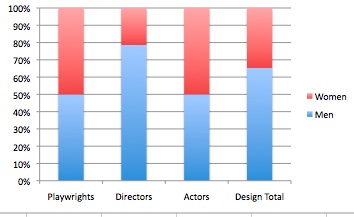
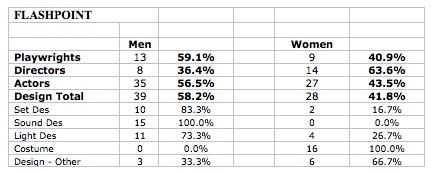
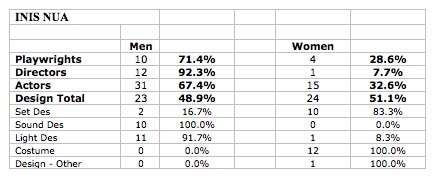
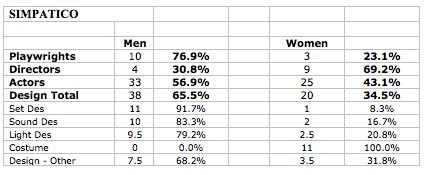
And without any more ado, here’s four companies (Azuka, Flashpoint, Inis Nua, and Simpatico) that fall on the small theater end. According to the same site I used yesterday, three of these companies had revenues listed less than $200,000, putting them at least a quarter of the size of the companies from the last post, in some cases much less. Simpatico’s info wasn’t listed there or on Guidestar’s website so I’m making an educated guess here on size.

More to come tomorrow on how we might start interpreting this data.

azuka stats azuka graph

flashpoint stats flashpoint graph

inis nua stats inis nua graph

simpatico stats simpatico graph

Adrienne

Middle of the Road

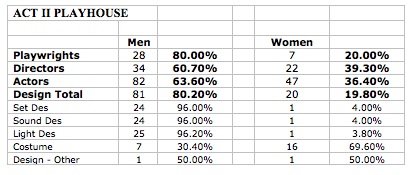
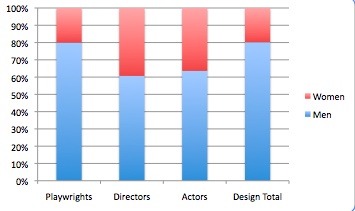
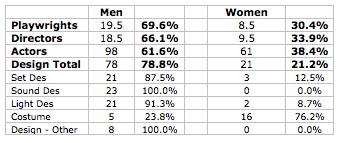
Yesterday we looked at the folks on the upper end. Now let’s look at some people in the middle.  Here are data sets for four mid sized companies: The Lantern, Interact, Theatre Exile, and Act II Playhouse.

Using this website I found the “revenue” listed for each of these companies to be in the mid to high hundred thousands. I’m assuming that’s for the most recent tax filing. For comparison yesterday’s figures for the Arden, People’s Light, PTC, and Wilma had revenues listed at 5.29 million, 4.11 million, 3.95 million, and 3.64 million respectively.  So on the whole we’re looking roughly at an order of magnitude smaller.

This is useful to note for two semi-self evident reasons:

1) Larger companies tend to employ more people and therefore a difference in representation in these companies has a higher impact on the community as a whole.

2) We can make a reasonable assumption that jobs at better funded theaters will tend to pay at a higher pay grade.

This is obviously not always true in every instance, but gives a useful bit of context when comparing numbers across company sizes. Still, unfair representation is, obviously, unfair at any scale.

lantern stats

Lantern graph

interact stats Interact graph
 theatre exile stats

theatre exile graph

act ii stats act ii graph

A

PS –

1) Act II’s data on designers was particularly tough to find (especially for seasons 08/09 and 09/10). This is why the total numbers of designers is lower than the expected based on corresponding number of productions. This data is less complete than the other theaters’ info. If you’d like the raw data feel free to ask.

2) Again, if you want to know how I calculated these numbers you can check back on the PS from yesterday’s post.

True Story

If you give me an ear, I will give you eyes with which to see.
– Kahlil Gibran

True story.

Two years ago, I took a shower. I had just purchased a house in south Philly, most of which needed some major rehab. As such I, and all of the stuff that went along with me (including my fiancée) was confined to one large front room in the house on the second floor. I slept there, ate there, did all my work there.  It was, in essence, a studio apartment in the middle of a three-story row home.

I say all of this to so that you can understand that though technically this space is now my living room, I was very comfortable there.  Unlike most living rooms, I did my most intimate things there. In other words, I was actually living in there.

Which is why I was walking around in it naked. That and it was summer and hot and I was still adjusting to a living space without air conditioning.

It was a Friday morning and as such, was trash day on our block. And I realized this with sudden vehemence as I, naked and sauntering through my living space, walked near to the windows to grab something and made direct eye (among other things) contact with a garbage man outside.

He smiled, nodded and gave me a thumbs up.

It took me a second. Probably a couple. I was a half second away from giving a thumbs up back. Like I said, I was comfortable and in my domestic space, I wasn’t thinking about myself in the subtly different way I do when I imagine myself being seen by others. So it took me that long to realize what had happened. And as best as I can construct the thought process went something like this:

“That guy can see me.”

“I’m naked.”

“I’m a girl.”

“There’s a guy outside looking at my boobs because I’m a girl.”

“I should back away from the window.”

“We really need to get some blinds in this room.”

The truth is, I don’t really care that the garbage man saw me naked. I mean, I guess in a world where I could go back and redo anything that ever bothered me, I might, at some point, go back and erase that event. But on the list of things that I regret or would change about my existence, this is on the very very low end of the list. It’s one that probably wouldn’t be worth the energy to undo.

I don’t usually think about this moment and when I do, I don’t reflect on it with a whole lot of shame or embarrassment. I’ve categorized it in my mind as a silly thing that happened a couple of years ago. But when I was trying to think of a way to introduce the second half of the post for today, it kept creeping back into my mind. Not because of how I see it now after processing it, but for the way I felt the very moment after it happened.

I kept remembering how in that moment before this guy looked at me and I looked back at him I was just “Adrienne”, wandering around my apartment thinking about the day and the stuff I had to do. And then in the moment right afterwards, I was not just Adrienne but “naked female Adrienne” who had been seen (ogled? admired? violated? made to feel beautiful?) by some sanitation worker because I got too close to the window. I kept thinking how aware I became of this one particular aspect of myself. And in thinking about it now, I remember how vividly in that moment I became so aware of the two sets of eyes through which I could view this event.

There was one part of me that looked at this situation in that moment right afterwards and saw no big deal: just a naked person walking past a window that someone sees and makes light of. And there was another part of me that felt different, uncertain, and weird and saw this as a potentially troubling incident: a woman alone in a house who is stared at and then evaluated (thumbs up!) and potentially left feeling sexualized in a way she didn’t agree to.

At moments like these I have a tough time knowing which set of eyes to use. And I’m using this moment as an illustrative point because it helps me try and quantify something that is really difficult to say with clarity or the depth with which I feel it:

It takes work to view the world with dual vision all the time. It is hard to know how and when to apply that second sight.

If somehow I could run this experiment again as a guy standing naked at the window would I think about the fact I was a naked dude or just that I was naked and too close to the window?  Would I interpret the thumbs up as a “hah hah, caught you naked, oh the things you see as a city employee” droll little interlude or would I get a creepy “I’m staring at you and personally up-voting your sexy nakedness” vibe?  Would it have gone down the same way or been different?  And above all – even if I could know that his reaction was in response in some amount to my gender – do I have to care?

Is this something that should bother me?

Sometimes it takes a new vision or angle on something very familiar to know that it is something that should bother people. Sometimes we normalize things we shouldn’t and it takes some one who takes a step back to say “Uh, what the hell? Why aren’t we all seeing this?” It’s awesome when those people do that for us who have the luxury not to notice.  But it’s a lot to ask of those second visioned people to do all that work alone.

Are there situations where people are legitimately undermining or diminishing someone based on their being a woman?  Yes.

Are there times when someone is undervaluing female perspective or representation without realizing it? Of course.

Are there times when choices are made that coincidentally result in unfair gender balance that have nothing to do with gender at all? Absolutely.

I can’t remove the lens that constantly evaluates the world this way. So when I, or anyone with an outsider lens that they view the world with, witnesses something that is potentially disturbing, it it is real mental work to try and suss out which of these scenarios is at its core. Sometimes you’re not sure which is happening. You don’t want alienate people that you care about. You want to believe they aren’t doing things that hurt you on purpose.  But you also don’t believe you can let them continue to make this mistake.

It’s a super tricky dance, deciding how to proceed. That takes effort.

And I’ve mentioned before that sometimes it’s tiring to try and figure it out alone. Sometimes, you just wish you could hand that lens off for a little, try and put it into a forum for debate, and try to ask the people that don’t usually bother to shoulder that task to take up the burden for a little bit.

This is an attempt to do that. It’s an attempt to make the problem of gender imbalance that I see in theater not just a “female” problem but a communal one.

You didn’t give me your ears, but I’m grabbing them anyway. It’s not meant to be an attack, but it is meant to try and give some people that may or may not being making choices intentionally the eyes with which I’m seeing things. And I’m doing it with numbers and graphs because it feels like it’s a little easier to get you to look with my eyes that way.

Over the next few weeks, I’m going to roll out data on gender breakdowns over 6 seasons (12/13 through 07/08) of playwrights, directors, actors and designers in Philly theater productions. I think the numbers speak for themselves in many ways, but at some point, I think I will also add some thoughts about how we might interpret such data and what could be a productive set of actions that might result from it.

So here goes

I thought it might be illustrative to start with four of the largest and most visible non-profits. Below is the raw data with percentages and a graphical breakdown for The Arden, People’s Light, PTC and The Wilma. In all cases the graphs are totals of all 6 seasons of productions and blue in the pie chart indicates men and red indicates women.

ARDEN THEATRE CO.

arden stats

arden pie combined

people's light stats

people's light pie combined

Philadelphia Theatre Company

PTC stats

PTC pie combined

The Wilma

wilma stats

wilma pie combined

There’s an awful lot more blue.

A

PS – Some notes on methodology:

1) These numbers are based, when available, on information provided by companies on their websites.

2) For any info not listed online by the company itself I have searched online reviews to confirm missing information, ideally from more than one source when possible.

3) Many seasons (most especially the current one) have incomplete listings and are indicated as such in the raw season by season data (which anyone is welcome to request).

4) The raw numbers indicate a slot in which a male or female is chosen to fill a position and not total number of different individuals hired. In many cases the same person directs, acts, designs, etc multiple times at a venue.

5) In the case of adaptors, translators, and multiple authors I have evenly split writing credit across all names listed. While I recognize this may overvalue on creator’s input from the reality of a particular project, I believe that will balance out over the entire data set and removes me from making personal judgment calls. For example, in a translation of a classic work by a male author with a female translator I would give .5 playwright credits to each gender. For musicals I have similarly split credit among composers and lyricists.

6) For ensemble-generated works I have excluded playwright credits unless specifically listed.

7) Shows calculated are those that are listed as part of their regular season. Benefits, special events, and fundraisers are not included.

8) I have listed designers as a combined figure but also shown breakdowns by category which differ vastly in some cases.

Where the ladies at?

This post came from some thinking I’ve been doing in general about what I wrote yesterday (about defining your working ethics) and specifically in response to a lovely and honest comment from Meghan Williams a couple days ago (about how tough it is to be happy for your fellow female creators).

When I was in college and first starting the directing track, I only directed plays by female playwrights with all female casts. I did this for almost three years. It drove a few people around me nuts, even though I was at one of the most liberal colleges in the US, even though there were 6 women for every guy in the department, even though they were great plays well known to many.

I finally broke the trend on my final project in the directing course, our devised piece. I’d intended to use an all female group but for creative reasons ended up changing my mind and cast three women and two men. One of the actresses later confided she was thinking about backing out of the show until I had changed my stance on that.

Initially, I actually wasn’t trying to make a statement. I really just didn’t see as many men who I wanted to work with. I was low on the director totem pole and figured I’d get way better performers if I used the glut of women that hadn’t gotten a role in one of the department projects. I liked working with a lot of those people so I decided to do it again. And again. It was super weird. I remember being on break one semester in an acting course in which we literally had to find a creative solution to triple cast the sole meaty female in Brecht’s Man is Man while an actress gave me shit for doing another all female play.

And the weird thing was that I too started to doubt myself. You should make the best art, not art that just makes a statement. But now I think, what the hell, why does it have to be either or? And why does it make us so uncomfortable? Is there a world in which a female dominated production would provoke the same sleepy non-awareness as the plethora of the plays with 75% and up male dominated parts? Why is it a statement?

And the worst of it is that it is not the dudes who are the sole problem.

Have you read this study?

Is this not the most depressing thing in the world? Read the details, they’re too varied and complex without dominating this post, but do read them. One finding researcher Emily Glassberg Sands cites that is especially depressing to me:

Sands also sent out four previously unseen scripts by prominent female playwrights — Lynn Nottage, Julia Jordan, Tanya Barfield, and Deb Laufer — to artistic directors and literary managers nationwide. Each script was assigned two pen names, like Mary Walker and Michael Walker. The results were surprising: Female readers rated scripts with female pen names 15 percent lower than those with male pen names, while male readers rated the scripts equally.

What!?!

Sand also used box-office grosses for Broadway plays over the last decade to measure economic success and audience appeal to show, for example that:

Women represented 60 to 70 percent of ticket buyers, and plays written by women sold almost one quarter more tickets per week than those by men, earning 18 percent higher grosses weekly. Yet even though plays written by men tend to earn less, they ran about the same amount of time as those by women.

Sands ultimately concludes that in fact there are in fact just fewer female playwrights, likely due to the many forces that disincentivize women to write plays. The ones that do, though they tend to write more female parts than men, often create smaller cast sized works to appeal to theaters.

There are bajillion books about female socialization and the toxic ways that gender stereotypes wiggle their way into our brains against our wills. I’m not going to try to break down the complicated dynamics that exist between women interacting with each other socially and professionally. But I do think it’s safe to say that there are clearly a lot of influences that can affect how women are treated in the world, especially how they are treated by other women.

I don’t think competition is a bad thing. I love to beat other people. I really like working hard to get better and there is no easier way to motivate me to do that than with a racing partner. What I don’t believe in is an unfair race. And I really hate the idea that I’m part of making the race unfair.

Take an anecdotal mental walkthrough of the major theater companies in town. We are not overwhelmed by dudes running theaters. Philly is pretty luck that way: to have a decent sized high level talent pool of women running companies and directing work. This has not always been true and is not true everywhere else.

Now take an anecdotal walk through the productions you’ve seen in the last year. I listed 10 Philly theaters off the top of my head, trying to come up with a mix of small to large in sized. I combed the online records of their last completed season (2011-2012) and made a list of the playwright, director and actor gender break downs.

Wilma – Playwrights: M 3   F 1     Directors: M 1  F 3   Actors:  M  21  F 10

Arden – Playwrights: M 7    F 1      Directors: M 8   F 0   Actors:  M 36   F 22

Theatre Exile – Playwrights: M 3    F 1     Directors: M 2   F 2    Actors:  M 9   F 3

Simpatico – Playwrights: M 2     F 1      Directors: M 1    F2     Actors:  M 14   F 10

Lantern – Playwrights: M 4    F0      Directors: M 3  F1      Actors:  M15    F8

Flashpoint – Playwrights: M 2    F2      Directors: M 2   F 2    Actors:  M 7   F 6

PTC – Playwrights: M 4    F0      Directors: M 2.5   F 1.5 (One show co-directed)    Actors:  M 19   F 4

Plays &Players:  Playwrights: M 2    F 1     Directors: M 1   F 2   Actors:  M 12   F 10

Ego Po – Playwrights: M 1    F 1  (Note one ensemble script)    Directors: M 2   F 1  Actors:  M14    F 10  (This number is short four unnamed actors who’s gender I couldn’t find online)

Azuka – Playwrights: M1     F 2     Directors: M 2   F 1  Actors:  M 7   F 9

TOTALS –  Playwrights: M 30 (75%)   F 10 (25%)     Directors: M 24.5 (61%)   F 15.5 (39%)     Actors: M 154 (63%)  F 92 (37%)

Does that shock you? The sad truth is, probably not. I would guess this is not atypical.  But it should. It should horrify you.

I don’t think the people who run these theaters are doing this on purpose. But this is what I meant yesterday when I said you need to define what’s acceptable and know when you’re doing something that isn’t. Do you believe that women are 2 to 3 times less talented and capable of being writers, directors and actors? Of course not. But that’s what’s essentially being born out in this trend.

Listen people, especially you female artistic directors, we can’t keep going along with this. We need to point out that it’s not cool. When we’re in positions of power we need to work to do better. We all need to confront a little dissonance.

“But it’s the cannon.” Too damn bad. Make a new goddam cannon. Is the cannon worth diminishing more than 50% of the population? Is it worth undervaluing their stories 3 to 1? No, it’s not. And we need to pay attention that choices we make professionally will determine whether this trend continues. We have to do something. Even if it’s hard. Even if it’s initially unpopular. (Though according to statistics, it won’t be, remember that female playwrights sell 18% more…)

I’m not saying down with men. I’m saying we need to balance this shit out. You want to produce a male playwright. Fine. Do three female playwrights for your following shows. You want to do a Shakespeare (aka dude heavy) show? Go ahead, but you better dig up a ton of pieces with badass female parts to balance the cosmic spectrum. Read a ton of plays by women. Decide to produce them at a higher percentage for a season or two or twelve. Intentionally hire some more female directors. Pick the show with a balanced gender ratio. And if you’re an actor for hire who doesn’t have a hand in programming, FIND the incredible plays by and about women and send them to the people that do. Write about how amazing they are and why they are so important to produce and demand they do so.

We are all responsible. We all need to teach the larger community that this is the kind of theater you believe in. Because if you aren’t you’re teaching the opposite. If you don’t create room then there will never be space for this to happen in the future. If there is a city it could happen in, I’d bank on this being the one.

Come on Philly. Say fuck yeah, we NEED some amazing fucking plays that are all or mostly women. And we need to do enough of them so that the next generation of directors don’t have to feel weird if they happen to choose a series of all women pieces. Not because they are super feminists. But because THAT’S TOTALLY NORMAL. Just as normal as if I’d happened to do Zoo Story, Art, or Glengary Glen Ross.

A

PS – In the the spirit of disclosure I thought I’d share breakdowns of works I’ve been had a major hand in shaping. Obviously the director stat is moot but here are their breakdowns by performers:

Ink and Paper – 1 woman

Joe Hill – 6 men, 1 woman

Echo – 2 men, 2 women

recitatif – 2 women

Giant Squid – 4 men, 1 woman

Owning Up to the Corn – 1 man, 1 woman

Neverboy – 1 man

Master and Margarita – 2 men

Purr, Pull, Reign – 3 men, 7 women

SURVIVE! – 3 men, 2 women

Lady M – 12 women

TOTAL: 22 men, 29 women

If you look at those same works for playwright collaborators it’s about equal in split (depending on what level you count ensemble members) between genders.