Philadelphia

#thesummit

Look.

I am bad at twitter. I don’t tweet much or well. Call me twit-illiterate. It’s also been a heinously busy couple of weeks. Which is why it’s taken me a bit of time to catch up on #thesummit.

More than a few people have passed along thoughts about this. More than a few have asked my opinion. But I wanted to wait until I felt like I’d really read enough about it to have an informed opinion before responding. If you haven’t caught up check out this for an overview. And this for the much commented on tweets in-situ. And here’s the quote from Ryan Rilette quoted from the DC Theatre Scene article:

“It’s really hard, and here’s why it’s hard.  I think it’s hard because there’s not enough in the pipeline right now.  …There are a lot of new plays that are getting produced by small theatres that are by women.” 

He went on to discuss how there are not enough plays by women produced in New York City and not enough in London (although he credited London with doing a great job), and said that a theatre needs something that’s going to help sell any play they put on.  He said one can’t choose a total unknown, and that to find three plays a season by female playwrights would require them to have name recognition or something else to draw audiences, if one is not going to go the route of using star actors. 

He said there are “not enough yet in the pipeline” and that “it’s gonna take a couple of years… a decade… before it’s going to shift, but it’s going to shift.”

A decade. Wow. I’ll be in my 40’s then.

That would be awfully… depressing to have to wait that long for more opportunities to arise. Probably depressing enough to just stop entirely. Something I see an awful lot of my female counterparts begin to contemplate around this age. It would be something I’d contemplate if I actually believed it would take that long. If I really thought my female peers had to wait around for these folks to use that whole decade’s worth of time to see some progress.

But I don’t buy this. And I also don’t feel like waiting.

Which is why what’s far more interesting to me, and what seems to have shifted this forum out of the standard and unremarkable bias women artists see and deal with all the time, is the final provocation of the night from Elissa Goetschius from Strand Theater that included a series of statistics:

  • At Signature, since the 2005 season, only 10 of 90 credited writers have been women, with women directing 2 of 54 productions.
  • Since Ford’s reopened after renovations, 2 out of 29 productions have been directed by women – the same woman.
  • At the Shakespeare Theatre, since opening the Harman in 2007, they have produced 51 shows – none of which have been written by a woman. 3 were adapted by women, and 9 were directed by women.
  • At Arena, since the 1998 season, 44% of productions have been directed by women. However, three women account for over half of those woman-directed productions, while 49 different men have directed here. The plays and lyrics that have appeared on Arena’s stages reflect the work of 110 men, but only 35 women.

When I read that and I thought, “Sounds familiar.”

I’m guessing, like myself, she’s been having this conversation for a long time. And as I went digging into her online presence I found this from March 2013.

I went back and checked my own blog for my statistics project on representation of women in Philly theaters. The dates of these posts? January 8th, 2013 AND February 7th, 2013 AND Febraury 8th, 2013.

Just about a year… Just about a year those facts have been out there. Hard numbers that do not lie about the state of the art we are in. Mine in Philly and Ms. Goetschius’ in DC.  As a former student of chemistry, I really thought when I threw my info out there it would set something off in other people. But it’s been a year now and not enough is different. I still think numbers and data are useful; they are a tool to wield. But they are not, as it turns out, enough on their own.  I admire Elissa Goetschius for going to #thesummit with numbers but I believe it is her fortitude to require their presence in the conversation that really started the firestorm.

Is it odd, do you find it strange, that within weeks of my post about gender parity in Philly theaters last year that another female director in another large America city was taking up another numerical compilation project in much the same way?

I do not think this is incidental. This means that it is clearly time to be having this conversation. I think it’s a sign we are gearing up for the real deal fight. I think it means the troops are gathering the tools we need to start taking this on. The numbers are a beginning. And now it’s time for all of us to make the response to them a necessity.

Elissa, if you happen to be reading this, I want you to know we are having this conversation in Philly too.

Like you, I am not waiting 10 years. I’ve already waited one, and not enough has changed.

So, like you, I’ve decided we’re having it now.

Which is why in honor of last March’s statistics project, I’m devoting this entire March’s blog to this issue. Every day a new article.

Every. Day. A few hours of time devoted to thoughts or actions to tackle this shit.

Cause it is shit.

Which why it stinks so badly.

You can expect more updates from The Awesome Lady Squad soon.

You can expect more thoughts about how we can critique and work with critics to change the way we frame women in theater to our audiences.

You can expect more observations about the myriad of ways we undercut women in subtle and unintentional ways.

You can expect more on what we can start doing NOW to make next year look different.

And hopefully by the end of March, by the time my 3/30 birthday rolls around, I’ll get a big fat present in the form of some actual movement and change.

I’m not giving it a year to start moving.

I’m giving it a month.

Are you ready?

I am.

– A

PS – Also worth reading is the fateful final question-er Elissa Goetschius’ thoughtful response and Brett Steven Abelman‘s as well.


Dispatches from the Awesome Lady Squad #4: On the topic what we’d like to see instead

cooltext1368115366 

Yesterday I reviewed the last meeting of the most Awesome-est of Lady Squads and I ended with a section called:

What we’d like to see instead

This section for me is key.

I believe in the power of talking and sharing and creating a sense of community in perspective. But I value even more the ability to take the power of that sense of community and perspective and identify problems and find awesome ways to solve them. Tackling the issues we identify, this is for me what elevates support into a sense of empowerment. It’s the thing that brings me back to my super lofty goal for us Awesome Ladies: To make Philadelphia a model city for how women work in the arts. Some part of that will be discussion of the problems we face. But I hope a much bigger part is piece by piece finding concrete projects to start tackling them.

And I find that the easiest way to get to that new place is to have a vision of what it might be. So in identifying how to best channel the building energy of the Awesome Lady Squad I started with a line from the  “What we’d like to see instead” category and coupled it with a concrete projects to help start to accomplish it.

This is the list I came up with:

The “What we’d like to see instead”

–       A re-framing of how we look at each other as female artists. Replacing the model of scarcity and competition to a model of abundance.

A project that could help us get there:

–       Create a concise and clear code of ethics for how the Awesome Lady Squad. Inspired by the Core Principles of Artist U this document should contain clear and simple guidelines that underpin the way Awesome Lady Squad members promise to work with each other and the world around them. It is an agreement that details the ways we can model the behavior we want to see around us.

The “What we’d like to see instead”

–       More models of women in roles of leadership and success in the arts. Seeing female artists successful in their practices. A commitment by established artists to identify and foster talent in emerging female art makers.

Two projects that could help us get there:

–       Foster an Awesome Lady Squad Recruit! This could include: creating an survey for young artists to talk about interest areas that is then used to pair them with artists and administrators already working in the field, “Take an Emerging Lady to work day” in which young creators get to shadow women doing their awesome professional thing in action, and/or an “Ask the Lady Squad Anything” advice column in which new Squad members send their questions to the email list in search of advice.

–       An Awesome Lady Arts Administrators caucus. Bring together women who already get to make choices about the work they make and produce (as self producers or as a member of a larger company) and talk about how they can use that leverage for positive gain.

The “What we’d like to see instead”

–       Skills to handle tough conversations about gender parity. A way to talk about this that doesn’t become apologetic or defensive. Something to say when I sense people starting to roll their eyes.

–       The ability to say no to a project that doesn’t conform to my moral code.

Three projects that could help us get there:

–       A “manifesto” of the AwLaSq that details in a fuller form the believes and aims of its members. Defining your core principles specifically will help when you have to articulate them to others

–       A workbook or simple writing project that helps codify and set bars for situations you will and won’t tolerate artistically that you can come back to when trying to decide if you want to take part in a new project.

–       Conversation toolkits and practice. Just like a business negotiation, knowing that you’ve done this thing before is half the battle. This task force will identify such potentially sticky moments and help craft language and talking points that are clear and concise. It will also identify the potential counter arguments and possible responses. These “toolkits” could be downloadable online. We could also organize a session where people simulate these conversations with others coaching from the outside so that there is a low stakes situation to practice so they are more confident and comfortable in the moment.

The “What we’d like to see instead”

–       Female directors, designers, administrators and actors represented in equal numbers.

A project that could help us get there:

–       Create a symbol of Awesome Lady Approval for arts organizations that meet a certain minimum set of Awesome Lady requirements. Before minimum wage was mandated if you were an employer willing to pay a certain wage you could display a certain color flag. What if Philly had a stamp that you could put in your program, on your door, in your marketing material that indicated that your company had a commitment to women in the artistic community? Using this positive reinforcement, we could also find ways to make sure our audience bases understood what this symbol means and to help promote the theaters that make this commitment.

The “What we’d like to see instead”

–       More awareness of the size and scope of the problem.

Two projects that could help us get there:

–       Create an Awesome Lady Squad shirt. Make it something awesome that you will definitely want to share with the world. Then make a promise that any time you wear it and someone sees it and asks about it you stop and take a second to share a bit about the vision of the squad. Possible offshoots:

  • Use any proceeds to fund childcare at future Awesome Lady Squad events
  • Organize a city-wide Awesome Lady Squad “shirt-in” day to show the size and reach of all the awesome ladies that live and work here

–       A marketing effort in conjunction with our other projects (like the gender report card or Awesome Lady approval symbol) to help reach not only fellow creative sector workers but audiences as a whole. Use the model of the DC based female playwright initiative to create powerful marketing leverage that makes it Awesome and sexy to be a part of the movement.

The “What we’d like to see instead”

–       A genuine curiosity in discussions we have with people about these issues. Figuring out what’s really motivating the choices that undercut female artists and getting at them. Not assuming the worst of our peers even if they display behavior we don’t approve of.

A project that could help us get there:

–       Create a “Gender Parity Report Card”:

  • Develop a set of standards as a Squad for what poor, mediocre and outstanding work at creating equal opportunity for Awesome Ladies looks like.
  • Gather measurable, concrete, data to evaluate artistic producers in Philly and then create an awesome and well-articulated assessment of that data we share with these companies along with an invitation for dialogue about the results.
  • The key here is to find out 1) if theaters know their own stats in this regard 2) if there are trends that might indicate a lack of opportunity for women if they are willing to dialogue about how and why such trends occur 3) if they are willing to make a commitment to change

The “What we’d like to see instead”

–       A way to share these issues with my male colleagues. A means by which they can help support these issues when they see them.

A project that could help us get there:

–       Bring together an Awesome Lady Squad support team: Set up a meeting that includes a discussion forum specifically for guys who think the Awesome Lady Squad is awesome. Talk about ways that they can become Awesome Lady Allies and strategize about means through which they can help. Give them some of the tools we offer the core members so that they can go and spread the Awesome word.

And finally:

The “What we’d like to see instead”

–       Funding targeted for women that doesn’t carry a social change element.

–       Non-traditional funding opportunities and alternate way to fund and produce work

–       Subversion of some of the power systems that currently undercut the issues we’ve discussed. Starting a conversation on “this is the way that funding has worked” and “here’s how it might work in the future”

A project that could help us get there:

–       An Awesome Lady Grants and Funding Task Force that:

  • Meets and discusses what might be problematic about certain kinds of funding structures
  • Strategizes about ways to approach funders about these concerns
  • Envisions and articulates the kinds of funding we would wish in Philadelphia for the future and shares this vision with the funding community
  • Works together to try and brainstorm and create alternatives to the current structures

These are what I envision as the first tangible steps towards seeing the “What we’d like to see instead.” And over the next year, they’ll be the ways the Lady Squad starts gathering energy and focus around all those things we discussed.

The next step is to figure out which of these takes our energy and focus first.

If you have thoughts about what should happen first, let me know.

If you have expertise in one of these areas and want to help out, let me know.

If you have a lot of passion about one of the items and want to get in on the ground floor, let me know.

If you don’t really care where we get started but are interested in helping to organize or send emails or type minutes or whatever just let me at it, let me know too.

And soon, let’s say in the next couple weeks, we’ll roll out the first phase of one or more of these…

Until then…

A

Quickie

Image

Just a reminder that we’ll be convening the Awesome Lady Squad this Sunday the 26th at the Parlor (come snow or come sun) from 7 – 9 pm at The Arts Parlor (1170 S Broad Street).

All ladies of all genres are welcome – artists, administrators, creators, interpreters, any and all folks with thoughts about how they’d like to see women take part in the arts community in Philadelphia. Feel free to pass the invite along to others as well.

And if you want to make sure you’re on the list to hear all the awesome updates about the Awesome Lady Squad as they happen just click here and you’ll be assured to get the info.

Have an awesome day.

A

Dispatches from the Awesome Lady Squad, #2: In which the ladies plan to meet for a second time

cooltext1368115366I’ve been feeling lighter lately.

I’ve been walking around with just a bit more bounce in my step.

I’ve been feeling, well there’s just no other word for it, rather awesome indeed.

I believe I’ve been feeling that way because for the first time in a long time it seems like change is imminent.  Over the past few years, I’ve spent a lot of time worrying about finding my place as an artist in the world. I’ve worried about whether I was doing the right thing. I’ve worried about whether a choice I made would get me on the right path. I’ve worried if I’d ever land in the place where I was supposed to be. But you know what? I think I’m finally, finally, finally, realizing that the whole idea that there is a right place, that there is one just path, that there’s even a standard of measurement that is anything close to absolute is a load of crap. And that realization is part of what I think is making me feel so awesome in particular about the Awesome Lady Squad.

After the last squadron meeting I felt the positive power of defining a new perspective. About refuting the idea that there is an absolute when it comes to what’s “normal or that there is a fixed set of disadvantages and that there are givens that stay given about the way that things work.

I thought about the way I run my theater company: as a hybrid artist somewhere between non-profit and individual who is able to make the kind of creative work that doesn’t fit easily into categories and still manage to pay my collaborators the same level as many mid-sized theaters in town. I’m pretty sure that if I’d asked my mentors first coming out of school if such a set up would be possible, they’d have all said no. My guess is that at that time they would have told me there wasn’t funding or structure or opportunity for such a different way of doing things.

At the time, there probably wasn’t an obvious route towards what I wanted.

Now, there is. But that’s only because I found it.

I’ve spent a lot of time in 2013 fretting about whether it’s possible to change how women are treated in the arts. And as one of the attendees from the last meeting said, it’s a feeling that has taken up a lot of space in my life. I’ve felt mad that things aren’t the way they should be. But at this moment, I’m a lot more interested in putting that energy towards actually getting them so they are.

Right now, the route to doing that isn’t obvious.

But after we do it, other cities can look to Philly and see that it was there all along.

The resolution I want you to join me on in 2014 is this: you have to know – not desire, not wish, not hope – but deep down truly know that there is a future world where the Awesome Lady Squad doesn’t need exist because we’ve solved all the problems we’ve identified. And we need to know that it’s going to become reality, and soon. Gathering people and realizing that you are not alone, that your perspective is one that is shared by many, that your view of the world need not be rage-inducing or isolating, that you can indeed find a space where every person around you also starts from the same set of ethical givens, this is the first step. It’s an important one. Because it’s the one where we all have to stop and say, hey, the things that I disagree with are actually NOT truth. They are NOT givens. Not in this room. Not right now.

And once we carve out a little bit of space to stake our the Awesome Lady Nation, we’ll be able to invite the rest of the world in as citizens. One by one, we’ll make them all denizens of our Awesome new world.

Charting that course is already underway and you can check out our first scouting mission here. On Sunday January 26th from 7 – 9pm at the Arts Parlor (1170 S Broad) we walk just a little further down that road.

We’ll use the same format from last time, me asking some big questions, and you guys sharing your big answers. For a few hours in a few square feet of space we’ll create a world where people believe in equity and fairness and respect for female creators. And if we can make it true in a room at the Parlor for a few hours at a time, there MUST be a way to expand that perspective, that new sense of reality past that room and out into the world.

Hope to see you there.

An as always, thanks for being awesome.

– A

Philly reviewers, it is Tim-on to get your shit together

Excuse the bad joke. I can’t help it. I pun when I’m pissed.

Ooo-hoo. Adrienne is angry.  (Can you hear it in the typing? CLACK! CLACK CLACK CLACK!)  I would write in all caps (LIKE THIS!) because that is how I feel, but you would probably stop reading, and I do NOT want you to stop reading.

If you frequent this blog you likely have a sense of what I think about the role of women in the contemporary theater scene.

(In the off chance you are new here, feel free to go back and read this, or this, or this, or this…)

So when I heard that the Philadelphia Artists’ Collective (or PAC) was doing a production of a Shakespeare play – Timon of Athens – that included a bunch of cross gender casting I was interested. Interested because I will be doing a similar (even more substantial) gender re-assigning in Clark Park’s Tempest this summer. Interested to see how they handled this gender switcheroo in context of the classical cannon. But most of all interested to see how people reacted to what they were doing.

And, like one sometimes does when one is intrigued by a colleague’s choices for a production, I read a few reviews about the show to see how it was received.

And now, as previously mentioned, I’m really really angry.

First off: my job here is not to defend this particular production. In fact, I have not yet seen this play. I will, next week. But I write this now, not yet having seen this play, quite intentionally.

There are statements in the reviews of Timon assessing creative choices that I cannot substantiate or discredit.  I do not know if the actors in the various roles are interesting to watch. I do not know if the opulence and greed of the play is borne out in the staging. I do not know if some of the problems that reviewers cite around this particular staging are true. Indeed, given that some of them appear in multiple assessments, perhaps some of the points they mention are quite valid.

But then again, I don’t know, I haven’t seen it yet. And my problem is not with the specifics of one stylistic choice or another.

Indeed, my problem here is quite the opposite.

I will say upfront that there are several actresses in this production I admire and respect, whose work I tend to like very much. And I am making such a long and belabored point of not knowing anything about the show’s specifics because I know that once I have seen the performance I may well be inclined to defend these performers’ specific choices. And I really don’t want that to get all muddled up with what’s really problematic here: the thing that’s really sticky and challenging.

I want to be absolutely and unwaveringly clear that my issue has nothing to do with giving specific critique to these particular people – be positive or negative – and everything to do with the blithe and blanket notions undercutting the women in this production that I see made under the banner of “criticism.”

“Them’s is fightin’ words.” You might be thinking.

You betcha.

Let’s start with Philly.com.  You can read the whole thing if you want to, but I’ll skip to this sentence starting off the final paragraph:

As director, Dan Hodge makes a tactical error in casting women in many of the male roles; it knocks the play off balance (tiny women playing cutthroats and shrill senators), and confuses the issues that have nothing to do with gender.

Ok. (deep breath)

Let’s play a little mad libs game. Pretend this statement isn’t about a play but a business. Everywhere there’s a statement about theater, I’ll replace it with a corresponding business word. Let’s see what we get:

As CEO, Dan Hodge makes a tactical error in hiring women in many of the male jobs; it knocks the company off balance (tiny women working as cutthroats and shrill managers), and confuses the business plans that have nothing to do with gender.

You wanna publish that in a newspaper and see what kind of letters you get?

I didn’t think so.

Having no women in a play doesn’t mean the play has nothing to do with gender in the same way that having a play with only white people has nothing to do with race. It has everything to do with gender: about our conception of what greed is, what it looks like, who is allowed to display it, and the gender with which we associate that quality.

If the play’s issues – greed, ruthlessness, heroism unrewarded – are indeed not about gender, than it really shouldn’t matter if a man or a woman displays those things. The point of the review should be whether the specific actor embodying that role is successful in doing so.

That you make a point to say that “tiny women” should not be onstage displaying those things says to me that you have now made this a play about gender in a way that Shakespeare did not. It says to me that you don’t think tiny women, in general, as a whole, are not suited to being greedy or ruthless. That you can look at a tiny women and know by virtue of her tiny woman-ness that she is neither of those things.

You dislike this particular actress? Fine. Cite the specifics of their performance. But to lump women as a category under the “not viable to play this role” category is demeaning and ignorant.

And don’t get me started on the misogyny inherent in the word “shrill.”

The lesson here is that men playing aggressive roles have the potential to be booming and commanding while aggressive woman onstage are annoying and screechy.  Ladies interested in Shakespeare’s works, please stick to Desdemona or Ophelia or Juliet or Cordelia or Lavinia and go die because you love a dude who is kind of an emotional asshole to you.

Or go be Lady Macbeth and kill yourself.

Or go be Cleopatra and die (again) because you’re an oversexed “gipsy.”

Or be really excited to get married.

Or a witch.

Who wouldn’t be totally satisfied with that?

Moving on.

Here is what Citypaper has to say. Again, feel free to read the whole thing but I’m skipping here to the summation at the end:

And while I understand the need for good women’s roles in an ensemble company like this one, it’s still a mistake to have Apemantus and several other key male characters played by women — Timon’s wretched world of greed and infighting is, in every sense, man-made.

Is it possible that this is worse? I think it is. Worse because of the infantilizing and diminishing way that it’s phrased.  It is the casualness of these words that more than anything makes me want to punch the paper upon which the words are written:

Dan, Dan, Dan… Silly man.

Oops! I think you made a “mistake”.

FYI, this play is male-driven. You might not remember because you’ve been around so many ladies (I mean 50/50 in the cast, but come on, that’s an awful lot for a Shakespeare play).

You forgot it’s about BIG things like “greed and infighting”. It’s not that this particular female performer is not powerful commanding. It’s not that this particular actress you’ve chosen is not ferocious or greedy or money hungry. It’s not that many of the women in your show are young apprentices and might be worth evaluating based on experience or talent instead of gender.

No, no. You didn’t realize that women are not capable of such things.

This story is “man-made.”

Oh, Dan. I hope you don’t make that mistake again…

Because “while I see the need for good women’s roles,” while I see that the two female co-founders of your company are excluded from this very large and powerful portion of the theatrical cannon, while I see the incredibly limited scope of what a woman is traditionally defined as in some of these plays, while I see the subtle and casual limitations that I am placing on them, while I see the constant barrage of definition that many works put on women, a definition they constantly have to battle against, while I see that the logical extension of my argument is that because I don’t usually see women play these roles and it feels weird to me I want you to stop doing it thus ensuring that women are never cast in these roles and making sure that I, nor any audience really, will ever ever acclimate to seeing such a thing –

While I see all of these things, I’d really rather not have to deal with that.

So could you just, you know, not make me think about it?

Punch. The. Paper.

I’m out.

– A

PS –  I sincerely hope that some of these reviews are a product of bad editing. If there is a fuller version, one that addresses some of my problems with generalizing here, I’d love to read them.

And, I would like to point out and credit reviewers like Howard Shapiro who manage to give their opinion about this piece without invoking a lady’s inherent inability to be greedy.

Context

The other day I spent my lunch chatting with a group of apprentices from Interact and then immediately went and had a meeting with a soon to be graduated student from a small liberal arts college. In both cases the conversation centered on navigating a career as a maker and producer of theater. In both cases I had plenty of concrete advice about resources to look for, things that I had tried in the past and either found successful or not, and how to keep a hold on the reasons one starts making art in the first place. I found myself repeating this phrase a whole lot:

“I’m not sure if it’s like this everywhere, but I know that here in Philadelphia…”

This combined with the recent discussions in relation to grad school and collaborators has me wondering how environment affects our work. A bad rehearsal space can hinder creation. An underwhelming performance locale can limit the scope of one’s imaginings. But what about a city? These smart young women I met last week have all had to weigh the question of context. They are all in the midst of deciding if this city is fertile ground from which to plant their artistic seed/selves. And I started thinking, “Why?”

Why Philly or why not? What does this city have to offer an artist and how does that offer change as they grow? I started to think about how I have been shaped by the place in which I now live and create my work. I started wondering how the daily backdrop of Philly and the people within it have made me the artist I am.

I’m interested in what questions a city can raise. What thoughts and ideas does it bring out of us? How does being here in particular color us as creators?

For the record, I didn’t intend to live here. I moved to the east coast for school and always thought that eventually I’d go back to Chicago. Somehow everything in the east coast cities I visited felt like it had a little less breathing room than back home. My family was there and at heart I felt like a Midwesterner. People here seemed a little harder, a little more closed off. I didn’t want the scale and exhausting competitiveness of New York. Boston seemed too small and insulated. And Philly was… a little off-putting.

I knew very little about this place before I came here. In college the entirety of my sense of the city was limited to taking the R3 from Swarthmore and bumming around South Street. I thought Olde City was cute but small. I had a few bewildering encounters with Fringe shows. I capped every expedition with a wait for the train in Market East. In short, my sense of the whole place was a bit gritty, a little dated and a lot dirty.

I see it differently now. That one-year gig after college turned into more. I grew up a lot while being here. I found a strong and supportive community. And something about this place now feels like a familiar if sometimes frustrating kind of home. So here I am. But going back to the initial questions – what influence does the city have on its artists? If it had gone another way, would I still be the same?

So for those new folks, looking to weigh the city on its artistic-potential inducing merits, here are a few observations:

Philadelphia feels like a small city, at least artistically. “Philadelphia County” is listed 5th most populace US city.  We’re bigger than Dallas according to 2010 census data. But I don’t think most of us think of this place as having a big city feel. The areas of Philly you move within are likely rather confined. It feels like a city of neighborhoods and we tend to stay loyal to the areas we inhabit. The artistic community in particular feels small. This can be great to be so familiar, to watch people grow and change, but it can also be limiting, difficult to be honest in critique. With the web so interconnected each shake or tear carries more weight.

This place feels like a family in the best and worst ways. It is hard to define oneself entirely out of context of the artistic family members that one is surrounded by. Sometimes it feels like funders are like parents with only so much love to go around. As a second generation experimentalist there are times when I feel like a second sibling who will always be in the shadow of those who came on the cultural landscape earlier than myself. I can’t help but wonder about those that will come after me. Will they have any room?

Philly is a place of genuine artistic fraternity and support. The arts are where the real brotherly love lies. I have shared stories with friends of mine in other communities about the help and mentorship I have received here. They are often jealous or astonished. No one can believe me when I tell them that things like Artist U are free. I have been amazed at the kindness of those ahead of me in sharing their knowledge, skill sets and literal stuff. It makes me want to do the same. We are a familiar folk, we Philadelphians, and in general we pay it forward and want to love and support each other.

We are also a city with a lot of history and legacy. It creeps into works in small and big ways. We employ a lot of theater folk in our historic cultural centers. We make stuff in sites of history. We have stuff that’s older than most US cities. There have been lots of “Philadelphia”s – from Ben Franklin’s to Rocky’s. We are still figuring out how to blend them together both in life and our work.

We are a relatively cheap city that feels like it’s on an economic upswing. An artist can own a house here. Let me repeat that. An artist can own a house here. Do not underestimate how radical that is to people living elsewhere. You can get space for cheap or free. There’s a bit of breathing room in a city that isn’t so expensive. People are easier with giving things away. You hustle a lot less. Art is more of your actual income. And at the same time, it doesn’t feel like that is at the cost of the city falling apart. Even in the midst of the worst housing crisis, many neighborhoods (mine included) have not lost property value.

There’s that Quaker thing. Maybe it’s because of my Quaker college that I feel so aware of it, but I do think there’s something about the large presence of Quakerism in the early history of this city and the quiet witness it continues to bear here that raises a sense of consensus and social justice in its people.

In a similar vein, we are a city surrounding by academic institutions. There are those obviously in its borders (Temple, UPenn, Drexel, Jefferson, PCOM, UArts, St. Joe’s, Pierce, La Salle, University of the Sciences, PAFA, Curtis, Moore, Chestnut Hill, CCP) and all the ones within the city’s reach – Villanova, Bryn Mawr, Swarthmore, Haverford, Arcadia, Rowan, Rutgers, Ursinus, Cabrini, Eastern (I know I’m forgetting some). This is an insane number of schools. And all these are places we create our work, teach, attend and learn from, make money at, borrow resources from, use the libraries of, connect with students from. Whether you personally work or study you are still the beneficiary of the many intersections of these institutions with the arts community.

Philly is dirty. What is up with all the trash? In both 2011 and 2012, TRAVEL & LEISURE put Philadelphia in near the top of “America’s Dirtiest City” list, for having the most unremoved, publicly visible litter, selected and voted for by both magazine readership and city residents. What does that do to our sense of aesthetic? How does it change our relationship to beauty in our work?

Philly has a higher than average rate of crime for a city our size. As sensitive people, we take in our environment. Ask most artists and they have multiple stories of witnessing or personally being the victim of crime. That stuff can’t help but come out in one’s creations and the more it happens, the larger it weighs in your work.

It takes a long time to get anywhere. “SEPTA. We’re getting there.” Is this the most unintentionally accurate slogan ever? And given the small size of the city and the high number of artists that use public transport, this matters a lot. I think it holds us back as a metropolitan community. I think makes our city seem less professional and unapproachable (as do we, its artists, by association). I once had to give an NYC playwright friend directions on taking a Philly bus. Just one, in a straight line from the north part of 4th street to the south. I had to make sure she had two dollars, exactly. I had to promise a bus would come to the directed corner even though no sign would indicate such. I had to tell her to go 10 minutes before the schedule said because you can’t trust what’s printed (but then it might be 10 minutes late, sorry it’s cold outside). Thank god she didn’t need to get from south Philly to the Museum district.

We are a city with a deep racial divide. Last April I was lucky enough to be sitting in the “grantee” section at a Knight Arts. As I flipped through the book of other winners I noticed another listing for Theater: $20,000 for GoKash Productions to expand the Philly Urban Theatre Festival. It amazed me that here was an award winning company creating original works and an ENTIRE FESTIVAL that I had no idea existed. I thought it amazing that such a company has survived without support from the traditional funding sources and, as far as I know, with little support so many other small companies enjoy from the larger theater community. There’s been a lot flying around the major theater blogs recently about how get people of color to the theater. I thought of GoKash. They’ve already done it. How many others companies like them are out there? Why are they disconnected from the community I am connected to? What is my responsibility in that? More recently, as I gathered data for my women in theater posts, I noticed a trend, especially among larger companies, to produce a single “diversity” play in a season with a relatively small (if existent) number of actors of color throughout the rest of the year. I thought a lot about how I feel about all women shows  – incredibly protective of their importance but at the same time nervous about being set apart. Racial division is a backdrop to our lives. How can we become smart and aware about its influence in our art?

It’s not as easy as you’d think to be a solo creator. Though we have a lot of them, solo creator artists don’t have the easiest time. The funding structures in this city are pretty company (aka non-profit) oriented. Despite a few high profile grant programs, we are overwhelmingly deficient on residencies and grants for individuals. Most foundations won’t let you apply until you have the tax exempt status and a certain level of size. There are precious few folks past their 30’s still making their own work without having gotten the 501 c 3. Which means in general, if you want to make your own work in Philly you not only need to be a creator but a producer as well. This is not the case everywhere else. We are in desperate need of curatorial institutions. Yes, we have Fringe Arts. And they do a lot. But we need more than one voice. Where are our PS 122’s, La Mama’s, and HERE Arts spaces?

We have some crazily bizarre liquor laws. Alcohol, like it or not, is a huge part of how most people socialize. I’m going to guess that’s even more true for the coveted 20 – 30 something age range, one that theater in particular has a hard time reaching. Imagine a band in a place where no drinks were served. And while some people get around this, I think that it cuts out a huge social lubricant and money-making avenue for smaller theaters (who could never afford the insane liquor license fees) to access.

And finally, when I step back, I see that we are not actually one artistic community. We aren’t even just one kind of theater community. There is a dividing line in town between the generative artists and the interpretive ones. Between “straight” theater and devised. Between the experimenters and those who find meaning in tradition. But as different as we are, there’s an open curiosity that I see around me. What I like about Philly is that this division is, as the cell biologists say, a permeable membrane. I’ve found real growth in interacting with actors who have never written their own lines before or created a scene. It reminds you to questions your assumptions. I’ve learned a lot by jumping out of my usual role and ADing a super “play play.” And as I grow, I find that more and more useful, to seek out opportunities to watch how other people do what they do. And there’s a trust and respect that Philly fosters that allows that to happen. And if there’s anything that’s kept me in this place, that’s it.

A

Middle of the Road

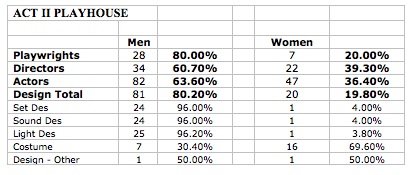
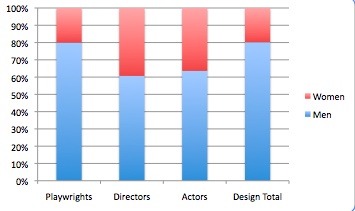
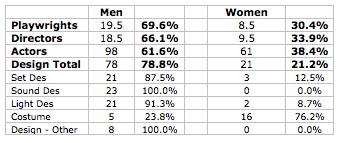
Yesterday we looked at the folks on the upper end. Now let’s look at some people in the middle.  Here are data sets for four mid sized companies: The Lantern, Interact, Theatre Exile, and Act II Playhouse.

Using this website I found the “revenue” listed for each of these companies to be in the mid to high hundred thousands. I’m assuming that’s for the most recent tax filing. For comparison yesterday’s figures for the Arden, People’s Light, PTC, and Wilma had revenues listed at 5.29 million, 4.11 million, 3.95 million, and 3.64 million respectively.  So on the whole we’re looking roughly at an order of magnitude smaller.

This is useful to note for two semi-self evident reasons:

1) Larger companies tend to employ more people and therefore a difference in representation in these companies has a higher impact on the community as a whole.

2) We can make a reasonable assumption that jobs at better funded theaters will tend to pay at a higher pay grade.

This is obviously not always true in every instance, but gives a useful bit of context when comparing numbers across company sizes. Still, unfair representation is, obviously, unfair at any scale.

lantern stats

Lantern graph

interact stats Interact graph
 theatre exile stats

theatre exile graph

act ii stats act ii graph

A

PS –

1) Act II’s data on designers was particularly tough to find (especially for seasons 08/09 and 09/10). This is why the total numbers of designers is lower than the expected based on corresponding number of productions. This data is less complete than the other theaters’ info. If you’d like the raw data feel free to ask.

2) Again, if you want to know how I calculated these numbers you can check back on the PS from yesterday’s post.

True Story

If you give me an ear, I will give you eyes with which to see.
– Kahlil Gibran

True story.

Two years ago, I took a shower. I had just purchased a house in south Philly, most of which needed some major rehab. As such I, and all of the stuff that went along with me (including my fiancée) was confined to one large front room in the house on the second floor. I slept there, ate there, did all my work there.  It was, in essence, a studio apartment in the middle of a three-story row home.

I say all of this to so that you can understand that though technically this space is now my living room, I was very comfortable there.  Unlike most living rooms, I did my most intimate things there. In other words, I was actually living in there.

Which is why I was walking around in it naked. That and it was summer and hot and I was still adjusting to a living space without air conditioning.

It was a Friday morning and as such, was trash day on our block. And I realized this with sudden vehemence as I, naked and sauntering through my living space, walked near to the windows to grab something and made direct eye (among other things) contact with a garbage man outside.

He smiled, nodded and gave me a thumbs up.

It took me a second. Probably a couple. I was a half second away from giving a thumbs up back. Like I said, I was comfortable and in my domestic space, I wasn’t thinking about myself in the subtly different way I do when I imagine myself being seen by others. So it took me that long to realize what had happened. And as best as I can construct the thought process went something like this:

“That guy can see me.”

“I’m naked.”

“I’m a girl.”

“There’s a guy outside looking at my boobs because I’m a girl.”

“I should back away from the window.”

“We really need to get some blinds in this room.”

The truth is, I don’t really care that the garbage man saw me naked. I mean, I guess in a world where I could go back and redo anything that ever bothered me, I might, at some point, go back and erase that event. But on the list of things that I regret or would change about my existence, this is on the very very low end of the list. It’s one that probably wouldn’t be worth the energy to undo.

I don’t usually think about this moment and when I do, I don’t reflect on it with a whole lot of shame or embarrassment. I’ve categorized it in my mind as a silly thing that happened a couple of years ago. But when I was trying to think of a way to introduce the second half of the post for today, it kept creeping back into my mind. Not because of how I see it now after processing it, but for the way I felt the very moment after it happened.

I kept remembering how in that moment before this guy looked at me and I looked back at him I was just “Adrienne”, wandering around my apartment thinking about the day and the stuff I had to do. And then in the moment right afterwards, I was not just Adrienne but “naked female Adrienne” who had been seen (ogled? admired? violated? made to feel beautiful?) by some sanitation worker because I got too close to the window. I kept thinking how aware I became of this one particular aspect of myself. And in thinking about it now, I remember how vividly in that moment I became so aware of the two sets of eyes through which I could view this event.

There was one part of me that looked at this situation in that moment right afterwards and saw no big deal: just a naked person walking past a window that someone sees and makes light of. And there was another part of me that felt different, uncertain, and weird and saw this as a potentially troubling incident: a woman alone in a house who is stared at and then evaluated (thumbs up!) and potentially left feeling sexualized in a way she didn’t agree to.

At moments like these I have a tough time knowing which set of eyes to use. And I’m using this moment as an illustrative point because it helps me try and quantify something that is really difficult to say with clarity or the depth with which I feel it:

It takes work to view the world with dual vision all the time. It is hard to know how and when to apply that second sight.

If somehow I could run this experiment again as a guy standing naked at the window would I think about the fact I was a naked dude or just that I was naked and too close to the window?  Would I interpret the thumbs up as a “hah hah, caught you naked, oh the things you see as a city employee” droll little interlude or would I get a creepy “I’m staring at you and personally up-voting your sexy nakedness” vibe?  Would it have gone down the same way or been different?  And above all – even if I could know that his reaction was in response in some amount to my gender – do I have to care?

Is this something that should bother me?

Sometimes it takes a new vision or angle on something very familiar to know that it is something that should bother people. Sometimes we normalize things we shouldn’t and it takes some one who takes a step back to say “Uh, what the hell? Why aren’t we all seeing this?” It’s awesome when those people do that for us who have the luxury not to notice.  But it’s a lot to ask of those second visioned people to do all that work alone.

Are there situations where people are legitimately undermining or diminishing someone based on their being a woman?  Yes.

Are there times when someone is undervaluing female perspective or representation without realizing it? Of course.

Are there times when choices are made that coincidentally result in unfair gender balance that have nothing to do with gender at all? Absolutely.

I can’t remove the lens that constantly evaluates the world this way. So when I, or anyone with an outsider lens that they view the world with, witnesses something that is potentially disturbing, it it is real mental work to try and suss out which of these scenarios is at its core. Sometimes you’re not sure which is happening. You don’t want alienate people that you care about. You want to believe they aren’t doing things that hurt you on purpose.  But you also don’t believe you can let them continue to make this mistake.

It’s a super tricky dance, deciding how to proceed. That takes effort.

And I’ve mentioned before that sometimes it’s tiring to try and figure it out alone. Sometimes, you just wish you could hand that lens off for a little, try and put it into a forum for debate, and try to ask the people that don’t usually bother to shoulder that task to take up the burden for a little bit.

This is an attempt to do that. It’s an attempt to make the problem of gender imbalance that I see in theater not just a “female” problem but a communal one.

You didn’t give me your ears, but I’m grabbing them anyway. It’s not meant to be an attack, but it is meant to try and give some people that may or may not being making choices intentionally the eyes with which I’m seeing things. And I’m doing it with numbers and graphs because it feels like it’s a little easier to get you to look with my eyes that way.

Over the next few weeks, I’m going to roll out data on gender breakdowns over 6 seasons (12/13 through 07/08) of playwrights, directors, actors and designers in Philly theater productions. I think the numbers speak for themselves in many ways, but at some point, I think I will also add some thoughts about how we might interpret such data and what could be a productive set of actions that might result from it.

So here goes

I thought it might be illustrative to start with four of the largest and most visible non-profits. Below is the raw data with percentages and a graphical breakdown for The Arden, People’s Light, PTC and The Wilma. In all cases the graphs are totals of all 6 seasons of productions and blue in the pie chart indicates men and red indicates women.

ARDEN THEATRE CO.

arden stats

arden pie combined

people's light stats

people's light pie combined

Philadelphia Theatre Company

PTC stats

PTC pie combined

The Wilma

wilma stats

wilma pie combined

There’s an awful lot more blue.

A

PS – Some notes on methodology:

1) These numbers are based, when available, on information provided by companies on their websites.

2) For any info not listed online by the company itself I have searched online reviews to confirm missing information, ideally from more than one source when possible.

3) Many seasons (most especially the current one) have incomplete listings and are indicated as such in the raw season by season data (which anyone is welcome to request).

4) The raw numbers indicate a slot in which a male or female is chosen to fill a position and not total number of different individuals hired. In many cases the same person directs, acts, designs, etc multiple times at a venue.

5) In the case of adaptors, translators, and multiple authors I have evenly split writing credit across all names listed. While I recognize this may overvalue on creator’s input from the reality of a particular project, I believe that will balance out over the entire data set and removes me from making personal judgment calls. For example, in a translation of a classic work by a male author with a female translator I would give .5 playwright credits to each gender. For musicals I have similarly split credit among composers and lyricists.

6) For ensemble-generated works I have excluded playwright credits unless specifically listed.

7) Shows calculated are those that are listed as part of their regular season. Benefits, special events, and fundraisers are not included.

8) I have listed designers as a combined figure but also shown breakdowns by category which differ vastly in some cases.