Today during a call with two friends, I noticed myself articulating that I am clearer in dialogue. That I know myself and my thoughts better when I write them down and can look at myself from the outside.
Something the pandemic is teaching me is that there is no one that requires you to create a space to look back at yourself. Even when the entire world is upended, it is still necessary to decide to do it for oneself. Perhaps we are more keenly aware these days of the way “civilization” has been designed (through intentionality or apathy or some combination of the two) to keep us running running running, busy busy busy. But it still takes work to leave room for reflection. It must be a conscious choice to refuse the default assumption that productivity and intake is the useful way to spend our time. Even when we are forced to accept space we lament it, mourn the absence of fullness, and resist slowness when it comes knocking on our door.
I feel so far from writing these days. It has become a functional tool, no longer one used for dreaming. The small stirrings of impulse to communicate and the pain of trying to translate them into this form are the least frequent they’ve been in a while. As I struggle at this very moment to share these sentiments, I can feel the rust accrued, calcified. As I write this I feel the work of shaking them off, trying to revive the spirit of connection in my fingers, my mind, my insides.
…
Oblique entryway are something I’ve long known is what I need to find deeper connection. I cannot simply stare at a thing and key into it. It takes sidelong approach, an extended period of side-by-side walking rather than a perpendicular assault.
I remember once reading a study that said stepparents, because they are not afforded the assumption of direct familial connection, do better at making interpersonal inroads with the offspring of their partners if they engage in activities that are side-by-side rather than face-to-face. Watching a movie, playing a game, things that allow each person to do their own thing while just generally being in the vicinity of the other. Autonomous with the option for connection when it arises, but not required when it has not authentically emerged. What sticks in the mind from my memory is the idea that we listen differently when we are not in the spotlight, when we are shoulder to shoulder looking at the same thing rather than facing off, trying to pour the other into ourselves or vice versa.
This makes an instinctual sense to me. I wonder if a similar dynamic is at play when we try to jump into the center of systemic problems we are wrestling with. If we must make sense of them and cudgel them into order, can we be surprised that they pull away from our grasp. Might it not be better to sit beside our problems, know that they and we will likely be together for a long and winding route? In this way might we get to know them before we assume we know how to change them? Could we learn to be ready to be there when we useful and also stay intact and still when we are not?
I think this could teach us something about how connection and action might become a give and take rather than a demand.
Writing has always been a bit of this for me – a way to stop staring head on at my own mind and instead set it down for consideration. Something about the imperfectness of trying to translate what’s in there to a space that’s out here corrupts things a little bit and in creating those slight defects I also allow these thoughts to become a little bit other-ed, a little separate from myself. In coming out of phase with myself they are allowed to sit next to me and become their own thing for consideration.
I look out the window of my office this afternoon and notice this is the first time in many months that I am doing something I do not need to define the directionality of, a thing for which I don’t need to anticipate outcome. Pandemic has been such a battle to keep afloat on the work that seems must be done – the onslaught of deadlines for projects delayed, forms to be filled out for government agencies, little emergencies on the home front and homeland that must must must be tended to. I have been productive, and in seeing praise from others in my forward motion I am aware of how lucky I am such capacity, but another part of me keenly feels the dissonance of such vectored motion.
When this time of uncertainty and unknowing sends the compass dial spinning, it seems absurd to be racing towards a pole.
…
My working hours these past few months have been mixed with long hours of intentional not working, by which I mean time expressly designed as anti-work – walks, cooking, exercise, television – activities to occupy me when my brain is too full of choice-making fatigue to do any more. I’ve such an awareness of my limited capacity to get things done these days and I’ve tried solving that problem by being as rigorous in my restorative goals as I’ve been in my professional ones. But I’m coming to wonder if this isn’t just another facet of the thinking that says one ought to take the direct and most efficient line from point A to point B.
Is it truly leisure when a walk is done with the aim to restore one’s mental capacity to go back and be productive again?
Is it really taking in the lessons of the moment when we come up with tactics to get through this time and get back to something like the life we were living before?
Or maybe a better question: what’s the use in spending an hour this afternoon to write these words?
Nothing I can put into concrete form as easily as the “X” in the box next to the “Finish sending marketing emails” line on my to do list. But, then, is that check mark the metric I want to be measuring my days, my months, my life with?
I think this is the question I’m finally coming around, in my oblique way, to asking.
And if the answer is “No,” then what then is the gravitational pull I can embed in myself to take its place?
– A

 And then, at the very end of the circle through the museum, we came upon an exhibit cataloguing the work of an artist named Paul Stankard. His form: nature-inspired themes encased to form paperweights. Collected in this area were hundreds of small round objects taking nearly identical form in perfect rows. His early stuff felt about the same to me as much of what we’d already encountered – pretty but a bit too delicate and girly for my tastes. These first works were thing I would never buy for my home because a) where would I put them, b) fancy glass makes me nervous, and c) the only thing they do is gather dust on some shelf where they never get looked at.


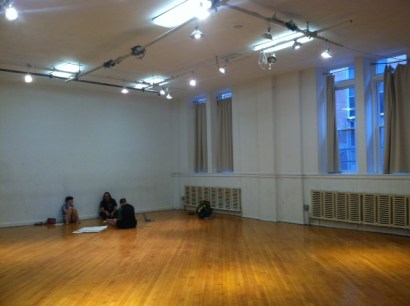
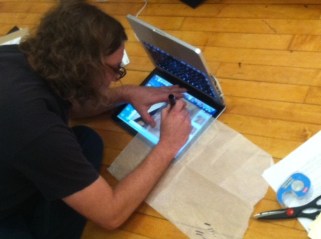 It is a pace I am so thoroughly uneasy with because it is so thoroughly rare in my regular artistic life. So rare that I allow myself permission not to be in charge, not to have the active working idea, not to try and keep the energy of the room moving forward and productive. As a director, I feel myself wanting to know the answer, wanting to show people their faith in me as leader is secure, wanting to get us on track already towards where we are going.
 Last night I finished recording backing vocals for a second album with Johnny Showcase.
 The process of change is so slow we barely see it.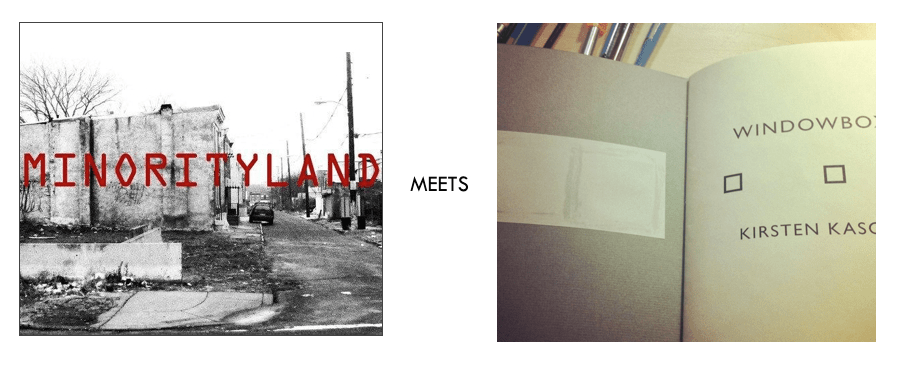

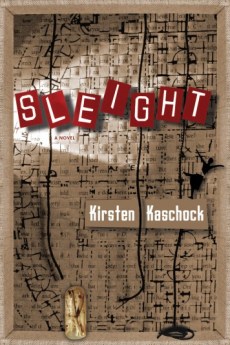 successful career with a large body of output, how amazing to be on a precipice of something wholly new. I loved the bit from her novel Sleight, loved the slow burning build of tension that the back and forth between the interviewer and subject creates. It’s a lovely and quiet power. One that made me guess at answers in advance, trying to anticipate the person I felt myself in conversation with.
 interesting mash up to see how these two writers might write together. How their differing experiences and approaches could inform each other. How their experience with their respective strengths might shift each other’s sensibilities.

 Whether expressed through a
  my everyday life and constitutes an essential part of my creative process.”

 swimpony.org